RenoHouse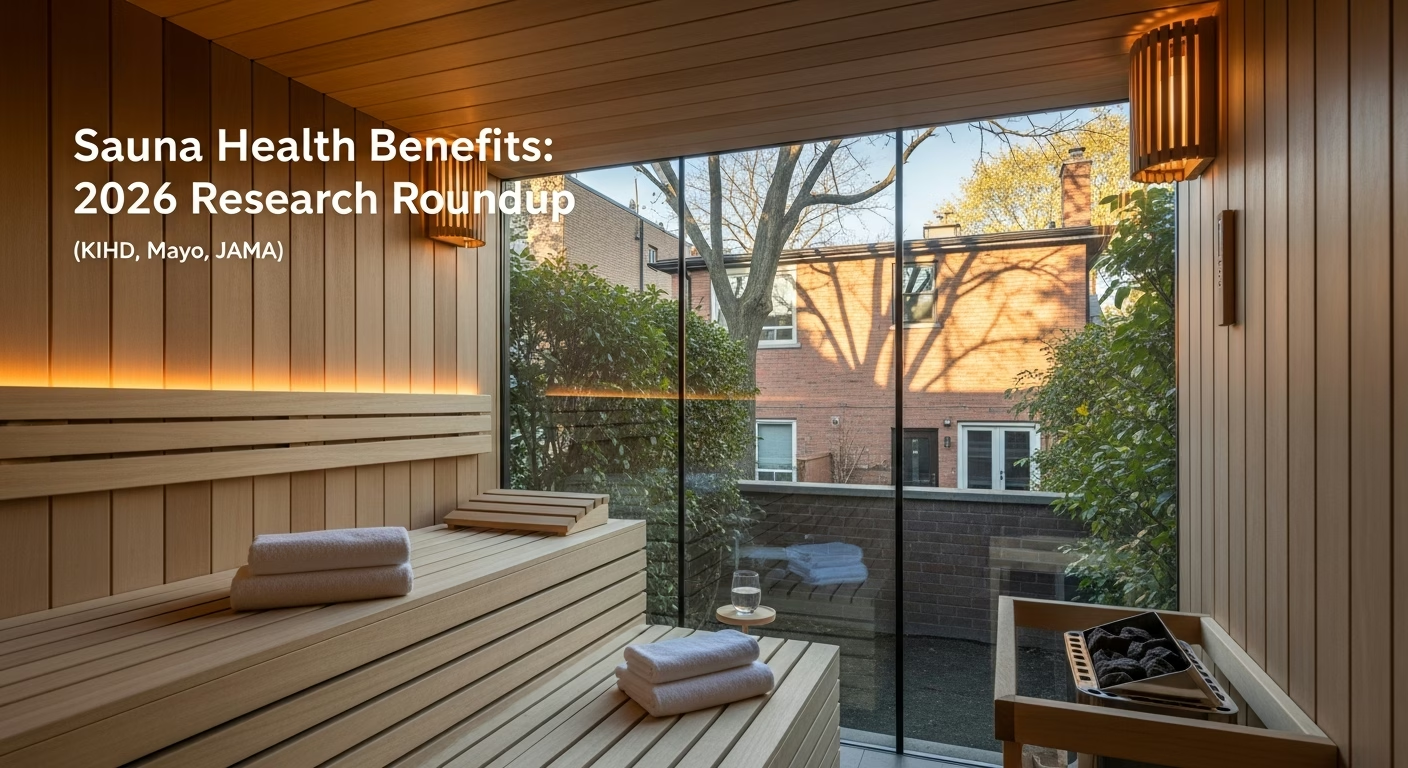

# Sauna Health Benefits: 2026 Research Roundup
Quick answer. Sauna research has matured from anecdote and tradition to a credible peer-reviewed evidence base — particularly in cardiovascular medicine. This roundup covers what the major studies actually show, where the evidence is strong, where it's preliminary, and the contraindications you should know before designing a daily-use sauna habit.Sauna research has matured from anecdote and tradition to a credible peer-reviewed evidence base — particularly in cardiovascular medicine. This roundup covers what the major studies actually show, where the evidence is strong, where it's preliminary, and the contraindications you should know before designing a daily-use sauna habit.
For the practical install context behind these benefits, see our Basement Sauna Installation Toronto 2026 Guide.
Cardiovascular Health — The Strongest Evidence
The Finnish KIHD Study (Laukkanen et al., JAMA Internal Medicine, 2015)
The cornerstone study: 2,315 middle-aged Finnish men, 20-year follow-up. Subjects who used a sauna 4–7 times per week showed:
- 63% lower risk of sudden cardiac death vs. once-weekly users.
- 50% lower cardiovascular disease mortality.
- 40% lower all-cause mortality.
Session duration also mattered — sessions >19 minutes had stronger benefits than <11-minute sessions. The study was published in JAMA Internal Medicine, 2015 and has been cited thousands of times.
2018 Follow-up — Both Sexes (BMC Medicine)
A 2018 follow-up extended the analysis to 1,688 men and women with 15-year follow-up, published in BMC Medicine. The dose-response held in both sexes — CVD mortality decreased linearly with frequency *and* duration, with no threshold effect (i.e., more is better, up to the point of safety).
Mayo Clinic Proceedings 2018 Review
Hussain & Cohen's comprehensive review in Mayo Clinic Proceedings30275-1/fulltext) consolidated the evidence into a clinical recommendation: regular sauna bathing is associated with reduced risk of cardiovascular and all-cause mortality. The review is now standard reading in cardiology and lifestyle medicine.
Mechanism: Why It Works
Heart rate during a sauna session reaches 100–150 bpm — equivalent to moderate-intensity exercise. The cardiovascular system responds with:
- Improved endothelial function — the inner lining of blood vessels becomes more responsive.
- Reduced arterial stiffness — lower pulse-wave velocity, a measured cardiovascular risk marker.
- Increased plasma volume — similar to exercise adaptations.
- Heat-shock protein expression — proteins that protect cells under stress, with downstream cardiovascular and longevity effects.
- Lower resting blood pressure — documented in multiple cohorts.
A 2024 paper in the Journal of Applied Physiology examined Finnish sauna effects on vascular health in patients with coronary artery disease and confirmed acute and adaptive vascular benefits.
Harvard Health Endorsement
Harvard Health summarized the KIHD findings as evidence that "sauna use is linked to a longer life, fewer fatal heart problems" — a notable signal from a conservative academic institution.Stress, Mood, & Sleep

Lifestyle Practice Review (Patrick & Johnson, 2021)
A 2021 review in *Experimental Gerontology* framed sauna use as a "lifestyle practice to extend healthspan" and synthesized evidence on:
- Reduced depression scores in regular users.
- Improved sleep onset and sleep quality.
- Lower post-session cortisol — the body shifts from stress activation to parasympathetic recovery.
User-Reported Sleep Improvements
Subjective sleep improvement is one of the most consistently reported benefits in user surveys — typically 70–80% of regular sauna users report falling asleep faster and sleeping more deeply on sauna nights. The mechanism is likely related to the post-session core-temperature drop, which mimics the natural circadian sleep onset signal.
Athletic Recovery & Performance
Multiple studies document post-exercise sauna benefits:
- Scoon et al. (2007): post-training sauna improved running endurance performance via plasma volume expansion.
- Stanley et al. (2015): heat acclimation through sauna improved cycling time-trial performance.
- Heat tolerance — endurance athletes use sauna to acclimate for hot-weather races.
In Toronto, the Maple Leafs facility, Toronto FC, and Raptors training centres incorporate sauna for recovery — a notable sign of the protocol moving from biohacker fringe to professional sports mainstream.
Need professional home renovation?
Call RenoHouse at 289-212-2345 or get a free estimate today.
Get Free Estimate →Pain & Inflammation

The 2018 Hussain & Cohen systematic review in PMC identified evidence of benefit in:
- Fibromyalgia — reduced pain scores, improved quality of life.
- Rheumatoid arthritis — reduced morning stiffness.
- Chronic fatigue syndrome — improved fatigue scores in small trials.
- Chronic pain syndromes generally.
Mechanisms include heat-induced muscle relaxation, anti-inflammatory cytokine modulation, and endorphin release.
Skin Health
Increased blood flow improves nutrient delivery to skin. A 2013 Finnish study found regular sauna users showed improved skin moisture barrier and pH balance vs. non-users. Sauna use is not a substitute for skincare, but the cardiovascular effect on skin perfusion is real.
Detoxification — The Honest Take

This is the area where claims most often outpace evidence. The honest summary:
- Sauna does increase sweat volume, and sweat does contain trace heavy metals (cadmium, lead, mercury) and some persistent organic pollutants.
- A 2018 systematic review found certain persistent chemicals excrete via sweat at rates that exceed urinary excretion.
- However: "forever chemicals" (PFOA, PFOS) are eliminated almost entirely via kidneys, not sweat. Heavy-metal removal via sweat is real but small in absolute terms.
Avoid marketing claims like "sweat out toxins" — they overstate the evidence and damage credibility.
Infrared vs Traditional Finnish — Research Comparison
This is the most common question we get, so it warrants direct treatment. All of the major cohort studies above used traditional Finnish saunas at 80°C+. None used infrared. So:
- Traditional Finnish sauna has the strongest evidence base for long-term cardiovascular and mortality benefits.
- Infrared sauna has a smaller (but growing) literature on circulation, recovery, and pain — see Mayo Clinic's position on infrared and Cleveland Clinic's review.
- Both induce sweat, raise heart rate, and trigger heat-shock protein responses — the magnitude differs.
If your motivation is research-backed cardiovascular benefit, traditional Finnish has the data. If your motivation is comfort, longer sessions, or specific musculoskeletal/circulation use, infrared is well-supported. Full comparison in Finnish vs Infrared Sauna Toronto: Which Is Right for Your Basement?.
How Often & How Long
Based on the KIHD dose-response curve:
| Frequency | Cardiovascular Benefit |
|---|---|
| 1×/week | Baseline |
| 2–3×/week | Moderate (significantly reduced risk) |
| 4–7×/week | Strongest (50% lower CVD mortality) |
Per session: 15–20 minutes is the sweet spot for benefit and tolerability. Longer (>19 min) sessions show stronger effects but also higher risk of dehydration or orthostatic hypotension on standing.
For building a sauna habit, most users start at 2–3 sessions/week of 10–15 min, then build to 3–5 sessions/week at 15–20 min over 2–3 months.
Caveats: Contraindications
Sauna isn't safe for everyone. Talk to your physician first if you have:
- Unstable angina or recent MI (within 3 months).
- Severe aortic stenosis or other obstructive cardiac conditions.
- Late-stage pregnancy — first-trimester especially is generally avoided.
- Severe orthostatic hypotension — risk of fainting on exit.
- Active alcohol use — increases dehydration and arrhythmia risk.
- Children under 12 — thermoregulation isn't fully developed.
Even healthy users should:
- Hydrate — 500ml of water before and after each session.
- Limit early sessions to 10–15 min until acclimated.
- Cool down between rounds — 5+ min of room-temperature rest, ideally with a cool shower or splash.
- Don't drink alcohol in the sauna.
- Exit if you feel dizzy or unwell — don't push through.
What This Means for a Basement Sauna Build
If health benefit is your primary motivation, the design implications are:
- 1. Build for 4–7×/week use — that means sized for your actual usage pattern, not aspiration. A 2-person sauna used daily delivers more benefit than a 6-person sauna used monthly.
- 2. Comfort matters for adherence — proper ventilation, good lighting, comfortable benches, and a glass door (visual openness) all increase actual use frequency.
- 3. Wellness suite integration — adding a cold plunge or shower nearby supports the cool-down protocol and increases session compliance. See Sauna + Cold Plunge: Designing a Wellness Suite in Toronto Basement.
- 4. Smart controls — Wi-Fi pre-heat from your phone removes the friction of waiting 30–45 min for warm-up. Strongly correlated with actual frequency of use.
FAQ
Are these benefits unique to Finnish sauna or does any heat exposure work?The cohort data is on Finnish sauna specifically. Hot tubs, steam rooms, and infrared all produce similar acute physiological responses, but the long-term mortality data is Finnish-sauna-specific.
Can I get the same benefits from exercise alone?Exercise produces overlapping but not identical benefits. Sauna seems to be additive for cardiovascular outcomes — the KIHD subjects who exercised *and* sauna'd had the lowest mortality.
Are the benefits cumulative — do I lose them if I stop?The cohort data isn't designed to answer this directly. By analogy with exercise, the cardiovascular adaptations likely fade over weeks to months without continued use.
What about the heat shock protein hype?Real but oversold. HSP expression after sauna is well-documented; the downstream clinical implications are still being mapped.
How does this compare to ice baths / cold plunges?Different stressors, different adaptations. Many practitioners do contrast therapy (sauna + cold plunge) for additive parasympathetic recovery effects. Design implications in Sauna + Cold Plunge: Designing a Wellness Suite in Toronto Basement.
---
Ready to build a sauna habit at home? RenoHouse designs and installs basement saunas across the GTA — sized for your real usage pattern. Book a free assessment on our basement sauna installation service page.
Sources & References
Authoritative sources cited in this guide:
- Ontario Building Code — OBC official text
- Toronto Building Permits — City permit portal
- Tarion Warranty — Ontario warranty regulator
- CSA Group Standards — Canadian standards
Continue Reading
- Cold Plunge Health Benefits: 2026 Research & Wim Hof Method
- Sauna Cold Plunge Contrast Therapy: Protocol & Benefits
- Finnish vs Infrared Sauna Toronto: Which Is Right for You?