RenoHouse

# Home Gym ROI: Does It Add Toronto Home Value?
Quick answer. Home gym ROI in Toronto is a more nuanced question than most homeowners realize. The honest answer: a properly built, permitted basement home gym recovers 40–65% of project cost on resale — improving to 60–85% when integrated as part of a wellness suite (gym + sauna + plunge).Home gym ROI in Toronto is a more nuanced question than most homeowners realize. The honest answer: a properly built, permitted basement home gym recovers 40–65% of project cost on resale — improving to 60–85% when integrated as part of a wellness suite (gym + sauna + plunge). But the resale number isn't really the right ROI measurement, because the daily-use value (gym savings, time savings, adherence) typically exceeds resale recovery within 3–5 years of ownership. This guide breaks down both. For the full cost framework that anchors this math, start with our Basement Home Gym Toronto 2026 Guide.
The Two ROI Frames
There are two ways to measure home-gym ROI:
- 1. Resale recovery — how much of the project cost shows up in your sale price when you eventually sell
- 2. Daily-use value — money saved on gym membership, time saved on commute, training adherence improvements
Most buyers focus on (1) because it's tangible. But for an owner who actually uses the gym 3+ times a week, (2) usually dominates the math.
Resale Recovery: The Real Numbers
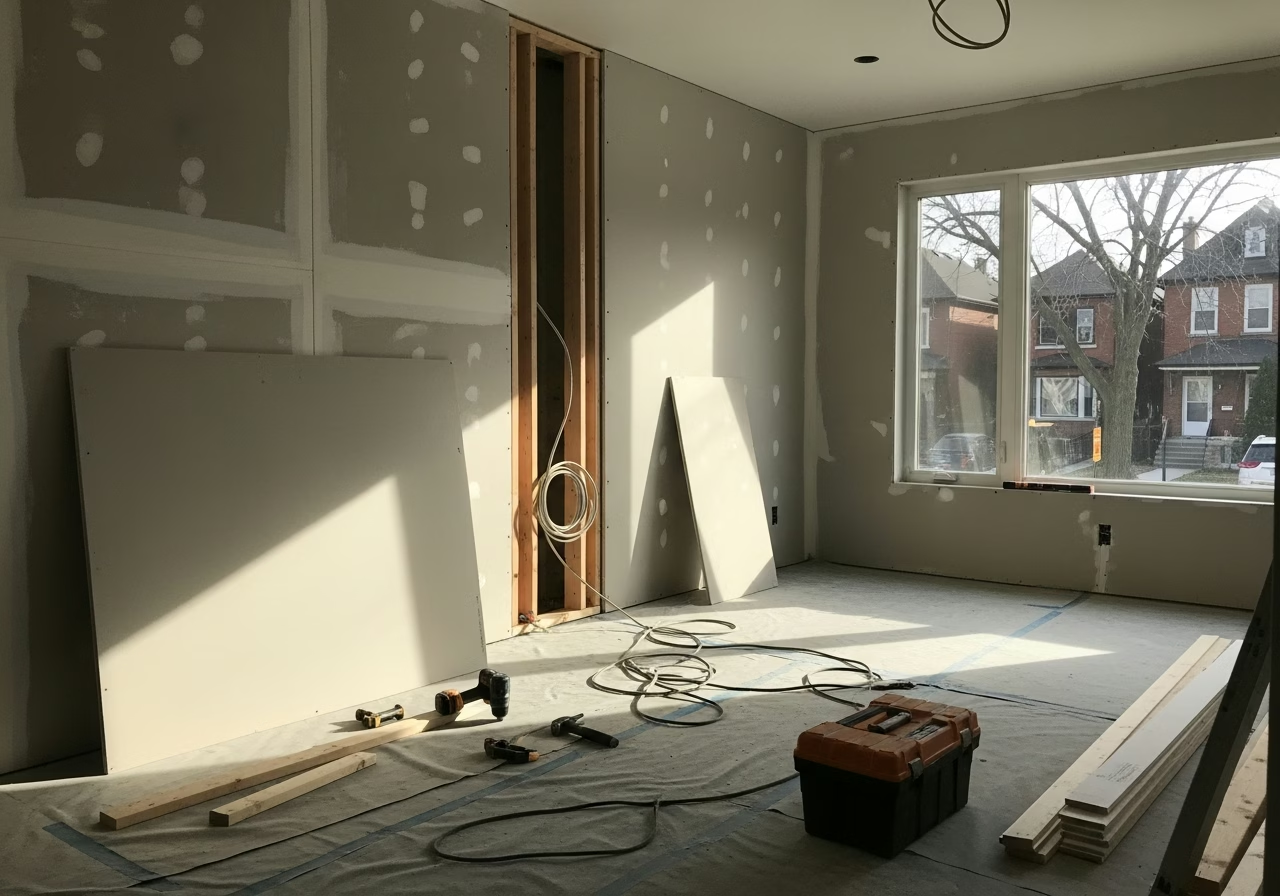
Based on our 2026 GTA buildout portfolio and real estate practitioner feedback in target neighbourhoods:
| Build Tier | Project Cost | Typical Resale Recovery | Recovery Range |
|---|---|---|---|
| Basic gym | $12K–$20K | 35–50% | $4K–$10K |
| Standard gym | $20K–$40K | 45–65% | $9K–$26K |
| Premium gym (standalone) | $40K–$60K+ | 50–70% | $20K–$42K |
| Wellness suite (gym + sauna + plunge) | $60K–$120K+ | 60–85% | $36K–$102K |
Recovery is highest when:
- The build is permitted and ESA-inspected (appraisers flag unpermitted work)
- The space is integrated as a designed amenity, not an afterthought
- The home is in a higher-end neighbourhood ($1.5M+) where the buyer profile values fitness amenities
- The finishes match the rest of the home (a luxury home with a basic-tier gym can actually hurt; a luxury gym in a basic-tier home doesn't fully recover either)
Why Wellness Suite Recovery Beats Standalone Gym
A standalone gym recovers 45–65%. The same money spent on gym + sauna + plunge in an integrated wellness suite recovers 60–85%. Three reasons:
- 1. Appraisers code "wellness suite" as a recognized amenity category, similar to how a finished basement with a wet bar codes as a designed feature.
- 2. The buyer profile that values wellness suites is concentrated in $1.5M+ homes — exactly the price range where amenities matter most.
- 3. Integrated buildouts read as intentional design rather than a tacked-on hobby room.
Layout and design coordination in Home Gym + Sauna + Cold Plunge: Ultimate Wellness Suite.
Neighbourhood-Specific Premium
Recovery varies dramatically by Toronto/GTA neighbourhood:
Highest premium (60–85% recovery for standalone, 75–95% for wellness suite):- Forest Hill, Lawrence Park, Hoggs Hollow, Bridle Path
- Oakville Old, Mississauga Mineola
- Markham Cathedraltown, Unionville
- Rosedale, Moore Park
- High Park / Bloor West Village (premium Edwardians)
- North York, East York family neighbourhoods
- Mississauga Lorne Park, Oakville Bronte
- Vaughan Kleinburg, Richmond Hill (newer subdivisions)
- The Beaches, Leslieville, Roncesvalles
- Etobicoke and Scarborough family suburbs
- Brampton, Ajax, Pickering, Whitby
- Older condo conversions
The pattern reflects buyer profile: in $1.5M+ neighbourhoods, the typical buyer is a professional couple with disposable income and an active lifestyle — exactly the demographic that values a home gym. In $700K–$1.2M neighbourhoods, the buyer prioritizes bedroom count and finished basement space over fitness amenities.
Daily-Use ROI: The Real Story
For most homeowners who actually use their gym, daily-use value dominates resale recovery. Let's run the math.
Gym Membership Savings
Toronto fitness costs in 2026:
Need professional home renovation?
Call RenoHouse at 289-212-2345 or get a free estimate today.
Get Free Estimate →- Standard chain (GoodLife, LA Fitness): $50–$80/month = $600–$960/year
- Premium chain (Equinox, La Vie): $200–$280/month = $2,400–$3,360/year
- Boutique (Barry's, Soulcycle, F45): $150–$300/month per discipline
- Crossfit box: $200–$280/month = $2,400–$3,360/year
A serious 2026 fitness household typically spends $200–$400/month total. Annual: $2,400–$4,800.
A standard $30K home gym pays for itself in 6–12 years on membership savings alone, before any resale recovery.
Time Savings
Round-trip commute time to a gym: 30–60 min × 3 sessions/week = 90–180 min/week = 80–160 hours/year.
At even modest professional billable rates ($50/hour personal time value), that's $4,000–$8,000/year of time recovered. Conservatively half that ($2,000–$4,000/year) materializes as actual additional productive or family time.
Adherence Improvements
This is the one most clients underweight at design time and overweight after a year of use.
Research consistently shows home-gym owners maintain 30–50% higher workout frequency than commercial-gym members of similar demographics. The mechanism is friction reduction: 3 minutes from couch to gym vs. 25 minutes (drive + park + locker + change).
If your goal is general fitness adherence (which most professionals 35–55 would say it is), the home gym is the highest-leverage purchase you can make. Hard to put a dollar value on, but if you're a professional whose career and family well-being depend on baseline cardiovascular health, the calculation isn't subtle.
Daily-Use ROI: Worked Example
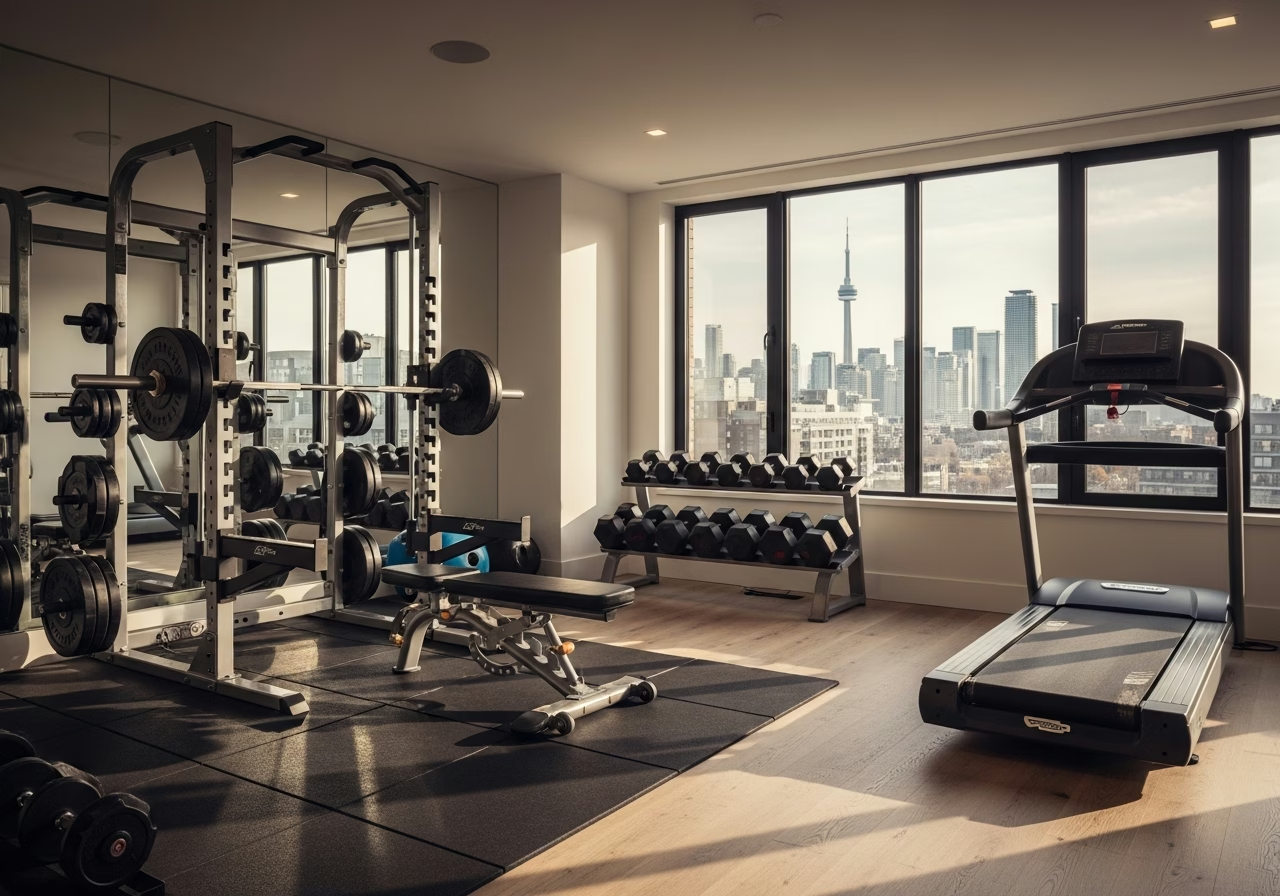
Let's run a 10-year hold on a $30K standard buildout:
Costs:- Project cost: $30,000
- Maintenance over 10 years: ~$3,000 (flooring touch-ups, mirror cleaning, AV updates)
- Operating cost: ~$50/month for HVAC supplement, lighting, AV = $6,000 over 10 years
- Total 10-year cost: ~$39,000
- Gym membership savings (avg $250/month): $30,000
- Personal training savings vs. commercial gym package: $5,000–$15,000
- Time savings (conservative): $20,000
- Adherence/health value: not quantified
- 50% on $30K original = $15,000
Even ignoring intangibles, the math is positive. For wellness-suite builds the math is more dramatic because the operating cost ratio is similar but the resale recovery and use-value scales aggressively.
What Hurts Resale Value
A home gym can be a *negative* on resale if it's done poorly. Specific failure modes:
- 1. Unpermitted work — appraisers flag this and discount the entire renovation
- 2. Foam puzzle mat flooring — reads "kids playroom" not "gym"
- 3. Aesthetic mismatch with rest of home — luxury Forest Hill home with $5K gym in unfinished basement looks worse than no gym
- 4. Equipment-heavy aesthetics — buyers can't see past your specific equipment choices to imagine their own use
- 5. Awkward layout — gym crammed into a corner, with bedroom or office sharing a wall
- 6. No HVAC plan — visible inadequacy means buyer assumes the worst
Detail in Home Gym Mistakes: 10 Common Buildout Failures.
What Helps Resale Value
- 1. Permits and inspections documented and provided to buyer
- 2. Removable/replaceable equipment (not built-in mounting that limits future buyer's choices)
- 3. Aesthetic continuity with rest of home
- 4. Wellness-suite integration with sauna or plunge nearby
- 5. Versatility — the room could plausibly be a yoga studio, gym, or rec room with minor modifications
- 6. High ceiling — codes as "premium" basement space
- 7. Daylight if available — even one egress-size window changes appraiser perception
Comparison: Home Gym vs Other Renovations
ROI ranking of common renovations on Toronto homes:
| Renovation | Cost Range | Resale Recovery |
|---|---|---|
| Kitchen reno (mid-range) | $40K–$80K | 75–95% |
| Bathroom reno | $20K–$40K | 70–90% |
| Wellness suite (gym + sauna + plunge) | $60K–$120K | 60–85% |
| Basement finishing (general) | $30K–$60K | 65–80% |
| Standalone home gym | $20K–$40K | 45–65% |
| Deck addition | $15K–$40K | 50–75% |
| Pool installation | $40K–$80K | 30–55% |
| Sunroom | $25K–$60K | 40–60% |
The standalone gym ranks similar to a deck or sunroom for resale — middle of the pack. Bundled with sauna/plunge, it climbs into kitchen-reno territory.
Equipment Resale Considerations
Equipment depreciates separately from the buildout. A $4,000 Tonal that's 3 years old at sale time is worth maybe $1,500. A $2,500 treadmill is worth $800. Plan to *not* count equipment in your resale recovery — assume it stays with you (which buyers often prefer anyway, since they want their own equipment choices).
Closing the Math: Should You Build?
The honest financial argument for a basement home gym:
Build it if:- You're staying in the home 5+ years
- You will actually use it 3+ times per week (be ruthless about this — most don't)
- You can afford the project without compromising other priorities
- You're in a $1M+ neighbourhood (the resale recovery bothers you less)
- You're integrating with sauna/plunge for the wellness-suite package
- You might sell within 18 months (recovery hasn't built up; transaction friction)
- You can't be honest about whether you'll use it
- You're underbudgeting the HVAC, electrical, or acoustic scope (a $15K "gym" with no HVAC plan and foam flooring will likely hurt resale, not help)
For the full project framework, costs, and process, see our Basement Home Gym Toronto 2026 Guide.
---
Building for ROI? RenoHouse builds permitted, ESA-compliant gym and wellness-suite buildouts engineered for daily use AND resale value. Book a free assessment on our basement home gym buildout service page.
Sources & References
Authoritative sources cited in this guide:
- Ontario Building Code — OBC official text
- Toronto Building Permits — City permit portal
- Tarion Warranty — Ontario warranty regulator
- CSA Group Standards — Canadian standards
Continue Reading
- Basement Sauna ROI: Does It Increase Toronto Home Value 2026?
- Cold Plunge ROI: Does It Add Toronto Home Value?
- Wine Cellar ROI in Toronto: 2026 Resale and Home Value Analysis