RenoHouse

# Attic Insulation Greener Homes Grant Toronto: Application Walkthrough 2026
Quick answer. The federal Greener Homes program is the largest rebate opportunity for Toronto attic insulation in 2026, but the application process trips up most first-time homeowners. The structure has shifted: the Greener Homes Grant was paused for new applicants mid-2024 in most provinces, while the Greener Homes Loan ($40,000 interest-free) remains active.The federal Greener Homes program is the largest rebate opportunity for Toronto attic insulation in 2026, but the application process trips up most first-time homeowners. The structure has shifted: the Greener Homes Grant was paused for new applicants mid-2024 in most provinces, while the Greener Homes Loan ($40,000 interest-free) remains active. This guide walks through the full 2026 application flow for Toronto attic insulation, from Energy Advisor selection through final reimbursement, and how to stack rebates with Ontario HRS and the City of Toronto HELP program.
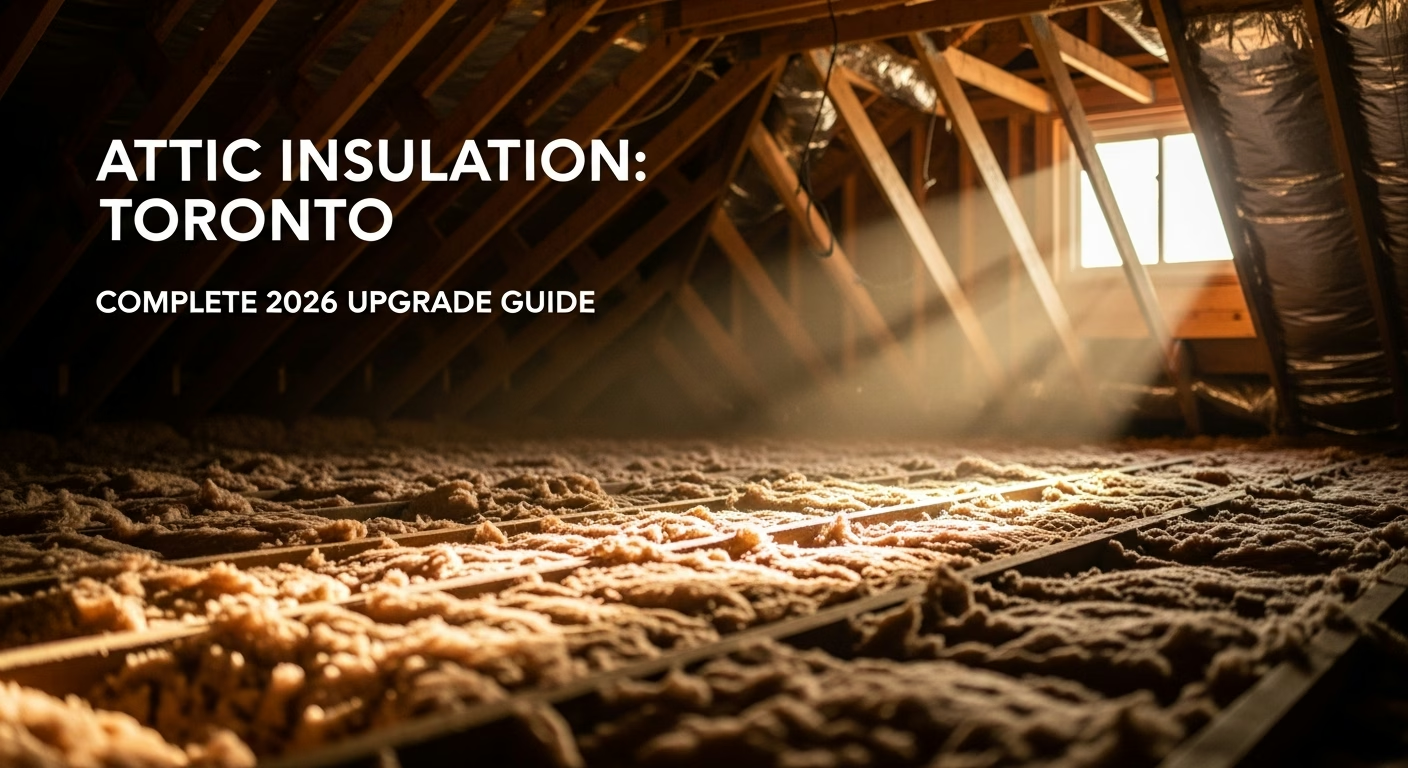
For the broader pillar context, see Attic Insulation Toronto: Complete 2026 Upgrade Guide. For R60 specifications that the program requires, see R60 Attic Insulation Toronto: Rebates and OBC Requirements.
Program Status as of May 2026
- Canada Greener Homes Loan: Active. Up to $40,000, interest-free, 10-year term. Requires NRCan Energy Advisor pre/post evaluations.
- Canada Greener Homes Grant: Paused for new applicants since mid-2024 in most provinces. Ontario applicants who registered before the pause may complete claims through 2026. Watch NRCan for new program announcements.
- Enbridge Home Renovation Savings (HRS) [HRS retired Dec 31 2025]: Active. Up to $10,000 across measures.
- City of Toronto Home Energy Loan Program (HELP): Active. Up to $125,000 financed via property tax.
- Save on Energy (Toronto Hydro / IESO): Active with periodic incentives.
The Greener Homes Loan Process
Step 1: Confirm Eligibility (Day 1)
To qualify for the Greener Homes Loan in 2026:
- You must be the homeowner (not renter, not commercial)
- The home must be your primary residence
- Home must be located in Canada (all of Toronto qualifies)
- You must be applying for at least one eligible measure (attic insulation qualifies)
- You must complete a pre-retrofit Energy Advisor evaluation
Step 2: Find a Registered Energy Advisor (Day 2–7)
Search the NRCan Service Organization registry for a Toronto-area Energy Advisor. Look for:
- "EnerGuide rating" certified service organization
- Active registration (status: registered, not lapsed)
- Within 30 km of your home
Typical Toronto Energy Advisor cost: $400–$700 for the pre-evaluation, $400–$700 for the post-evaluation. Some service organizations bundle both for $700–$1,000.
NRCan reimbursement: was $600 for combined pre+post under the Grant program; under Loan-only flow, the cost is borne by the homeowner unless reimbursed via Ontario HRS ($250 reimbursement) or City of Toronto programs.
Step 3: Schedule Pre-Evaluation (Day 7–21)
The Energy Advisor visits, conducts a blower door test, inspects all insulation, HVAC, windows, and DHW. You receive an EnerGuide rating report (a number from 0–100, lower = more efficient — wait, actually under the new system: GJ/year — lower is better) and a list of recommended upgrades.
Typical Toronto pre-evaluation results for a 1960s bungalow with R20 attic:
- EnerGuide rating: ~250 GJ/year
- Air leakage: 5–8 ACH50 (target: <3.5 for new construction)
- Recommended attic upgrade: R20 → R60
- Estimated savings: $500–$800/year
Step 4: Apply for Loan (Day 21–35)
Apply through the Canada Greener Homes portal. Required documents:
- Pre-evaluation EnerGuide report (PDF from Energy Advisor)
- Quote from licensed contractor for the upgrade
- Personal identification
- Home ownership proof
- Banking information
Approval typically takes 4–6 weeks. Funds flow as a draw at completion (not upfront).
Step 5: Complete the Upgrade (Day 35–60)
Schedule the contractor. Tier 2 attic insulation upgrade typically takes 1–2 days. Make sure to:
- Receive itemized invoice with R-value certificate
- Document via photos
- Keep all receipts
Step 6: Schedule Post-Evaluation (Day 60–90)
Energy Advisor returns, conducts second blower door test, verifies the upgrade was completed and meets the specified R-value. Issues post-retrofit EnerGuide report.
Typical post-evaluation results:
- EnerGuide rating improvement: 5–15 GJ/year (varies by upgrade scope)
- Air leakage improvement: 0.5–2 ACH50 reduction
- Attic R-value confirmed at target
Step 7: Submit for Loan Disbursement (Day 90–110)
Submit post-evaluation report and final invoices through the portal. Funds disburse to your bank account in 2–4 weeks.
Need professional exterior renovation?
Call RenoHouse at 289-212-2345 or get a free estimate today.
Get Free Estimate →Total Timeline: 90–130 Days
Don't start your contractor before your pre-evaluation is complete. The pre-evaluation must capture the home in its un-upgraded state.
What Counts as an Attic Insulation Upgrade
The program requires the upgrade to deliver a minimum increase in thermal resistance to qualify:
- Minimum upgrade: RSI 3.5 (R20) increase
- Target for highest rebate tier: reach R60 (RSI 10.6)
So if your existing attic is R30, you must upgrade to R50 or higher (preferably R60) to qualify for the full rebate. If existing is R10, you must upgrade by at least R20 (so to R30 or higher) — but to maximize the rebate, hit R60.
Eligible scope items:
- Removal of existing insulation (when needed)
- Air sealing
- Baffles
- Pot light covers
- New insulation to R60
- Attic hatch insulation/weatherstripping
Not eligible:
- Roof replacement
- Soffit/fascia/eaves trough work
- Drywall ceiling repairs
- Mold remediation (other programs cover this)
- Vermiculite abatement (some programs cover this — Greener Homes does not)
Stacking with Ontario HRS
Ontario HRS rewards combinations of upgrades. For Toronto homeowners:
- Attic insulation alone: not eligible
- Attic insulation + furnace upgrade: $250 attic + $1,000–$2,000 furnace
- Attic insulation + basement insulation: $250 attic + $1,500 basement
- Attic insulation + windows: $250 attic + $40 per window
HRS requires Energy Advisor evaluation, which you've already done for Greener Homes — the same evaluation supports both programs (no double-evaluation needed).
Application: Ontario HRS portal. Required documents: pre/post EnerGuide reports, contractor invoices, proof of payment, photos.
Typical Toronto stacking outcome for attic + furnace:
- Attic upgrade: $5,500
- Furnace upgrade: $7,000
- Total project: $12,500
- Greener Homes Loan: $12,500 at 0% over 10 years = $104/month payment
- Ontario HRS rebate: $1,250
- Energy savings: $1,200/year
- Net: rebate covers ~10% of project cost; energy savings cover loan payment
Stacking with City of Toronto HELP
HELP makes sense when the project is $20,000+ stacking multiple measures. For attic-only at $4K–$7K, the Greener Homes Loan is simpler.
Comparison for a $25,000 multi-measure upgrade (attic + windows + furnace):
- Greener Homes Loan covers $40,000 cap, but only attic+furnace+window+heatpump qualify for full eligibility
- HELP covers any energy upgrade at low fixed rate (typically 4–6%) repaid via property tax over 5–20 years
- HELP doesn't require Energy Advisor (simpler application)
- HELP is non-callable: it doesn't accelerate if you sell the home (the next owner inherits the property tax addition)
For attic-only: skip HELP, use Greener Homes Loan.
Common Application Mistakes
- 1. Starting the contractor before pre-evaluation. Disqualifies the project. The Energy Advisor must capture the home in its starting state.
- 2. Using a contractor not registered with NRCan. Some programs require registered service providers. Check the registry before contracting.
- 3. Submitting hand-written invoices. Program requires itemized invoices with company letterhead, GST/HST number, and signatures.
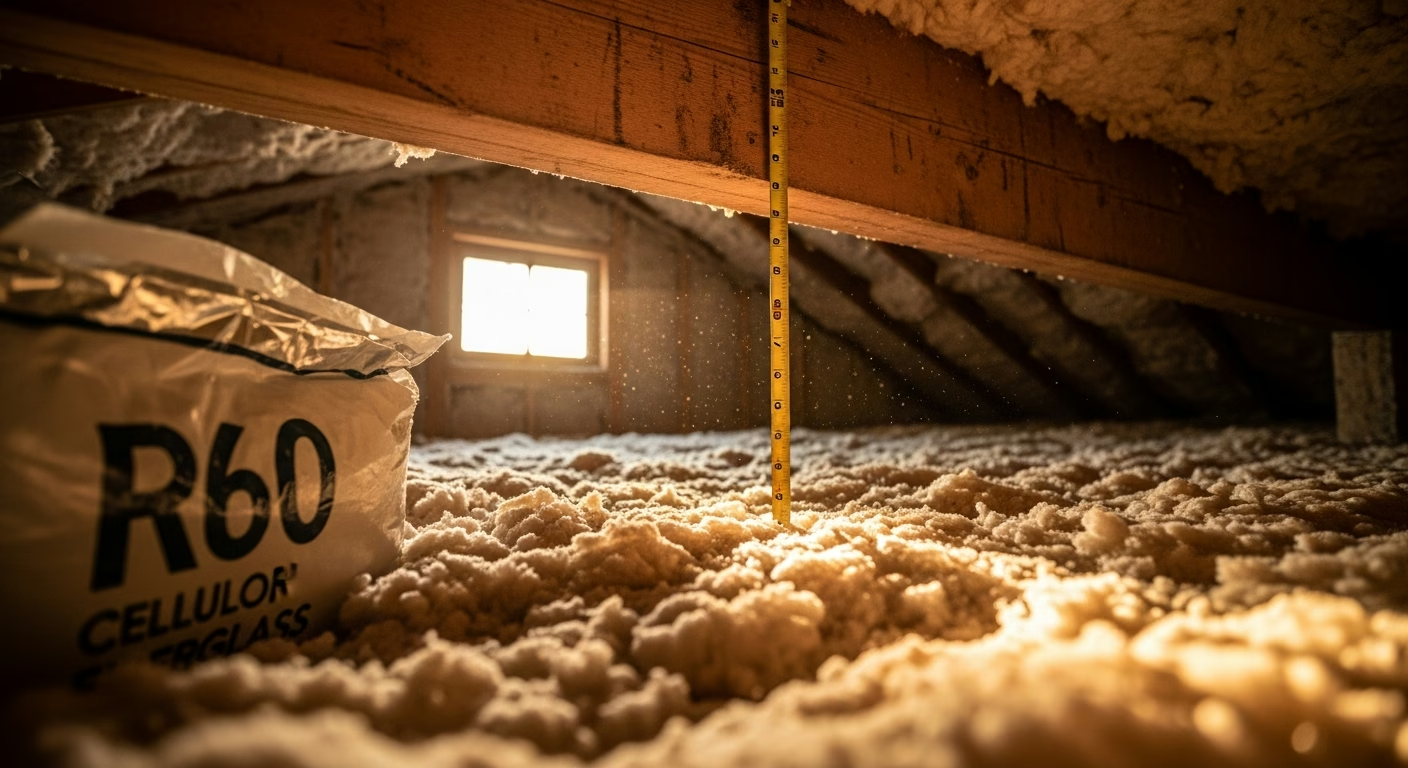
- 4. Missing photos. Most rebate denials are due to insufficient documentation. Photo every step: pre-existing insulation, removal, air sealing, baffles, pot light covers, depth markers, finished install.
- 5. Not hitting R60. Quoted R60 but contractor delivered R45. Post-evaluation flags it. Some rebates are graded by R-value achieved; under-delivery means partial rebate.
- 6. Mismatched measures. Quoted attic + furnace, but only attic completed by deadline. Submitting partial scope often delays the full disbursement.
- 7. Letting the loan period expire. Greener Homes Loan has a 18-month window to complete from loan approval. Past that, funds are recalled.
Documentation Checklist
For Greener Homes Loan:
- [ ] Pre-evaluation EnerGuide report (PDF)
- [ ] Contractor quote (itemized)
- [ ] Personal ID
- [ ] Home ownership proof (property tax bill or deed)
- [ ] Banking info for disbursement
- [ ] Final contractor invoice
- [ ] R-value certificate from manufacturer (Owens Corning, GreenFiber, etc.)
- [ ] Photos of pre-existing, removal, sealing, baffles, depth markers, finished
- [ ] Post-evaluation EnerGuide report (PDF)
For Ontario HRS:
- [ ] Same EnerGuide reports
- [ ] Contractor invoice with HVAC SEER/AFUE numbers (if furnace included)
- [ ] Proof of Enbridge gas service (gas bill)
- [ ] Banking info
Tax Implications
The Greener Homes Loan principal is not taxable income. The Greener Homes Grant (when active) was also non-taxable. Energy savings are not taxable.
If you sell the home within 10 years and the loan isn't fully repaid, the remaining balance is typically called or transferred to closing — NRCan can clarify case-by-case.
When Rebates Aren't Worth It
For some Toronto homeowners, the paperwork friction outweighs the rebate value:
- Small project ($2,500 top-up): Energy Advisor cost ($800 for pre/post) eats most of the rebate. Skip rebates, do the work cash.
- Tight timeline (selling in 12 months): 90–130 days application timeline doesn't fit. Skip rebates.
- Cathedral ceiling project: Often doesn't reach R60, so misses the highest rebate tier. Calculate net carefully.
For Tier 2 ($5K–$7K) and Tier 3 ($7K–$11K) projects, rebates almost always pay back even after Energy Advisor cost. For Tier 1 ($2K–$3K), they often don't.
Bottom Line for Toronto Greener Homes Application
For a $5,500 Tier 2 Toronto attic upgrade:
- Pre/post Energy Advisor: $800 ($250 reimbursable via HRS if paired)
- Greener Homes Loan: $5,500 at 0% over 10 years = $46/month
- Greener Homes Grant (if available): $1,200–$1,800 cash
- Ontario HRS (paired with one other measure): $250
- Net cash outlay: ~$3,500 over 10 years vs $5,500 lump
- Energy savings: $400–$700/year
The math works for most Toronto homeowners doing R20→R60 upgrades. The critical success factor is sequence: Energy Advisor first, contractor second.
---
Pursuing Greener Homes for your Toronto attic upgrade? RenoHouse coordinates Energy Advisor scheduling, manages all rebate paperwork, and provides photo documentation for application. Visit our attic insulation upgrade service page or book an insulation thermal audit to start your scope-and-rebate plan.
Sources & References
Authoritative sources cited in this guide:
- Canada Greener Homes Initiative — Federal retrofit programs
- ENERGY STAR Canada — Canadian ENERGY STAR specs
- Ontario Building Code SB-12 — OBC energy efficiency supplementary standard
- Toronto HELP — Home Energy Loan — Toronto Home Energy Loan Program
Continue Reading