RenoHouse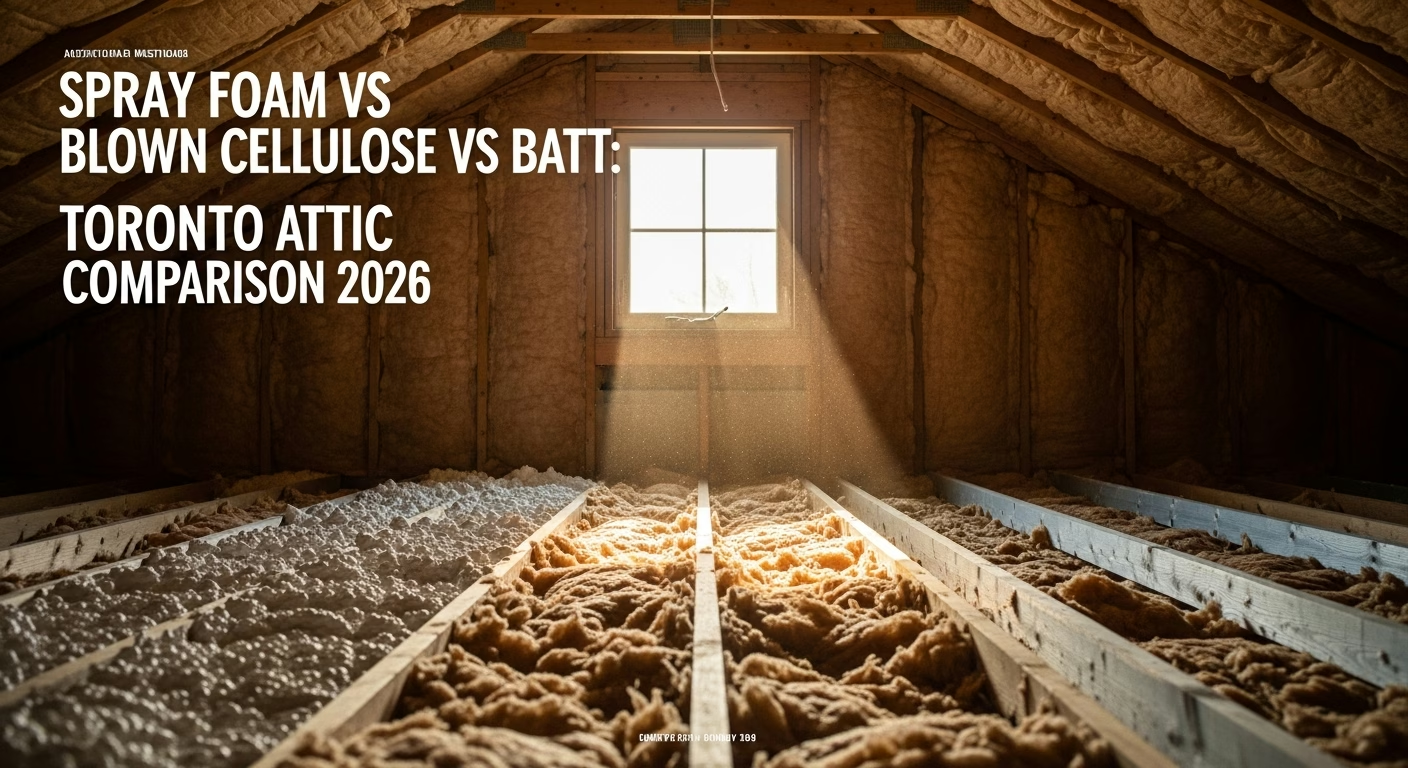

# Spray Foam vs Blown Cellulose vs Batt: Toronto Attic Comparison 2026
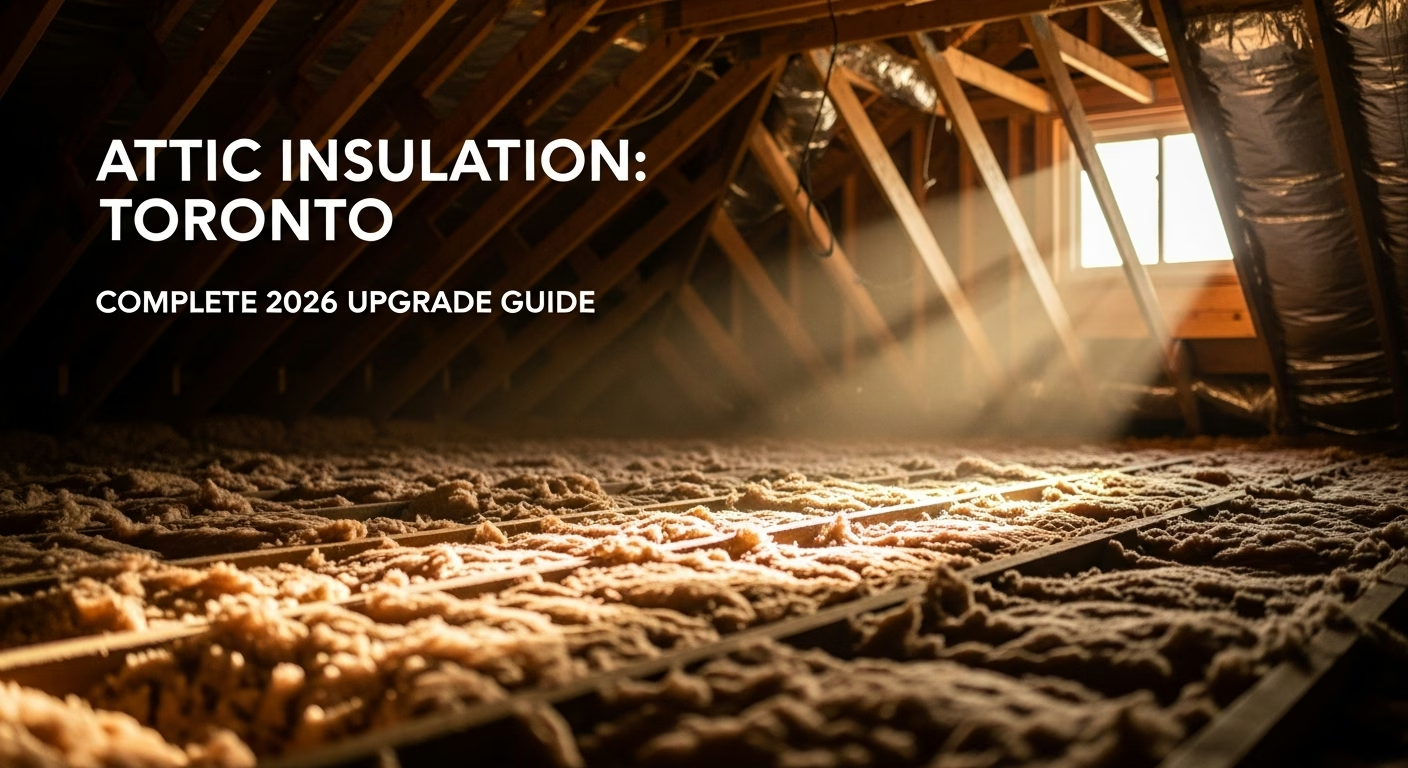
Quick answer. The three primary attic insulation materials behave very differently in Toronto's freeze-thaw climate, and the wrong choice for your specific attic geometry can cost you 30–50% of theoretical R-value within five years.The three primary attic insulation materials behave very differently in Toronto's freeze-thaw climate, and the wrong choice for your specific attic geometry can cost you 30–50% of theoretical R-value within five years. This guide compares spray foam, blown cellulose, and fiberglass/mineral wool batt across every variable that matters: thermal performance, air sealing, moisture, settling, fire, environmental impact, cost, and lifespan.
For the broader pillar guide, see Attic Insulation Toronto: Complete 2026 Upgrade Guide. For the cost angle specifically, see Attic Insulation Cost Toronto: R-Value Tier-by-Tier Pricing.
The 60-Second Decision Framework
- Standard rectangular attic with adequate ventilation: Blown cellulose. Best $/R, good air-blocking, recycled content.
- Cathedral ceilings, complex framing, or air-leakage problems: Closed-cell spray foam at roof deck (hot-roof) or hybrid.
- Rim joists, knee walls, fire-rated assemblies: Mineral wool batt (Rockwool/Roxul).
- Standard attic when fiberglass is preferred: Loose-fill fiberglass (Owens Corning, Knauf, CertainTeed).
- Almost never in attic floors: Fiberglass batts. They don't fill irregular cavities and air-leak heavily.
R-Value per Inch
| Material | R-Value per Inch | Inches Needed for R60 |
|---|---|---|
| Closed-cell spray foam | R6.0–R7.0 | 9"–10" |
| Open-cell spray foam | R3.5–R4.0 | 15"–17" |
| Blown cellulose | R3.2–R3.8 | 16"–19" |
| Loose-fill fiberglass | R2.2–R2.7 | 22"–27" (settled) or R2.5 dense-pack |
| Fiberglass batt | R3.0–R3.7 | 16"–20" |
| Mineral wool batt | R3.7–R4.3 | 14"–16" |
R-value per inch matters when ceiling height in the attic is limited. In a typical Toronto bungalow with truss-framed attic, you have 18"–30" of clearance — plenty for any material. In a 1920s East York attic with shallow rafter bays, closed-cell spray foam may be the only way to hit R60 without losing usable space.
Air-Sealing Performance
Air sealing is where the materials diverge most dramatically. Air leakage causes 30–50% of total heat loss in poorly sealed homes — sometimes more than conduction.
| Material | Air-Sealing Rating | Notes |
|---|---|---|
| Closed-cell spray foam | Excellent | Air barrier built-in, no separate sealing needed |
| Open-cell spray foam | Good | Air barrier built-in but lower density |
| Blown cellulose (dense-pack) | Good | At 3.5+ lb/cuft density, near-air-barrier performance |
| Blown cellulose (loose-fill) | Fair | Reduces convection but not an air barrier |
| Loose-fill fiberglass | Poor | Air passes through readily |
| Fiberglass batt | Poor | Air passes through, edges leak |
| Mineral wool batt | Poor | Same as fiberglass |
The takeaway: only spray foam is itself an air barrier. Every other material requires separate air sealing of penetrations before installation.
Moisture Behavior
Toronto's climate creates two moisture stresses on attic insulation: winter condensation (warm interior moisture meets cold roof deck) and summer humidity (hot humid attic air meets cool ceiling).
| Material | Moisture Performance | Risk |
|---|---|---|
| Closed-cell spray foam | Excellent — vapor retarder | Can trap moisture if installed over wet substrate |
| Open-cell spray foam | Fair — vapor permeable | Can hold moisture; not recommended for cold climates without vapor control |
| Blown cellulose | Good — manages moisture | Borate-treated, dries slowly but doesn't lose R-value when damp |
| Loose-fill fiberglass | Fair — water passes through | Loses R-value when wet, recovers when dry |
| Fiberglass batt | Same as loose-fill | Same |
| Mineral wool batt | Excellent — hydrophobic | Sheds water, doesn't lose R-value when damp |
For a Toronto-specific issue: many old homes have intermittent ice dam leaks that wet the attic insulation. Cellulose and mineral wool tolerate this best. Closed-cell spray foam tolerates it but masks the leak (you don't see water staining). Open-cell spray foam can hold moisture and grow mold.
Need professional exterior renovation?
Call RenoHouse at 289-212-2345 or get a free estimate today.
Get Free Estimate →Settling and Long-Term R-Value
| Material | Settling | R-Value at 5 Years |
|---|---|---|
| Closed-cell spray foam | None | 100% |
| Open-cell spray foam | None | 100% |
| Blown cellulose | 10–15% | R52–R54 (from R60 install) |
| Loose-fill fiberglass | 2–5% | R57–R58 (from R60 install) |
| Fiberglass batt | None (but compresses if walked on) | 100% if undisturbed |
| Mineral wool batt | None | 100% |
The settling number is the strongest argument for fiberglass over cellulose in Toronto attics where you want sustained R-value 10+ years. The counter-argument: cellulose is cheaper per inch of install, so over-installing to R65 to settle to R55 is roughly cost-equivalent to installing R60 fiberglass.
Fire Performance
| Material | Fire Behavior |
|---|---|
| Closed-cell spray foam | Combustible — requires thermal barrier (drywall) below in conditioned attics |
| Open-cell spray foam | Combustible — same |
| Blown cellulose | Class A fire rating — borate-treated to resist ignition |
| Loose-fill fiberglass | Non-combustible (glass) but binders can burn |
| Fiberglass batt | Same as loose-fill |
| Mineral wool batt | Non-combustible — melts at 1,000°C+ |
For Toronto attics, fire performance matters most around recessed lights, chimneys, and attic-floor penetrations. Mineral wool batts are often used as a fire-rated transition between insulation and chimney cleanouts.
Environmental Impact
| Material | Recycled Content | GWP (CO2 Equivalent) |
|---|---|---|
| Closed-cell spray foam (HFO blowing agent) | 0–10% | Low (HFO replaces high-GWP HFC) |
| Closed-cell spray foam (HFC blowing agent — older formulations) | 0–10% | Very High — being phased out |
| Open-cell spray foam | 0–5% | Low — water-blown |
| Blown cellulose | 80–85% (recycled newsprint) | Very Low |
| Loose-fill fiberglass | 30–60% recycled glass | Low-Medium |
| Fiberglass batt | 30–60% recycled glass | Low-Medium |
| Mineral wool batt | 40–75% recycled slag | Medium |
For homeowners pursuing LEED or Passive House certification, blown cellulose is typically the lowest-impact choice. For homes pursuing Net Zero retrofit, low-GWP closed-cell spray foam (Demilec Heatlok HFO) provides the best thermal performance with acceptable carbon footprint.
Cost per Square Foot (1,500 sqft Toronto attic, install only, no removal)
| Material | Cost per SqFt | Total |
|---|---|---|
| Blown cellulose | $1.20–$1.60 | $1,800–$2,400 |
| Loose-fill fiberglass | $1.40–$1.80 | $2,100–$2,700 |
| Fiberglass batt R60 | $1.80–$2.40 | $2,700–$3,600 |
| Mineral wool batt R60 | $2.20–$3.00 | $3,300–$4,500 |
| Open-cell spray foam (10") | $3.50–$4.50 | $5,250–$6,750 |
| Closed-cell spray foam (3" floor) | $2.80–$3.70 | $4,200–$5,500 |
| Closed-cell spray foam (full hot-roof) | $4.50–$7.00 | $6,750–$10,500 |
Lifespan
| Material | Functional Lifespan |
|---|---|
| Closed-cell spray foam | 50+ years |
| Open-cell spray foam | 40+ years |
| Blown cellulose | 30+ years (with periodic top-up to maintain R-value) |
| Loose-fill fiberglass | 50+ years |
| Fiberglass batt | 50+ years |
| Mineral wool batt | 75+ years |
In practice, all materials outlast the homeowner's tenure if installed correctly and not damaged.
Common Toronto Use Cases
Case 1: 1960s Leaside bungalow, 1,500 sqft attic, truss framing, R30 existing. Tier 2 with blown cellulose to R60. Cost: $5,500. Reasoning: standard scope, best $/R, no geometric complications. Case 2: 1920s East York 1.5-storey, complex framing with knee walls, R20 existing, ice dam history. Hybrid: closed-cell spray foam at knee walls and roof deck transitions, blown cellulose at flat attic floor. Cost: $8,500. Reasoning: spray foam handles the geometry that cellulose can't fill cleanly. Case 3: 1990s High Park two-storey, 1,200 sqft attic, R40 existing, no ice dams. Top-up only with blown cellulose to R60. Cost: $2,800. Reasoning: existing insulation is already adequate; just need a refresh. Case 4: 2010 Leslieville townhouse with cathedral ceilings (no attic). Closed-cell spray foam at the underside of the roof deck. Cost: $7,000. Reasoning: only material that fits the assembly. Case 5: 1955 Beaches detached, suspected vermiculite. Vermiculite testing first; if positive, abatement, then blown cellulose. Cost: $9,000–$13,000. Reasoning: standard cellulose scope after the abatement, since the geometry isn't complex.When to Avoid Each Material
Avoid closed-cell spray foam if: The roof deck has a known leak (foam masks the leak; water rots the deck under the foam). Or if the home is being sold within 5 years to a buyer who values "natural" materials (some buyers see spray foam as a negative). Avoid open-cell spray foam in Toronto attics: Toronto's climate has too much moisture stress. Open-cell holds moisture and can grow mold. Use only with explicit vapor control. Avoid blown cellulose if: Attic has chronic moisture issues that haven't been resolved (cellulose holds moisture and dries slowly). Avoid fiberglass batt if: You're insulating an attic floor (it doesn't fill irregular geometry). Use loose-fill fiberglass or cellulose instead. Avoid mineral wool batt as primary attic floor insulation: Cost is too high vs cellulose for equivalent R-value. Use mineral wool for fire-rated transitions, rim joists, or knee walls.Brand Notes
Closed-cell spray foam: Demilec Heatlok HFO is the dominant Toronto product (low-GWP, ULC-listed). Icynene ProSeal HFO is the runner-up. Huntsman Building Solutions and BASF Walltite are also available. Blown cellulose: GreenFiber Cocoon is the most common in Toronto. Applegate is regional but available. Both are borate-treated for fire and pest resistance. Loose-fill fiberglass: Owens Corning ProPink is the most-installed loose-fill in Toronto. Knauf Jet Stream Ultra is a higher-density premium option. CertainTeed InsulSafe SP rounds out the top three. Mineral wool: Rockwool (formerly Roxul) is the dominant brand. Comfortbatt for residential, Comfortboard for exterior continuous insulation.For brand-specific R-value certificates and warranty terms, see Attic Insulation Toronto: Complete 2026 Upgrade Guide.
What to Specify in Your Scope of Work
When asking for quotes, specify:
- 1. R-value target (R60 minimum for OBC compliance)
- 2. Material (or "any of cellulose/loose-fill fiberglass — please quote both")
- 3. Density (for cellulose, request 1.2–1.5 lb/cuft minimum for blown attic floors)
- 4. Settled R-value, not installed R-value (cellulose settles 10–15% — install R65–R68 to settle to R60)
- 5. Air sealing scope (comprehensive, not just attic hatch)
- 6. Baffles (every rafter bay, not just visible ones)
- 7. Pot light covers (specify quantity)
- 8. Documentation (photo, R-value certificate, depth markers)
Bottom Line for Toronto Material Choice
For 80% of Toronto attics: blown cellulose at R65 (settles to R60) with comprehensive air sealing. Cheapest, environmentally best, performs well in Toronto climate.
For attics with complex geometry, ice dam history, or cathedral elements: hybrid with closed-cell spray foam at problem areas + cellulose at flat floor.
For attics where settling is a major concern (you don't plan another insulation top-up for 20+ years): loose-fill fiberglass (Owens Corning ProPink or Knauf Jet Stream Ultra) at R62.
For specialty applications (knee walls, rim joists, fire transitions): Rockwool batts.
---
Choosing materials for your Toronto attic insulation? RenoHouse installs all four primary attic materials and will recommend based on your home's specific geometry, age, and rebate strategy. Visit our attic insulation upgrade service page or schedule an insulation thermal audit to scope materials precisely for your home.
Sources & References
Authoritative sources cited in this guide:
- Canada Greener Homes Initiative — Federal retrofit programs
- ENERGY STAR Canada — Canadian ENERGY STAR specs
- Ontario Building Code SB-12 — OBC energy efficiency supplementary standard
- Toronto HELP — Home Energy Loan — Toronto Home Energy Loan Program
Continue Reading