RenoHouse

# Attic Insulation Mistakes Toronto Homeowners Make 2026
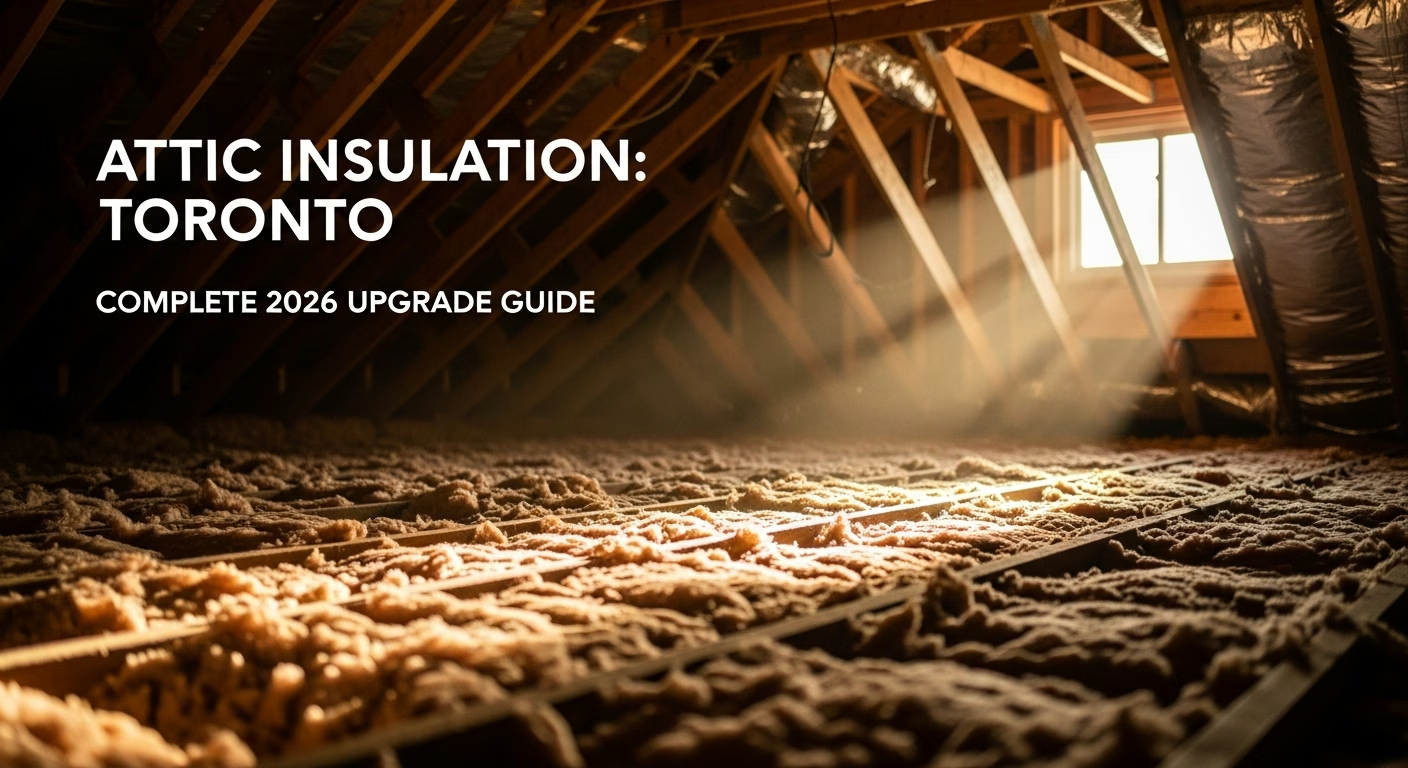
Quick answer. Toronto attic insulation looks simple from a homeowner's perspective: pay someone, they blow stuff in, you save energy. The reality is more complex — and the mistakes contractors and DIYers make are predictable and costly.Toronto attic insulation looks simple from a homeowner's perspective: pay someone, they blow stuff in, you save energy. The reality is more complex — and the mistakes contractors and DIYers make are predictable and costly. This guide covers twelve common attic insulation mistakes in Toronto, what they cost in lost performance and damage, and how to avoid them in your 2026 upgrade.
For the pillar context, see Attic Insulation Toronto: Complete 2026 Upgrade Guide. For the foundational air sealing decision, see Attic Air Sealing Before Insulation: Why It's Non-Negotiable in Toronto.
Mistake 1: Skipping Air Sealing
The most expensive mistake. Insulation without air sealing delivers 50–70% of theoretical performance. The contractor saves 4–6 hours of labor; the homeowner loses thousands in energy savings over the next decade and risks roof deck moisture damage.
Sign of the mistake: invoice has "insulation install" but no "air sealing" line item, or the line item is $100–$200 (token amount, not a real scope).
How to avoid: specify in writing that air sealing must include top plates, plumbing stacks, electrical penetrations, bathroom fan housings, attic hatch, chimney chase, and recessed lights. Require photo documentation of each penetration before/after sealing.
Cost of the mistake: $150–$400 per year in lost energy savings, plus $3,000–$8,000 in moisture damage repair within 7–10 years.
Mistake 2: Burying Knob-and-Tube Wiring
Knob-and-tube (K&T) is a fire hazard when buried under thermal insulation because the wiring depends on air gaps for heat dissipation. ESA prohibits burying K&T. Insurance companies often deny claims if K&T is buried.
Sign of the mistake: contractor proceeded with insulation without addressing visible ceramic insulators or single-conductor cloth wiring.
How to avoid: pre-install inspection. If K&T present, electrician must remove or replace before insulation. Cost: $1,500–$5,000.
Cost of the mistake: insurance claim denial during fire ($100,000+ exposure), code violation, eventual forced removal of insulation when next homeowner discovers issue ($3,000–$8,000).
Mistake 3: Burying Vermiculite Without Testing
Pre-1990 Toronto vermiculite (gold/grey pebble insulation) often contains asbestos. Disturbing or burying it spreads asbestos fibers throughout the home.
Sign of the mistake: contractor blew over visible vermiculite without testing.
How to avoid: any pre-1990 home with pebble insulation gets tested ($150–$300) before any work. If positive, professional abatement ($2,500–$5,000) before new insulation.
Cost of the mistake: indoor air quality issue, potential health consequences, eventual forced abatement at much higher cost when discovered.
Mistake 4: Vented Bathroom Fans Buried Under Insulation
If a bathroom fan vents into the attic (instead of outside the home), each shower deposits 1–2 liters of moisture into the attic. Burying the duct outlet under insulation traps moisture in the insulation and on the roof deck.
Sign of the mistake: visible flexible duct ending mid-attic, or fan housing under fresh insulation with duct that doesn't exit the home.
How to avoid: pre-install verification of fan duct routing. Re-vent to exterior before insulation. Cost: $250–$400 per fan.
Cost of the mistake: mold on roof deck within 2–3 years, insulation degradation, potential ceiling drywall water staining, $2,000–$5,000 to fix retroactively.
Mistake 5: Non-IC Pot Lights Buried
Non-IC pot lights vent heat into the attic by design. Burying them is a fire hazard and code violation. Code requires either replacing with IC-AT (Insulation-Contact, Airtight) fixtures or installing IC-rated covers.
Sign of the mistake: insulation laid directly over older recessed light housings without covers.
How to avoid: count pot lights before quoting; specify IC covers (Tenmat, DCI) for each non-IC fixture. Cost: $25–$45 per cover plus 15 minutes installation.
Cost of the mistake: fire risk, code violation, insulation melting near hot fixtures, eventual forced retrofit.
Mistake 6: No Baffles at Soffit Vents
Soffit-to-ridge airflow is critical for attic moisture management. Insulation blown into the eave area without baffles blocks soffit vents, kills ventilation, and creates condensation.
Sign of the mistake: insulation visible at the eave touching the roof deck with no baffles between.
How to avoid: install plastic or rigid foam baffles at every rafter bay before blowing insulation. For a typical 1,500 sqft Toronto attic, that's 24–32 baffles. Cost: $400–$600.
Cost of the mistake: ventilation failure, condensation, mold, ice dams, $3,000–$8,000 in roof deck repair within 5–10 years.
Mistake 7: Quoted R-Value Not Delivered
Contractor quotes R60 but installs R45 or R50 — by under-blowing material to save bag costs.
Sign of the mistake: no depth markers, no manufacturer R-value certificate, no bag count documentation.
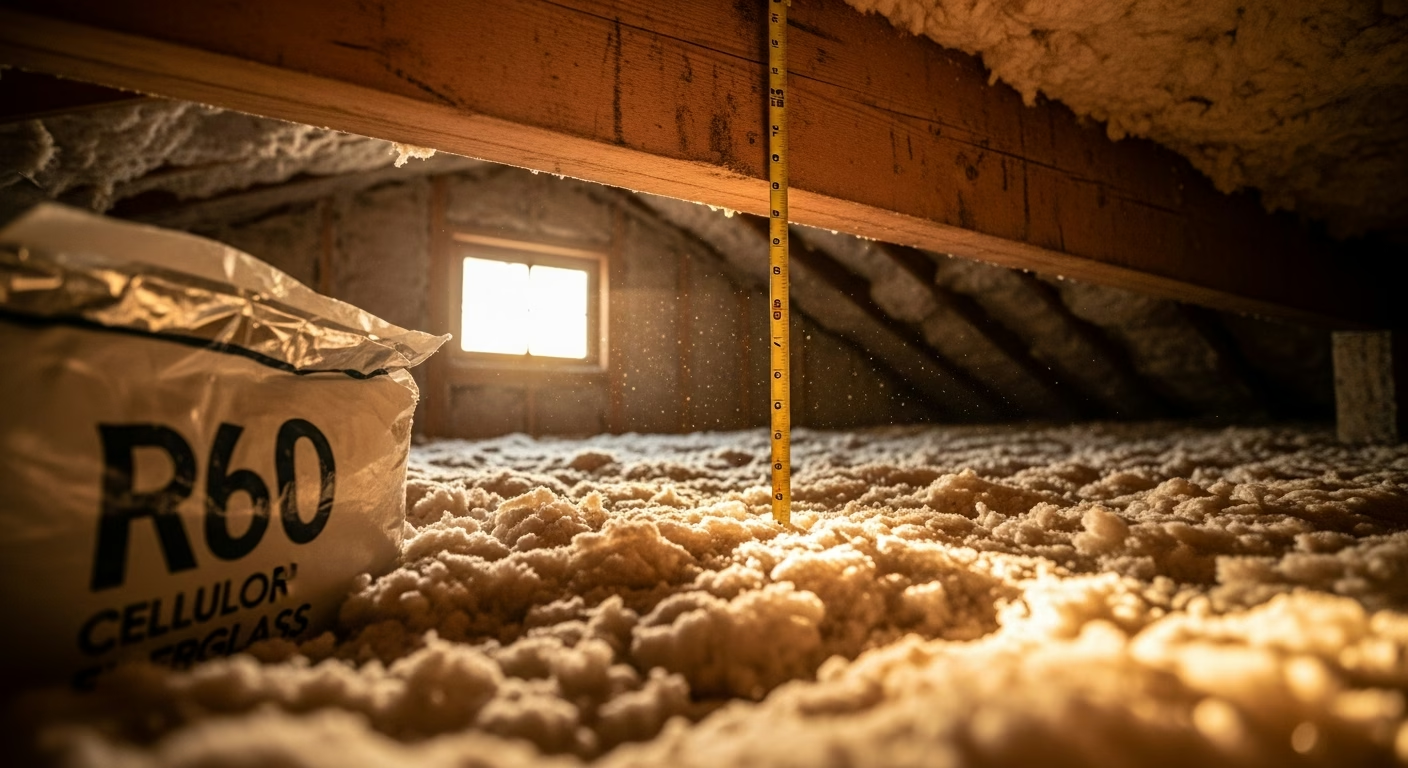
How to avoid: require depth markers (6–10 stakes throughout attic). Require manufacturer certificate documenting bag count and depth. Calculate bag count from manufacturer charts: GreenFiber Cocoon at R60 settled is ~33 sqft per 25-lb bag; for 1,500 sqft, expect ~45 bags.
Cost of the mistake: 25% reduction in thermal performance, $100–$200/year lost energy savings, no recourse if not documented at install time.
Need professional exterior renovation?
Call RenoHouse at 289-212-2345 or get a free estimate today.
Get Free Estimate →For verification methods, see R60 Attic Insulation Toronto: Rebates and OBC Requirements.
Mistake 8: Ignoring Attic Hatch
The attic hatch is the single largest air leak point in many Toronto homes. A 24"x24" hatch with no weatherstripping leaks more than all the top plates combined.
Sign of the mistake: hatch left as-is at end of project, no insulated cover added, no weatherstripping.
How to avoid: insulated R30+ hatch cover (rigid foam panel with fabric cover) plus full perimeter weatherstripping. Cost: $80–$200.
Cost of the mistake: stack-effect leak undermines all other air sealing work, $50–$100/year lost.
Mistake 9: Compressing Insulation With Storage
After install, homeowners often install plywood storage platforms over the new insulation, compressing it and destroying R-value.
R-value is roughly proportional to thickness for cellulose and fiberglass. Compressing R60 cellulose from 17" to 12" reduces R-value to ~R42 in that zone.
Sign of the mistake: plywood platforms or storage on top of insulation.
How to avoid: build storage above the insulation on raised platforms (12"+ above joists), or use a dedicated storage area outside the insulation field.
Cost of the mistake: significant R-value loss in storage zones, often hundreds of square feet of attic compromised.
Mistake 10: Sealing Soffit Vents
Some misguided DIYers (and a few bad contractors) seal soffit vents to "stop drafts." This kills attic ventilation and guarantees condensation problems.
Sign of the mistake: soffit vents painted over, taped closed, or stuffed with insulation.
How to avoid: never seal soffit vents. They're intake; they need to flow freely. Add baffles to keep insulation off the vents while preserving airflow.
Cost of the mistake: full ventilation failure, mold, ice dams, roof rot — same consequences as missing baffles.
For full ventilation strategy, see Attic Ventilation Toronto: Soffit and Ridge Vent Strategy.
Mistake 11: Wrong Insulation for Cathedral Ceilings
Cathedral ceilings (no attic — rafters are the only insulation cavity) require closed-cell spray foam to achieve adequate R-value within rafter depth. Contractors who try to use blown cellulose or batts in cathedral assemblies typically deliver R20–R30 effective when R31+ is required by code.
Sign of the mistake: cellulose or batts in cathedral ceiling rafter bays, or rafter bays not fully filled.
How to avoid: cathedral ceilings always get closed-cell spray foam (Demilec Heatlok HFO, Icynene ProSeal HFO). Cost: $4.50–$7.00 per sqft of ceiling area.
Cost of the mistake: code non-compliance, poor performance, condensation in rafter bays.
Mistake 12: No Vapor Barrier Verification
Toronto ceilings should have a 6-mil polyethylene vapor barrier under the drywall. If it's missing, torn, or perforated, warm interior moisture reaches the cold attic and condenses.
Sign of the mistake: contractor proceeded without checking vapor barrier integrity, or known holes/tears not addressed.
How to avoid: pre-install inspection of ceiling vapor barrier where accessible (often visible from the attic side at top plates and around penetrations). Patch tears with poly tape and acoustic sealant. If vapor barrier is missing entirely, supplemental measures (vapor-impermeable insulation like closed-cell spray foam, or interior vapor retarder paint) may be needed.
For full vapor barrier discussion, see Vapor Barrier and Attic Insulation Toronto.
Mistake 13 (Bonus): Stacking Insulation Types Without Vapor Strategy
Some homeowners or contractors layer different insulation types (closed-cell spray foam below cellulose, or batts below blown). Each material has different vapor permeability. Stacking without thinking through vapor flow can trap moisture between layers.
Common bad combinations in Toronto:
- Closed-cell spray foam at attic floor + cellulose on top: works if foam is thick enough to keep dewpoint inside foam
- Open-cell spray foam at attic floor + cellulose: dangerous — moisture can condense within open-cell foam
- Polyiso rigid foam at attic floor + cellulose: works only if foil-faced foam acts as vapor barrier and is sealed at edges
How to avoid: hire a contractor who understands hygrothermal modeling, or stick to single-material installs.
Mistake 14 (Bonus): Choosing Insulation Type Based on Cost Alone
Cellulose is cheapest. That doesn't mean it's right for every Toronto attic. Cathedral ceilings need spray foam. Knee walls benefit from mineral wool. Specific moisture problems may warrant closed-cell spray foam at the deck.
How to avoid: scope-driven material selection, not budget-driven.
For material selection guidance, see Spray Foam vs Blown Cellulose vs Batt: Toronto Attic Comparison.
Mistake 15 (Bonus): No Documentation, No Recourse
Homeowner gets a one-page invoice with no photos, no R-value certificate, no scope detail. Years later something fails. No way to claim warranty, no way to verify what was installed.
How to avoid: require a documentation package: pre-existing photos, removal photos, air sealing photos (per penetration), baffles photos, pot light covers photos, depth markers photos, finished install photos, R-value certificate from manufacturer (Owens Corning, GreenFiber, Knauf, etc.), bag count breakdown.
A reputable Toronto contractor delivers 40–80 photos for a Tier 2 attic upgrade. Insist on this.
How These Mistakes Cluster
The mistakes don't happen randomly. They cluster around contractor quality:
- High-quality contractors: Air seal comprehensively, install baffles and pot light covers, verify K&T and vermiculite, document everything. Premium pricing ($5,500–$7,500 for 1,500 sqft Tier 2).
- Mid-tier contractors: Air seal somewhat, install some baffles, miss pot light covers or shortcut hatch insulation. Mid-range pricing ($4,500–$5,500).
- Low-quality contractors: Skip air sealing, no baffles, blow over everything. Budget pricing ($3,000–$4,200 looks cheap, but the work is worth $1,500–$2,000 in true value).
The "savings" from a low-quality contractor are wiped out by lost performance and remediation costs within 5 years.
Toronto-Specific Risks
Several mistakes are more common in Toronto due to the city's housing stock:
- K&T burial: Pre-1950 East York, Beaches, High Park, Annex are all high-risk neighborhoods.
- Vermiculite: Same neighborhoods + Riverdale.
- Bathroom fan venting into attic: Pre-1990 homes throughout Toronto.
- Knee wall mistakes: 1.5-storey homes in East York and Riverdale (storey-and-a-half style).
- Cathedral ceiling errors: Modern Leslieville and Liberty Village townhomes with sloped ceilings.
If your home matches any of these patterns, ask the contractor specifically how they're addressing the relevant risk.
What a Good Contractor Says vs Bad
Good: "Before we quote, I need to inspect for K&T and vermiculite. If we find either, we need to address them before insulation."
Bad: "We can blow over anything. Don't worry about it."
Good: "I'll send you 40+ photos including before/after of every penetration we sealed."
Bad: "We don't do photos."
Good: "Here's the manufacturer R-value certificate showing 47 bags of GreenFiber Cocoon at 17.5" depth for R60 settled."
Bad: "Yeah, it's R60, trust me."
Bottom Line on Avoiding Mistakes
Pay attention to scope, not just price. Specify air sealing, baffles, pot light covers, K&T/vermiculite handling, depth markers, and documentation in writing. Reject "trust me" contractors. Require photo documentation. Verify R-value with manufacturer certificate.
The best Toronto attic insulation jobs in 2026 are the ones that prevent mistakes 1–12 (and bonus 13–15) systematically.
---
Concerned about avoiding common Toronto attic insulation mistakes? RenoHouse provides scope-driven proposals with full documentation, K&T/vermiculite handling, and manufacturer R-value certificates. Visit our attic insulation upgrade service page or book an insulation thermal audit for a thorough pre-project assessment.
Sources & References
Authoritative sources cited in this guide:
- Canada Greener Homes Initiative — Federal retrofit programs
- ENERGY STAR Canada — Canadian ENERGY STAR specs
- Ontario Building Code SB-12 — OBC energy efficiency supplementary standard
- Toronto HELP — Home Energy Loan — Toronto Home Energy Loan Program
Continue Reading