RenoHouse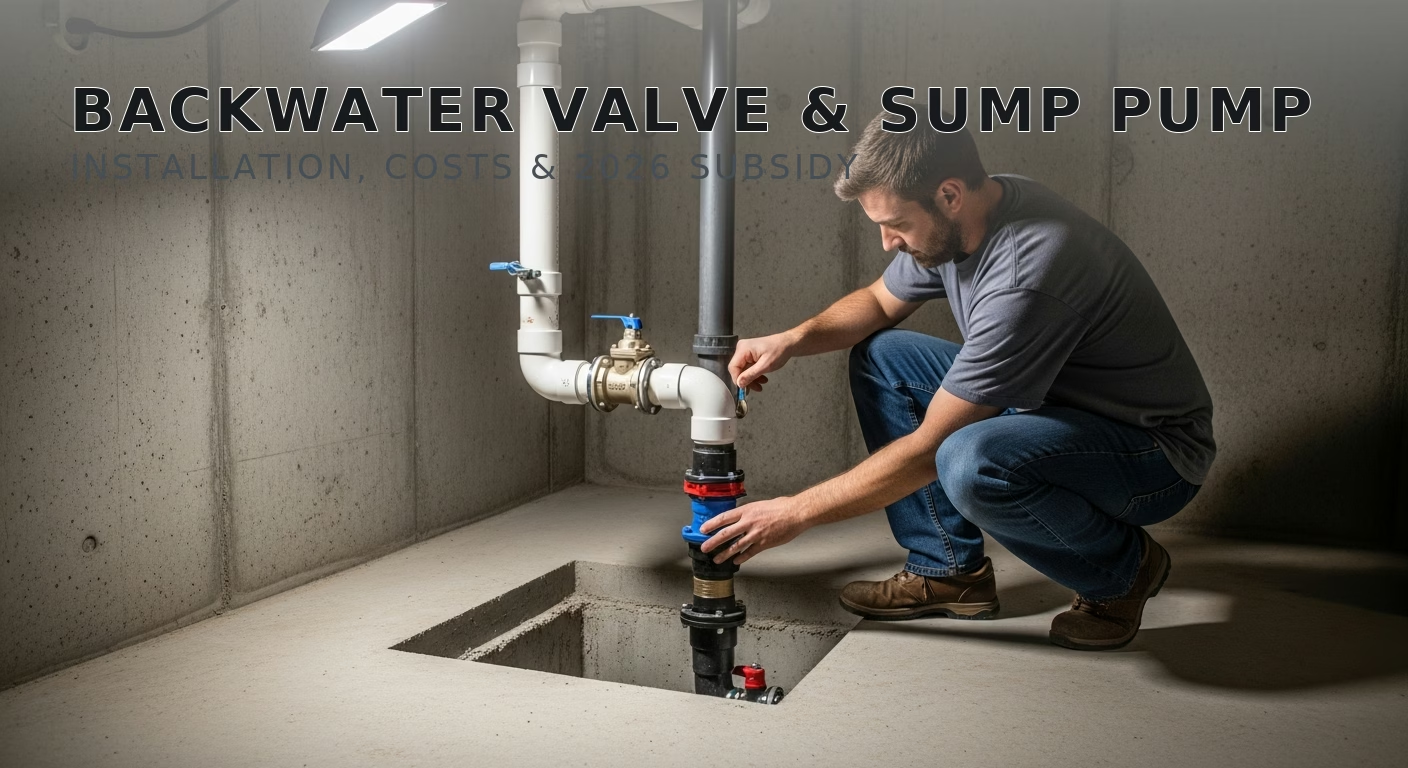

# Backwater Valve & Sump Pump Toronto: Complete 2026 Subsidy Guide
Quick answer. Toronto homeowners now have access to the most generous flood-protection subsidy in the city's history. Effective May 1, 2026, the City of Toronto's Basement Flooding Protection Subsidy Program was raised from $3,400 to $6,650 per property — a 96% increase that almost completely covers the cost of a properly designed flood-protect...Toronto homeowners now have access to the most generous flood-protection subsidy in the city's history. Effective May 1, 2026, the City of Toronto's Basement Flooding Protection Subsidy Program was raised from $3,400 to $6,650 per property — a 96% increase that almost completely covers the cost of a properly designed flood-protection bundle (backwater valve + sump pump + weeping-tile/foundation-drain disconnection). The program is also retroactive to November 12, 2025, so eligible work done in the past six months still qualifies.
This is the RenoHouse pillar guide for backwater valves and sump pumps in Toronto for 2026. We cover the full subsidy structure, real CAD costs before and after rebate, brand comparison (Mainline Backflow, Liberty Pumps, Zoeller, Wayne Plumbing), the difference between mainline and floor-drain valves, sump pump sizing for typical Toronto homes, battery backup options, permit and inspection requirements, and the application process from pre-approval to rebate cheque.
If you are starting at the subsidy itself, see Toronto Basement Flooding Subsidy 2026: $6,650 Program Explained. For a cost-only breakdown, see Backwater Valve Cost Toronto: Installation Pricing 2026. For application paperwork, see Backwater Valve Rebate Application Toronto 2026: Step-by-Step.
Why Toronto Basements Flood (and Why 2026 Is Different)
Toronto's sewer system was largely built between 1890 and 1960, and large parts of the older core (Old East York, Riverdale, Cabbagetown, Leslieville, North Etobicoke, parts of Rosedale and Forest Hill) still operate on a combined sewer — a single pipe carrying both sanitary waste and stormwater. When a heavy rain event overwhelms the combined sewer, water backs up through the lowest opening in your house — typically the basement floor drain, laundry standpipe, or basement toilet.
Climate change is accelerating the problem. Toronto Water has recorded four "1-in-100-year" rain events since 2013:
- July 8, 2013 — 126mm in two hours, $940M in insured damage, Don Mills/Bayview corridor hit hardest.
- August 7, 2018 — 71mm in one hour, multiple subway flood-outs, Yonge-Eglinton and the Annex hardest hit.
- June 22, 2024 — 97mm in three hours, Lake Shore underpasses flooded, basement claims spiked in Old East York.
- August 17, 2025 — 84mm in 90 minutes, triggered the subsidy expansion proposal.
The result is a structural, growing demand for residential flood protection. The new $6,650 subsidy is the City's response — and for Toronto homeowners, the financial math has fundamentally changed. A complete flood-protection bundle that cost $8,000–$11,000 net of the old $3,400 subsidy now costs $3,000–$5,000 net under the new program. For combined-sewer neighbourhoods, this is no longer a discretionary upgrade; it is a defensive investment with a measurable ROI.
What the $6,650 Subsidy Covers
The expanded program is structured as three reimbursement categories:
| Component | Subsidy Coverage | Per-Device / Cap | Notes |
|---|---|---|---|
| Backwater valve install | 80% of eligible cost | $1,250 per valve, max 2 devices ($2,500) | Up from $1,250 single-device cap |
| Sump pump install (with connection to foundation drain / weeping tile) | 80% of eligible cost | $1,750 | Up from $1,750 |
| Weeping tile / foundation drain disconnection from sanitary sewer | 80% of eligible cost | $3,650 | NEW category in 2026 expansion |
| Total maximum per property | $6,650 | Was $3,400 |
The numbers above reflect the May 1, 2026 program structure. Some neighbourhoods qualify for an additional plumbing-assessment grant of up to $500 (80% of cost) when paired with the bundle.
Two important rules:
- 1. Licensed plumber required. All work must be performed by a Toronto-licensed plumber (Master Plumber's licence on file with City of Toronto Municipal Licensing & Standards).
- 2. Permit required. Backwater valves require a plumbing permit from Toronto Building. Inspection happens at rough-in stage (before backfill) and final.
Backwater Valve Basics
A backwater valve is a one-way valve installed on your home's main sanitary sewer line (or on a specific drain branch) that prevents sewage in the city's sewer from flowing back into your house during a surcharge event.
Two physical types are installed in Toronto:
- Normally-closed (also called "flap-style" or "automatic") — a hinged flap stays closed except when household waste is flowing out. The flap floats up when sewage backs up. Most common in Toronto installations because it provides protection at all times.
- Normally-open — flap stays up by default and only closes when reverse flow is detected via a float. Slightly less restrictive on outflow but more expensive and less common.
Most Toronto installations use the Mainline Backflow Fullport Valve (locally manufactured in the GTA, 4-inch standard, normally-closed design). Backwater valves typically install at the floor of the basement on the main sewer lateral, accessed through a sealed, removable cover plate.
For a deeper comparison of valve types, see Mainline vs Floor-Drain Backwater Valve: Which Is Right for Your Toronto Home and Backwater Valve vs Check Valve: Critical Difference Toronto Homeowners Need to Know.
Sump Pump Basics
A sump pump sits in a sealed pit (the "sump") at the lowest point of your basement. Groundwater that drains through the foundation perimeter (weeping tile / foundation drain) collects in the pit and is pumped out via a discharge pipe to the lawn or storm sewer.
For a typical Toronto home, the choice is between three horsepower tiers:
- 1/3 HP — adequate for dry-soil zones (sandy fill, gravel-rich areas of Etobicoke, Scarborough). Pumps roughly 35 gallons per minute at 10 feet of lift.
- 1/2 HP — the workhorse for most Toronto homes on clay soil (most of Old East York, Leslieville, Riverdale). Pumps 50–60 GPM.
- 3/4 HP — used for high-water-table homes, deep basements, or homes near the Don/Humber/Mimico ravines. Pumps 70–80 GPM.
Top brands installed in Toronto:
- Liberty Pumps 257 (1/3 HP) and 287 (1/2 HP) — cast-iron housing, 3-year warranty.
- Zoeller M53 (1/3 HP) — the unofficial standard; most Toronto plumbers stock it.
- Zoeller M267 (1/2 HP) — heavier-duty version of the M53.
- Wayne CDU980E (3/4 HP) — premium tier, vertical-float switch.
- Zoeller Aquanot Fit 508 — battery-backup unit, pairs with primary pump.
For sizing details, see Sump Pump vs Backwater Valve: Do You Need Both in Toronto.
Need professional plumbing?
Call RenoHouse at 289-212-2345 or get a free estimate today.
Get Free Estimate →Why Most Toronto Homes Need BOTH
A backwater valve protects against sewer surcharge (city sewer backing up into your house). A sump pump protects against groundwater intrusion (water pushing through the foundation from outside). These are two completely different failure modes. The 2013 and 2018 floods damaged tens of thousands of Toronto homes with simultaneous sewer surcharge and groundwater intrusion — homes with only one system protected against half the threat.
The new subsidy structure recognizes this. The maximum $6,650 reimbursement only applies if you install all three components (backwater valve + sump pump + weeping tile disconnection). Installing just one element caps your rebate at the per-device limit ($1,250 for a single valve, for example).
Real Toronto Costs (Gross + Net of Subsidy)
Below are 2026 GTA pricing ranges from RenoHouse projects and competing quotes:
Backwater Valve (single, mainline)
- Gross install: $1,800–$3,200 (depends on basement floor depth, slab thickness, access)
- Subsidy: $1,250 max
- Net cost: $550–$1,950
Sump Pump (1/2 HP, new pit + discharge)
- Gross install: $2,500–$4,500 (depends on existing pit, discharge routing, frost-line considerations)
- Subsidy: $1,750 max
- Net cost: $750–$2,750
Weeping Tile Disconnection from Sanitary Sewer
- Gross cost: $3,500–$6,500 (excavation, re-routing to sump pit)
- Subsidy: $3,650 max
- Net cost: $0–$2,850
Combined Flood Protection Bundle
- Gross: $7,800–$14,200
- Subsidy: $6,650 max
- Net cost: $1,150–$7,550
For an itemized cost breakdown, see Backwater Valve Cost Toronto: Installation Pricing 2026.
Where Each Device Goes (Toronto-Specific Layout)
In a typical Toronto semi-detached or detached home built before 1980:
- Backwater valve — on the main sanitary sewer lateral, usually 2–4 feet inside the foundation wall on the side facing the street. Cut into the existing 4-inch ABS or clay tile.
- Sump pit — at the lowest interior corner, typically against the rear or side foundation wall. Pit is 18–24 inches deep, 18–24 inches diameter, lined with a perforated polyethylene liner.
- Discharge pipe — runs from sump pit through rim joist, exits foundation, daylights at least 6 feet from foundation. Must NOT discharge to the sanitary sewer (this is the violation that triggered the weeping-tile disconnection rebate category).
- Weeping tile re-route — the foundation drain originally connected to the sanitary lateral is cut and re-routed to the sump pit instead.
Toronto Bylaw 681 (Sewer Use)
Toronto's Sewer Use Bylaw (Bylaw 681) governs what may be discharged to the sanitary and storm sewers. Three rules matter for flood-protection projects:
- 1. Foundation drains cannot discharge to the sanitary sewer. This was technically illegal for decades but rarely enforced. The 2026 subsidy expansion makes the disconnection financially viable.
- 2. Sump pump discharge cannot connect to the sanitary sewer. Must daylight to lawn/grade or to the storm sewer (with City approval).
- 3. Backwater valve cannot block any vent or relief opening. Installation must preserve fixture-trap venting.
A licensed plumber will ensure compliance. For more detail on bylaw requirements, see Toronto Basement Flooding Subsidy 2026: $6,650 Program Explained.
Combined Sewer Overflow Neighbourhoods
These Toronto neighbourhoods sit on combined sewers and have the highest flood-claim history:
- Old East York (Pape, Donlands, O'Connor)
- Riverdale (Broadview, Logan, Withrow)
- Cabbagetown (Parliament, Carlton, Wellesley)
- Leslieville (Queen East, Jones, Greenwood)
- North Etobicoke (Albion, Rexdale, parts of Mount Olive)
- Parts of the Annex and South Hill
If your home is in one of these areas, both the backwater valve AND weeping-tile disconnection are essentially required, not optional. For neighbourhood-by-neighbourhood claim history, see Toronto Basement Flooding History: 2013 and 2018 Events Explained and Combined Sewer Overflow in Toronto Explained.
The Permit and Inspection Process
Backwater valve installation requires a plumbing permit from Toronto Building. The process:
- 1. Licensed plumber pulls permit (typical fee $200–$350).
- 2. Rough-in inspection — valve installed, slab not yet poured back. Inspector verifies valve type, orientation, accessibility, cleanout.
- 3. Final inspection — slab restored, cover plate visible, sign-off.
Sump pump installation does not require a plumbing permit unless new sanitary or storm connections are added. Discharge piping outside the foundation typically does not require a permit, but discharge to municipal storm sewer requires a Toronto Water connection permit.
The Subsidy Application Workflow
The City of Toronto requires this exact sequence:
- 1. Hire a licensed plumber. Verify their licence number at the City's Municipal Licensing & Standards portal.
- 2. Get a written estimate. The estimate must itemize each subsidy-eligible component separately (the City will not reimburse a single lump sum).
- 3. Apply for pre-approval (optional but recommended). Submit the estimate to Toronto Water for confirmation that the work qualifies. This protects you if program terms change between estimate and install.
- 4. Permit & install. Plumber pulls the permit and completes the work.
- 5. Pass City inspection. Inspector signs off via Toronto Building.
- 6. Submit rebate application. Online via toronto.ca/floodingsubsidy. Required documents: paid invoice, permit number, inspection sign-off, photos of the installed equipment, plumber's licence number.
- 7. Rebate payment. Currently 8–12 weeks turnaround. Direct deposit or cheque.
For step-by-step walkthrough including photo requirements and common rejection reasons, see Backwater Valve Rebate Application Toronto 2026: Step-by-Step.
Common Installation Mistakes
Five mistakes account for most of the failed flood-protection installations we see in Toronto:
- 1. Backwater valve installed on the wrong side of the cleanout — must be downstream of the cleanout for proper service access.
- 2. No service access cover — slab poured directly over the valve. Inspector will fail this; valve must be accessible for annual cleaning.
- 3. Sump pit not sealed — open pits release radon and humidity into the basement. Code now requires a sealed pit with airtight cover.
- 4. Discharge pipe re-frozen in winter — discharge that runs along the foundation surface freezes solid. Burying the discharge below frost line (4 ft in Toronto) is standard.
- 5. Weeping tile disconnection done without re-routing to sump — leaves foundation drain dead-ended. Water pools at footing.
For more on installation pitfalls, see Backwater Valve Installation Mistakes in Toronto Homes.
Battery Backup Options
A primary sump pump runs on 120V household power. When the grid goes down during a storm — which is exactly when you need it most — the primary pump stops. Battery-backup pumps are the answer.
The two common Toronto setups:
- Battery-backup-only secondary pump (Zoeller Aquanot Fit 508, Wayne ESP25) — separate 12V DC pump in the same pit, runs off a deep-cycle battery, pumps 25–35 GPM for 6–10 hours.
- Combined primary + backup unit (Liberty Pumps PC257-Series, Wayne WaterBUG combo) — single integrated unit with primary AC and backup DC.
Battery-backup is NOT subsidy-eligible by itself. However, it is included in the bundled "sump pump install" rebate up to the $1,750 cap if installed at the same time as the primary pump. For a brand-by-brand comparison, see Battery Backup Sump Pump Toronto: Brand & Capacity Comparison.
Insurance Implications
Major Toronto insurers (Intact, Aviva, TD, Wawanesa, Co-operators) treat backwater valve + sump pump installation as a risk-reducing improvement. Most will:
- Reduce the sewer-backup deductible by $250–$1,000 once a backwater valve is installed.
- Lower the annual sewer-backup premium by 5–15%.
- Lift sewer-backup exclusions that were placed after a previous claim.
Some insurers (Intact in particular) require professional installation documentation (plumber's licence, permit number, inspection sign-off) — exactly the paperwork that the subsidy already requires. For more, see Sewer Backup Insurance Coverage Toronto: What You're Actually Protected Against.
Annual Maintenance
A backwater valve has one moving part (the flap) and needs annual inspection:
- Flap free of debris — wipe clean of grease, hair, small solids. The flap should move freely.
- Gasket in good shape — replace every 5–7 years.
- Cleanout port accessible — confirm the access cover is not buried under flooring or storage.
A sump pump needs:
- Float test — pour 5 gallons of water into the pit, confirm pump activates and shuts off cleanly.
- Battery test (if backup exists) — disconnect AC, confirm DC system kicks in.
- Discharge clear — verify outdoor discharge is not blocked by ice, debris, or snow.
For a full homeowner annual checklist, see Flood Prevention Toronto: Homeowner Checklist for 2026.
When You Should Act Now (and Why May 2026 Is Critical)
The first-mover advantage on the new $6,650 program will narrow quickly. Three reasons to start now rather than wait:
- 1. Licensed plumber capacity — Toronto has roughly 1,400 licensed plumbers and an estimated 80,000 homes that would benefit from the bundle. Demand is already exceeding supply; lead times for late-summer install are 6–10 weeks as of May 2026.
- 2. Spring storm season — Toronto's most damaging rain events historically fall between June and September. Installing in May/June protects you for the worst window.
- 3. Permit queue — Toronto Building's plumbing permit queue lengthens through summer; pre-approval applications submitted in May 2026 are already taking 2–3 weeks.
For a quick self-assessment of whether your home needs this work, see Signs You Need a Backwater Valve in Your Toronto Home.
Related Reading
For pricing details: Backwater Valve Cost Toronto: Installation Pricing 2026. For the subsidy itself: [Toronto Basement Flooding Subsidy 2026: $6,650 Program Explained](/blog/toronto-basement-flooding-subsidy-2026-6650-program). For sump-vs-valve choice: Sump Pump vs Backwater Valve: Do You Need Both in Toronto. For battery backup: Battery Backup Sump Pump Toronto: Brand & Capacity Comparison. For valve types: Mainline vs Floor-Drain Backwater Valve. For installation pitfalls: Backwater Valve Installation Mistakes in Toronto Homes. For flood history: Toronto Basement Flooding History: 2013 and 2018 Events Explained. For prevention checklist: Flood Prevention Toronto: Homeowner Checklist for 2026. For valve vs check valve: Backwater Valve vs Check Valve: Critical Difference. For insurance: Sewer Backup Insurance Coverage Toronto. For warning signs: Signs You Need a Backwater Valve in Your Toronto Home. For application paperwork: Backwater Valve Rebate Application Toronto 2026. For combined sewer context: Combined Sewer Overflow in Toronto Explained.
Ready to Protect Your Toronto Basement?
RenoHouse provides licensed-plumber backwater valve and sump pump installations across the GTA, complete with subsidy pre-approval support and rebate-application assistance. Visit our Backwater Valve & Sump Pump Bundle Service Page for a free site assessment and quote.
Sources & References
Authoritative sources cited in this guide:
- Toronto Sewer Use Bylaw 681 — Toronto plumbing/sewer regulations
- Ontario Building Code 7 (Plumbing) — OBC plumbing standards
- Health Canada — Drinking Water — Health Canada drinking water guidelines
- CSA B149.1 Natural Gas Code — Canadian gas installation code
Continue Reading