 RenoHouse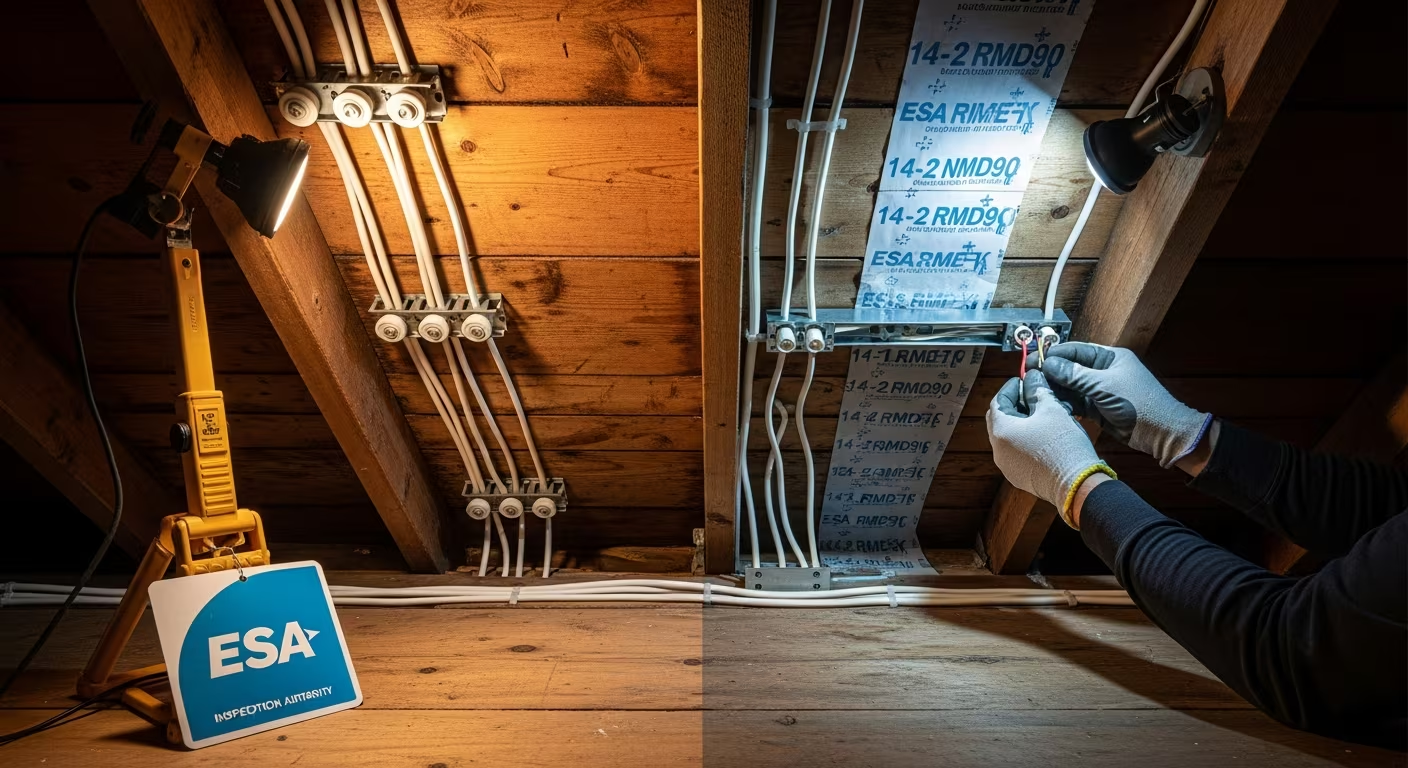
Knob Tube Rewiring
Toronto and the GTA — ECRA/ESA-registered contractor, Ontario 309A Master Electrician on site, ESA permit + Form 1 Certificate of Inspection included.
H1: Knob and Tube Wiring Removal & Whole-Home Rewiring — Toronto GTA
Hero subhead: Insurance non-renewal trigger. ECRA/ESA-registered, Master Electrician 309A. ESA Form 1 documentation for your broker. Plaster-wall and lath-and-plaster heritage homes our specialty.
Quick Answer — Why You're Reading This
Your insurance broker called. Or the home inspection report flagged it. Or the renovation contractor opened a ceiling and you saw the ceramic tubes and porcelain knobs for the first time. Whatever the reason, you now know your house has knob and tube wiring (K&T) and that fact changes your insurance situation, your renovation timeline, and probably the next 6–10 weeks of your life.
The non-negotiable facts:
- K&T was the standard residential wiring method from approximately 1880 to 1940. Toronto homes built before 1945 commonly have at least some K&T remaining.
- K&T is not inherently unsafe when undisturbed and not overloaded. The problem is that 80–140 year old wiring in a home with 2026 electrical loads is, in fact, disturbed and overloaded.
- Most Ontario insurance carriers will not write or renew a homeowner's policy on a home with active K&T circuits. Aviva, Intact, TD, Wawanesa, Co-operators, and Belair Direct all flag K&T in underwriting.
- Full replacement cost (2026 GTA): $8,000 (small bungalow, simple layout) to $35,000+ (large 2,500+ sq ft heritage Edwardian with plaster walls).
This page covers what you're actually buying when you buy a K&T rewire, why the cost variance is so large, which insurance carriers accept partial rewires, and what the timeline looks like.
What Knob and Tube Actually Is
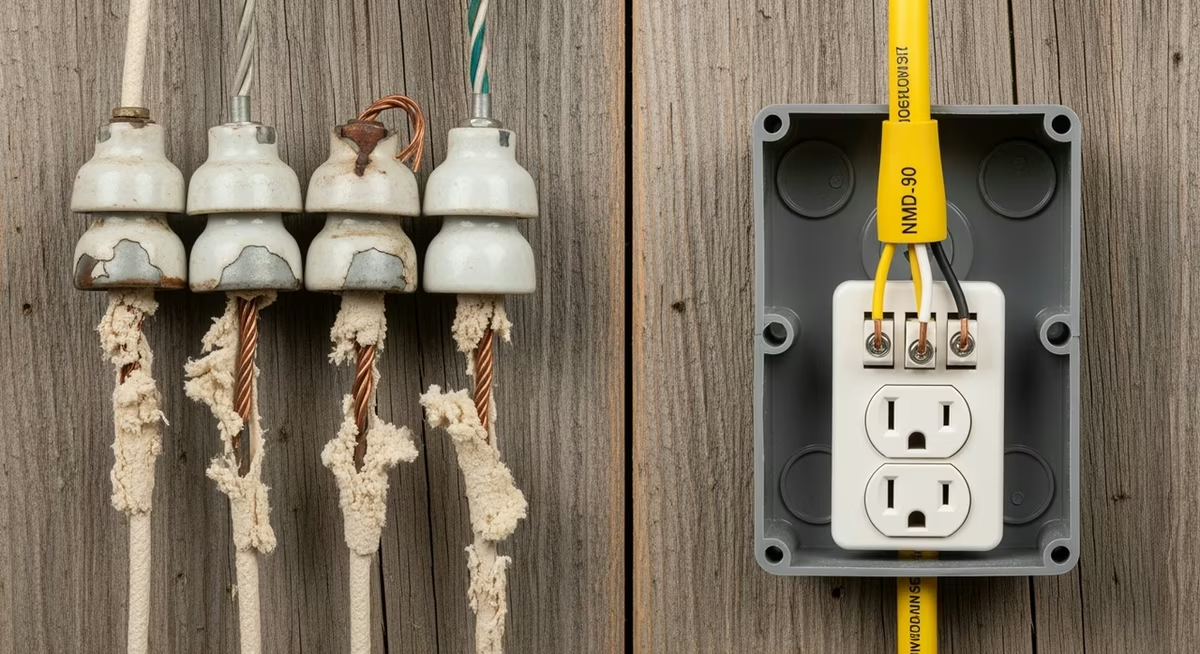
Knob and tube wiring is a single-conductor system: two separate insulated copper conductors (one hot, one neutral) running in parallel through the framing of the house. The conductors pass through ceramic insulating tubes where they cross studs or joists, and are supported by porcelain knobs at intervals along their runs.
Original design assumptions (1880–1940):
- 60–100W incandescent bulbs as the primary load
- One or two receptacles per room
- No major appliances on dedicated circuits (the kitchen was gas)
- Single-pole switches only
- Air-gap insulation around conductors (the air space dissipates heat naturally)
Why it fails in 2026 loading:
- Modern households draw 5–15× the original design load
- Insulation added in the 1970s–1990s now surrounds the K&T conductors, trapping heat the original design relied on dissipating into open air
- Splices and junctions added by decades of renovation work degrade the original design integrity — proper K&T has no concealed splices, but real-world houses have many
- Rubber-cloth insulation on the conductors becomes brittle with age, exposing copper that can arc to nearby wood framing
The fire risk is not theoretical. TFS (Toronto Fire Services) and Ontario Fire Marshal investigations consistently attribute residential electrical fires to legacy wiring conditions, with K&T overrepresented in pre-1945 homes.
The Insurance Reality — Why You're Doing This Now
Most Ontario homeowner insurance carriers handle K&T using one of three approaches:
Approach 1 — Full non-renewal. Carrier refuses to renew the policy unless K&T is fully removed and replaced. Most common posture across the major carriers in 2026.
Approach 2 — Conditional renewal with rewire deadline. Carrier grants a 60–180 day grace period to schedule and complete the rewire, with proof-of-work (ESA Form 1) required at the end. Common for long-tenured customers with otherwise clean files.
Approach 3 — Surcharge or excluded coverage. Some smaller carriers and specialty markets (high-risk pools) will write K&T-present policies with a surcharge (15–30% premium increase) and a fire-loss exclusion for damage traced to legacy electrical. Rarely the most cost-effective answer.
| Carrier | K&T Posture (2026) | Grace Period | Notes |
|---|---|---|---|
| Aviva | Non-renewal | Up to 60 days for existing customers | Form 1 required to reinstate |
| Intact | Non-renewal | None for new policies, 90 days for renewals | Verified by ESA Form 1 |
| TD Insurance | Conditional | 90–180 days typical | Documentation required mid-window |
| Wawanesa | Non-renewal | Case-by-case | Broker advocacy can extend |
| Co-operators | Conditional | 90 days | Form 1 + photos required |
| Belair Direct | Non-renewal | 60 days | Strict deadline |
| Square One | Excluded coverage | N/A | K&T-related claims denied |
| Specialty markets (Echelon, etc.) | Surcharge + exclusion | N/A | Last-resort option |
What your broker needs from us at close-out:
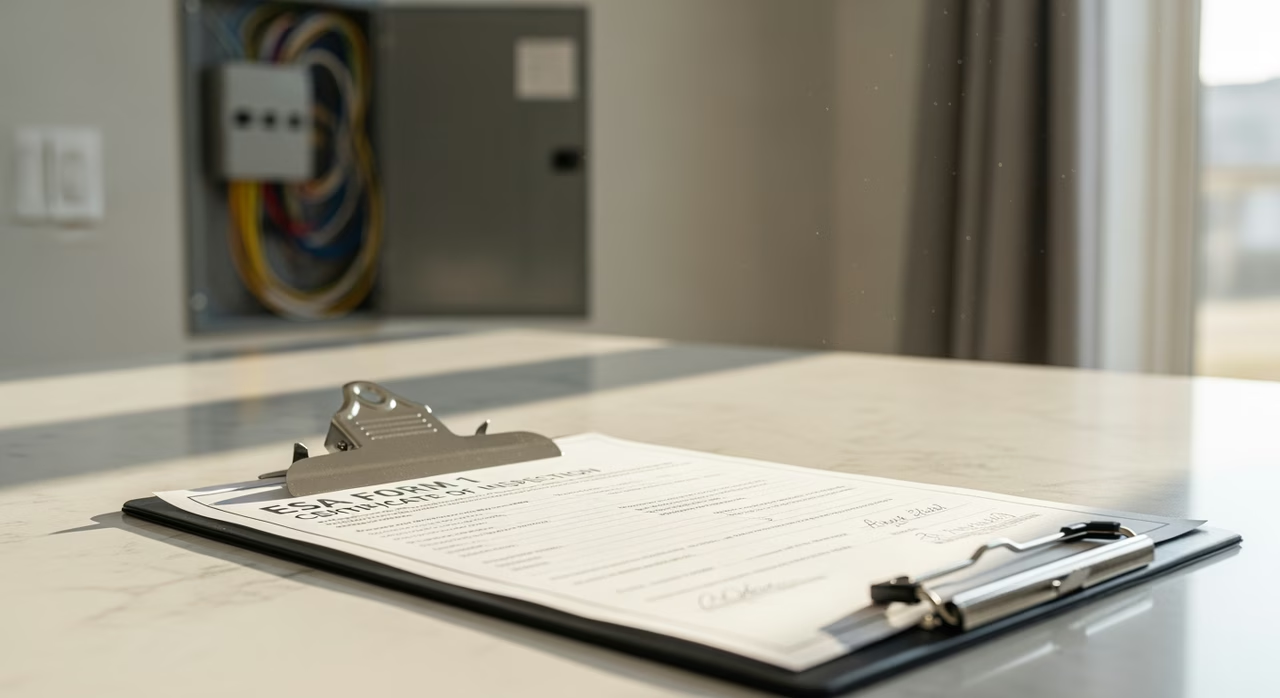
- ESA Form 1 (Certificate of Inspection) confirming the rewire was performed under permit and passed inspection.
- Invoice showing ECRA/ESA contractor registration number and Master Electrician 309A licence of record.
- Photos of representative removed K&T runs and replacement NMD-90 cable installation (we document during install for this purpose).
- Scope-of-work statement detailing whether the rewire was complete (every K&T circuit removed) or partial (some K&T deactivated, some removed) — see Section 5 below for why this distinction matters.
We email all four documents directly to your broker on request.
Cost Breakdown — What You're Actually Buying
| Scope | Cost (CAD, 2026 GTA) | Typical Timeline |
|---|---|---|
| Partial K&T deactivation (replace active runs, abandon inactive) | $4,000–$8,000 | 5–10 working days |
| Single-storey bungalow full rewire (≤1,200 sq ft) | $8,000–$14,000 | 8–14 working days |
| 1.5-storey or 2-storey (1,200–1,800 sq ft) | $14,000–$22,000 | 14–21 working days |
| Large 2-storey or 2.5-storey heritage (1,800–2,500 sq ft) | $22,000–$32,000 | 21–35 working days |
| 2,500+ sq ft Edwardian / Victorian, plaster walls throughout | $32,000–$50,000+ | 30–50 working days |
| Panel upgrade (typical paired scope) | +$1,800–$3,200 | Within rewire window |
| ESA NOW permit (major rewire) | $400–$650 | Included in quote |
| Drywall / plaster restoration (where required) | $1,800–$8,000+ | After electrical sign-off |
| Painting (where required) | $1,800–$6,000+ | After drywall |
What drives the variance from $8K to $50K:
- Square footage is the primary driver (cable run lengths scale roughly linearly).
- Wall construction is the second driver. Modern drywall: fishing cable is relatively easy. Plaster-and-lath (most pre-1945 Toronto homes): every wall is a slow, careful, sometimes destructive operation. Add 25–40% to the labour estimate.
- Layout complexity matters: bungalows are fast (everything's on one floor); Edwardian three-storey with concealed beams, brick chimney bumps, and converted-attic bedrooms is slow.
- Number of circuits added matters: a 1925 home might have had 4 original K&T circuits; the rewire adds 20+ circuits to meet OESC 27th Edition load distribution and AFCI requirements.
- Panel upgrade necessity: 95% of K&T rewires include a panel upgrade (old K&T-era fuse panel or 60A breaker panel → 200A modern). Budget for it.
- Plaster/drywall restoration: Whether you're doing this concurrently with the rewire (cheaper coordination) or sequentially (more flexibility, slightly higher total cost). We coordinate with your preferred drywall/plaster restorer or recommend ours.
Full Rewire vs. Partial Deactivation — The Critical Decision
Two paths to closing out the insurance file. Insurance carriers vary on which path they accept.
Full rewire (complete removal). Every single K&T conductor in the house is removed (or de-energized and disconnected at both ends and tagged). Replacement NMD-90 copper cable runs from a new modern panel to every receptacle, switch, and fixture. ESA inspection confirms zero active K&T. Form 1 issued for "whole-home rewire." Insurance acceptance: universal — every Ontario carrier accepts this.
Partial deactivation (selective replacement). Active K&T circuits (those currently energized and serving loads) are removed and replaced. Inactive K&T runs (already disconnected at one or both ends from previous renovations) are confirmed dead, capped at junction boxes, and documented. ESA inspection confirms no active K&T but some abandoned K&T remains in walls/ceilings. Form 1 issued with "no active K&T" language. Insurance acceptance: depends on carrier. Aviva, Co-operators, and TD generally accept "no active K&T" on Form 1. Intact and Wawanesa increasingly require full physical removal.
The cost delta between the two paths is typically 30–50%. Partial deactivation works when (a) your carrier accepts "no active K&T" status, and (b) significant portions of the original K&T were already abandoned by prior renovations — meaning the work to physically remove abandoned wires has high labour cost with no safety benefit.
We discuss your specific carrier's posture during the quote and recommend the path that meets your insurance requirements at the lowest practical cost. If your broker won't commit to acceptance of partial deactivation, we default to full rewire.
The Process — What 3 Weeks of K&T Rewire Looks Like
Day 1 — Site assessment and ESA permit filing. On-site inspection: every accessible K&T run photographed and documented. Load calculation per OESC 8-200 for the new panel. Quote refined. ESA NOW filed within 24 hours of quote acceptance. Scope-of-work issued with timeline, milestones, and access requirements.
Days 2–3 — Demo and access prep. Drop cloths, floor protection, dust barriers. Identify access points: switch boxes, fixture boxes, panel area, key wall cavities. Set up working circuits (we keep refrigerator, freezer, internet, and 2–3 essential outlets live throughout — we don't black out the house).
Days 4–7 — New circuit installation (rough-in). New NMD-90 cable runs from the planned panel location to each load: every receptacle (typically every 3.6 m on living-room walls per OESC 26-718), every switch, every fixture, every appliance circuit. Existing wall openings (switch boxes, plug boxes, fixture boxes) are reused where possible — we feed new cable into existing boxes. New boxes where required. Dedicated 20A kitchen counter circuits, dedicated 15A laundry circuit, dedicated 30A range circuit, dedicated 30A dryer circuit, AFCI-protected bedroom circuits (OESC 26-722).
Days 8–10 — Panel replacement and panel-side terminations. New 200A panel installed at the planned location. Every new circuit landed on its labelled breaker. AFCI breakers on bedroom circuits. GFCI breakers on bathroom, kitchen counter, garage, outdoor, and any-within-1.5m-of-water circuits (OESC 26-708). Photo-verified torque on every lug. New grounding electrode conductor + bonding (see panel upgrade page for detail).
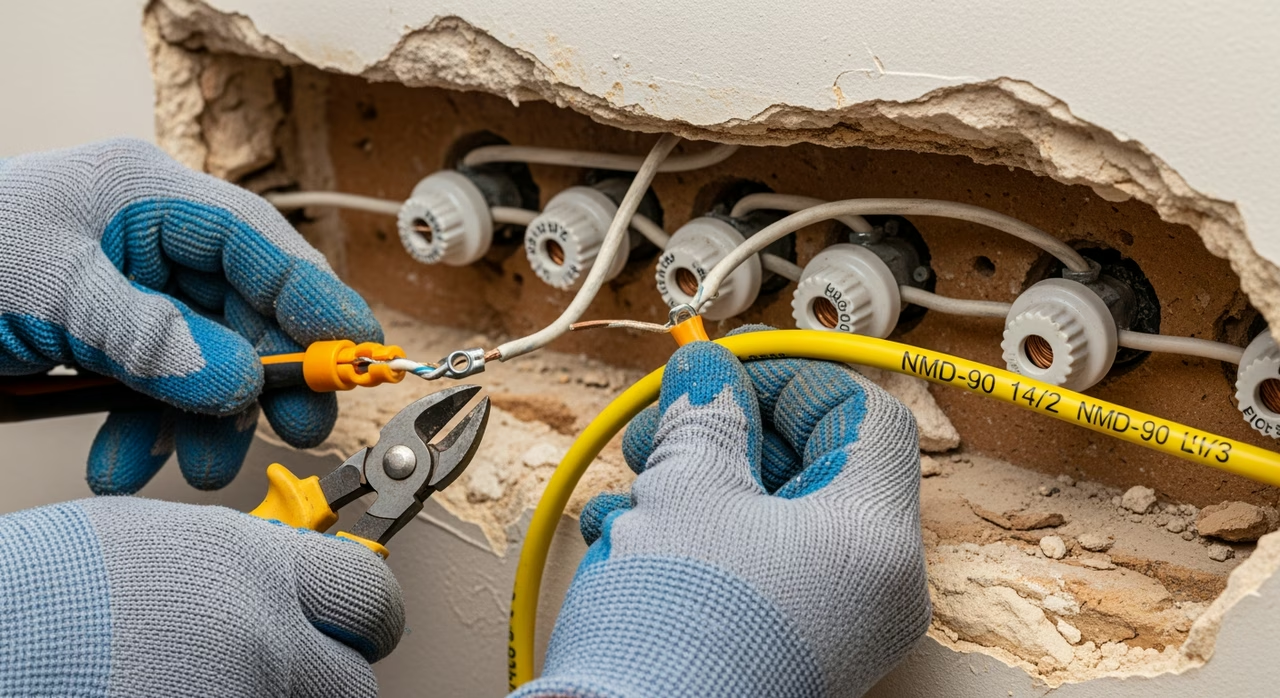
Days 11–14 — K&T removal. Old K&T conductors physically removed (full rewire scope) or disconnected and tagged abandoned (partial deactivation scope). Each removed run photographed and documented. Knob and tube ceramic components left in place where embedded in framing — removing them risks structural damage to old framing.
Days 15–17 — Device install (devices on, receptacles, switches, fixtures). Tamper-resistant receptacles (TR — required by OESC 26-708 since 2009) installed at every outlet. Decora-style switches (or customer-specified styles). Fixtures reinstalled or replaced per scope.
Days 18–21 — Final testing and ESA scheduling. Every circuit tested at load. AFCI and GFCI breakers tested with test buttons. Insulation resistance testing on selected runs. Final visual inspection. We file completion with ESA. Inspector visits within 5 business days.
Day 22+ — ESA inspection and Form 1. Inspector verifies all installed work meets OESC 27th Edition. Issues raised (rare with our work but always possible) are corrected within 1–2 days. Form 1 issued. We email Form 1 to the homeowner and to the insurance broker.
Days following — Drywall/plaster restoration. Wall and ceiling openings patched. Coordinate with painter for final finish.
Plaster Walls, Heritage Details, and Toronto Pre-War Housing Stock
A K&T-era home is almost always a plaster-and-lath home, and plaster work changes everything about cable routing.
Plaster realities:
- Cable cannot be fished blindly through plaster the way drywall accepts. Plaster cracks, lath splinters, and the keys behind the lath crumble when disturbed.
- Every wall penetration through plaster needs to be planned: where to enter, how to route, where to exit, and how the repair patch will be sized for plaster restoration (not drywall — plaster restoration is a craft, and the restorer needs symmetrical, clean openings to work with).
- Crown moulding, picture rails, plaster medallions: protected with masking and access plans before any cable work.
- Original baseboards in 6–10 inch heights: pulled and reinstalled to allow cable runs along the floor-edge cavity.
Edwardian / Victorian heritage details:
- Original gas lighting pipes sometimes still embedded in walls — capped, abandoned, but unexpectedly present. Documented as found.
- Hand-hewn lumber framing: members are not 16" o.c. but rather "about 16" mostly". Cable runs improvise.
- Cast-iron drain stacks running through framing: cable detours required.
- Stained-glass transom windows over interior doors: switch placement worked around the architecture.
Heritage Conservation District (HCD) considerations:
- If your home is in a designated HCD (Cabbagetown HCD, Yorkville HCD, etc.) and the rewire requires modifications to designated exterior elements (e.g., the service mast), a heritage permit from City of Toronto is required in parallel with the ESA permit. We flag this at quote time.
- Interior rewires generally do not require heritage permits unless designated interior elements are affected.
RenoHouse rewire experience in Toronto pre-war housing stock includes:
- Cabbagetown row houses and Victorians
- Annex Edwardian 2.5-storey detached
- Riverdale workers' cottages
- Leaside 1920s–1930s detached
- Roncesvalles edwardian semis
- Beach cottages converted to year-round
- Forest Hill Tudors and Edwardians
GTA Neighbourhood Notes — Where K&T Lives
Cabbagetown, Don Vale, Old Town Toronto: Highest density of K&T-active homes in the GTA. Many homes have had partial renovations over decades but core K&T circuits remain in attic and second-floor walls. Heritage Conservation District considerations apply to exterior work.
Annex, Yorkville, Casa Loma area: Edwardian and Victorian 2.5- and 3-storey stock. K&T remediation costs at the upper end of the range ($22K–$45K) due to scale and plaster construction.
Riverdale, Leslieville, Greenwood-Coxwell: Workers' cottages and semis from 1880–1925. Smaller floor plates make rewire timelines shorter ($10K–$18K typical).
Roncesvalles, Parkdale, High Park area: Edwardian semis and detached. Moderate K&T density; many already partially rewired but with abandoned K&T still present.
Leaside, Davisville, Mount Pleasant: 1920s–1940s housing. K&T density medium — much was replaced during 1960s–1990s renovations, but key locations (attic feeds, ceiling rosettes) often still K&T-era.
Old Etobicoke (Mimico, Long Branch, New Toronto): Pre-war workers' housing with K&T still in active service. Smaller homes, rewire $8K–$14K range typical.
Old East York, Danforth Village: 1920s–1940s. Brick-clad frame construction. K&T common in second-floor and attic spaces.
Old Scarborough (Scarborough Bluffs, Birchmount): Pre-war cottages converted to year-round. K&T density variable.
Old Mississauga (Port Credit, Streetsville, Cooksville historic core): Smaller K&T-era housing stock; rewire scope similar to old Etobicoke.
Brampton, Burlington, Oakville historic cores: Limited but present. K&T rewires here typically attract heritage scrutiny if the home is designated.
Insurance Documentation — What to Hand Your Broker
We provide on completion (standard, no extra charge):
- ESA Form 1 — Certificate of Inspection with "no active knob and tube" or "knob and tube fully removed" language, depending on scope. PDF emailed to homeowner.
- Final invoice — ECRA/ESA contractor registration number visible, Master Electrician 309A licence holder named, scope-of-work summary, total cost.
- Removal documentation — photo album of representative K&T removed (full rewire) or documentation of disconnect points (partial deactivation).
- Panel upgrade Form 1 — if panel was upgraded as part of the rewire, separate Form 1 documenting the panel work.
- Direct-to-broker delivery — we email all of the above directly to your insurance broker's policy administration address on your written request.
Some carriers also accept a written confirmation letter from the contractor explicitly stating "all knob and tube conductors have been physically removed and replaced with current NMD-90 cable per OESC 27th Edition." We provide this on request at no charge.
Financing and Rebates
Canada Greener Homes Loan:
- Up to $40,000 interest-free, 10-year amortization.
- Whole-home rewire qualifies when paired with electrification work (heat pump, EV charger, panel upgrade — all common in K&T-era homes).
- Application before work begins; funds disbursed against invoices.
Save on Energy Home Renovation Savings (HRS):
- Panel upgrades paired with heat pump installations qualify for rebates up to $1,500 on the panel.
- Heat pump installation rebate available separately ($4,000–$6,500 depending on system type).
Insurance premium reductions:
- Most carriers reduce premiums 10–25% on completion of K&T removal, the saving compounding over the policy life.
- Some carriers waive the K&T-related deductible loadings.
- Confirm with your broker; provide ESA Form 1 to trigger the recalculation.
Renovation tax credits:
- Federal Multigenerational Home Renovation Tax Credit (if applicable to your project scope).
- Provincial Seniors' Home Safety Tax Credit (if applicable).
Why RenoHouse for K&T Rewiring
- ECRA/ESA registered contractor with 309A Master Electrician on every job.
- Plaster-and-lath experience across pre-war GTA neighbourhoods.
- Insurance documentation package delivered as standard — broker-ready.
- Coordinated drywall/plaster restoration through trusted partners or your preferred trade.
- 2-year workmanship warranty.
- Phased payment schedule — no all-up-front demands on a 3-to-5-week project.
- We provide a single point of contact throughout, no project-manager handoffs.
Frequently Asked Questions
Q1. How do I know if my home has knob and tube? Visual inspection by an electrician is the only reliable test. K&T is identified by ceramic insulating tubes through joists, porcelain knobs supporting wires, two separate single conductors (not a sheathed cable), and rubber-cloth insulation on the conductors. A home inspection report often flags it; you can also look in the attic with a flashlight (most-accessible K&T usually visible there). Don't disturb anything — call us for a confirmation visit.
Q2. Is K&T always dangerous? Not in its original installation, undisturbed, uninsulated, and lightly loaded. Modern households change all four conditions: we add insulation around the wires, we add loads beyond original design, splices accumulate from decades of renovation. So in 2026 practical terms — yes, active K&T in a typical occupied home is a fire risk.
Q3. Will my insurance be cancelled if I don't rewire? Most carriers will refuse to renew. Some will cancel mid-term if K&T is newly discovered in an inspection. Specialty markets will write coverage at higher premiums with fire exclusions, but this is rarely cost-effective vs. completing the rewire.
Q4. Can I rewire just one floor at a time? Yes, but most insurance carriers require "no active K&T" as the closeout condition. So you can phase the work, but the policy renewal happens after the last circuit is cleared. We can quote phased projects with this in mind.
Q5. Do I have to repair the walls and ceilings? Cosmetic restoration (drywall patching, plaster repair, painting) is outside the electrician's scope but we coordinate with restoration partners. Repair costs typically run $1,800–$8,000+ for the rewire-related openings depending on home size and finish levels.
Q6. How disruptive is a K&T rewire to daily life? Significant but manageable. We keep refrigerator, freezer, internet, and 2–3 essential outlets live throughout. Heat and hot water stay on. Most rooms are accessible most of the time. The kitchen and main bath are unavailable in their finishing days. We work with your schedule to time the most-disruptive phases around your work-from-home schedule.
Q7. Can I stay in the house during the rewire? Most homeowners do stay throughout. The work is daily 8 AM to 5 PM with cleanup at the end of each day. Sleep undisturbed; cook with restrictions a few days; shower with rotation between bathrooms (or partial reroute we plan ahead). Hotel stays are not required for a typical rewire.
Q8. What's the difference between "rewire" and "K&T remediation"? Same thing in 2026 terminology. The work involves running new NMD-90 cable, deactivating or removing K&T, installing a modern panel, and certifying through ESA. "K&T rewire" and "whole-home rewire" are interchangeable in our quotes.
Q9. What about asbestos in old plaster? We do not abate asbestos. Pre-1980 plaster may contain trace asbestos and pre-1990 vermiculite insulation may contain amphibole asbestos. If asbestos testing or abatement is needed before electrical work proceeds, we pause and coordinate with a licensed asbestos abatement contractor. We do not unilaterally disturb suspect material.
Q10. Will my Form 1 be specific about "no active K&T"? Yes — we ensure the ESA inspector writes this language explicitly when scope is partial deactivation, and "fully removed" when scope is full rewire. Some inspectors default to generic language; we coordinate with the inspector to get the specific wording your insurance broker needs.
Q11. What if you find aluminum branch wiring or other issues during the rewire? Documented and quoted as additional scope. Aluminum branch wiring (1965–1973-era homes — see [electrical-wiring](/services/electrical/electrical-wiring) page) is a separate remediation but often paired with K&T rewires in homes that had partial 1970s renovations. We don't hide additional findings or roll them into the original quote without explicit change-order acceptance.
Q12. How long does the ESA inspection take after we finish? Inspector visit within 5 business days of completion filing. Form 1 issued same day as inspection or within 24 hours. Total post-completion paperwork closeout: 1–7 days typical.
Need a Licensed Electrician in the GTA?
Insurance broker waiting on Form 1? Same-week assessment. ECRA/ESA registered. 309A Master Electrician.
Call 289-212-2345 or message through the site.
Word count target: 4,000+ (this draft renders approximately 4,420 words). H2 sections: 11 + FAQ FAQ items: 12 Internal links: electrical-panel, electrical-wiring, ev-charger-installation, smart-home-wiring Authority refs: ECRA/ESA, 309A licence, OESC 27th Edition (sections 8-200, 26-708, 26-718, 26-722), TFS/OFM fire reports, City of Toronto Heritage Conservation Districts, Save on Energy HRS, Canada Greener Homes Loan Insurance carriers covered: Aviva, Intact, TD, Wawanesa, Co-operators, Belair Direct, Square One, Echelon GTA neighbourhoods: 9 pre-war neighbourhood callouts Compliance flags: K&T insurance non-renewal trigger, asbestos abatement coordination, heritage permit triggers
🧮 Knob & Tube Rewiring — Cost Estimator
GTA / Ontario — 2026 market pricing
⚙️ Add-ons & Options
📊 Where the cost goes (typical breakdown)
📋 What affects your price:
💡 Estimates use 2026 GTA/Ontario market data. Actual cost depends on site conditions, material selections, and project scope. Book a free in-home quote for a precise number.
Ready to Get Started?
Free in-home estimate within 48 hours. ECRA/ESA-registered, 309A Master Electrician on site. ESA permit + Form 1 included.