RenoHouse

# Asbestos Abatement Toronto 2026: Complete Guide
Quick answer. If your Toronto home was built before 1990 and you are planning any renovation that disturbs walls, ceilings, floors, insulation, or pipe coverings, Ontario law requires a Designated Substance Survey (DSS) before work begins. This is not a contractor preference.If your Toronto home was built before 1990 and you are planning any renovation that disturbs walls, ceilings, floors, insulation, or pipe coverings, Ontario law requires a Designated Substance Survey (DSS) before work begins. This is not a contractor preference. It is Ontario Regulation 278/05 under the Occupational Health and Safety Act, and it applies whether you hire a general contractor or take on the project yourself with a Toronto building permit.
This RenoHouse pillar guide explains the full Toronto asbestos abatement landscape for 2026: which homes are affected, where asbestos hides, what a DSS costs, what Type 1, Type 2, and Type 3 abatement work actually involves, realistic CAD pricing, and how to sequence abatement so your kitchen, bathroom, or basement renovation can proceed on schedule.
A note on our role. RenoHouse is a project coordination firm. We are not a licensed asbestos abatement contractor. We coordinate the DSS, manage the timeline, refer to HCRA-licensed Type 1, 2, and 3 abatement specialists (such as Pinchin, EHS Partnerships, Talon, and Restorx Disaster Restoration), and oversee the post-clearance air monitoring step before construction begins. This honest division of labour is the standard professional model in Ontario, and it is how the larger renovation firms in Toronto handle pre-1990 homes.Why Reg 278/05 Exists and Who It Applies To
Asbestos was used widely in Canadian residential construction from the 1930s through the mid-1980s. Chrysotile (white asbestos) and amosite (brown asbestos) were added to dozens of common building materials because the fibres resist heat, sound, and chemical degradation. Health Canada and the Occupational Cancer Research Centre confirm that asbestos fibres become a respiratory hazard only when the material is disturbed and fibres become airborne — which is precisely what happens during demolition, drilling, sawing, scraping, sanding, or removal.
Ontario Regulation 278/05 is the Designated Substances Regulation for construction projects involving asbestos. The regulation requires:
- A DSS (Designated Substance Survey) of any building before construction, alteration, repair, or demolition.
- Worker notification when asbestos work will be performed (WSIB Form 2156 / Ministry of Labour notification for Type 3 work).
- Type classification (Type 1, 2, or 3) based on the material and quantity being disturbed.
- Clearance air sampling after Type 3 work before re-occupancy.
The regulation applies to any "workplace" — and an Ontario homeowner becomes the constructor of a workplace the moment they hire a contractor. Even if you do the work yourself under a Toronto permit, the regulation still applies to anyone you hire (electrician, plumber, drywaller). DIY-only work without any hired trades is a narrower exemption, but you assume all health and disposal liability personally.
The Pre-1990 Toronto Reality
A meaningful share of Toronto's housing stock predates 1990: East York, the Beaches, High Park, Leaside, the Junction, Riverdale, parts of North York, and most of the older Scarborough and Etobicoke neighbourhoods are dominated by homes built between the 1920s and the 1980s. The conservative professional rule is "assume asbestos until tested otherwise" for any home built before 1990 — and in particular for materials installed between 1950 and 1985.
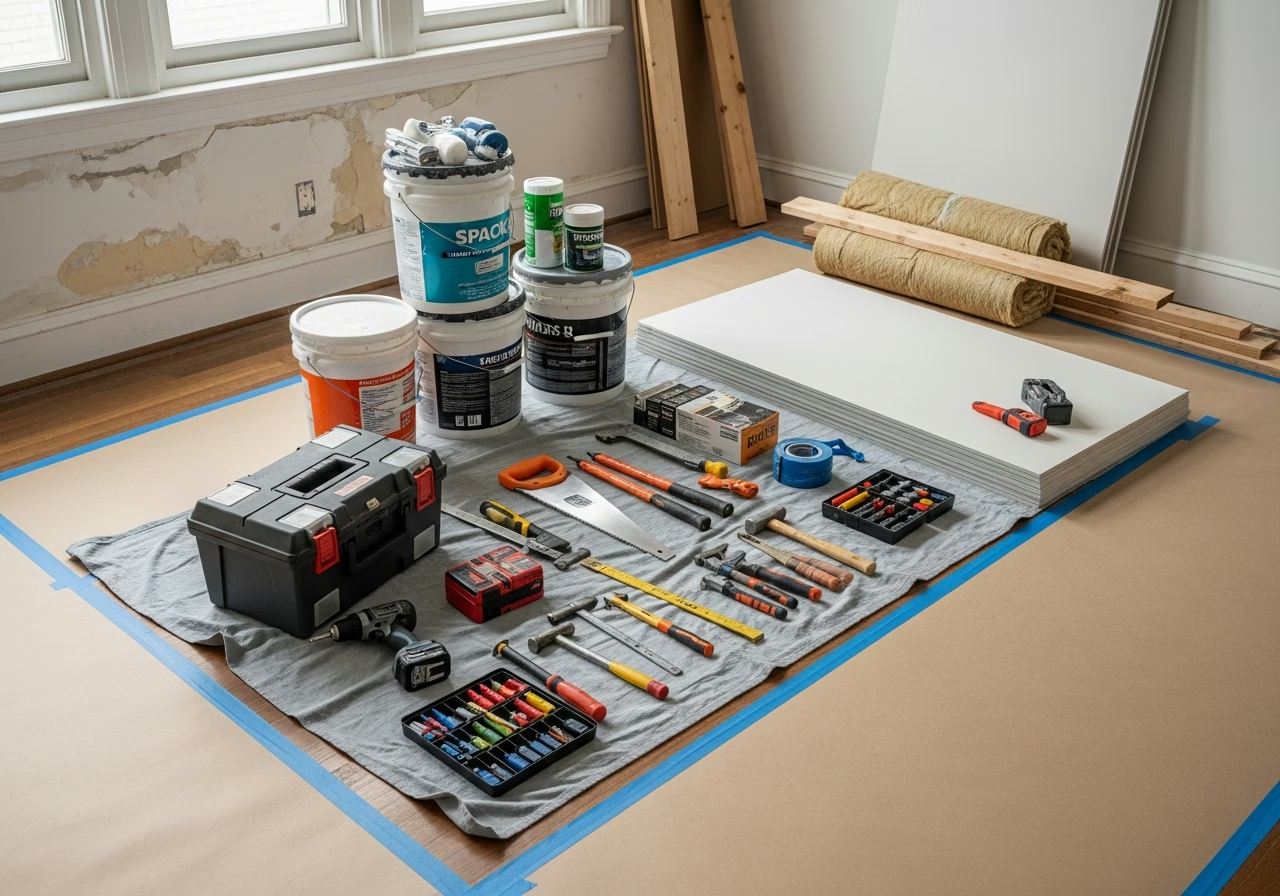
Asbestos use in Canadian residential materials was banned at different points:
- Spray-applied asbestos: banned in 1973 (Canada-wide).
- Asbestos in popcorn ceilings: phased out by 1985 in Canadian residential applications.
- Asbestos in vermiculite attic insulation (Zonolite/ZAI): Libby, Montana mine closed in 1990. Material distributed in Toronto into the early 1990s.
- Asbestos in vinyl floor tiles and mastic: declined sharply after 1980 but persisted in some product lines into the early 1990s.
- Comprehensive Canadian asbestos ban: 2018 (with limited exemptions).
Material installed before these dates is not automatically asbestos-containing — but laboratory testing is the only way to confirm.
Where Asbestos Hides in Toronto Homes
The DSS surveys we coordinate consistently flag the same materials. The most common asbestos-containing materials (ACMs) in pre-1990 Toronto homes:
- Vermiculite attic insulation (loose, pebble-like, gold-grey) — see Vermiculite Attic Insulation Asbestos Toronto.
- Popcorn ceiling texture (acoustic spray) — see Popcorn Ceiling Asbestos Removal Toronto.
- 9"x9" vinyl floor tiles and mastic adhesive — see Asbestos Floor Tile Removal 9x9 Toronto.
- Drywall joint compound (mud) in homes finished 1950s–1980s — see Asbestos Drywall Joint Compound Toronto.
- Pipe insulation wrap on hot-water and steam pipes (corrugated paper, white plaster jacket) — see Asbestos Vinyl Pipe Wrap Removal Toronto.
- Boiler and furnace insulation jackets.
- Transite siding and cement-board sheets (exterior cladding, soffits, some interior fire walls).
- HVAC duct tape and tape-on-fibreboard duct.
- Plaster textured finishes in some pre-1960 Toronto homes.
- Linoleum sheet flooring backing (jute and asbestos paper backings pre-1980).
- Roofing felts and shingle backings in some pre-1980 applications.
A standard residential DSS for a Toronto detached or semi-detached home samples 6 to 18 different materials. The lab analysis (Polarized Light Microscopy, PLM, or Transmission Electron Microscopy, TEM) confirms which contain regulated levels of asbestos (greater than 0.5 percent by weight under Ontario's threshold).
DSS: The Designated Substance Survey
A DSS is the document that drives every downstream decision. It is performed by an environmental consultant (commonly Pinchin, EHS Partnerships, Talon Environmental, or smaller Toronto-based firms). The deliverable is a written report that lists every suspect material, the sampling method, the laboratory results, the locations on a building plan, and the recommended abatement approach.
For a typical Toronto home renovation, a DSS includes:
- Site visit and visual inspection of the planned work area.
- Collection of bulk samples (10–25 samples is typical for a single-floor reno; 25–60 for a whole-home gut).
- Lab analysis (PLM is standard, TEM for low-percentage drywall mud).
- Written report with sample locations, results, and abatement recommendations.
- Letter of clearance for materials that test negative.
For full DSS coverage, see DSS Designated Substance Survey Toronto. For test pricing and provider comparison, see Asbestos Testing Toronto: Cost & Where.
Type 1, Type 2, and Type 3 Abatement Explained
Ontario Reg 278/05 classifies asbestos work into three categories based on risk and required controls. The classification determines worker training, containment, and notification requirements.
Need professional home renovation?
Call RenoHouse at 289-212-2345 or get a free estimate today.
Get Free Estimate →For full breakdown, see Type 1 vs Type 2 vs Type 3 Asbestos Toronto.
Realistic 2026 Toronto Asbestos Abatement Costs
Pricing varies by material, location, accessibility, and contractor. Industry-typical 2026 ranges:
- DSS only (testing and report): $400 to $1,200 for a single-family home; $1,500 to $3,000 for a whole-home gut sample set.
- Type 1 minor work: $300 to $1,500 (single tile, single drilled penetration, small patch).
- Type 2 vinyl floor tile and mastic, single room (12'x12'): $1,800 to $4,500.
- Type 2 pipe insulation (linear foot): $35 to $90 per linear foot.
- Type 3 popcorn ceiling, single room (12'x12'): $1,800 to $3,500.
- Type 3 popcorn ceiling, whole bungalow (1,200 sqft): $7,500 to $14,000.
- Type 3 vermiculite attic removal (1,000 sqft): $8,000 to $18,000 (varies with fill depth).
- Type 3 drywall mud, whole-home gut: $12,000 to $25,000+.
- Air clearance sampling (post-Type 3): $400 to $900 per clearance event.
- WSIB Form 2156 notification, abatement contractor: typically included in quote.
Full per-material breakdown in Asbestos Abatement Cost Toronto Comparison.
Sequencing Abatement Inside a Renovation Project
The single biggest source of renovation delay we see in pre-1990 Toronto homes is failure to sequence abatement correctly. The correct sequence:
- 1. Pre-design DSS — schedule the DSS before architectural drawings are finalized so the abatement scope is known.
- 2. Bid abatement separately — the abatement contractor is a specialist; do not wrap their cost into a general contractor markup if it can be avoided.
- 3. Notification and scheduling — Type 3 work requires 24-hour Ministry of Labour notice and WSIB notification.
- 4. Containment setup — typically 1 day for a single-room project, 2–3 days for whole-home gut.
- 5. Abatement work — typically 1–5 days depending on scope.
- 6. Air clearance — 24-hour wait for lab results before construction trades enter.
- 7. Construction begins — kitchen, bathroom, basement, or whole-home reno proceeds on a clean slate.
The full pre-renovation checklist is in Asbestos Renovation Checklist Toronto. For specific air monitoring requirements, see Air Monitoring & Clearance Asbestos Toronto.
Common Mistakes Toronto Homeowners Make
We see the same five mistakes repeatedly. They cost time, money, and in the worst cases trigger Ministry of Labour stop-work orders:
- 1. Skipping the DSS because "the house looks renovated already."
- 2. Hiring a general contractor who self-attests the materials are clean.
- 3. DIY popcorn ceiling scraping before testing the texture.
- 4. Disturbing vermiculite in the attic when running new electrical or HVAC.
- 5. Removing 9"x9" floor tiles during a basement reno without testing the mastic adhesive.
The full list is in Asbestos Renovation Mistakes Toronto.
Homeowner Disturbance vs Hiring a Contractor
Ontario law treats DIY homeowner work and hired-trade work differently. A homeowner can legally disturb asbestos in their own home, but the moment a paid worker enters the site, Reg 278/05 applies in full. The practical consequence is that anyone planning to hire any trade — including for the post-abatement renovation — must complete the DSS first. Full breakdown in Homeowner vs Contractor Asbestos Removal Toronto.
Toronto Neighbourhoods With the Highest Pre-1990 Stock
Based on Toronto building permit data and assessment records, the neighbourhoods with the highest density of pre-1990 housing stock — and therefore the highest concentration of likely asbestos-containing materials — include:
- East York — heavy 1940s–1960s post-war stock, vermiculite common in attics.
- The Beaches — pre-war Edwardian and post-war infill, popcorn ceilings common in 1960s–1980s upgrades.
- High Park / Roncesvalles — pre-war stock with extensive 1970s renovation; drywall mud and pipe insulation common.
- Leaside — 1930s–1950s detached homes; vermiculite, plaster, drywall mud all flagged.
- The Junction — workers' cottages from 1900s–1940s; pipe insulation, transite siding, plaster.
- Riverdale — pre-war semi-detached with multiple renovation layers; expect mixed-era materials.
- North York (older sections) — 1950s–1980s bungalows; vermiculite, popcorn ceilings, vinyl tile.
- Scarborough Bluffs and East Scarborough — 1950s–1970s bungalows and split-levels with high vermiculite incidence.
If you live in any of these neighbourhoods and your home is pre-1990, plan for a DSS before any meaningful renovation.
Disposal: Where Toronto Asbestos Waste Legally Goes
Asbestos waste in Toronto must be:
- Double-bagged in 6-mil polyethylene with the asbestos warning label.
- Sealed and labelled at the work site.
- Transported by a licensed asbestos waste carrier.
- Disposed of at a Ministry-approved Class II landfill — for the GTA, this typically means the Brock West landfill in Pickering or the Green Lane Landfill near St. Thomas.
The abatement contractor's quote should include disposal manifest documentation. Keep the manifest on file for at least 5 years.
Insurance and WSIB Considerations
Type 3 abatement contractors must carry:
- WSIB clearance (current).
- Commercial General Liability of at least $2 million (often $5 million for larger firms).
- Pollution / Environmental Liability coverage (this is the key differentiator — many general contractors do not carry it).
- Type 3 worker certification documentation.
When you receive an abatement quote, request a copy of the WSIB clearance certificate, the General Liability declaration, and the Pollution Liability declaration. Reputable Toronto firms (Pinchin, EHS Partnerships, Talon, Restorx) provide these as part of their standard package.
Why RenoHouse Coordinates and Does Not Self-Perform
We are explicit with every client: RenoHouse does not hold a Type 3 abatement license, and we do not employ Type 3 certified workers. Our role on a pre-1990 Toronto renovation is:
- Schedule the DSS with one of our partner consultants.
- Translate the DSS report into an abatement scope for the homeowner.
- Solicit competitive quotes from at least two HCRA-licensed abatement contractors.
- Coordinate the schedule so abatement, air clearance, and renovation trades sequence cleanly.
- Verify the post-clearance air sample before our renovation crew enters.
- Manage the renovation that follows once the home is cleared.
This division of work reflects how the better renovation firms in Toronto operate. It keeps each part of the project in the hands of a specialist and keeps liability clearly assigned. If a renovation contractor offers to "take care of the asbestos" without naming a licensed sub-contractor and without producing a DSS, that is a warning sign.
Frequently Asked Questions
Do I need a DSS for a small bathroom renovation?
If the home is pre-1990 and a paid trade (plumber, electrician, drywaller) will disturb walls, ceilings, or floors, the DSS is required. A simple fixture swap with no demolition does not trigger the requirement.
Can I just test the materials I am disturbing?
Yes. A targeted test (3 to 6 samples of just the materials in your renovation scope) is a legitimate alternative to a full DSS for small projects. It is cheaper ($300–$600) but it does not protect you against discovering additional ACMs mid-project.
How long does a typical Type 3 popcorn ceiling abatement take?
For a single Toronto bungalow main floor (about 800 square feet of ceiling), the work is typically 2 to 3 days for setup, removal, and final HEPA cleaning, plus 1 day for the air clearance result.
Will the abatement contractor patch and finish the surface?
No. Abatement work ends with the material removed and the substrate cleaned. Drywall, plaster, paint, and finish work is the renovation contractor's scope. This is one of the reasons coordination matters.
Is asbestos in my home an emergency?
Almost never. Asbestos fibres become a hazard only when the material is disturbed. Intact popcorn ceiling, intact vinyl tile, undisturbed vermiculite — none of these pose a respiratory hazard until you start renovating. The decision to abate is driven by your renovation plan, not by the simple presence of the material.
Ready to Plan a Pre-1990 Toronto Renovation?
RenoHouse coordinates DSS surveys and licensed abatement work as the first phase of every renovation in pre-1990 Toronto homes. We manage the survey, broker the abatement quote, oversee air clearance, and run the renovation that follows. Visit our Asbestos Abatement Service Page to start.
Sources & References
Authoritative sources cited in this guide:
- Ontario Building Code — OBC official text
- Toronto Building Permits — City permit portal
- Tarion New Home Warranty — Ontario new-build warranty regulator
- HCRA — Home Construction Regulatory Authority — Ontario builder/vendor licensing
Continue Reading