RenoHouse

# Asbestos Drywall Joint Compound Toronto: 2026 Guide
Quick answer. Drywall joint compound — the "mud" used to tape and finish drywall seams, corners, and screw heads — was a routine asbestos-containing material in Canadian residential construction from the 1950s through the late 1970s. Asbestos was added to mud as a fibre reinforcement that improved sandability and reduced cracking.Drywall joint compound — the "mud" used to tape and finish drywall seams, corners, and screw heads — was a routine asbestos-containing material in Canadian residential construction from the 1950s through the late 1970s. Asbestos was added to mud as a fibre reinforcement that improved sandability and reduced cracking. The percentage was typically low (0.5 to 5 percent), which is why drywall mud is often missed by standard PLM-only testing and why TEM analysis is the professional standard for this material.
This guide explains the risk, why testing matters even at low percentages, Type 3 implications during whole-home gut renovations, and realistic 2026 Toronto abatement costs. For broader context, see Asbestos Abatement Toronto 2026: Complete Guide.
Where the Mud Sits
Drywall joint compound is invisible once the wall is painted. It sits:
- At every taped seam between drywall sheets.
- At every inside and outside corner.
- Over every drywall screw head.
- Sometimes as a full skim coat across an entire wall (for textured finishes or imperfect drywall).
A typical Toronto bungalow has 200 to 600 linear feet of taped seams plus several thousand screw-head spots. A whole-home gut renovation that demolishes plaster or drywall will inevitably disturb mud throughout the home.
Why TEM Testing Matters
PLM (Polarized Light Microscopy) is the standard lab method for bulk asbestos analysis. It is reliable for materials with greater than 1 percent asbestos. But Reg 278/05 sets the regulated threshold at 0.5 percent by weight — and drywall mud commonly tests in the 0.5 to 1.5 percent range. PLM alone can return a "trace" or "less than 1 percent" result that is in fact above the regulated threshold.
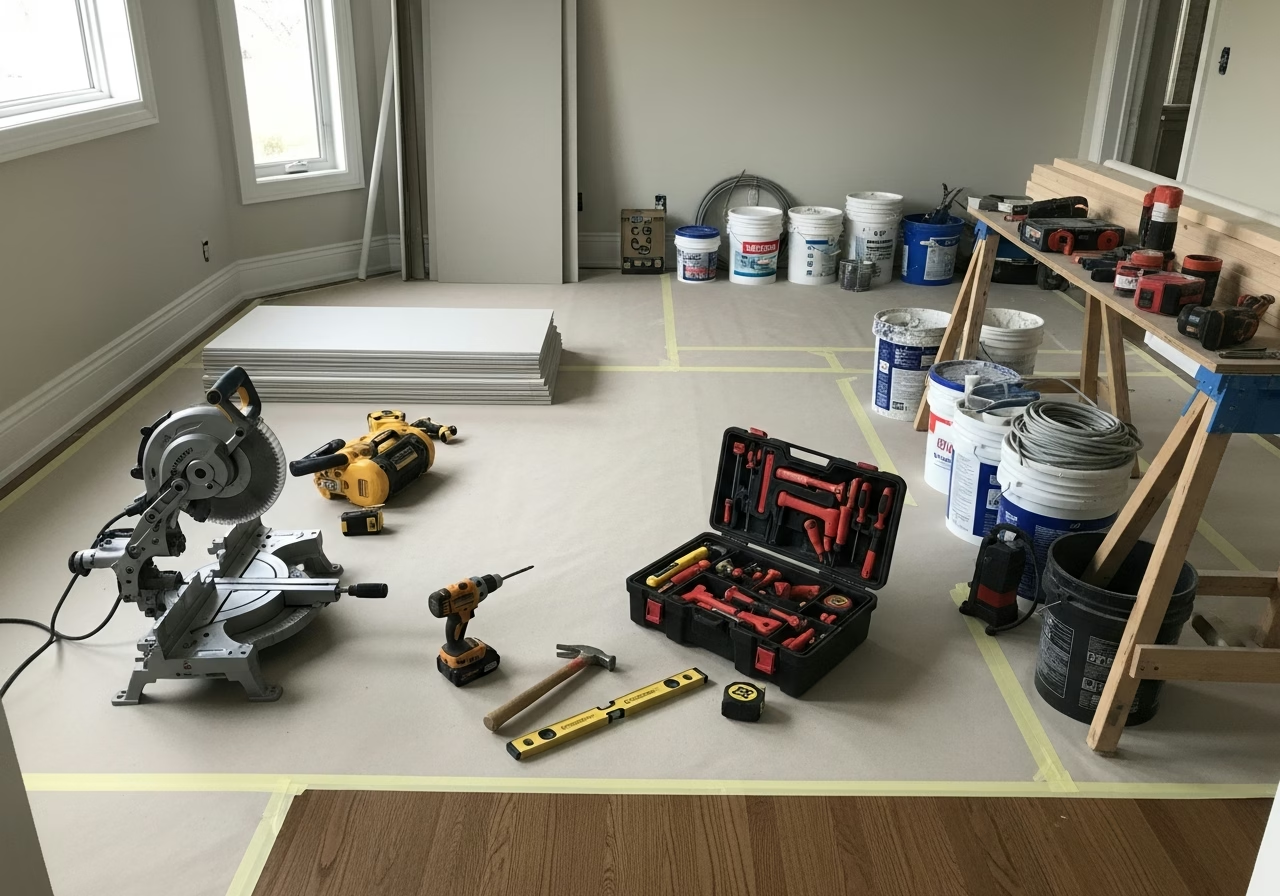
TEM (Transmission Electron Microscopy) provides quantitative results down to 0.1 percent and is the appropriate method for drywall mud confirmation. Reputable Toronto consulting firms (Pinchin, EHS Partnerships, Talon) automatically run TEM on mud samples that PLM returns as "trace" or low-percentage.
When you receive a DSS report, check that the mud samples were analyzed by TEM if PLM was inconclusive. If the report shows only PLM with a "trace" result on mud, request TEM follow-up.
Need professional home renovation?
Call RenoHouse at 289-212-2345 or get a free estimate today.
Get Free Estimate →When Drywall Mud Triggers Type 3
Most renovation projects do not trigger full Type 3 mud abatement because the mud is intact and confined to wall seams that will not be disturbed. Type 3 becomes relevant when:
- Whole-home gut renovation — every wall is being demolished. Volume of disturbance is high; airborne fibre potential is substantial.
- Plaster removal — older Toronto homes have plaster walls; removing plaster exposes the underlying lath and any taped seams.
- Major wall removal — opening up multiple walls during a kitchen or basement reno.
- Sanding for refinishing — aggressive wall sanding to remove old wallpaper or texture is essentially mud disturbance.
Smaller scopes — patching a single hole, hanging a TV bracket, opening a wall for plumbing — are typically Type 1 work.
2026 Toronto Cost Implications
Drywall mud abatement is rarely a standalone job. It is bundled into a broader scope:
- Type 1 patch work (single hole, single bracket): $300 to $800.
- Type 2 wall opening (one room, multiple walls): $1,500 to $4,000.
- Type 3 whole-home gut, drywall mud disturbance included: $12,000 to $25,000+ as the abatement line item on a whole-home reno.
- TEM testing surcharge: $40 to $90 per sample.
The Type 3 whole-home figure is the line that surprises homeowners. A $200,000 gut renovation in a pre-1980 Toronto home can carry $15,000 to $25,000 of mud abatement on top of any specific material removal (popcorn ceiling, vermiculite, floor tile). This is why DSS-first sequencing matters — knowing the mud result before architectural drawings are finalized lets the homeowner adjust scope to keep walls or absorb the cost in the budget.
How Type 3 Mud Abatement Differs
Mud abatement during a whole-home gut is not a separate scope so much as a containment-and-method protocol applied to the demolition itself:
- 1. Whole-home negative-air containment — full containment at the front door, decontamination chamber, HEPA-filtered air machines run continuously.
- 2. Wet demolition — drywall is wetted before removal. Sheets come down intact where possible.
- 3. No dry sanding — the rule throughout. Any sanding is wet-sanding with HEPA capture.
- 4. Bagged disposal — drywall and plaster waste is double-bagged and labelled as ACM.
- 5. HEPA cleaning — at end of demolition, full HEPA vacuum and wet wipe of every framing member, subfloor, and remaining surface.
- 6. Air clearance — third-party air sampling before construction trades enter.
The construction trades (framers, electricians, plumbers, drywallers) enter only after clearance.
Plaster vs Drywall
Many pre-1960 Toronto homes have plaster walls, not drywall. Plaster itself sometimes contains asbestos (in the textured finish coat), but the underlying lath and the body coats typically do not. The DSS will sample the plaster.
When plaster is removed during renovation:
- Lath-and-plaster removal is Type 2 or Type 3 depending on volume.
- Wet demolition is the standard.
- Disposal weight is significant — plaster is much heavier than drywall.
DIY Risk
A homeowner sanding wallpaper, scraping texture, or opening walls without testing is the most common drywall-mud disturbance event we encounter. The mud release is invisible — you cannot see fibres in the sanding dust, and the dust spreads through HVAC systems quickly.
If you have a pre-1980 Toronto home and you are about to refinish walls, test before sanding.
Selective Approaches
In a partial renovation where the whole-home gut is not budgeted, selective approaches reduce mud abatement scope:
- Keep existing walls and renovate around them. Only walls that are demolished need mud abatement.
- Skim coat over existing walls with a fresh, asbestos-free mud layer. Skim coating is a Type 1 activity if done with HEPA tools.
- Build a stud wall in front of the existing wall. This is unusual but appropriate for select cases.
A good renovation plan, informed by the DSS result early, shapes the scope around the abatement reality rather than the other way around.
Related Reading
Type 1 vs Type 2 vs Type 3 Asbestos Toronto, Asbestos Testing Toronto: Cost & Where, Asbestos Renovation Checklist Toronto.Planning a Whole-Home Toronto Gut?
RenoHouse coordinates the DSS, the TEM-confirmed mud results, the abatement scope, and the renovation that follows. Visit our Asbestos Abatement Service Page to start.
Sources & References
Authoritative sources cited in this guide:
- Ontario Building Code — OBC official text
- Toronto Building Permits — City permit portal
- Tarion New Home Warranty — Ontario new-build warranty regulator
- HCRA — Home Construction Regulatory Authority — Ontario builder/vendor licensing
Continue Reading