RenoHouse

# Basement Apartment Legalization Toronto: 2026 Code, Egress, Ceiling Height, Fire Separation
Quick answer. In virtually every Toronto multiplex conversion, one of the units is the basement. Legalizing a basement apartment is a discipline of its own — Ontario Building Code (OBC) ceiling height, egress window dimensions, fire-separation assemblies between the basement and upper units, dampproofing, and a compliant separate entry all have to align.In virtually every Toronto multiplex conversion, one of the units is the basement. Legalizing a basement apartment is a discipline of its own — Ontario Building Code (OBC) ceiling height, egress window dimensions, fire-separation assemblies between the basement and upper units, dampproofing, and a compliant separate entry all have to align. This guide gives you the full code-and-cost playbook for 2026 Toronto basement legalization, with realistic ranges for each scope and the underpinning vs bench-footing decision.
For the broader context of why basement units matter in Toronto's multiplex economy, see the pillar guide Multiplex Conversion Toronto: Complete 2026 Guide.
Why Basement Units Matter Economically
A legal basement apartment in Toronto rents for $1,500-$2,200/month in mid-suburb neighbourhoods and $2,000-$2,800/month in inner-core areas (Trinity-Bellwoods, Leslieville, Roncesvalles). The cost to legalize a basement (assuming the existing space is not far from compliant) is $60K-$140K — yielding payback periods of 3-6 years on rent alone. In a fourplex conversion, the basement unit is typically the lowest-cost-per-square-foot to develop of the four units because:
- The foundation already exists.
- The exterior walls already exist.
- The roof load is already absorbed by the upper structure.
- The only "new" structural work is interior partitions and possibly underpinning.
This is why the basement unit drives strong marginal returns in any Toronto duplex, triplex, or fourplex conversion.
OBC Ceiling Height: The Single Biggest Gating Item
The Ontario Building Code (OBC) Section 9 sets minimum ceiling heights for habitable basement units:
- 2.05 m (6'-9") in living rooms, dining rooms, kitchens, and bedrooms.
- 1.95 m (6'-5") under beams, ducts, and bulkheads (these can drop below the 2.05 m clearance over up to 50% of the room area in some configurations, but the local Toronto building examiner has discretion).
- 2.0 m (6'-7") in bathrooms, hallways, and stairs.
Toronto's housing stock has three typical basement scenarios:
| Existing Ceiling Height | Compliance Status | Required Action | Typical Cost |
|---|---|---|---|
| 7'-9" or greater | Compliant as-is | None | $0 |
| 7'-3" to 7'-9" | Marginal; depends on beam locations | Soffit relocation, possible bench-footing | $5K-$25K |
| 6'-9" to 7'-3" | Non-compliant in most rooms | Bench-footing or shallow underpinning | $35K-$80K |
| 6'-3" to 6'-9" | Non-compliant throughout | Full underpinning | $50K-$120K |
| Under 6'-3" | Severely non-compliant | Deep underpinning + structural intervention | $90K-$180K |
Underpinning vs Bench-Footing
These are the two methods of lowering a basement floor:
Underpinning. The existing foundation is excavated below in 3-4 ft sections (alternating to maintain structural support), new concrete piers are poured to a deeper elevation, and the original wall is then supported on the new deeper foundation. The basement floor is poured at the new lower elevation, gaining 12-24 inches of headroom. Cost: $50K-$120K for a 1,000 sq ft basement footprint. Engineer-stamped design required. Permit required. Bench-Footing. Easier and cheaper, but reduces interior floor area. The existing foundation stays in place; instead, an interior "bench" of concrete is poured along the perimeter at the original footing elevation, and the new floor is poured at a lower elevation in the centre of the room. The bench typically takes 18-30 inches off each wall. Cost: $35K-$70K. Engineer-stamped design also required.Bench-footing is faster (4-6 weeks vs 8-12 for underpinning) and cheaper but loses 30-50 sq ft of usable floor area in a typical Toronto bungalow basement. Most investors choose underpinning when the goal is a market-rate 1BR or 2BR rental unit; bench-footing when the basement is a smaller studio.
Egress Windows: The Mandatory Bedroom Requirement
Every legal basement bedroom in Toronto must have an egress window. OBC requirements:
- Unobstructed opening of at least 0.35 m² (3.77 sq ft).
- Minimum dimension of 380 mm (15") in any direction of the unobstructed opening.
- Sill height no more than 1.5 m (4'-11") above the finished floor.
- Window must open from inside without keys, tools, or special knowledge (typically casement or sliding sash that can be operated by a child or elderly tenant).
- Window well drainage required if the sill is below grade — connected to weeping tile or daylight via French drain.
- Window well minimum dimensions: 760 mm (30") of clear ventilation space outward from the opening, with a step or ladder if the well is more than 1.1 m (3'-7") deep.
Cost to install a code-compliant egress window in an existing basement:
- Cutting through poured concrete foundation: $4K-$8K including engineering review for opening size relative to wall thickness.
- Window unit + frame + flashing: $1.5K-$4K depending on size and quality.
- Excavation + window well + drainage: $2K-$5K.
- Total per egress window: $7.5K-$17K typical.
If the basement unit has two bedrooms, each bedroom needs its own egress window. Most fourplex basement units in Toronto are configured as 1BR to minimize this cost; 2BR units add $7.5K-$17K for the second window.
Need professional renovation?
Call RenoHouse at 289-212-2345 or get a free estimate today.
Get Free Estimate →Fire Separation Between Basement and Upper Units
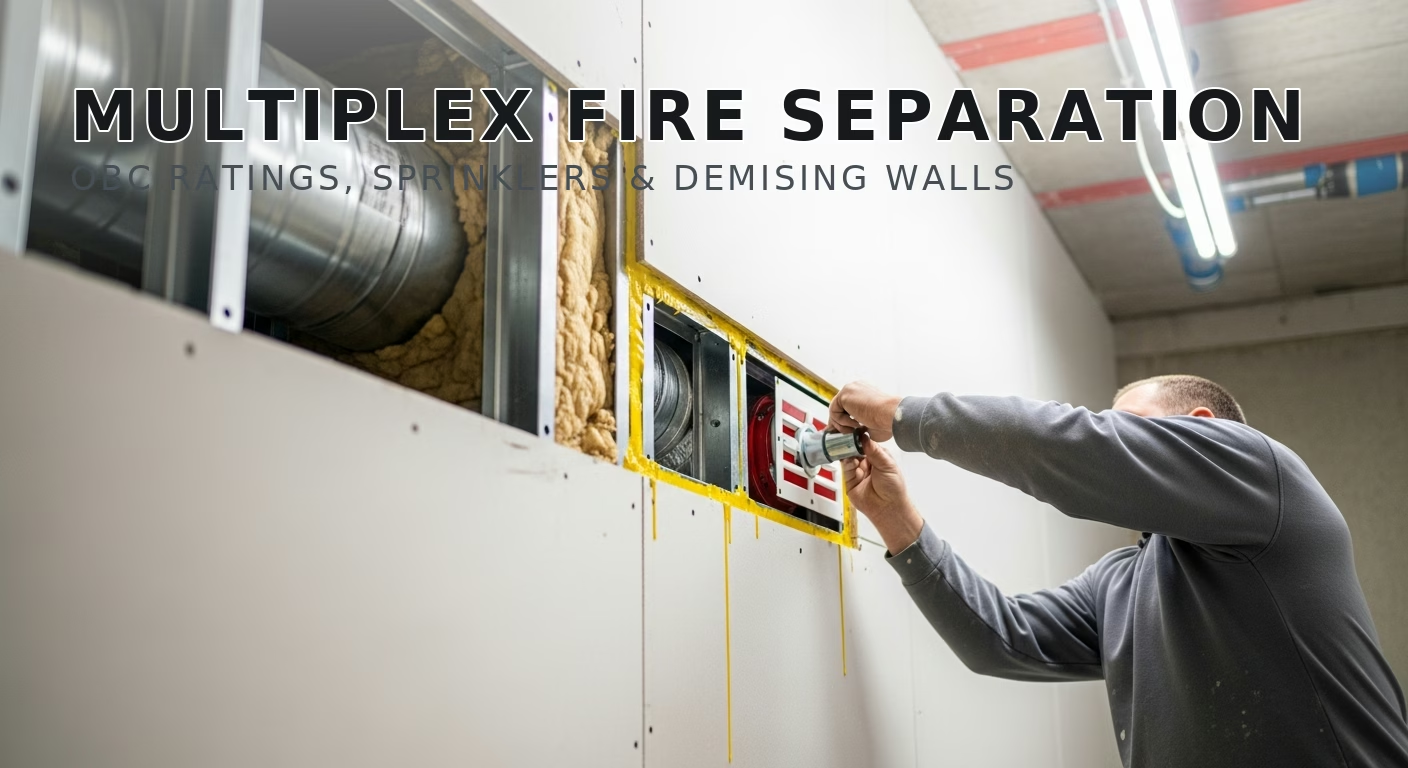
The OBC requires a 45-minute fire-resistance rating between the basement unit and the unit(s) above. The standard assembly:
- Existing wood joist floor structure remains.
- Underside of joists: 5/8" Type X drywall fastened directly to joists, fully taped and finished.
- Mineral wool batt insulation (Roxul Safe'n'Sound or equivalent) between joists, full depth — this addresses both fire performance and acoustic transmission.
- Subfloor and finished flooring above in the upper unit.
Where ductwork or plumbing penetrates the assembly, firestop sealant (3M FireDam, STI SpecSeal, or equivalent) is required at every penetration. Where ductwork has openings into both the basement and upper unit, fire dampers (typically 1.5-hour rated, mechanically actuated) are required.
Cost to install full fire-separation assembly under a 1,000 sq ft basement:
- Drywall + tape + finish: $3-$5/sq ft = $3K-$5K.
- Insulation: $2-$3.50/sq ft = $2K-$3.5K.
- Firestop + fire dampers: $1K-$3K.
- Self-closing fire-rated doors at unit entry: $800-$2,000.
- Total: $7K-$13.5K for a typical basement unit's worth of fire separation.
For full multi-unit fire-separation detail, see Multiplex Fire Separation OBC Toronto.
Separate Entry: A Hard Requirement
A legal basement apartment in Toronto must have a separate entry that does not require passing through the upper unit's living space. Acceptable configurations:
- 1. Side walk-out — most common in Toronto bungalows. New stairwell excavated alongside the foundation, finished with retaining walls, drainage, and an exterior door at grade. Cost: $12K-$30K including permit, excavation, structural lintels above the new door, and finishing.
- 2. Rear walk-out — common in bungalows where the rear yard slopes down. Often less expensive than a side entry if grade naturally falls away from the house. Cost: $8K-$22K.
- 3. Front separate entry — a separate door at the front of the building, typically into a small foyer that descends to the basement unit. Cost: $5K-$15K (less excavation but more facade alteration).
- 4. Shared lobby/vestibule — the front door opens into a small fire-rated vestibule with stairs going up to the main unit and stairs going down to the basement. Permitted under OBC if the vestibule is a fire-rated space serving only the entries. Cost: $4K-$12K.
The 4th option (shared vestibule) is technically allowed but in practice most Toronto building examiners prefer Options 1-3 because they create a cleaner unit separation and reduce common-area complexity.
Dampproofing & Moisture Management
Older Toronto basements (pre-1970) frequently have inadequate dampproofing. The OBC and Toronto Building Code require:
- Damp-proof membrane behind interior finishes on any below-grade wall.
- Sub-slab vapour barrier (6-mil polyethylene minimum) under the basement floor slab.
- Functional weeping tile at the base of foundation walls, draining to a sump pump or storm sewer.
- Sump pump in the basement for any below-grade unit.
If the existing basement has signs of efflorescence, mould, or active water entry, remediation is required before unit conversion. Common fixes:
- Interior weeping tile + sump retrofit: $5K-$12K.
- Exterior waterproofing membrane (involves excavating along foundation): $15K-$35K per side.
- Crystalline waterproofing application to interior walls: $3K-$8K.
- Mould remediation (for any visible growth): $2K-$15K depending on extent.
Plumbing & HVAC for the Basement Unit
A basement apartment needs:
- Kitchen rough-in (sink, dishwasher line, range, fridge water) — $4K-$8K added cost.
- Bathroom rough-in (toilet, sink, tub or shower) — $5K-$9K.
- Drain system that ties into the existing main drain. If the main drain is above the basement floor (common in older homes), an ejector pump is needed for the bathroom and kitchen — adds $3K-$6K.
- Separate HVAC zone or mini-split to allow tenant-controlled comfort and (potentially) separate utility metering — $4K-$10K.
- Separate hot water tank (40-gallon electric or tankless): $2K-$4K.
The Permits
A basement apartment legalization requires:
- Building Permit (BP): typically $1.5K-$4K in fees for a basement-only scope; $5K-$15K if part of a fourplex conversion.
- ESA (Electrical Safety Authority) Permit + Inspection: $400-$1,200.
- Plumbing Trade Permit: $400-$1,200.
- HVAC Permit: $300-$800.
Toronto Building Services typically reviews basement legalization permits in 6-10 weeks. The City of Toronto also offers a Second Suite Approval Program for owner-occupied homes, which can streamline the application for single basement apartments in single-family contexts. Multi-unit (fourplex) basement legalizations go through standard multiplex review.
Cost Summary: Total Basement Legalization
For a typical 1,000 sq ft basement being converted into a 1BR unit:
| Item | Cost Range |
|---|---|
| Underpinning (if needed) | $50,000-$120,000 |
| Egress window(s) | $7,500-$17,000 |
| Fire separation assembly | $7,000-$13,500 |
| Separate side entry | $12,000-$30,000 |
| Dampproofing remediation (if needed) | $5,000-$25,000 |
| Plumbing + drain + ejector pump | $10,000-$20,000 |
| HVAC + hot water | $6,000-$14,000 |
| Kitchen | $12,000-$22,000 |
| Bathroom | $9,000-$15,000 |
| Flooring + paint + finishes | $10,000-$20,000 |
| Permits | $3,000-$8,000 |
| Contingency 10-15% | $13,000-$30,000 |
| Total | $144K-$334K |
| Mid-range | ~$210K |
If the basement already has compliant ceiling height (no underpinning), the all-in cost drops to $80K-$180K — making basement legalization the highest-ROI single component of any multiplex conversion.
Rooming House Distinction (Important)
A multiplex with four self-contained units is NOT a rooming house, and is NOT subject to Toronto's rooming-house licensing regime. The distinction:
- Self-contained dwelling unit = unit has its own kitchen, bathroom, and exclusive living space; tenant is on a residential tenancy.
- Rooming house = tenants share kitchen and/or bathroom with non-family members; each room is rented separately; landlord requires a Toronto Rooming House Licence.
In a multiplex, every unit (basement included) must be self-contained — full kitchen, full bathroom, dedicated entrance, no shared facilities. This is why a fourplex conversion ALWAYS includes four full kitchens and four full bathrooms; cutting corners by sharing a kitchen between the basement and main floor crosses into rooming-house territory and triggers different (more onerous) licensing.
Owner-Occupied Path (Tax Credit)
If you intend to occupy the main unit and rent only the basement (creating a duplex rather than a fourplex), and the basement unit is for a senior or disabled relative, you may qualify for the Multigenerational Home Renovation Tax Credit (MHRTC) — a 15% refundable federal credit on up to $50K of eligible expenses, capped at $7,500. Conditions:
- The unit must be a self-contained secondary unit within or attached to the existing home.
- It must be occupied by a senior (65+) or disabled relative.
- Detached structures (garden suites, laneway houses) do NOT qualify, but basement apartments in the principal residence DO.
For garden-suite and laneway alternatives, see Garden Suite Toronto and [Laneway House Toronto](/blog/laneway-house-construction-toronto-2026-complete-guide).
Common Pitfalls
- 1. Skipping the underpinning calculation. A 6'-3" basement is NOT legalizable without floor lowering, regardless of how good the rest of the build is.
- 2. Egress window with non-compliant well dimensions. A 30"×30" well is fine for a 30"×24" window; a 24"×24" well is non-compliant. Excavate the well to spec from the start.
- 3. Routing the basement entry through the upper unit's foyer. Not allowed; basement unit must have an entry that does not pass through the upper unit's exclusive space.
- 4. Forgetting the ejector pump. Older Toronto homes have main sewer drains above the basement floor. Without an ejector pump, the basement bathroom cannot connect.
- 5. Insulating only the rim joists. OBC requires basement walls to be insulated to current SB-12 standards: typically 2-inch spray foam OR 2x4 wall with R-22 batt + vapour barrier OR equivalent assembly. Half-measures fail energy compliance review.
- 6. Treating the basement as a rec room and "renting it out without a permit." Unauthorized rentals are not legal apartments. Insurance companies deny claims on undeclared rentals; tenants can withhold rent under the RTA; municipal property standards bylaw can result in stop-work orders.
Why Legalize: The Insurance and Liability Story
Beyond the rental income, legalizing a basement matters for:
- Insurance. Most Toronto homeowner policies exclude losses arising from undeclared rental units. A fire, flood, or tenant injury in an unpermitted unit can result in full denial of claim — including the loss of the main home structure.
- Resale. A legal multi-unit dwelling lists at $80K-$200K higher than the same building with unpermitted units, because financed buyers cannot mortgage based on illegal rental income.
- Refinance. Banks will not include rent from unpermitted units in debt-service calculations.
- Tenant rights. Tenants in unpermitted units still have full RTA protection; landlords have all the obligations and none of the legal income.
Get a Basement Assessment
RenoHouse offers a free basement legalization assessment for any Toronto property: ceiling height measurement, foundation inspection, dampproofing review, separate-entry feasibility, and a budget estimate for full legalization. Book your assessment.
Related Reading
- Pillar: Multiplex Conversion Toronto: Complete 2026 Guide.
- Cost: Multiplex Conversion Cost Toronto: Full 2026 Breakdown.
- Decision: Duplex vs Triplex vs Fourplex Toronto.
- Code: Multiplex Fire Separation OBC Toronto.
- ROI: Multiplex Conversion Rental Income & ROI Toronto.
- Cross-niche: Garden Suite Toronto, Laneway House Toronto.
Sources & References
Authoritative sources cited in this guide:
- Toronto Multiplex Bylaw 474-2023 — Toronto multiplex regulations
- Bill 23 — More Homes Built Faster Act — Provincial ARU enabling legislation
- CMHC MLI Select — Multi-unit financing program
Continue Reading