RenoHouse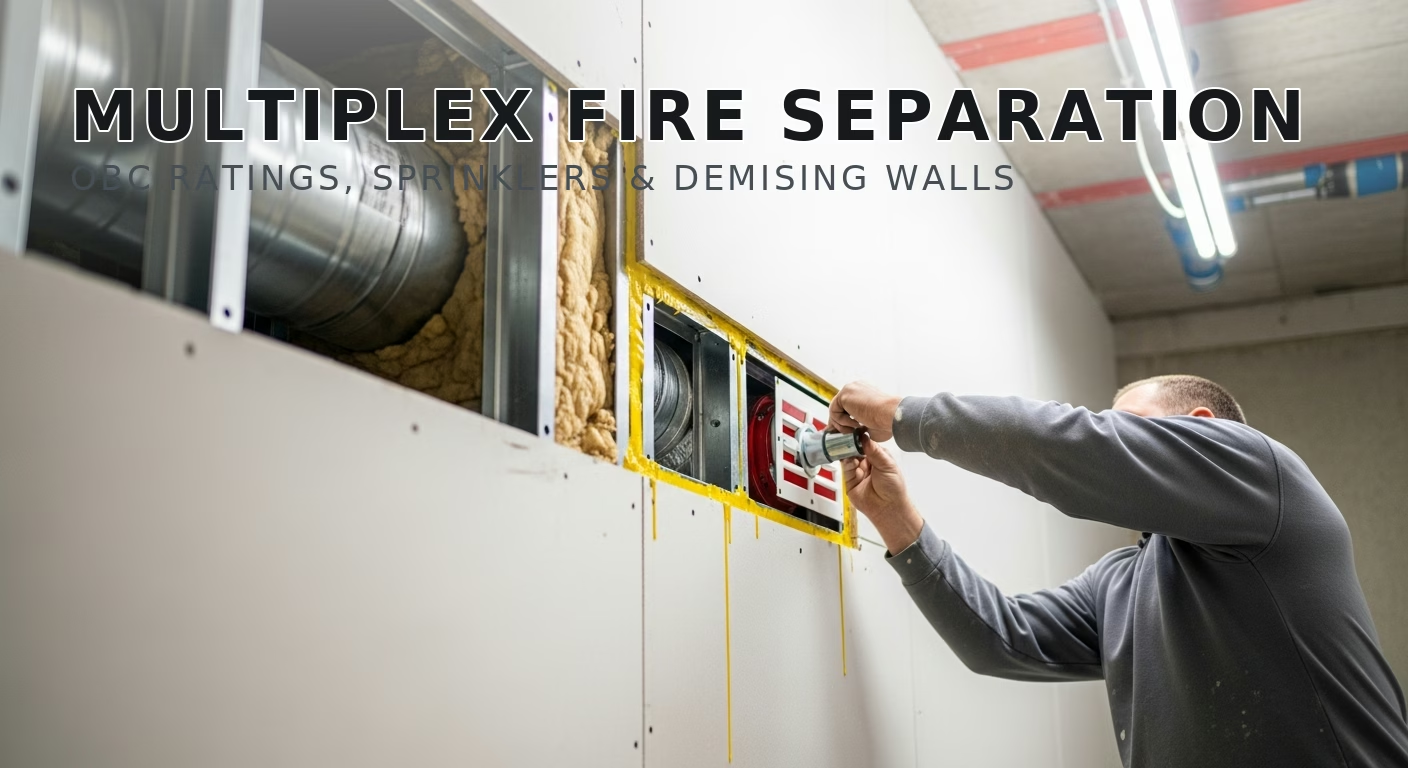

# Multiplex Fire Separation OBC Toronto: 45-Minute Ratings, Sprinklers, Demising Walls (2026)
Quick answer. The single most under-budgeted line item in a Toronto multiplex conversion is fire separation. The Ontario Building Code (OBC) requires a 45-minute fire-resistance rating between every dwelling unit and between dwelling units and common spaces, and the assemblies that achieve this rating require specific drywall types, insulation, and...The single most under-budgeted line item in a Toronto multiplex conversion is fire separation. The Ontario Building Code (OBC) requires a 45-minute fire-resistance rating between every dwelling unit and between dwelling units and common spaces, and the assemblies that achieve this rating require specific drywall types, insulation, and detailing. Get fire separation right and your building permit moves smoothly through review; get it wrong and you receive a Notice to Comply that adds 4-12 weeks of delay and tens of thousands of dollars in rework.
This guide gives you the full code-and-cost picture for fire separation in 2026 Toronto multiplex conversions: which OBC section applies (Section 9 vs Section 3), what 45-minute and 1-hour assemblies actually look like, when sprinklers (NFPA 13D) are required, fire dampers, and the building permit specifics. For broader context, see Multiplex Conversion Toronto: Complete 2026 Guide.
OBC Section 9 vs Section 3: Which Applies to Your Project
The first decision your designer makes is whether your multiplex falls under OBC Part 9 (Section 9 — Housing and Small Buildings) or OBC Part 3 (Section 3 — Larger Buildings and More Complex Buildings). The thresholds:
OBC Part 9 applies if ALL of the following are true:- Building is no more than three storeys above grade.
- Each storey is no more than 600 m² (6,460 sq ft).
- Total building area is no more than 600 m².
- The building is for residential use, business and personal services, mercantile, or low-hazard industrial occupancies.
For virtually all Toronto multiplex conversions of single-family bungalows or 2-storey detached homes, the building remains under Part 9. A typical 2,400 sq ft bungalow has roughly 100-110 m² per storey — well under the 600 m² threshold. Section 9 multiplex conversions are simpler, cheaper, and do not typically require sprinklers.
For new-build fourplexes with three full storeys above grade and floor plates over 600 m², or for buildings exceeding three storeys, Part 3 applies and the fire-protection requirements escalate substantially — including mandatory NFPA 13D residential sprinklers, more stringent stair enclosure ratings, and often a sprinklered standpipe system.
The 45-Minute Fire-Resistance Rating: What It Actually Means
A "45-minute fire-resistance rating" means an assembly that, when tested per CAN/ULC-S101 (Fire Endurance Tests of Building Construction and Materials), prevents the spread of fire and the transmission of heat for 45 minutes. The rating is achieved by specific assemblies that have been pre-tested and listed in the OBC tables (typically Table A-9.10.3.1.A) or in the Underwriters Laboratories of Canada (ULC) directory.
For a multiplex conversion, the OBC Section 9 minimum is 45-minute fire separation between every dwelling unit and 30-minute fire separation around stair enclosures (where the stair serves only one unit) or 45-minute (where the stair is a shared common stair).
In practice, most Toronto designers specify 45-minute throughout because:
- The cost difference between 30-minute and 45-minute assemblies is small.
- Building examiners prefer consistent ratings.
- Insurance underwriters view 45-minute assemblies more favourably.
The Standard 45-Minute Floor/Ceiling Assembly
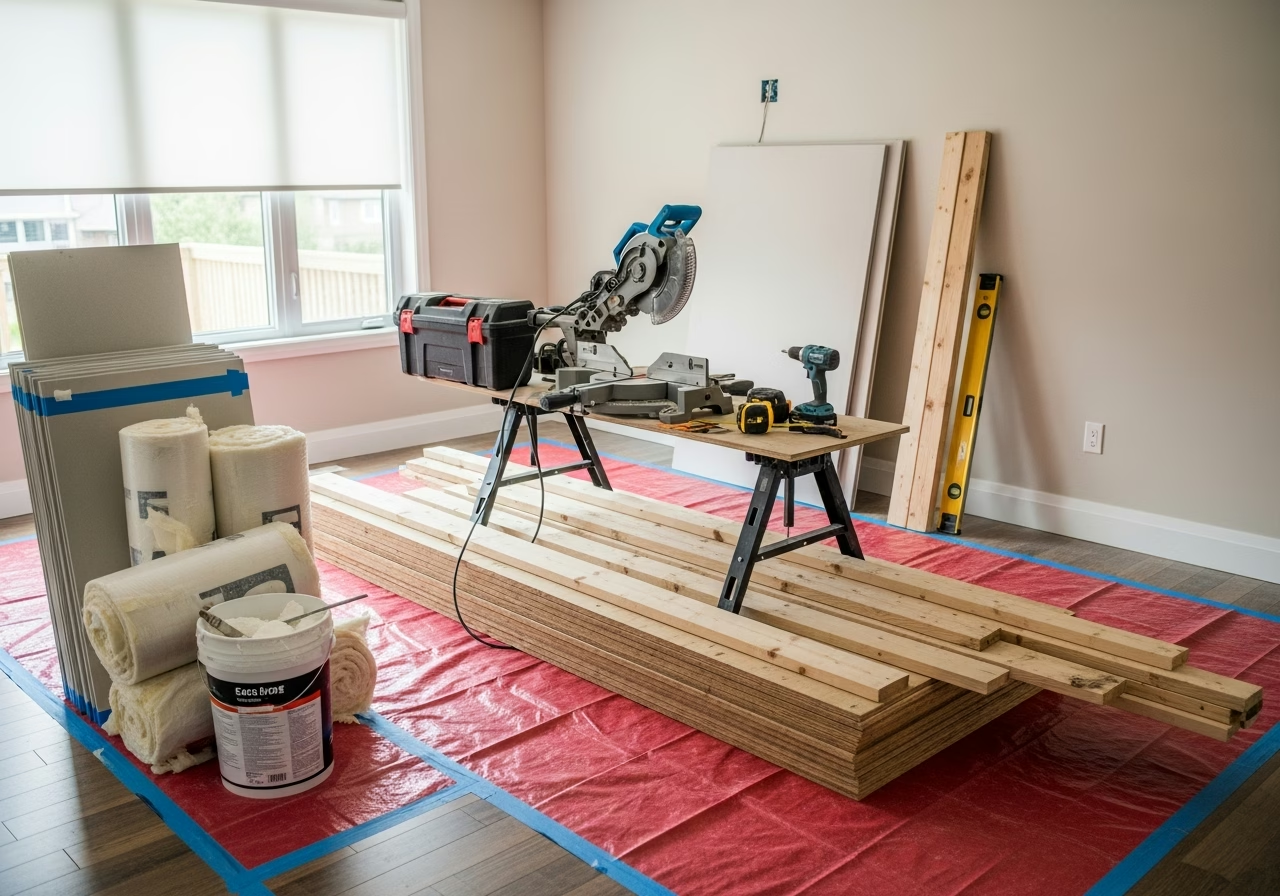
The most common Toronto multiplex floor/ceiling assembly between units (e.g., basement and main, or main and second-floor units):
Top of assembly (upper unit floor):- 1. Finished flooring (LVP, hardwood, or tile)
- 2. Underlayment if applicable
- 3. 5/8" T&G plywood subfloor (or 3/4" OSB)
- 4. Existing 2x10 wood joists @ 16" o.c.
- 5. Mineral wool batt insulation (Roxul Safe'n'Sound or equivalent), full depth, friction-fit between joists. Provides ~3+ STC acoustic improvement and contributes to fire performance.
- 6. Resilient channel (RC-1 or RC-2) screwed to underside of joists at 16" o.c. perpendicular to joist direction. The resilient channel decouples the drywall from the joists and is critical for both fire and acoustic performance.
- 7. Single layer of 5/8" Type X gypsum board screwed to resilient channel, with all joints taped and mudded.
This assembly achieves the 45-minute rating per OBC Table A-9.10.3.1.A and provides STC ~52-55 (well above the OBC minimum of STC 50).
For a higher-spec 1-hour rating (sometimes specified for stair enclosures or in Part 3 applications), the assembly upgrades to double 5/8" Type X drywall with staggered joints — adding ~$2-$3 per sq ft to the ceiling cost.
The 45-Minute Demising Wall Assembly (Side-by-Side Units)
Where two units share a vertical demising wall (e.g., side-by-side townhouse-style configuration in a multiplex):
The standard double-stud demising wall:- 1. 5/8" Type X drywall (interior face of unit A)
- 2. 2x4 stud wall @ 16" o.c. (unit A side)
- 3. Mineral wool batt in cavity
- 4. 1" airspace separation (this is critical — both walls must be acoustically and structurally decoupled)
- 5. 2x4 stud wall @ 16" o.c. (unit B side)
- 6. Mineral wool batt in cavity
- 7. 5/8" Type X drywall (interior face of unit B)
This achieves 45-60 minute fire rating and STC 60+. For most Toronto bungalow conversions, side-by-side demising is rare; the more common configuration is stacked units (basement, main, second floor) using the floor/ceiling assembly described above.
Need professional renovation?
Call RenoHouse at 289-212-2345 or get a free estimate today.
Get Free Estimate →A simpler single-stud demising wall (5/8" Type X drywall both sides of a 2x6 stud wall with mineral wool insulation) achieves a 45-minute rating but only STC 45-48 — sometimes acceptable for code but generally rejected by quality-conscious builders because of acoustic transmission. Most professional multiplex projects spec the double-stud assembly even when not strictly required.
Penetrations: The Quiet Killer
A 45-minute assembly is only 45-minute if every penetration is properly firestopped. The OBC requires:
- Plumbing penetrations: firestop sealant (3M Fire Barrier 2000+, STI SpecSeal SSS, Hilti CP 606) packed around the pipe to maintain the assembly rating.
- Electrical penetrations: firestop putty pads (3M FPP) installed around outlet boxes and switch boxes that pass through the assembly.
- HVAC duct penetrations: fire dampers (typically 1.5-hour rated) installed in any duct that crosses a fire separation. Fire dampers are mechanically actuated devices that close automatically in a fire to prevent flame and smoke transmission.
- Pot light/recessed lighting penetrations: in 45-minute assemblies, recessed lights must be IC-rated and, where they penetrate the rated ceiling, covered with a UL-rated fire box (Tenmat FF130, Specified Technologies SLF) to maintain the rating.
- Plumbing vent stacks: firestop collar at every floor crossing.
A typical Toronto fourplex has 50-100 penetrations across all fire separations. Cost of proper firestopping: $1,500-$4,000 in materials + $2,000-$5,000 in labour = $3,500-$9,000 total. This is often missed in early budgets.
Fire-Rated Doors
Every doorway across a fire separation must have a fire-rated door assembly. The minimums:
- Door from a dwelling unit into a common stair or corridor: 20-minute self-closing fire-rated door with closer.
- Door from a stair enclosure into a corridor (Part 3 only): 45-minute self-closing fire-rated door.
- Door from a service room (mechanical, electrical) into a unit or common space: 45-minute self-closing fire-rated door.
Cost per fire-rated door: $600-$1,800 including closer hardware. A fourplex typically has 4-7 fire-rated doors. Total budget: $3,000-$10,000.
The door, frame, and hardware must all be labelled with a UL or Warnock Hersey fire rating tag. Building examiners check for these labels at final inspection — unlabelled doors are rejected even if the assembly looks compliant.
Sprinklers (NFPA 13D): When They Are Required
For Section 9 multiplex conversions of single-family homes (the typical Toronto bungalow fourplex), sprinklers are NOT required. This is one of the most-asked questions and one of the most-misunderstood answers.Sprinklers ARE required when:
- 1. The building exceeds Part 9 thresholds (over three storeys, over 600 m² per storey, etc.) — moving the project into Part 3 where NFPA 13 (commercial-grade) sprinklers are typically required.
- 2. The building is a "Group C residential" classification with three storeys above grade and over 6 dwelling units — moving into Part 3.
- 3. The building is in a Heritage Conservation District where the Heritage Permit conditions specifically require sprinklers to compensate for non-compliant elements.
- 4. The building examiner specifically requires sprinklers as a condition of permit (rare, but happens in marginal Part 9/Part 3 boundary cases).
For new-build three-storey fourplexes (which exceed the typical Toronto bungalow conversion in floor count), NFPA 13D residential sprinklers are typically required. NFPA 13D is the residential standard — less stringent than NFPA 13 (commercial) and significantly cheaper:
- NFPA 13D system cost: $4-$7 per sq ft of building floor area = $15K-$30K for a typical 3,000-4,000 sq ft fourplex.
- NFPA 13 system cost: $8-$15 per sq ft = $30K-$60K for the same building.
If sprinklers are required, water service from the street typically must be upgraded to a 1-1/2" or 2" supply (vs the standard 3/4" or 1" for residential), adding $5K-$15K in service upgrade fees.
Smoke Alarms and Carbon Monoxide Alarms
Independent of sprinklers, every multiplex must have:
- Hardwired interconnected smoke alarms in every bedroom, in every hallway serving a bedroom, and on every storey of each unit. When one alarm sounds in a unit, all alarms in that unit sound. Battery-only is NOT acceptable for legal multiplex units.
- Carbon monoxide (CO) alarms within 5 m of every bedroom in any unit served by fuel-burning appliances or that has an attached garage.
- A separate alarm system per unit — alarms in unit A do NOT need to interconnect with alarms in unit B; each unit is its own alarm zone.
Cost: $200-$400 per unit for hardwired smoke + CO alarms = $800-$1,600 per fourplex. Always installed by a licensed electrician under the ESA permit.
Separate Utilities: The Fire Code Implication
Each unit in a multiplex should have its own electrical sub-panel, and ideally its own gas service (if gas is present). Beyond the obvious benefit of tenant utility metering, separate utilities reduce fire risk because:
- A fault or fire in one unit's electrical system is contained to that unit's panel.
- Gas appliance failures or leaks affect only one unit's gas line.
- Mechanical room separation between units (where each unit has its own water heater and HVAC) reduces shared-equipment failure modes.
The Electrical Safety Authority (ESA) typically expects multiplex conversions to have:
- Either one main service with separately-metered sub-panels per unit, or
- Multiple separate Toronto Hydro services (one per unit; uncommon and costly).
The first option is standard. Cost: $4K-$8K for sub-panels, plus $3K-$8K for separate sub-meters that allow tenants to be billed separately for electricity.
Building Permit Specifics for Fire Separation
Your building permit application must include:
- Fire separation drawings showing the location of every rated assembly (floor/ceiling, demising wall, stair enclosure, mechanical room separation).
- Assembly schedules specifying the materials and ULC listing number for each assembly type.
- Penetration schedules identifying every plumbing, electrical, and HVAC penetration with the proposed firestop method.
- Door schedule with fire ratings for every fire-rated door (typically 20-minute or 45-minute).
- Smoke alarm and CO alarm layout showing locations and interconnection per unit.
- Sprinkler design (if applicable) per NFPA 13D or 13.
Toronto Building Services has a dedicated Fire Protection examiner who reviews these submissions. Typical review cycle: 6-10 weeks for a fourplex conversion. Fire Protection is one of three "specialized" reviews (along with Mechanical and Plumbing) that can extend the permit timeline if comments are returned.
Inspection Schedule
During construction, the Toronto Building inspector will visit at:
- 1. Framing/Pre-Drywall Inspection: all rated walls and floors are inspected before drywall is installed. The inspector checks insulation, resilient channel installation, and structural framing. Plan for this inspection at week 12-16 of construction.
- 2. Drywall Inspection: type X drywall installation is verified with proper screw spacing and joint detailing. Week 16-20.
- 3. Penetration / Firestop Inspection: every penetration is checked for proper firestop sealant, putty pads, or fire damper. Often combined with mechanical and plumbing inspections.
- 4. Final Fire Safety Inspection: smoke alarms tested, fire-rated doors verified with self-closing operation, fire-rated door labels present, sprinklers (if any) tested and certified.
Cost Summary: Fire Separation in a Typical Fourplex
| Item | Cost Range |
|---|---|
| Resilient channel + 5/8" Type X drywall on 2,000 sq ft of fire-separated ceiling | $10,000-$18,000 |
| Mineral wool insulation in floor cavities | $5,000-$10,000 |
| Demising walls (if any side-by-side configuration) | $4,000-$10,000 |
| Stair enclosure rated walls | $3,000-$6,000 |
| Fire-rated doors (4-7 doors) | $3,000-$10,000 |
| Firestop materials + labour | $3,500-$9,000 |
| Fire dampers (HVAC penetrations) | $1,500-$4,000 |
| Smoke + CO alarm package (4 units) | $800-$1,600 |
| NFPA 13D sprinklers (if required) | $0 OR $15,000-$30,000 |
| Engineer review + drawings | $2,000-$5,000 |
| Total (no sprinklers) | $32,800-$73,600 |
| Total (with sprinklers) | $47,800-$103,600 |
Most Toronto Section 9 fourplex conversions land in the $35K-$60K range for fire separation, all-in.
Common Pitfalls
- 1. Specifying regular 1/2" drywall instead of 5/8" Type X. Fails the rated assembly. Detected at framing inspection or final inspection — full demolition and replacement required.
- 2. Skipping the resilient channel. Without resilient channel, the assembly may not achieve a 45-minute rating per the listed assembly. Acoustic performance also drops 5-8 STC points.
- 3. Forgetting fire dampers in HVAC. Smoke spread between units; failed final inspection.
- 4. Using non-fire-rated doors. Even if the door looks substantial, only labelled doors qualify. Final inspection rejects unlabelled doors regardless of construction.
- 5. Penetrating a rated wall after drywall is up. Plumber adds a vent pipe through a 45-minute wall and just spray-foams the gap. Fails firestop inspection — must be opened up and properly firestopped.
- 6. Treating Part 3 as Part 9. A new-build three-storey fourplex on a tight Toronto lot may exceed Part 9 thresholds. Designing it as Part 9 and discovering at permit submission that Part 3 applies adds 8-16 weeks and $30K-$60K to redesign.
Why Fire Separation Matters Beyond Code
Code is the floor, not the ceiling. Reasons to over-build fire separation:
- Insurance. Insurers offer reduced premiums for buildings with documented fire-rated assemblies.
- Tenant retention. Acoustically isolated units (which fire-rated assemblies also achieve) have lower tenant turnover.
- Resale. Buildings with documented fire separation through a mortgage refinance or insurance audit appraise higher than buildings without.
- Liability. In the event of a fire, demonstrable code-plus assemblies are a significant defensive position.
Get a Fire Separation Plan
RenoHouse builds every Toronto multiplex conversion to OBC fire separation specifications, with engineer-reviewed assemblies, ULC-listed materials, and all required penetration firestopping. Book a consultation.
Related Reading
- Pillar: Multiplex Conversion Toronto: Complete 2026 Guide.
- Cost: Multiplex Conversion Cost Toronto: Full 2026 Breakdown.
- Decision: Duplex vs Triplex vs Fourplex Toronto.
- Basement: Basement Apartment Legalization Toronto.
- Permits: Multiplex Conversion Permits Toronto.
- Cross-niche: Garden Suite Toronto, [Laneway House Toronto](/blog/laneway-house-construction-toronto-2026-complete-guide).
Sources & References
Authoritative sources cited in this guide:
- Toronto Multiplex Bylaw 474-2023 — Toronto multiplex regulations
- Bill 23 — More Homes Built Faster Act — Provincial ARU enabling legislation
- CMHC MLI Select — Multi-unit financing program
Continue Reading