RenoHouse

# Multiplex Conversion Toronto: Complete 2026 Guide (Bill 23, As-of-Right Fourplex, Costs, ROI)
Quick answer. In 2026, Toronto homeowners can convert almost any single-family detached, semi-detached, or row house into a fully legal two, three, or four-unit multiplex without a zoning amendment, without a Committee of Adjustment hearing, and without a single parking space.In 2026, Toronto homeowners can convert almost any single-family detached, semi-detached, or row house into a fully legal two, three, or four-unit multiplex without a zoning amendment, without a Committee of Adjustment hearing, and without a single parking space. The combination of Provincial Bill 23 (More Homes Built Faster Act, 2022) and Toronto's own Multiplex Zoning By-law Amendment 474-2023 has rewritten the math of residential investment in Canada's largest city. A typical Scarborough or Etobicoke bungalow that traded as a single-family home for $1.05M-$1.35M in 2026 can be converted into a four-unit multiplex for an additional $400K-$700K in renovation cost, generating $8,000-$15,000 per month in gross rent and unlocking CMHC MLI Select financing at up to 95% loan-to-value with 50-year amortization.
This is the RenoHouse pillar guide for multiplex conversions in Toronto. We cover the full regulatory stack (Bill 23, By-law 474-2023, OBC Section 9 fire separation, ESA permits, plumbing trade permits), realistic CAD pricing across each scope tier, the conversion vs new-build decision, ROI math against single-family alternatives, and the financing playbook that sophisticated investors are using in 2026 to scale rental portfolios. If you are weighing a smaller-scale ADU first, see Garden Suite Toronto: Complete 2026 Guide and [Laneway House Construction Toronto: Complete 2026 Guide](/blog/laneway-house-construction-toronto-2026-complete-guide).
Why Multiplex Conversions Are Suddenly the Best Investment in Toronto
Three converging policy changes have transformed multiplex conversions from a regulatory grey area into the single most powerful residential investment vehicle in the GTA:
- 1. Provincial Bill 23 (Royal Assent November 28, 2022). Schedule 9 amended the Planning Act to require all Ontario municipalities to permit "as-of-right" up to three residential units per lot wherever municipal servicing exists. This locked in ARU permissions province-wide and barred future Council backsliding.
- 2. Toronto Multiplex Bylaw 474-2023 (May 10, 2023). Council went one further than the province and permitted up to four units as-of-right on every lot in the RD, RS, and RT zones, with built-form standards similar to detached houses and zero parking minimums.
- 3. Federal CMHC MLI Select expansion (2023-2026). CMHC's Multi-Unit Insurance Select program now offers up to 95% LTV financing, 50-year amortizations, and forgivable energy-efficiency grants of up to $85K per unit for 5+ unit residential rental properties — meaning a four-unit multiplex plus one garden or laneway suite hits the threshold.
The result: in May 2026, the BRRRR (Buy, Renovate, Rent, Refinance, Repeat) investor cohort that previously focused on basement apartments and duplex flips has shifted decisively toward four-unit conversions of well-positioned bungalows and two-storey detached homes in Scarborough, Etobicoke, North York, and the inner suburbs of the old City of Toronto.
What "Multiplex Conversion" Actually Means in Toronto
A multiplex is any residential building containing two, three, or four self-contained dwelling units under a single roof on a single legal lot. The key distinctions:
- Duplex — two units (typically up/down or front/back)
- Triplex — three units (typically main / second / basement, or three side-by-side stacks)
- Fourplex — four units (commonly basement + main + second + attic/loft, or two-up/two-down)
- 5+ units — no longer a "multiplex" under Toronto zoning; subject to Site Plan Control and treated as low-rise apartment
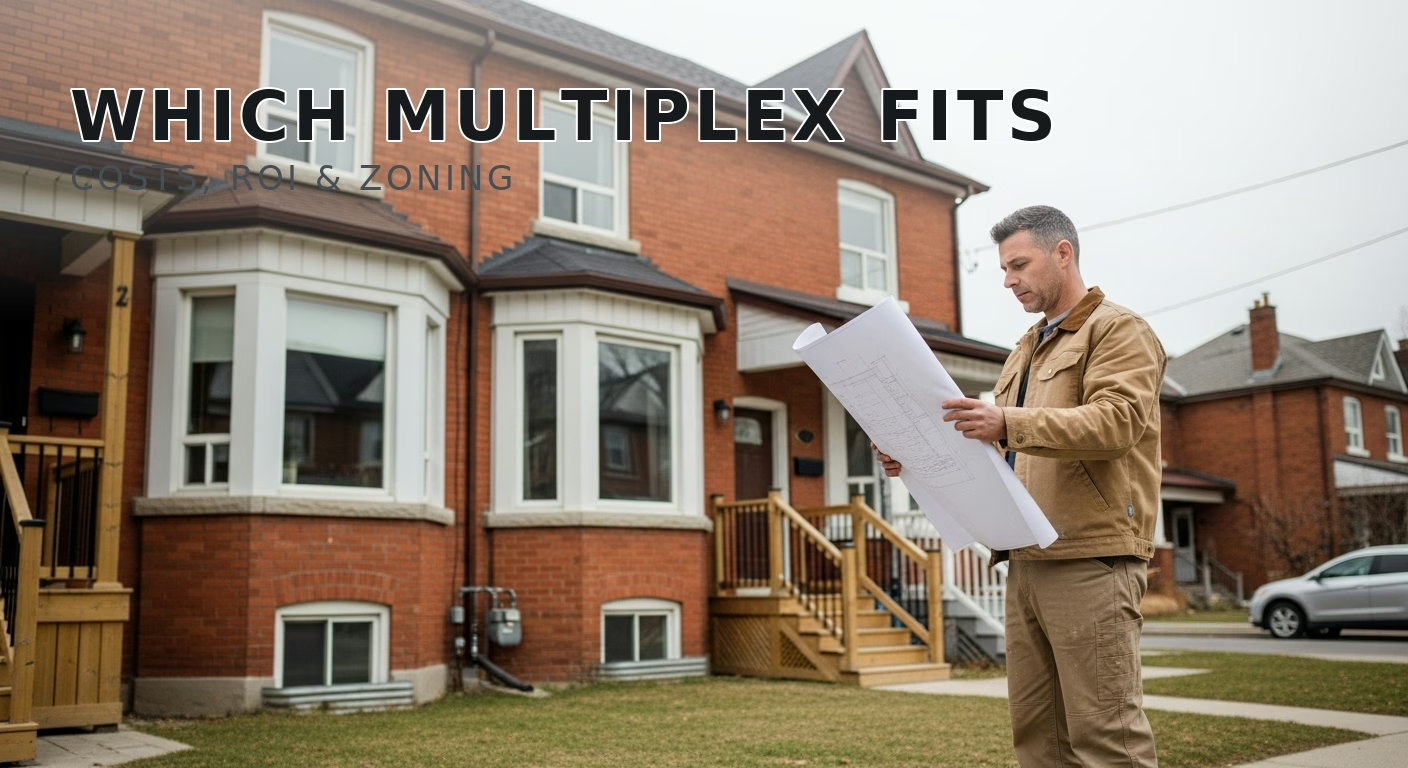
A conversion repurposes an existing single-family or duplex envelope into 2-4 units. A new build demolishes the existing structure and builds a purpose-designed multiplex from scratch. Bylaw 474-2023 permits both. This guide focuses on conversions — the dominant Toronto play because the existing envelope, foundation, and street-facing facade are retained, side-stepping demolition costs and Tarion new-build registration. For a deeper dive into fourplex new-builds versus conversions, see Duplex vs Triplex vs Fourplex Toronto: Which Conversion Fits Your Lot.
The Regulatory Stack: What Bylaw 474-2023 Actually Permits
The 2023 Multiplex Zoning By-law Amendment is the single most important reference document for any Toronto conversion. The headline provisions:
- Up to 4 units permitted as-of-right in RD, RS, and RT zones (covering virtually all single-family-zoned land in Toronto).
- Maximum building height up to 10.0 m where the existing zoning maximum is below 10 m (a small uplift to accommodate a habitable third storey or attic conversion).
- Up to two porches, decks, or balconies per unit — important for second and third-floor units that need outdoor amenity.
- No parking minimum (parking minimums for residential development were universally removed February 3, 2022 under By-law 89-2022).
- Front entrance restrictions for secondary suites deleted — meaning each of the four units can have its own front-facing entrance, with no rear-or-side-only restriction.
- Conversions OR new construction explicitly permitted within the same envelope rules.
Two important things to note. First, By-law 474-2023 was adopted without need for OPA appeal and survived all challenge windows; the City does not require a minor variance for any project meeting the standards. Second, the bylaw applies city-wide in residential zones, so a bungalow in West Hill, Scarborough is treated identically to a row house in Trinity-Bellwoods.
For projects that exceed the as-of-right standards (height, lot coverage, density), a minor variance through the Committee of Adjustment is still required. The City reports an approximate 80% approval rate on multiplex variances when the design is broadly consistent with the surrounding streetscape.
OBC Fire Separation: The Most Misunderstood Part of Multiplex Conversions
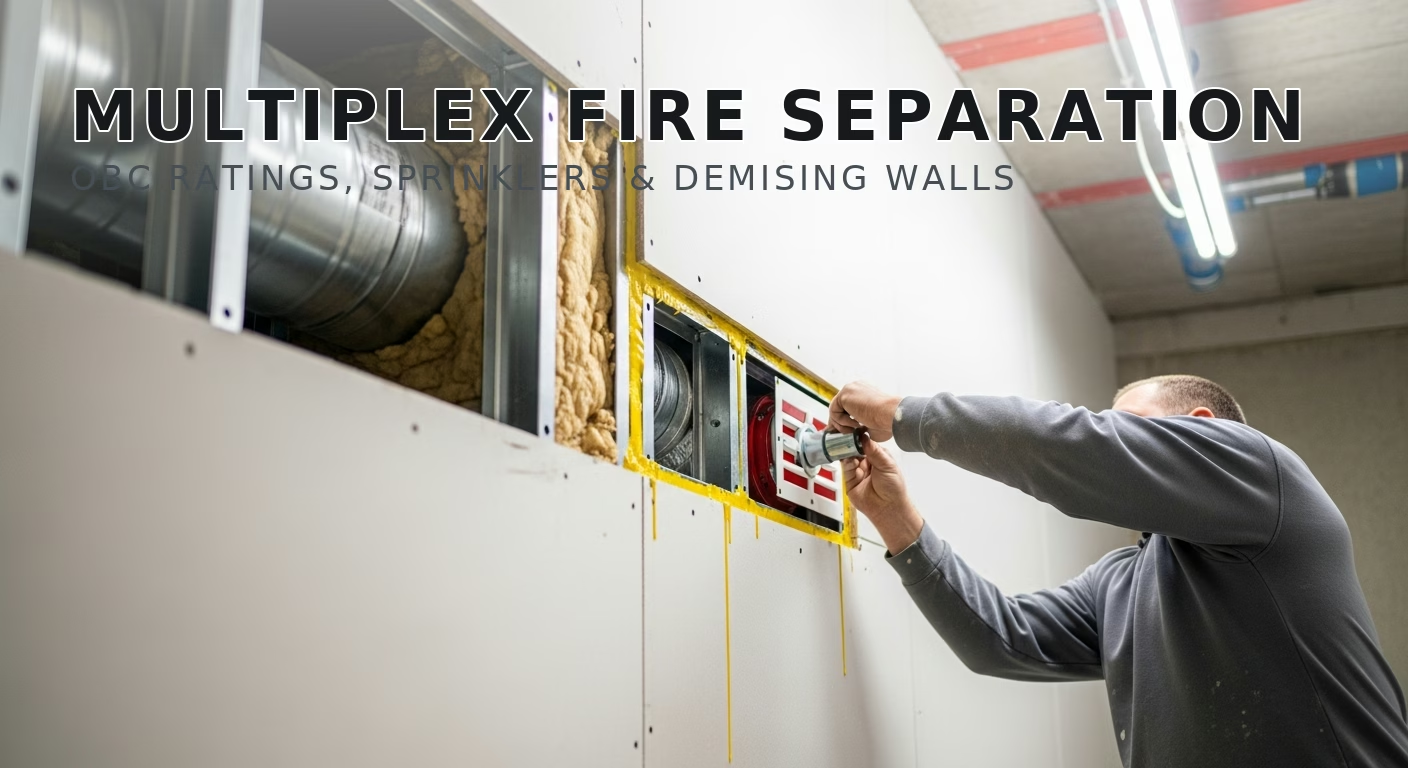
Most failed multiplex conversions fail on the fire-separation review, not on zoning. The Ontario Building Code (OBC) requires a 45-minute fire-resistance rating between every dwelling unit and between dwelling units and common spaces (corridors, stairwells, mechanical rooms). For a four-unit conversion this typically means:
- Floor/ceiling assemblies between units: 45-minute rated (typically Type X 5/8" drywall on resilient channel below the joists, plus a 1.5-hour or 2-hour assembly if the building exceeds three storeys).
- Demising walls between units (side-by-side configuration): 45-minute rated continuous from foundation to underside of roof sheathing.
- Stair enclosures: 45-minute rated walls separating the stair from each unit; self-closing fire-rated doors (20-minute typical for unit doors entering a common stair).
- Mechanical room separation: 45-minute rated walls and ceiling separating the furnace/HWT room from any unit.
For buildings of three storeys or fewer with each storey under 600 m² and total building area under 600 m² (covering virtually every Toronto bungalow conversion), OBC Part 9 (Section 9) applies and the fire separation rules are manageable with conventional drywall and joist-bay assemblies. For larger buildings or three-and-a-half storey designs that push into Part 3 (Section 3) territory, NFPA 13D residential sprinklers are typically required throughout the building, adding $15K-$30K to the project cost.
Need professional renovation?
Call RenoHouse at 289-212-2345 or get a free estimate today.
Get Free Estimate →Full breakdown in Multiplex Fire Separation OBC Toronto: 45-Minute Ratings, Sprinklers, Demising Walls.
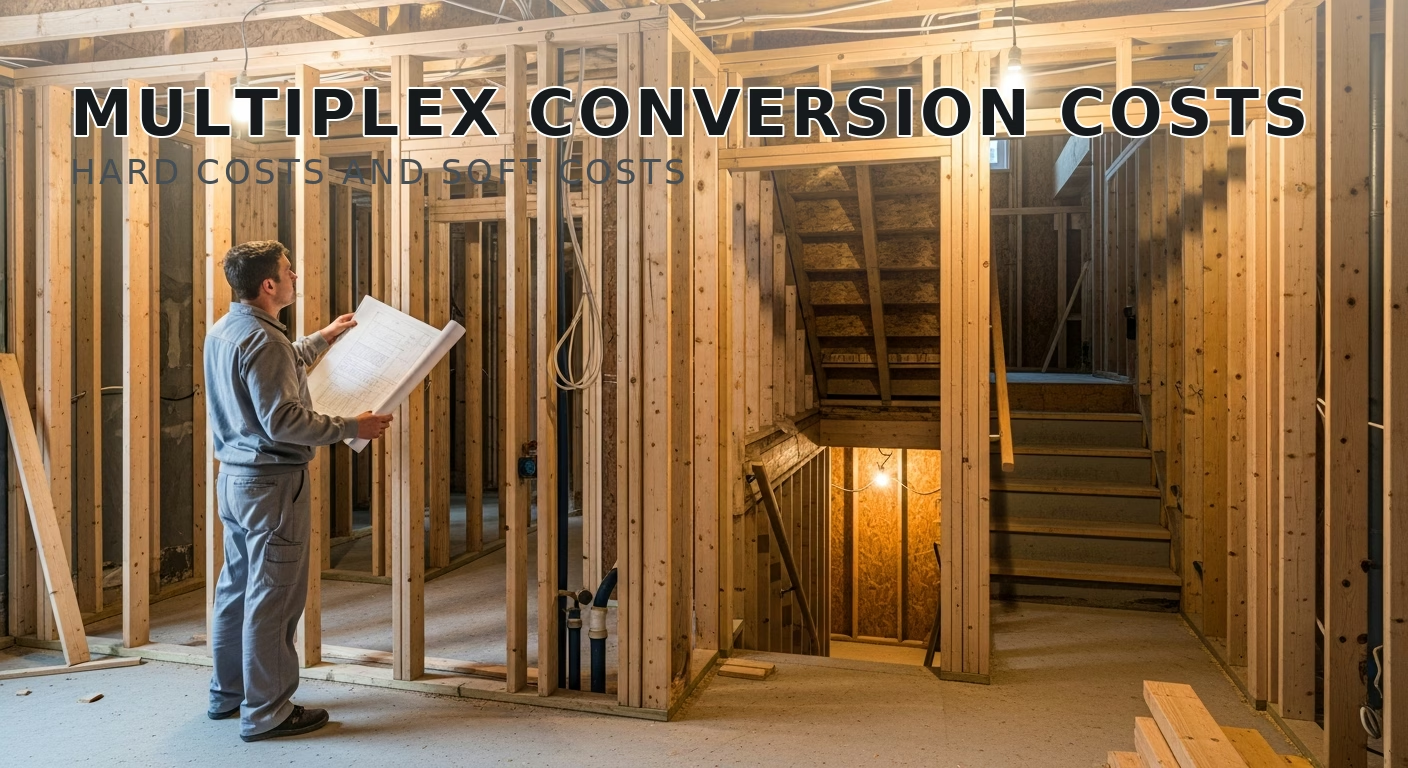
The Cost Reality: $200-$500K for a Typical Conversion
A multiplex conversion in Toronto costs $200/sq ft to $400/sq ft on top of acquisition cost, with the variance driven primarily by basement legalization scope, kitchen count, and whether utilities are separated unit-by-unit or stay shared. For a typical 2,000-2,500 sq ft Scarborough bungalow being converted to a fourplex:
| Phase | Cost Range |
|---|---|
| Pre-construction (architecture, structural, mechanical, permits) | $50,000-$120,000 |
| Demolition (interior selective; floors removed if needed for stair) | $20,000-$40,000 |
| Foundation underpinning + basement lowering (if needed) | $40,000-$120,000 |
| Framing for new partition walls + stairs | $30,000-$60,000 |
| Mechanical (4 separate HVAC zones, separate hot water, plumbing) | $80,000-$160,000 |
| Electrical (3-4 separate panels, ESA permit, possibly 200A service upgrade) | $30,000-$60,000 |
| Fire separation (drywall, doors, sprinklers if applicable) | $25,000-$60,000 |
| Kitchens (4 × $12K-$25K each) | $48,000-$100,000 |
| Bathrooms (4-5 × $8K-$18K each) | $40,000-$90,000 |
| Flooring + paint + trim throughout | $35,000-$70,000 |
| Site work, landscaping, separate-entry construction | $20,000-$50,000 |
| Contingency (10-15%) | $35,000-$75,000 |
| Total typical range | $453K-$1.0M |
| Mid-range | ~$650K |
For a full neighbourhood-by-neighbourhood and scope-by-scope cost tear-down with current Toronto trade pricing, see Multiplex Conversion Cost Toronto: Full 2026 Breakdown.
The Decision: Duplex, Triplex, or Fourplex?
Not every Toronto property is a fourplex candidate. The decision depends on lot geometry, existing house size, basement ceiling height, and your investment thesis:
- Duplex (2 units) — best for small lots (<25' frontage), heritage-restricted facades, or homes under 1,800 sq ft total. Conversion cost typically $150K-$280K. Returns are modest but the project is the easiest to finance and execute.
- Triplex (3 units) — the sweet spot for most Toronto bungalows and 2-storey detached homes in the 1,800-2,400 sq ft range. Adds a basement unit to a duplex up/down. Conversion cost $250K-$400K. Strong rental yield without needing a third-storey addition.
- Fourplex (4 units) — requires either (a) a 2,400+ sq ft existing house, (b) a finished basement + attic conversion, or (c) a small rear addition. Conversion cost $400K-$700K. Required to hit the CMHC MLI Select 5-unit threshold (when stacked with a garden or laneway suite).
For the full decision tree by lot type, neighbourhood, and budget, see Duplex vs Triplex vs Fourplex Toronto: Which Conversion Fits Your Lot.
Basement Legalization: Always One of the Four Units
In virtually every Toronto multiplex conversion, one of the units is the basement. Legalizing a basement apartment is a discipline of its own — egress windows, ceiling height, fire separation, dampproofing, and building permit requirements all have to align. Key OBC requirements:
- Minimum ceiling height: 1.95 m (6'5") under beams, 2.05 m (6'9") in living areas.
- Egress windows: at least one bedroom window with unobstructed opening of 0.35 m² (3.77 sq ft) and minimum dimension 380 mm (15"); sill height ≤ 1.5 m above floor.
- Fire separation from upper units: 45-minute rating in floor/ceiling assembly.
- Separate entry: typically a side or rear walk-out; cannot share a single shared corridor with the main unit unless the corridor is itself fire-rated.
If the existing basement has 7-foot ceilings, basement underpinning to lower the floor by 12-24 inches adds $50K-$120K but transforms a marginal basement into a market-rate unit. Full guide in Basement Apartment Legalization Toronto: 2026 Code, Egress, Ceiling Height.
Permits and Timeline: Plan for 12-18 Months Start to Finish
Multiplex conversions are as-of-right under By-law 474-2023, which means no Committee of Adjustment hearing is typically required if the design fits the bylaw envelope. However, the building permit process is meaningful:
- Building Permit (BP): $20-$40 per square metre of construction. Review time 8-14 weeks for multiplex (longer than an ADU because of fire-separation review).
- ESA (Electrical Safety Authority) permit: required separately for any electrical work.
- Plumbing trade permit: required for any new fixtures or unit-level water/drain runs.
- HVAC permit: required where mechanical systems are modified.
- Lot grading permit: required if any exterior work changes drainage.
Total permit fees for a typical fourplex conversion: $8K-$18K. Construction itself runs 6-10 months with vacant possession. Full timeline detail in Multiplex Conversion Permits Toronto: Full Process & Timeline.
Financing: CMHC MLI Select Is the Game-Changer
The single most important financing fact for any 2026 Toronto investor: CMHC's Multi-Unit Insurance Select program, when stacked with a garden or laneway suite to hit the 5-unit threshold, offers:
- Up to 95% loan-to-value (5% down or refinance to 95% of as-improved value)
- Up to 50-year amortization (with surcharges of 0.25% per 5-year increment beyond 25 years; max 1.25% surcharge)
- Forgivable energy-efficiency grants up to $85,000 per unit for Net Zero Ready or Passive House construction
- Reduced mortgage insurance premiums on points scoring (energy + affordability + accessibility)
A four-unit multiplex on its own (without the 5th ADU) does not qualify for MLI Select, but does qualify for CMHC standard multi-unit insurance at up to 85% LTV — still substantially better than the 80% conventional refinance ceiling.
Outside CMHC, the Equitable Bank Laneway House Mortgage (launched 2024) covers laneway and garden suite construction up to 80% LTV, and the Big 5 banks all offer construction draw mortgages with 4-5 stage draws. Full financing playbook in Multiplex Financing Toronto: CMHC MLI Select, BRRRR, 95% LTV.
ROI: Why the Numbers Are So Compelling
A worked example for a typical Scarborough fourplex conversion in 2026:
| Metric | Value |
|---|---|
| Acquisition (2,400 sq ft bungalow, Scarborough) | $1,275,000 |
| Renovation (4-unit conversion, mid-range finishes) | $550,000 |
| Total all-in | $1,825,000 |
| Gross rent (4 units × $2,500/mo avg) | $120,000/yr |
| Vacancy + collection (5%) | -$6,000 |
| Property tax + insurance + maintenance | -$22,000 |
| Property management (8%) optional | -$9,600 |
| NOI (self-managed) | ~$92,000/yr |
| NOI (managed) | ~$82,400/yr |
| Cap rate on cost | ~5.0% |
| As-improved value (at market 4.5% cap) | ~$2,000,000+ |
| Cash-on-cash @ 95% MLI Select financing | 12-18% |
| 10-year total return | 180-250% of total cost |
For the full ROI framework, BRRRR strategy, and rent-by-neighbourhood data, see Multiplex Conversion Rental Income & ROI Toronto.
Target Neighbourhoods: Where Multiplex Conversions Make the Most Sense
The economics of multiplex conversion favour areas where (a) acquisition prices are below downtown core levels, (b) lots are wider (28-50' frontages), (c) bungalows or 2-storey detached homes dominate, and (d) rental demand is strong:
- Scarborough. Birch Cliff, Cliffcrest, West Hill, Wexford, Bendale — bungalows priced $1.05M-$1.4M, lots 30-50' wide.
- Etobicoke. Mimico, New Toronto, Long Branch, Alderwood, Kingsview Village — 1950s-1970s bungalows and split-levels, $1.1M-$1.5M.
- North York. Bathurst Manor, Clanton Park, Newtonbrook, Willowdale (smaller lots), Don Mills — mid-century bungalows and ranch homes.
- East York. Pape Village, Topham Park, Crescent Town fringe — 1.5-storey post-war homes well-suited to triplex conversion.
- Old Toronto inner ring. Bloordale, Dovercourt-Wallace, Junction Triangle, Greenwood-Coxwell — Victorian and Edwardian semis priced $1.4M-$1.9M; higher rent ceiling but tighter conversion economics.
Garden Suite Stacking: The 5-Unit Play
The most aggressive 2026 strategy is the 5-unit stack: a four-unit multiplex (main house) plus a detached garden suite or laneway suite in the rear yard. This crosses the CMHC MLI Select 5-unit threshold and unlocks the full 95% LTV / 50-year amortization toolset. The combined construction cost is typically $700K-$1.5M on top of acquisition, but the property value uplift can be $1M-$1.6M and the all-in financing economics make this the highest-ROI residential investment available in Canada in 2026.
For the garden suite half of the equation, see Garden Suite Toronto: Complete 2026 Guide. For the laneway alternative, see Laneway House Construction Toronto: Complete 2026 Guide.
Common Pitfalls
- 1. Skipping the structural assessment. Many older Toronto homes have undersized joists or load-bearing walls in the wrong place; converting without a proper structural review leads to tear-out costs.
- 2. Underestimating utility separation. Each unit ideally has separate electrical metering, separate HVAC zoning, and (sometimes) separate hot water — the cumulative cost is $30K-$80K and is frequently missed in early budgets.
- 3. Ignoring rental control implications. Units in buildings constructed before November 15, 2018 are subject to Ontario rent control; conversions of pre-2018 buildings inherit this status.
- 4. Mismanaging vacant possession. Most banks will not finance a refinance until the units are tenant-occupied; vacancy during construction is the biggest cash flow risk.
- 5. Forgetting the rooming-house bylaw distinction. Multiplexes are NOT rooming houses; mixing tenants by bedroom rather than unit creates legal and insurance issues.
Why RenoHouse for Toronto Multiplex Conversions
RenoHouse is one of the few full-service Toronto general contractors who handles both the design-build and the regulatory pathway for multiplex conversions. We work end-to-end: zoning verification, OBC fire-separation engineering, building permit application, demolition, structural framing, mechanical, kitchens, bathrooms, finishes, and final ESA + plumbing inspections. Our fourplex conversion package targets the Scarborough, Etobicoke, North York, and East York markets where the acquisition-to-rental yield math is strongest.
If you are evaluating a property for a multiplex conversion, book a free consultation. We will run the as-of-right zoning check, basement legalization assessment, fire-separation envelope, and a high/low cost-and-rent estimate within 7 days.
Related Reading
- Pillar guides on adjacent ADU types: Garden Suite Toronto, Laneway House Toronto.
- Cost depth: Multiplex Conversion Cost Toronto: Full 2026 Breakdown.
- Decision logic: Duplex vs Triplex vs Fourplex Toronto: Which Conversion Fits Your Lot.
- Code and inspection: Multiplex Fire Separation OBC Toronto.
- Basement legalization: Basement Apartment Legalization Toronto.
- Permits: Multiplex Conversion Permits Toronto: Full Process & Timeline.
- Finance and ROI: Multiplex Financing Toronto: CMHC MLI Select, BRRRR, 95% LTV, Multiplex Conversion Rental Income & ROI Toronto.
Sources & References
Authoritative sources cited in this guide:
- Toronto Multiplex Bylaw 474-2023 — Toronto multiplex regulations
- Bill 23 — More Homes Built Faster Act — Provincial ARU enabling legislation
- CMHC MLI Select — Multi-unit financing program
Continue Reading