RenoHouse

# Basement Underpinning Mistakes Toronto: 10 Costly Errors
Quick answer. Basement underpinning is unforgiving of shortcuts. The expensive mistakes are almost never technical execution errors at the concrete stage — they are scoping, sequencing, and coordination decisions made early in the project that compound through construction.Basement underpinning is unforgiving of shortcuts. The expensive mistakes are almost never technical execution errors at the concrete stage — they are scoping, sequencing, and coordination decisions made early in the project that compound through construction. By the time the structural error becomes visible, the cost to fix it is often 3 to 10 times the cost of doing it right initially.
This article covers ten mistakes we see repeatedly on Toronto underpinning projects in 2026, the cost impact of each, and how to avoid them. For the full project framework, see our Basement Underpinning Toronto: Complete 2026 Guide.
Mistake 1 — Skipping the Soil Report to Save $2,500
The soil report (geotechnical report) typically costs $1,800 to $3,500. Some homeowners and contractors skip it, reasoning that experienced contractors can read soil conditions during excavation.
Why it backfires:- Discovering high water table at the new design depth means emergency drainage redesign mid-project — typically $5,000 to $15,000 in extra work and 2 to 4 weeks of schedule loss.
- Discovering soft fill where dense clay was assumed means the engineer has to redesign pin width and shoring on the fly — typically $4,000 to $10,000 in concrete and labour overrun.
- Discovering unexpected fuel oil contamination from a 1950s buried tank means environmental remediation — $8,000 to $25,000 plus 3 to 6 weeks delay.
Mistake 2 — Underpinning to "As Deep as Possible"
A surprising number of Toronto homeowners ask the contractor to "go as deep as you can" without a target finished height. The reasoning is "more depth equals more value." It does not.
- Each additional foot of depth adds 18 to 25 percent to the underpinning concrete cost.
- Going from a 24-inch underpin to a 36-inch underpin can add $15,000 to $30,000 to the structural budget.
- Once you exceed about 36 inches of additional depth, the engineering complexity, shoring requirements, and water management challenges scale faster than headroom benefit.
- A finished basement at 8'6" looks roughly the same to a buyer as one at 8'0", and both look great compared to 7'0".
Mistake 3 — Not Planning Mechanical Rough-in at the Structural Stage
The structural engineer designs the underpinning. The plumbing, electrical, and HVAC plans are often produced separately or much later. When mechanical planning lags structural planning, the result is fresh concrete being broken to chase ducts, waste lines, or electrical conduits.
Why it backfires:- Cutting fresh slab to install plumbing rough-in adds $3,500 to $8,500.
- HVAC rerouting after underpinning is complete may force unsightly soffits or, in worst cases, additional underpinning depth.
- Soil stack relocation discovered late may require a second concrete pour for the new stack base.
Mistake 4 — Forgetting Egress Windows for a Legal Apartment
If the basement is becoming a legal secondary suite, OBC requires egress — a window or door that allows escape in case of fire. The egress window typically requires a window well excavated outside the basement perimeter, with a deeper opening than a standard basement window.
Why it backfires:- Discovering the egress requirement after the underpinning is complete means breaking the new exterior wall to install the egress opening — $4,500 to $9,500 per window, plus the disruption of working from outside through the fresh underpin.
- Inspectors will not sign off on the legal apartment until egress is in place. The unit cannot be rented.
Mistake 5 — Underestimating Finished Basement Scope
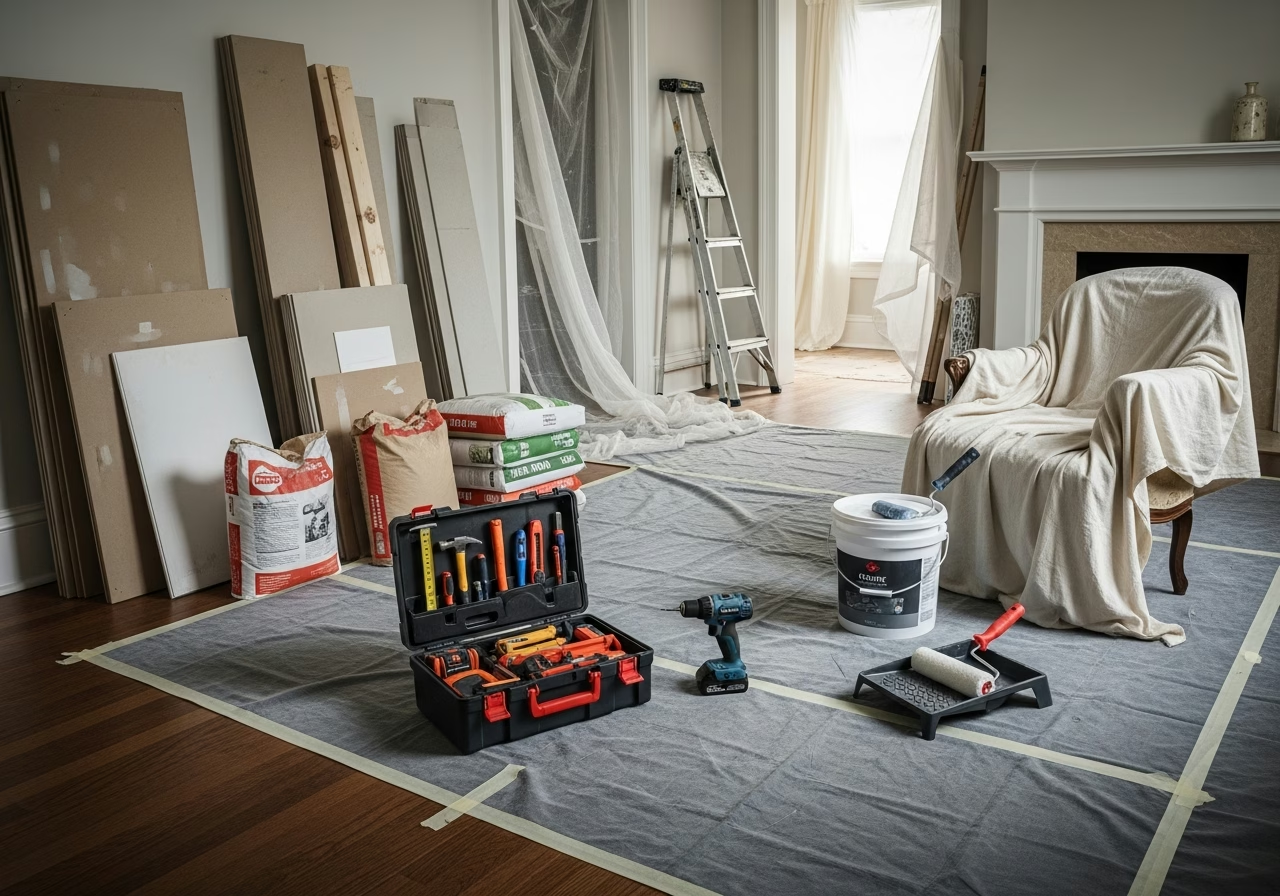
The structural underpinning is the visible, expensive line item. Homeowners commonly forget that finishing the basement (drywall, flooring, kitchen, bathroom, trim, paint) is a comparable cost to the structural work.
Need professional home renovation?
Call RenoHouse at 289-212-2345 or get a free estimate today.
Get Free Estimate →- Structural underpin: $80,000 to $150,000.
- Finished basement scope: $80,000 to $140,000 for a one-bedroom legal apartment, more for larger or higher-end finishes.
- Total project: $160,000 to $290,000+.
- Construction loans or HELOCs sized to the structural budget run dry during finishing.
- The basement sits as a poured-concrete shell for months waiting for finishing budget.
- Restarting trades after a pause adds $5,000 to $15,000 in coordination overhead.
Mistake 6 — Choosing the Lowest Bid Without Verifying Engineering Coordination
Three quotes for the same Toronto underpinning project can vary by $40,000. The homeowner who picks the lowest is sometimes choosing a contractor who has not budgeted engineer site visits, soil report, asbestos DSS, or contingency.
Why the lowest bid often grows:- "Engineer fees additional" — discovered at week 1.
- "Soil report by homeowner" — adds $2,500.
- "Asbestos DSS extra" — adds $400 to $1,200.
- "Contingency invoiced as encountered" — typical 15 to 20 percent of base cost.
- "Inspection coordination by homeowner" — labour-cost time the homeowner does not have.
By the time the lowest bid finishes, it often equals or exceeds the middle bid that quoted everything inclusive.
The fix: Compare quotes line item by line item. Use the question list in Basement Underpinning Cost Toronto Comparison. The cheapest quote is rarely the cheapest project.Mistake 7 — Ignoring Asbestos and Vermiculite
Toronto homes built before 1986 are subject to Ontario Regulation 278/05, which requires a Designated Substance Survey (DSS) before any demolition or major renovation work. Skipping the DSS does not eliminate the asbestos — it just makes it the contractor's and homeowner's problem at the worst moment.
Why it backfires:- Discovering vermiculite (Zonolite) when the slab is broken out shuts down the site immediately. Workers are pulled. Air sampling and abatement scheduling adds 2 to 4 weeks.
- Asbestos pipe wrap discovered during demolition triggers immediate stop-work pending licensed abatement.
- Plaster and drywall mud containing asbestos is widespread in pre-1970s Toronto homes — disturbing it without proper containment is a Ministry of Labour violation.
Mistake 8 — Lowering a Party Wall Without Engineer Coordination
On a semi-detached or row house, the party wall sits on a shared footing. Underpinning the party-wall side requires explicit engineering attention to the neighbour's foundation. Some contractors treat the party wall as just another wall, with predictable consequences.
Why it backfires:- Settlement on the neighbour's side. Cracks in the neighbour's basement or first floor. Possible legal exposure.
- Stop-work order if the neighbour reports the disturbance.
- Engineer recall to redesign the party-wall detail mid-project.
Mistake 9 — Combining Underpinning With a Major Above-Grade Renovation Without Sequencing
Some Toronto projects pair underpinning with a second-storey addition, kitchen extension, or full main-floor gut. The combination has real economics — one set of permits, one set of trades on site, one finishing season — but only if sequenced correctly.
- Underpinning and second-storey framing happening simultaneously means heavy upper-floor loads are bearing on a partially-underpinned foundation. Engineer specifies sequencing for a reason.
- Demolition above-grade dropping debris into the basement during underpinning excavation creates safety and contamination issues.
- Multiple trades on site with conflicting access needs causes delays that compound.
Mistake 10 — Treating the Project as Linear Instead of Coordinated
The biggest meta-mistake is treating underpinning as a sequence of independent tasks (engineer, then permit, then demo, then concrete, then rough-in, then finish) rather than as a coordinated project where decisions in any one stage affect the others.
Examples of coordination failures:- Engineer designs to 24-inch depth based on initial scope. Homeowner later decides to add a basement sauna requiring 7'4" finished height. Project is now under-designed and depth has to be increased mid-construction.
- Architectural plans show a kitchen on the front of the house. Plumbing rough-in is built accordingly. Owner decides to flip layout — kitchen to back. Slab has to be cut.
- Permit submitted with one mechanical layout. Trades arrive with a different layout because the contractor and the architect were not in sync.
Less-Common Mistakes Worth Mentioning
Beyond the top 10, a few more we have encountered:
- Insurance not notified. Most home insurance policies require written disclosure of structural work. Failure to notify can void coverage during construction.
- Neighbour not notified. Even on detached homes, courtesy notification reduces complaints and stop-work risk.
- Permit lapsing. A permit can become inactive if work pauses for more than 6 months. Restarting requires new fees.
- HVAC undersized. A finished basement adds significant heated and cooled square footage. The existing furnace may not handle the new load. Pre-project HVAC assessment avoids surprise upgrades.
- Sump pump undersized. New weeping tile around the underpinned perimeter may produce more sump load than the existing pump can handle. Pump and pit upgrade should be planned at the structural stage.
- Forgotten exterior service connections. Gas, hydro, water service connections may need to be relocated if the basement entrance is changing or if exterior excavation is significant.
What Goes Right When the Project Goes Right
For contrast, the recipe for a clean Toronto underpinning project:
- 1. Defined scope — exactly what the basement will be, target finished height, target use case.
- 2. Soil report — completed and integrated with engineer design.
- 3. Engineer engagement early — drawings stamped before contractor pricing finalizes.
- 4. Mechanical drawings integrated with structural drawings — no chasing ducts through fresh concrete.
- 5. Asbestos DSS — before demolition, abatement scheduled if needed.
- 6. Permit submitted clean — complete drawing set, no NORI.
- 7. Insurance notified — written disclosure to homeowner's insurer before work begins.
- 8. Neighbour notified — courtesy letter at minimum.
- 9. Construction sequenced per engineer — pin sequence, cure times, inspections all met.
- 10. Finishing scope budgeted — full project from concept to occupancy.
When all 10 are in place, the project lands on schedule and on budget. We have delivered enough Toronto underpinning projects to know that the homes where the homeowner and the contractor and the engineer all ran their part of the play book are the homes where the basement looks like the rendering at the end.
Common Toronto-Specific Watch-Outs
A few items unique to Toronto:
- Cabbagetown and Don Vale heritage designations — don't change the underpinning itself but add Heritage Preservation Services review if any above-grade element is involved.
- Old fuel oil tanks — pre-1955 homes often have buried oil tanks that were never properly removed. Discovery during excavation triggers Ministry of Environment notification.
- Toronto Sewer Connection bylaw — basement service rerouting may trigger sewer connection review if the sanitary line crosses the property line at a new location.
- Tarion — renovation work is not enrolled in Tarion. New construction is. Underpinning falls on the renovation side and is governed by the contract between the contractor and the homeowner plus any product warranties.
Next Steps
If you are evaluating an underpinning quote and want a second opinion on whether the scope, the engineering, and the sequencing are real, Contact RenoHouse. We provide a written project review before you sign anything.
Sources & References
Authoritative sources cited in this guide:
- Ontario Building Code — OBC official text
- Toronto Building Permits — City permit portal
- Tarion New Home Warranty — Ontario new-build warranty regulator
- HCRA — Home Construction Regulatory Authority — Ontario builder/vendor licensing
Continue Reading