RenoHouse

# DSS Designated Substance Survey Toronto: 2026 Guide
Quick answer. A Designated Substance Survey (DSS) is the document that drives every asbestos abatement decision on a pre-1990 Toronto renovation. Required under Ontario Regulation 278/05, the DSS is performed by an environmental consultant, results in a written report with lab-confirmed material classifications, and becomes the basis on which abatement...A Designated Substance Survey (DSS) is the document that drives every asbestos abatement decision on a pre-1990 Toronto renovation. Required under Ontario Regulation 278/05, the DSS is performed by an environmental consultant, results in a written report with lab-confirmed material classifications, and becomes the basis on which abatement contractors quote and Ministry of Labour inspectors verify compliance.
This guide explains what a DSS is, when it is mandatory, what a complete report looks like, sample counts and methods, the major Toronto consulting firms, realistic 2026 pricing, and how to translate the report into a renovation scope. For pre-renovation context, see Asbestos Abatement Toronto 2026: Complete Guide.
What "Designated Substance" Means
Ontario regulates eleven "designated substances" under the Occupational Health and Safety Act. The list includes asbestos, lead, mercury, silica, isocyanates, vinyl chloride, arsenic, benzene, ethylene oxide, acrylonitrile, and coke oven emissions. For residential renovation, the relevant substances are predominantly asbestos and lead (lead in paint and pipe solder), with silica relevant for any concrete cutting.
A DSS for residential renovation in Toronto typically focuses on asbestos with a lead paint check as a secondary scope. Some consultants offer a combined DSS that includes mercury (in old thermostats and switches) and PCB (in old fluorescent light ballasts).
When a DSS Is Mandatory
Reg 278/05 requires a DSS before any "construction project" — defined broadly to include alteration, repair, addition, or demolition. The trigger is straightforward: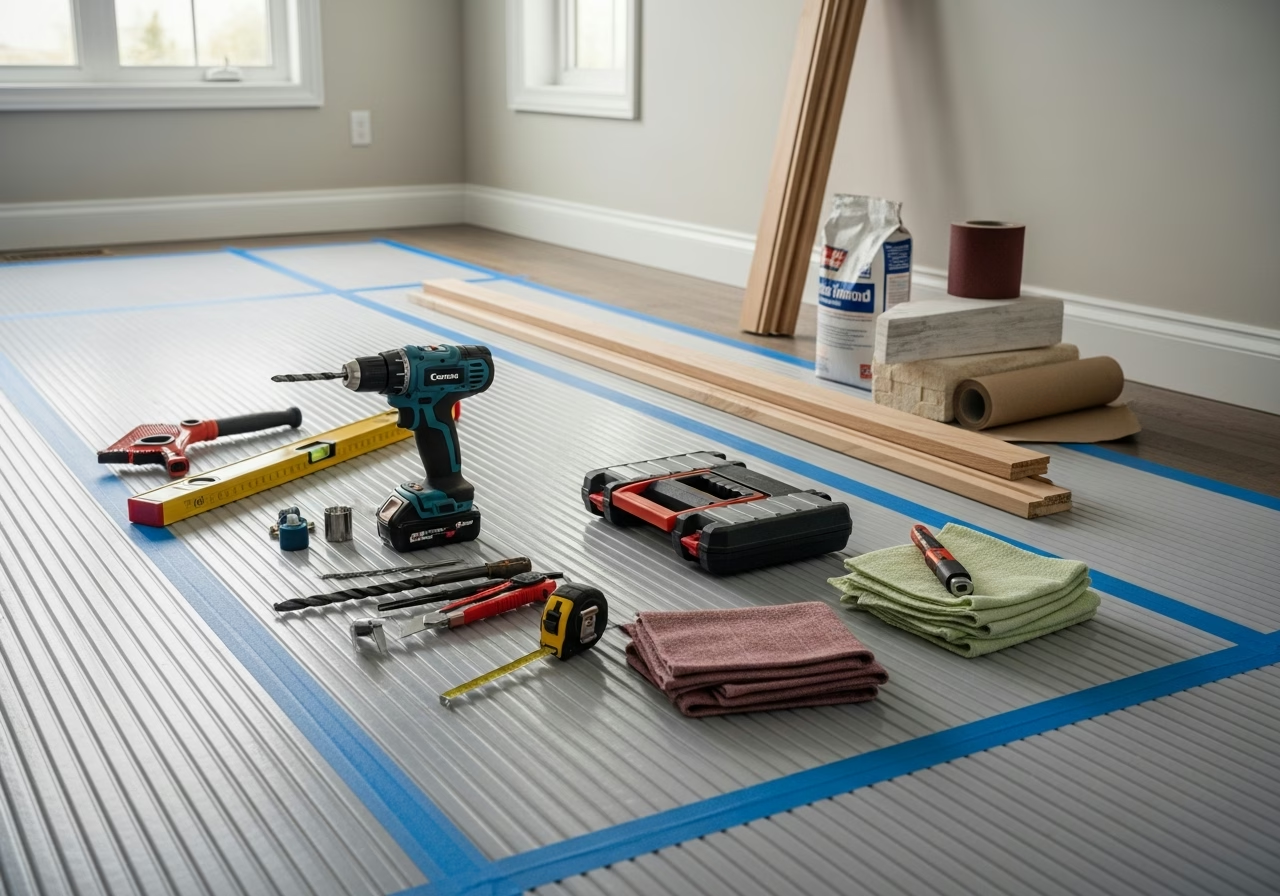
- Pre-1990 building — by professional convention; the regulation itself is age-agnostic but the practical age of concern is pre-1990.
- Disturbance of material — drilling, sawing, scraping, sanding, removing, demolishing.
- Hired workers involved — the regulation primarily protects workers, so the moment a paid trade enters the site, the regulation applies.
The DSS must be made available to all workers and contractors before they enter the site. In practice, the renovation contractor or homeowner provides the DSS as part of the bid package.
DSS vs Targeted Sample
Some homeowners ask whether they need a "full DSS" or whether a targeted bulk sample test is enough. The legal text of Reg 278/05 requires a "survey" — which is interpreted as a systematic identification of all designated substances likely to be disturbed by the project, supported by lab analysis.
A targeted sample (3 to 6 samples of materials in the immediate work area) is acceptable for narrow, well-defined scopes — for example, a kitchen reno where only the cabinets, drywall behind, and floor tile will be disturbed. The samples must cover all suspect materials in scope.
A full DSS (15 to 60 samples covering the entire renovation area or the entire home) is required when:
Need professional home renovation?
Call RenoHouse at 289-212-2345 or get a free estimate today.
Get Free Estimate →- Scope is large or evolving.
- Multiple rooms or floors are involved.
- The project will be phased over multiple years.
- The renovation contractor or insurance underwriter requires it.
For most Toronto renovations larger than a single bathroom, the full DSS is the better default. The cost difference ($300–$700 targeted vs $400–$1,200 full) is small relative to the project, and the report covers contingencies that targeted sampling does not.
What a Complete Toronto DSS Report Includes
A complete DSS report has eight standard sections:
- 1. Cover letter — addressed to the building owner, summarizing scope and findings in plain language.
- 2. Executive summary — list of materials confirmed positive, list confirmed negative, recommended actions.
- 3. Site description — address, building type, age, square footage, scope of planned renovation.
- 4. Sampling methodology — how samples were collected, lab method, ASTM or NIOSH reference standards.
- 5. Sample location plan — floor plan with marked sample points (e.g., S-01 through S-22).
- 6. Lab results table — sample number, location, material description, fibre type and percentage, regulated yes/no, recommended abatement type.
- 7. Photographs — each sampled material photographed with the sample number visible.
- 8. Lab certificate — signed lab certificate of analysis with the analyst's credentials.
The report should also include the consultant's professional credentials. Common designations: CIH (Certified Industrial Hygienist), ROHT (Registered Occupational Hygiene Technician), or P.Eng (Professional Engineer with environmental specialty).
Sample Counts: What Is "Enough"?
Industry guidance for residential DSS sampling:
- Single-room renovation: 5 to 12 samples covering all suspect materials in the room.
- Single-floor renovation: 12 to 25 samples.
- Whole-home renovation: 25 to 50 samples.
- Whole-home gut: 35 to 60 samples.
For each suspect material, EPA AHERA guidance recommends 3 samples for surfacing materials over 1,000 sqft (e.g., popcorn ceiling), 2 samples for materials between 5 and 1,000 sqft, and 1 sample for materials under 5 sqft. Ontario does not strictly mandate AHERA counts, but reputable consultants follow them as best practice.
2026 Toronto DSS Pricing
Realistic ranges:
- Targeted bulk sampling, 3–6 samples, single-room: $300 to $700.
- Standard residential DSS, single floor, 12–20 samples: $400 to $900.
- Whole-home DSS, 25–40 samples: $700 to $1,800.
- Whole-home gut DSS, 40–60 samples, including attic and basement: $1,200 to $3,000.
- Combined DSS + lead paint testing: add $200 to $500.
- Phase 1 environmental site assessment (commercial property pre-purchase): $2,500 to $6,000+.
Pricing varies between consulting firms by 20 to 40 percent. The differentiator is usually report quality, turnaround speed, and the consultant's reputation with Ministry of Labour inspectors.
Major Toronto Consulting Firms
Pinchin Ltd. — large national firm. Comprehensive reports, well-known to underwriters and inspectors. Higher pricing. EHS Partnerships Ltd. — Toronto-based, strong residential focus, mid-market pricing. Talon Environmental — Toronto-area, good residential and commercial mix. Restorx Disaster Restoration — primarily restoration but with consulting capability. Independent CIHs and consultants — several credible solo practitioners in the GTA. Lower price, slower scheduling.Turnaround
A typical DSS process from booking to final report:
- Booking to site visit: 1 to 3 weeks (often the bottleneck).
- Site visit duration: 1 to 4 hours.
- Lab analysis: 24 to 72 hours for PLM; 3 to 5 days for TEM.
- Report preparation: 3 to 7 business days after lab results.
- Total: 2 to 4 weeks from booking to receipt of final report.
For a renovation with a fixed start date, book the DSS 4 to 6 weeks in advance.
Reading the Report and Translating to Scope
Once you have the report, the next step is translating findings into a renovation scope:
- 1. List positive materials with locations and quantities.
- 2. Classify abatement type (Type 1, 2, or 3) per material.
- 3. Sequence the abatement in coordination with renovation phasing.
- 4. Solicit abatement quotes from at least two licensed contractors.
- 5. Schedule clearance between abatement and construction.
- 6. Update renovation drawings if scope must change to avoid abatement.
This translation step is where a project coordinator earns their fee. RenoHouse handles this step on every pre-1990 home we work on.
How Long the DSS Stays Valid
A DSS is valid for the renovation it was scoped for. If you are renovating in phases over multiple years, the DSS remains valid for materials it sampled. New work that disturbs untested materials requires supplemental sampling.
A DSS over 5 years old is sometimes refreshed for major projects, particularly if material conditions may have changed (water damage, pest damage, partial renovation by a previous owner).
Common Mistakes With DSS
- Skipping the DSS because the home looks "renovated." Renovations layer over original materials; the original is still under the new finish.
- Treating the DSS as a contractor sales pitch. It is a regulated document with legal weight.
- Letting the abatement contractor write the DSS. This is a conflict of interest. The consultant who scopes the work should not be the contractor who profits from removing it.
- Ignoring negative results. A "negative" letter for materials not requiring abatement is valuable for resale disclosure.
Related Reading
Asbestos Testing Toronto: Cost & Where, Type 1 vs Type 2 vs Type 3 Asbestos Toronto, Homeowner vs Contractor Asbestos Removal Toronto.Need a DSS Coordinated for Your Toronto Renovation?
RenoHouse books the DSS, translates the report, brokers the abatement quote, and runs the renovation that follows. Visit our Asbestos Abatement Service Page to start.
Sources & References
Authoritative sources cited in this guide:
- Ontario Building Code — OBC official text
- Toronto Building Permits — City permit portal
- Tarion New Home Warranty — Ontario new-build warranty regulator
- HCRA — Home Construction Regulatory Authority — Ontario builder/vendor licensing
Continue Reading