RenoHouse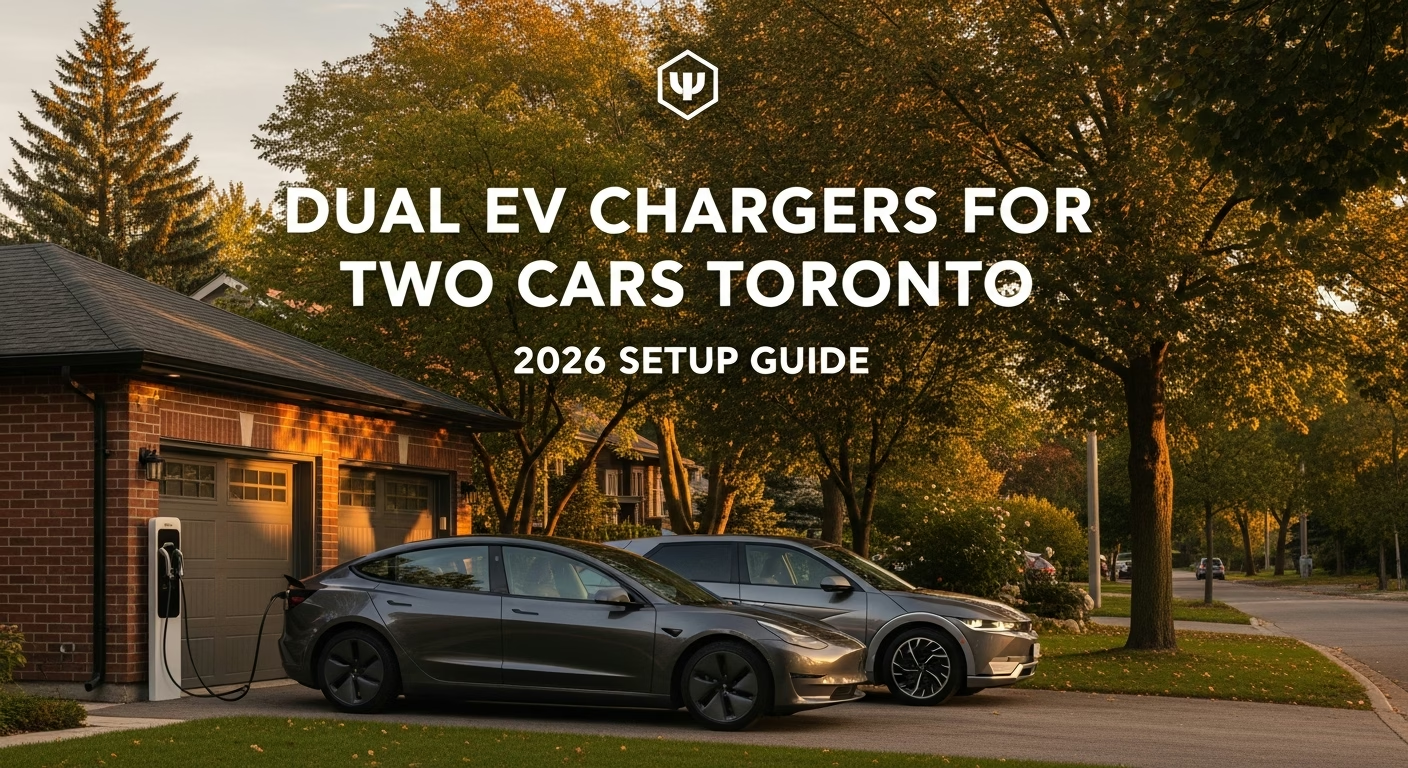

# Dual EV Chargers for Two Cars Toronto: 2026 Setup Guide
Quick answer. The fastest-growing EV install category in the GTA in 2026 is the two-charger setup for two-EV households. Mississauga, Markham, Oakville, and Vaughan have crossed the threshold where multi-EV families are common, and most of those households install dual chargers rather than rotating one charger between two cars.The fastest-growing EV install category in the GTA in 2026 is the two-charger setup for two-EV households. Mississauga, Markham, Oakville, and Vaughan have crossed the threshold where multi-EV families are common, and most of those households install dual chargers rather than rotating one charger between two cars. The question is no longer whether to do it but how — load sharing or independent circuits, hardwired or plug-in, single brand or mixed, and whether the existing panel can handle two 48A circuits.
This guide walks through the dual-charger options, costs, and the panel-capacity math. For the wider install context, see our pillar EV Charger Installation Toronto: Complete 2026 Guide, and for the panel-side analysis see 200 Amp Panel Upgrade for EV Charger Toronto.
The Three Dual-Charger Patterns
| Pattern | How It Works | Total Capacity | Best For |
|---|---|---|---|
| Load sharing on one circuit | Two chargers share one 60A circuit | 11.5 kW total split | 200A panels at capacity |
| Two independent circuits | Each charger on its own 60A circuit | 23 kW total | 200A+ with headroom |
| One charger + one outlet | Level 2 + NEMA 14-50 plug-in | 19 kW total | Mixed daily use patterns |
Pattern A: Load Sharing on One Circuit
Two chargers share a single 60A circuit. The chargers communicate (typically over Ethernet, WiFi, or RS-485) and dynamically split current. When one car is charging and the other is idle, the active car gets full 48A. When both cars charge simultaneously, each gets 24A (about 5.7 kW).
Brands that support native load sharing:
- Tesla Wall Connector Gen 3: native power sharing across up to 6 units. Best implementation in market.
- Wallbox Pulsar Plus: dynamic load balancing across multiple units.
- ChargePoint Home Flex: load sharing via ChargePoint app.
- FLO Home X5: does not support consumer-level load sharing; requires building-grade hardware.
Pros:
- Adds only one circuit, one breaker, one ESA permit line.
- Fits within existing 200A panel capacity in most cases.
- Simpler install — about 60% of the cost of two independent circuits.
- Total capacity matches one full Level 2 install (11.5 kW).
Cons:
- When both cars charge simultaneously, each is at half-speed.
- Requires same-brand chargers (or compatible cross-brand setup, rare).
- Some load-sharing features require cloud connection.
Best for: two-EV households where charging windows are non-overlapping (one car charges 9pm-1am, other 1am-5am), or where slower simultaneous charging is acceptable.
Pattern B: Two Independent 60A Circuits
Each charger on its own 60A breaker, full 48A continuous output independently. Both cars can charge at full speed simultaneously.
Pros:
- Maximum charging speed for both cars at all times.
- Each charger can be different brand.
- Simpler operationally — no app coordination.
- Resilient — if one charger fails, the other is unaffected.
Cons:
- Requires 200A panel with significant headroom (each circuit pulls 48A continuous = 60A capacity per CSA).
- Often requires panel upgrade to 200A or even 400A.
- Roughly 1.6x the cost of single-circuit load sharing.
Panel capacity math: two 60A circuits in CSA Section 8 are calculated as 2 × 48A × 125% = 120A total contribution to the load calculation. On a 200A panel with existing baseline loads of 100A, this puts the calculation at 220A — already over-capacity. Most homes need either load management (Pattern A) or a 400A service to do Pattern B safely.
Need professional electrical services?
Call RenoHouse at 289-212-2345 or get a free estimate today.
Get Free Estimate →Best for: large detached homes in Mississauga, Vaughan, Oakville with 200A+ service and limited other major loads, or homes upgrading to 400A as part of a larger electrification project.
Pattern C: Hardwired Level 2 + NEMA 14-50
A common compromise: install one full hardwired Level 2 (48A, 11.5 kW) for the primary daily-driver EV, plus a NEMA 14-50 receptacle for the second car (32A, 7.7 kW). The second car charges slower but it is also driven less.
Pros:
- Lower total cost than two full hardwired installs.
- Fits within most 200A panels with headroom.
- The plug-in receptacle is portable — usable for guest EVs, rental EVs, or eventual mobile chargers.
Cons:
- Asymmetric setup — one car always gets the better charger.
- Requires two breakers (60A + 50A) versus one for load-sharing.
Best for: households with one daily-driver and one weekend or short-distance second car, households where one driver has range anxiety more than the other.
Cost Comparison: Toronto 2026 Dual-Charger Install
Pattern A (load sharing, single circuit, two Tesla Wall Connectors):
| Item | Cost (CAD) |
|---|---|
| ESA permit | $180 |
| 60A breaker | $80 |
| AWG 4 copper, 50 ft | $440 |
| Conduit | $160 |
| Two Tesla Wall Connectors | $1,240 |
| Load sharing config (native, no extra hardware) | $0 |
| Cable management hardware | $200 |
| Labour (1.5 days) | $1,800 |
| Total | $4,100 |
Pattern B (two independent circuits, mixed brand):
| Item | Cost (CAD) |
|---|---|
| ESA permit | $220 |
| Two 60A breakers | $160 |
| AWG 4 copper, 100 ft total | $880 |
| Conduit | $260 |
| Tesla Wall Connector | $620 |
| ChargePoint Home Flex hardwired | $899 |
| Cable management × 2 | $400 |
| Labour (2.5 days) | $2,800 |
| Total | $6,239 |
Pattern C (hardwired + plug-in):
| Item | Cost (CAD) |
|---|---|
| ESA permit | $200 |
| 60A breaker + 50A breaker | $160 |
| Conductor for both runs | $720 |
| Conduit | $200 |
| Tesla Wall Connector hardwired | $620 |
| Grizzl-E with NEMA 14-50 plug | $549 |
| Industrial NEMA 14-50 receptacle | $130 |
| Cable management × 2 | $300 |
| Labour (2 days) | $2,200 |
| Total | $5,079 |
For full pricing context across all install tiers, see EV Charger Cost Toronto: Tier-by-Tier Installation Pricing.
Charger Placement in a Two-Car Garage
Two-car garage layouts in the GTA generally fall into three patterns:
For cable management strategies, see EV Charger Cable Management for Toronto Garages.
Brand Recommendations for Dual-Charger Setups
For Pattern A (load sharing):
- Two Tesla Wall Connectors: lowest-cost dual install. Native power sharing. Best for two-Tesla households.
- Two Wallbox Pulsar Plus: compact, app-driven, supports cross-brand vehicle compatibility.
- Two ChargePoint Home Flex: highest output, building-grade load management options.
For Pattern B (independent):
- Tesla Wall Connector + ChargePoint Home Flex: common when one car is Tesla and one is non-Tesla.
- Two of any brand if both cars are same-brand or matched compatibility.
For Pattern C (hardwired + plug-in):
- Tesla Wall Connector hardwired + Grizzl-E plug-in: lowest overall cost.
- ChargePoint Home Flex hardwired + JuiceBox plug-in: universal compatibility.
For brand details, see Tesla Wall Connector vs Universal EV Charger Toronto.
Panel Capacity: When Dual Installs Trigger Upgrades
The honest answer for most pre-2010 Toronto detached homes: dual chargers trigger a panel upgrade to 200A or higher. Specific scenarios:
- 100A panel: any dual charger setup requires upgrade to 200A. Non-negotiable.
- 200A panel with electric range, dryer, A/C: Pattern A (load sharing) typically fits. Patterns B and C require careful load calc.
- 200A panel with gas appliances: more headroom, often supports Pattern B or C.
- 400A service: any pattern works comfortably.
For load calculation methodology, see EV Charger Load Calculation and ESA Permit Toronto. For pre-install panel diagnostics, see our Pre-EV Charger Panel Scan service.
---
Setting up dual EV chargers for two cars in your GTA home? RenoHouse runs the load calculation, scopes the right pattern (load sharing vs independent vs mixed), and handles the full install across Toronto, Mississauga, Markham, Vaughan, and Oakville. Book on our EV charger bundle service page.
Sources & References
Authoritative sources cited in this guide:
- Electrical Safety Authority (ESA) — Ontario electrical regulator
- Ontario Electrical Safety Code — OESC Section 26 / latest amendments
- Canadian Electrical Code Part I (CSA C22.1) — CEC standard
- NRCan — Electric Vehicle Resources — NRCan EV/charging programs
Continue Reading