RenoHouse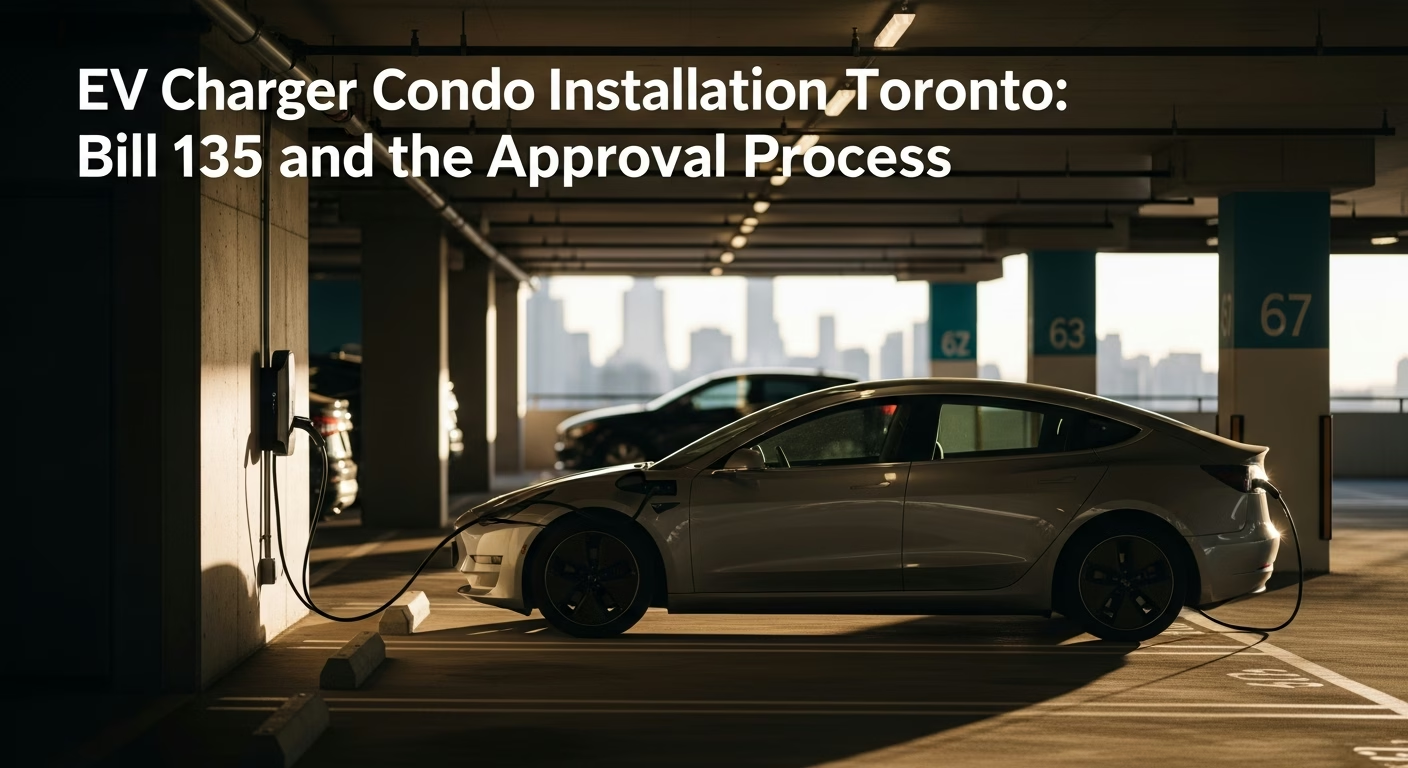

# EV Charger Condo Installation Toronto: Bill 135 and the Approval Process
Quick answer. Installing an EV charger in a Toronto condo is a fundamentally different project from a detached home — there is a legal process, a board approval, an electrical engineering load study, and usually a sub-metering arrangement to handle.Installing an EV charger in a Toronto condo is a fundamentally different project from a detached home — there is a legal process, a board approval, an electrical engineering load study, and usually a sub-metering arrangement to handle. The good news is that since Ontario passed Bill 135 — the EV Right to Charge legislation — condo boards can no longer refuse a reasonable request outright. The bad news is that "reasonable" is doing a lot of work in that sentence, and a typical Toronto condo install runs $3,500–$9,500 all-in with a 4–9 month timeline from request to commissioning.
This guide walks through the Bill 135 process, what condo boards can and cannot demand, the load-study requirements, and the realistic cost and timeline for an EV charger in a downtown Toronto building. For the wider context, see our pillar EV Charger Installation Toronto: Complete 2026 Guide.
Bill 135: What It Actually Says
Ontario's Bill 135, the EV Right to Charge legislation, amended the Condominium Act to require condo corporations to consider unit-owner requests for EV charger installation in good faith. The corporation cannot refuse outright; they must either approve, propose modifications, or demonstrate technical or financial reasons why the install is genuinely infeasible.
What Bill 135 does not do:
- It does not force condos to absorb the cost — the unit owner pays.
- It does not waive the requirement for an ESA permit.
- It does not waive the corporation's right to require an electrical engineering load study.
- It does not give the unit owner unlimited choice of charger location or hardware.
- It does not override local fire code or insurance requirements.
What it does:
- Establishes a clear request-and-response procedure with timelines.
- Requires the corporation to engage in good faith negotiation.
- Provides recourse to the Condominium Authority Tribunal if the corporation refuses unreasonably.
The Toronto Condo EV Install Process
A typical Bill 135-compliant install in a Toronto condo follows this sequence:
- 1. Unit owner request to the board in writing, specifying the parking spot, requested charger type, and proposed installer.
- 2. Board response within 60 days with approval, conditional approval, or refusal with stated reasons.
- 3. Electrical engineering load study of the building's main electrical service. The condo selects an engineering firm; the unit owner usually pays. Cost: $1,500–$4,000 (often shared across multiple unit applicants).
- 4. Sub-meter or shared-meter arrangement. The unit owner's charger usage must be billed to the unit owner, not the corporation. Three patterns: dedicated sub-meter, OPower-style smart charger reporting, or fixed-fee per kWh added to condo fees.
- 5. ESA permit pulled by Licensed Electrical Contractor (LEC).
- 6. Installation work during pre-approved hours (most condos require weekday daytime).
- 7. ESA inspection. Pass = certificate. Fail = corrections.
- 8. Building electrician sign-off that the install does not affect common-element electrical infrastructure.
- 9. Final commissioning and meter activation.
Realistic timeline: 4–9 months from initial request to first charge. The load study and the board scheduling are the slowest steps.
Toronto Condo Charger Cost Breakdown 2026
| Item | Cost (CAD) |
|---|---|
| Building electrical engineering load study (shared with other applicants) | $300–$1,500 |
| Charger hardware (typically Wallbox or ChargePoint) | $749–$1,099 |
| Conduit and conductor from electrical room to parking spot | $1,200–$3,800 |
| Sub-meter installation | $400–$900 |
| ESA permit and inspection | $180–$280 |
| Condo board admin fee | $0–$500 |
| Building electrician supervision (often required) | $300–$800 |
| Master Electrician labour | $1,800–$3,200 |
| Restoration of any drilled or core-bored common elements | $200–$600 |
Total range: $3,529–$12,679, with most landing in the $5,500–$8,500 band.
The single biggest cost variable is the run distance from the building's electrical room to the unit's parking spot. Underground parking with multiple levels and long horizontal runs through fire-rated walls drives cost up fast.
Sub-Metering: The Three Common Patterns
The corporation cannot let the unit owner's charger usage flow through the building's bulk electrical bill — it must be separately billed. Three patterns dominate:
Pattern A: Dedicated Sub-Meter
A revenue-grade sub-meter (Schneider, Honeywell, or Continental) installed in the electrical room, reading the unit's charger circuit. Building manager reads it monthly and bills the unit owner. Cost: $400–$900 for the meter, plus monthly admin fees of $5–$15.
Pros: simple, reliable, audit-friendly.
Need professional electrical services?
Call RenoHouse at 289-212-2345 or get a free estimate today.
Get Free Estimate →Cons: ongoing admin overhead.
Pattern B: Smart Charger Cloud Reporting
The charger itself (ChargePoint, Wallbox) reports usage to the cloud, which generates a monthly billing statement directly to the unit owner. No physical sub-meter needed.
Pros: zero ongoing admin.
Cons: requires cloud-connected charger; if the service goes offline, billing breaks.
Pattern C: Fixed-Fee Per Spot
The corporation charges a fixed monthly fee (typically $35–$80) regardless of usage. Simple but inequitable for low-usage owners.
Pros: zero metering complexity.
Cons: unfair to occasional users, poor incentive to charge off-peak.
What Condo Boards Can Legitimately Refuse
Bill 135 still allows refusal in limited circumstances:
- Insufficient electrical capacity in the building. If the load study shows the building service cannot handle the new load even with load management, the board can refuse pending a service upgrade.
- Fire code or insurance prohibition. Some older buildings have parking-area fire ratings that disallow charger installation.
- Heritage designation. Toronto heritage-designated condos (some King West and Distillery District buildings) may have restoration covenants.
- Disproportionate cost on the corporation. If the unit owner's install would require structural modifications to common elements at the corporation's expense, the corporation can refuse unless the unit owner pays.
Reasons that are not legitimate refusals:
- "Other owners might want one too" (this is anticipated; load study addresses it).
- "We don't want to set a precedent" (Bill 135 explicitly removes this).
- "It will affect property values" (no evidence; if anything, opposite).
- "The board doesn't approve of EVs" (irrelevant under Bill 135).
If a unit owner's request is unreasonably refused, recourse is the Condominium Authority Tribunal (CAT). The CAT has consistently sided with unit owners under Bill 135.
Load Management: How Buildings Avoid Service Upgrades
Most Toronto condos cannot absorb 30+ unit owners adding 7.7 kW chargers without a building service upgrade. Load management hardware solves this:
- Dynamic load sharing. Hardware monitors total building current and throttles all chargers proportionally during peak load. Each charger may deliver 4–6 kW during peak instead of 7.7 kW.
- Time-of-use scheduling. Chargers are restricted to off-peak hours (11pm–7am) so total daytime load is unchanged.
- Per-spot quotas. Each spot gets a fixed kWh allowance per day; the charger throttles when reached.
ChargePoint, Wallbox, and FLO all offer building-grade load management. The hardware is typically purchased and managed by the corporation, with usage costs distributed via sub-metering.
What to Do If You Are a Toronto Condo Owner
The practical path for a unit owner:
- 1. Read your condo's status certificate for any existing EV provisions.
- 2. Submit a written request to the board specifying parking spot, charger type, installer (Licensed Electrical Contractor with Master Electrician), and proposed sub-metering arrangement.
- 3. Coordinate with other interested owners in the building. A group request shares the load-study cost and accelerates the timeline.
- 4. Hire an LEC familiar with Toronto condo work. Not every electrician handles condo-specific permitting and building coordination.
- 5. Budget realistically: $5,500–$8,500 for a typical Toronto condo install, plus 4–9 month timeline.
Brand Recommendations for Condo Installs
The dominant condo-friendly brands in Toronto 2026:
- ChargePoint Home Flex — strong sub-metering integration, building-grade load management available.
- Wallbox Pulsar Plus — compact, dynamic load sharing across multiple units.
- FLO Home X5 — Quebec-engineered, durable, but lower output.
Tesla Wall Connector is technically installable in condos but Tesla does not offer the building-grade load management features required for most multi-unit deployments.
For brand details, see Tesla Wall Connector vs Universal EV Charger Toronto.
The Townhome Middle Ground
Toronto townhomes occupy a middle space — they are usually freehold with their own panel, but garage capacity is often tight and the building (in stacked or back-to-back configurations) shares walls and electrical rooms. Townhome installs are typically straightforward Tier 1 or Tier 2 from the homeowner's panel, but always require a 200A upgrade if the original panel is 100A.
For pre-install panel diagnostics in any condo or townhome scenario, see our Pre-EV Charger Panel Scan service.
---
Installing an EV charger in your Toronto condo? RenoHouse handles the full Bill 135 process — board liaison, load study coordination, ESA permit, sub-meter installation, and post-install inspection — across the GTA. Book a consultation on our EV charger bundle service page.
Sources & References
Authoritative sources cited in this guide:
- Electrical Safety Authority (ESA) — Ontario electrical regulator
- Ontario Electrical Safety Code — OESC Section 26 / latest amendments
- Canadian Electrical Code Part I (CSA C22.1) — CEC standard
- NRCan — Electric Vehicle Resources — NRCan EV/charging programs
Continue Reading