RenoHouse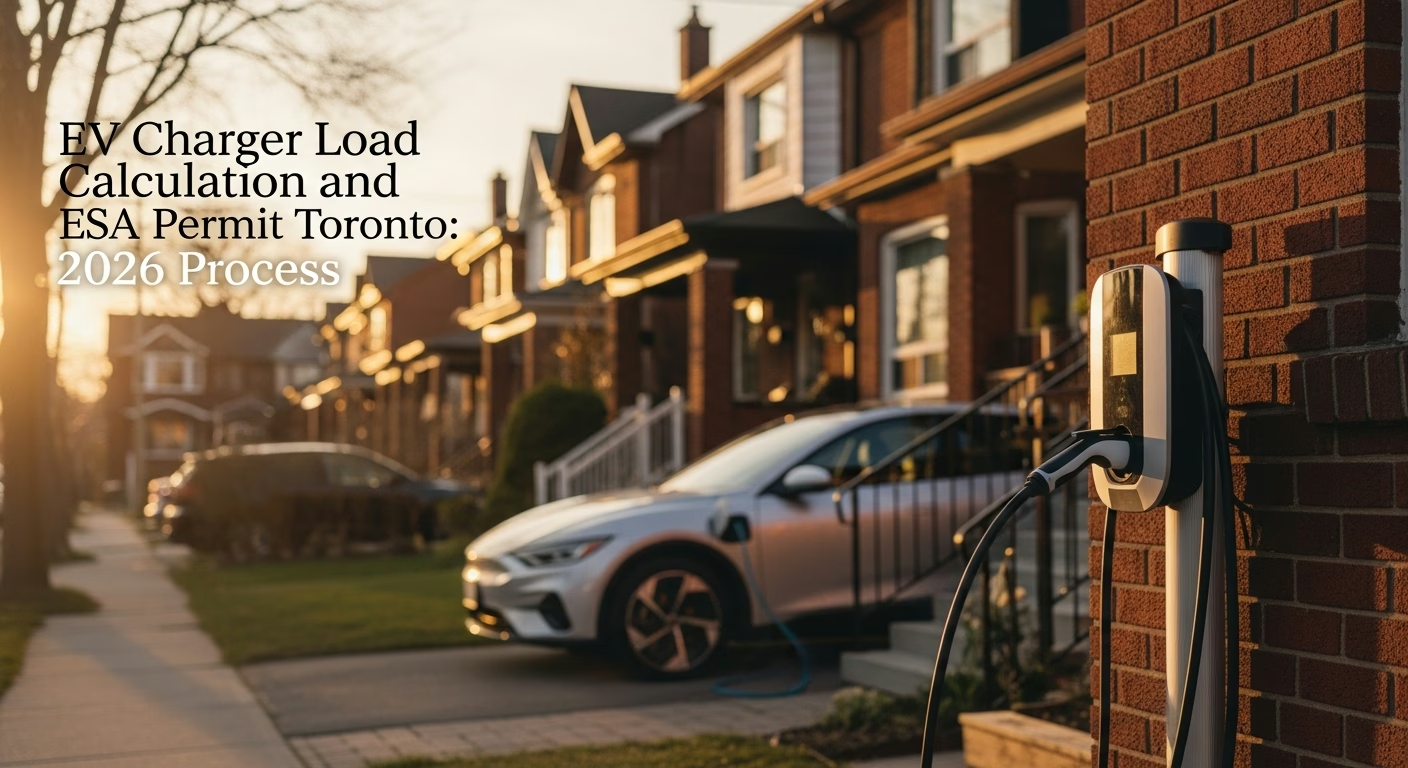

# EV Charger Load Calculation and ESA Permit Toronto: 2026 Process
Quick answer. Every Level 2 EV charger install in Ontario requires two technical artifacts before any conductor is pulled: a written load calculation per CSA C22.1 Section 8, and an ESA permit issued to a Licensed Electrical Contractor with a Master Electrician on staff.Every Level 2 EV charger install in Ontario requires two technical artifacts before any conductor is pulled: a written load calculation per CSA C22.1 Section 8, and an ESA permit issued to a Licensed Electrical Contractor with a Master Electrician on staff. These are not formalities — they are the difference between a code-compliant install that passes inspection and an unpermitted install that voids your home insurance and invalidates your home sale.
This guide walks through both processes in detail. For the wider install context, see our pillar EV Charger Installation Toronto: Complete 2026 Guide. For the panel-upgrade scenarios that the load calculation drives, see 200 Amp Panel Upgrade for EV Charger Toronto.
What a Load Calculation Actually Computes
The load calculation answers one question: can the existing service amperage handle the new EV charger continuous load on top of all existing loads, with code-required margins?
The Canadian Electrical Code (CSA C22.1) Section 8 lays out the methodology. The calculation sums:
- The base lighting and general-use load (calculated as watts per square foot of finished floor area).
- All major appliance loads (range, dryer, water heater, etc.).
- HVAC loads (central air, electric heat, heat pump).
- Any other major dedicated circuits (hot tub, pool, sub-panels, workshop).
- The new EV charger continuous load (40A or 48A) at 125% of nameplate (code requirement).
Sum total in watts is then divided by 240V to get total amps. If that total exceeds the service amperage (100A or 200A), the panel cannot safely carry the new load and an upgrade is required.
A Worked Example: 1985 East York Detached, 100A Service
A typical pre-2000 East York detached home, 1,800 sq ft finished, gas furnace, electric range, electric dryer, central A/C:
| Load | Calculation | Watts |
|---|---|---|
| Lighting and general (Section 8-200(1)(a)) | 1,800 sq ft × 5 W/sq ft | 9,000 |
| First 90 sq m at full | 90 × 50W (full demand) | minus 4,500 reduction |
| Electric range | At 6,000W (Section 8-200) | 6,000 |
| Electric dryer | At 5,500W | 5,500 |
| Central A/C | 3,500W (75% demand factor on cooling) | 2,625 |
| Other dedicated circuits | various | 1,200 |
| New EV charger 40A continuous | 40A × 240V × 125% | 12,000 |
| Total demand | 31,825 W | |
| Total amps at 240V | 132.6A |
A 100A service cannot legally carry 132.6A of calculated demand. Result: panel upgrade to 200A is required before the EV charger can be installed.
This is why approximately 60% of pre-2000 Toronto detached homes need the 200A upgrade as part of the EV project.
A Second Example: 2008 Mississauga Detached, 200A Service
Newer 2,800 sq ft Mississauga build, gas furnace, electric range, electric dryer, central A/C, hot tub:
| Load | Calculation | Watts |
|---|---|---|
| Lighting and general | 2,800 × 5 W | 14,000 |
| Demand factor reduction | (per Section 8) | minus 6,500 |
| Electric range | 6,000 | |
| Electric dryer | 5,500 | |
| Central A/C | 3,500 × 0.75 | 2,625 |
| Hot tub (40A continuous) | 40A × 240V | 9,600 |
| Other dedicated | 1,500 | |
| New EV charger 48A continuous | 48 × 240 × 1.25 | 14,400 |
| Total | 47,125 W | |
| Total amps | 196.4A |
A 200A service can carry 196.4A — at 98% of capacity. This passes ESA but with no margin. If a second EV charger or a heat pump is added later, a 400A upgrade or load-management hardware is needed.
This is why the load calculation is critical: a homeowner adding an EV today might pass at 98% capacity, but cannot add anything else without further work.
Need professional electrical services?
Call RenoHouse at 289-212-2345 or get a free estimate today.
Get Free Estimate →Demand Factors: Where Toronto Calculations Get Nuanced
Section 8 of the Canadian Electrical Code allows demand factor reductions on certain loads, recognizing that not all loads run simultaneously at full capacity. Common factors:
- Lighting and general: 100% of first 90 sq m, 25% of remainder.
- Electric range: 6,000W base or per nameplate.
- Heating and cooling: larger of the two at 100%, smaller can be excluded.
- EV charger: must be calculated at 125% of nameplate continuous current (no demand reduction).
The EV charger gets no demand reduction because it is treated as a continuous load — meaning it runs at full nameplate for more than 3 hours at a time, which is exactly what overnight charging does.
A common calculation error is applying a demand factor to the EV charger to make the math fit on a 100A panel. ESA inspectors will reject this immediately.
What the ESA Permit Actually Covers
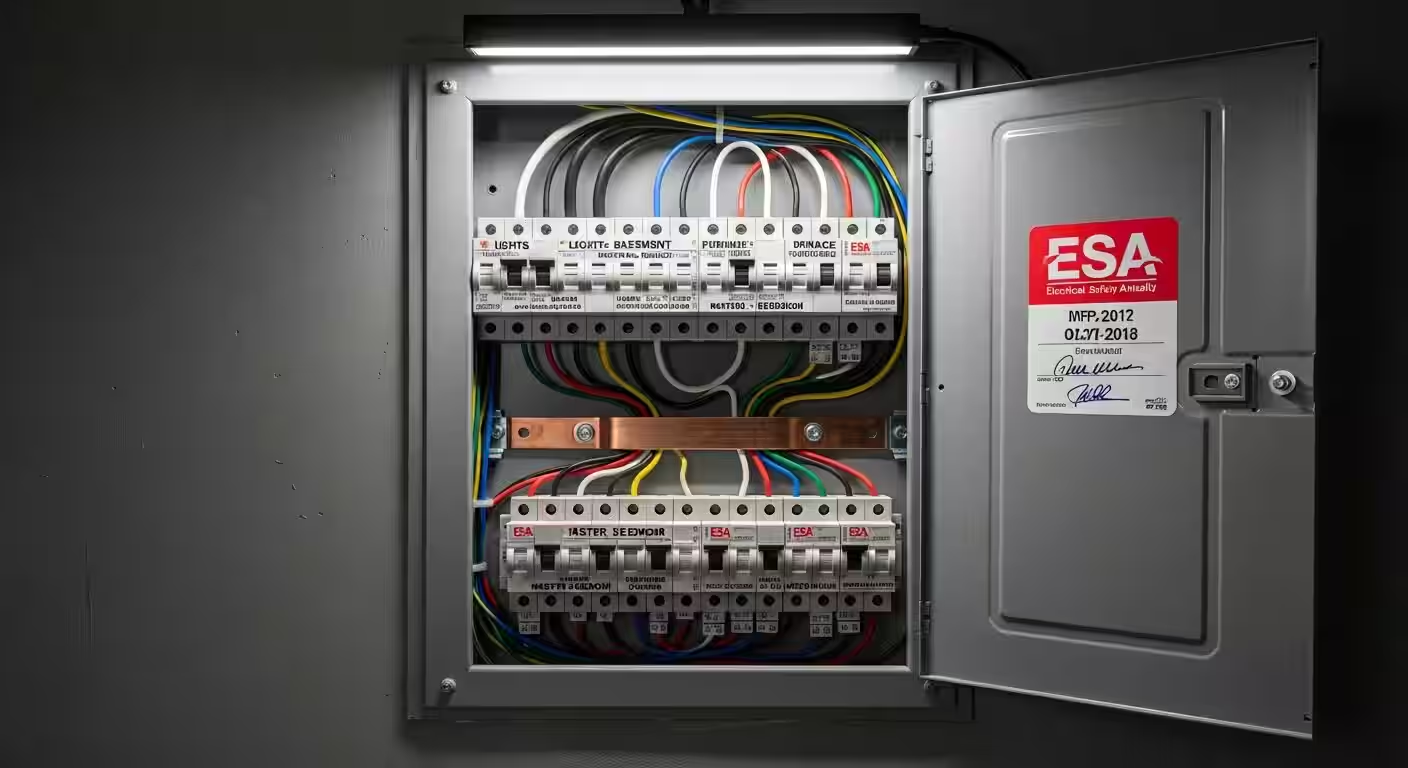
The ESA permit is a contract between the Licensed Electrical Contractor (LEC) and the Electrical Safety Authority that authorizes the work and triggers the inspection. The permit:
- Requires the contractor to be an LEC (firm-level license).
- Requires a Master Electrician on staff (individual designation).
- Specifies the scope of work (panel upgrade, EV circuit, etc.).
- Provides a permit number that must be on file with ESA.
- Triggers a post-work inspection by an ESA inspector.
The cost is $130–$280 depending on scope. The permit number is issued immediately upon application.
Who Can Pull an ESA Permit
Only Licensed Electrical Contractors can pull permits. To verify:
- 1. ESA maintains a public LEC database. Search by company name or LEC number.
- 2. Every quote should list the LEC number and the Master Electrician's name.
- 3. The LEC must hold both an ECRA (Electrical Contractor Registration Agency) license AND have a Master Electrician on staff.
Homeowners cannot pull permits for EV charger work in their own home (residential homeowner permits do exist for other electrical work but not for EV charger installs in 2026).
The Inspection Process
After installation, the LEC schedules an ESA inspection. The inspector visits and verifies:
- Panel is properly bonded and grounded.
- Conductor sizing matches the breaker and the calculated load.
- Conduit installation meets code (proper supports, fittings, junction box accessibility).
- Breaker is sized at 125% of EV charger continuous current.
- Charger mounting and termination match the manufacturer's instructions.
- All exposed terminations are inside enclosures.
- GFCI protection is present where required (outdoor receptacles, NEMA 14-50 in some configurations).
- Working space around the panel meets clearance requirements.
Result: pass = certificate issued (typically within 24 hours of inspection). Fail = correction notice listing specific issues; LEC fixes and requests re-inspection.
In the GTA, inspections are typically scheduled within 5–14 business days of the LEC's request. Same-day rush inspections are available for an additional fee.
What Happens If You Skip the Permit
The realistic consequences:
- 1. Insurance. Home insurance policies in Ontario require electrical work to be code-compliant and ESA-permitted where applicable. An unpermitted EV charger that causes a fire or panel failure will not be covered. This is the most-cited risk.
- 2. Resale. Toronto home inspectors routinely flag unpermitted electrical work. Buyers either demand the work be re-done (with permit and inspection) before closing, or walk away. Unpermitted EV charger installs reduce resale value by far more than the permit would have cost.
- 3. ESA discovery. ESA periodically audits installs, particularly after fire incidents. Discovery results in a remediation order, fines to the contractor, and potential prosecution for unlicensed practice.
- 4. Building code at sale. Some Toronto suburbs require ESA certificates for any electrical work as part of the sale process. Missing certificates delay closings.
The permit costs $130–$280. There is no scenario where skipping it makes sense.
What to Demand From Your Electrician
Before signing a quote:
- 1. LEC number. Verify in ESA database.
- 2. Master Electrician's name. Request it in writing.
- 3. Written load calculation. Specifically calculated for your home with your sq footage and existing loads.
- 4. Quote includes ESA permit and inspection. Both line items.
- 5. Quote includes ESA inspection certificate provision (you should receive a copy).
- 6. Re-inspection clause if the inspection fails on contractor's work (no charge to homeowner for contractor-error corrections).
If a contractor refuses to put the LEC number, Master Electrician's name, or the load calculation in writing, walk away.
What the Load Calculation Tells You About Your Future
A useful detail of the load calculation: it reveals how much spare capacity your panel has after the EV charger is added. If the calculation shows you are at 75% of 200A after the EV install, you have meaningful headroom for future loads (heat pump, second EV, hot tub). If it shows 95%, you are effectively at the ceiling and any future electrification triggers another upgrade.
For panel-side diagnostics that complement the load calculation, see our Pre-EV Charger Panel Scan service.
---
Need a Master Electrician to run the load calculation and pull the ESA permit for your GTA EV charger install? RenoHouse handles the full process — load calc in writing, permit pulled, inspection scheduled, certificate delivered. Book on our EV charger bundle service page.
Sources & References
Authoritative sources cited in this guide:
- Electrical Safety Authority (ESA) — Ontario electrical regulator
- Ontario Electrical Safety Code — OESC Section 26 / latest amendments
- Canadian Electrical Code Part I (CSA C22.1) — CEC standard
- NRCan — Electric Vehicle Resources — NRCan EV/charging programs
Continue Reading