RenoHouse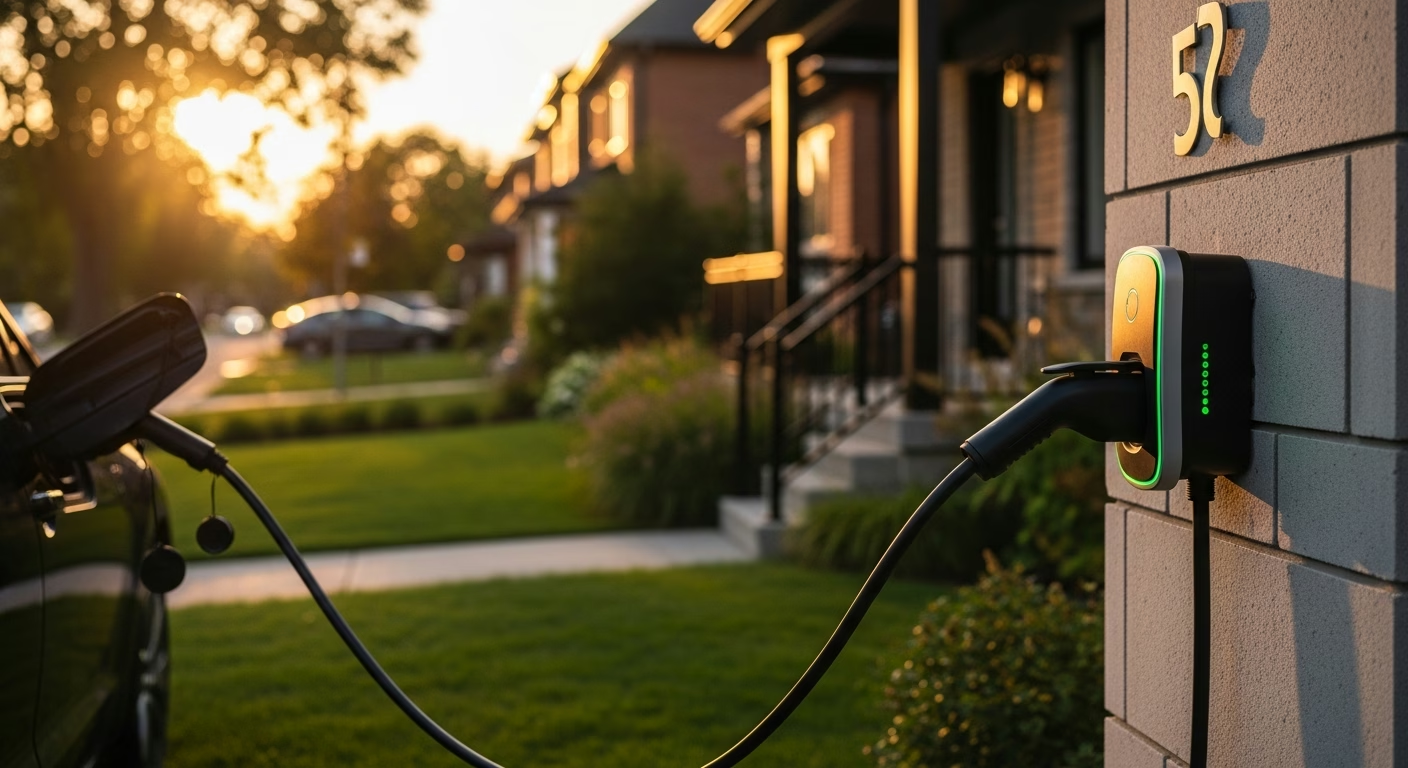

# EV Charger ROI vs Public Charging Toronto: 2026 Payback Math
Quick answer. The honest payback math for a home EV charger in the GTA in 2026: a Tier 2 hardwired install at $3,200 pays for itself in 22–30 months for any household driving more than 12,000 km annually. Compared against public charging, the home install is one of the highest-return home renovations available — better than a kitchen reno, better t...The honest payback math for a home EV charger in the GTA in 2026: a Tier 2 hardwired install at $3,200 pays for itself in 22–30 months for any household driving more than 12,000 km annually. Compared against public charging, the home install is one of the highest-return home renovations available — better than a kitchen reno, better than a bathroom redo, better than most landscaping. The numbers also account for the resale premium that GTA listings now show for hardwired Level 2 charging.
This guide runs the math three different ways: home charger versus public charging, home charger versus gasoline, and home charger as a resale-value play. For the underlying install costs, see EV Charger Cost Toronto: Tier-by-Tier Installation Pricing. For the wider context, see our pillar EV Charger Installation Toronto: Complete 2026 Guide.
The Three Reference Costs in 2026 Toronto
Three numbers anchor every calculation:
- Home charging on Toronto Hydro EV ultra-low rate (11pm-7am): about 2.4 cents per kWh.
- Home charging on standard off-peak TOU: about 8.7 cents per kWh.
- Public Level 2 charging (ChargePoint, IVY, FLO): about 35 cents per kWh.
- Public Level 3 DC fast charging: about 45-55 cents per kWh.
- Gasoline at $1.65/litre, fuel-efficient ICE at 8.5 L/100km: 14 cents per km.
- EV at 18 kWh/100km on home ultra-low rate: 0.4 cents per km.
The home-vs-public ratio is roughly 15:1. The home-vs-gasoline ratio is roughly 35:1. These are the spreads that drive the payback math.
ROI Scenario 1: Home Charger vs Pure Public Charging
The hardest-edge case: an EV owner with no home charger who relies entirely on public infrastructure.
A 15,000 km annual driver in a typical GTA EV (Tesla Model 3, Hyundai Ioniq 5, Kia EV6) consumes roughly 2,700 kWh per year. Cost on public charging:
- All public Level 2 at 35 cents per kWh: $945 per year.
- Mixed public Level 2 and Level 3 (typical pattern, 60/40): $1,080 per year.
Same 2,700 kWh on home ultra-low rate: $65 per year.
Annual saving from going to home: $880-$1,015.
Tier 2 install cost: $3,200.
Payback period: 3.2 to 3.6 years of pure public-charging avoidance.
ROI Scenario 2: Home Charger vs Gasoline (Pure Replacement)
The more common scenario: a gasoline driver buying their first EV and weighing whether to install the home charger or rely on Level 1 plus occasional public charging.
15,000 km annual driving at:
- Gasoline ICE at 14 cents per km: $2,100 per year in fuel.
- EV on home ultra-low rate at 0.4 cents per km: $60 per year.
Annual saving from going EV with home charging: $2,040.
Even if the homeowner attributes only 70% of that saving to the home charger (the other 30% is the EV decision itself), the home charger captures $1,430 per year in incremental savings versus Level 1 plus public.
Tier 2 install cost: $3,200.
Need professional electrical services?
Call RenoHouse at 289-212-2345 or get a free estimate today.
Get Free Estimate →Payback period: 2.2 years.
ROI Scenario 3: Two-EV Household (Mississauga 30,000 km Combined)
A typical Mississauga two-vehicle household with combined 30,000 km annual:
- Both on gasoline: $4,200/year in fuel.
- Both on EV with home charger: $120/year in electricity.
Annual saving: $4,080.
Tier 3 install with 200A panel upgrade and dual chargers: $8,500.
Payback period: 2.1 years.
For dual-charger setups, see Dual EV Chargers for Two Cars Toronto.
ROI Scenario 4: The Hidden Time Cost of Public Charging
Pure dollar math undersells the home charger value because it ignores time. Public charging adds friction:
- 30-minute Level 3 stop adds 30 minutes to a trip versus 0 minutes of home charging.
- Level 2 public station: 4-6 hours of dwell time per session.
- Queue time during commute hours: 10-25 minutes additional.
For a 15,000 km driver doing two public charging stops per week (typical for a no-home-charger user), the weekly time cost is 1.5-2.5 hours. That is 80-130 hours per year.
If that user values their time at $25/hour (conservative), the time cost of public charging is $2,000-$3,250 per year on top of the dollar cost.
Total all-in saving from home charging: $2,880-$4,265 per year.
Adjusted payback period: 9-13 months.
Resale Premium: The Sometimes-Overlooked Driver
GTA real estate data through 2025 shows hardwired Level 2 charging is now flagged in MLS listings and adds measurable closing-price premium:
- Detached homes with permit-verified Level 2 charging: $3,500-$8,000 premium vs comparable homes without.
- Reduced days-on-market by an average of 6 days.
- Higher offer count in competitive bidding.
The premium is heavily concentrated in detached and semi-detached homes in Etobicoke, North York, Mississauga, Markham, Oakville. Condo-level chargers carry less resale premium because most condo buyers cannot easily replicate the install.
If the homeowner sells within 5 years, the resale premium alone often exceeds the install cost.
ROI Adjustments for Specific Scenarios
Plug-in hybrid (PHEV): smaller battery (15-20 kWh), shorter electric range. Annual electricity savings reduced to about 35-50% of pure-EV scenarios. Payback period extends to 4-5 years. Still positive ROI but slower.
What About Maintenance Savings?
EVs have lower maintenance costs than ICE vehicles — no oil changes, no spark plugs, no transmission fluid, no exhaust system, brakes that last 2-3x longer due to regenerative braking. Typical Toronto annual maintenance:
- Gasoline ICE: $800-$1,400 in routine maintenance.
- EV: $200-$400 in routine maintenance.
Annual savings: $600-$1,000.
This is not directly attributable to the home charger but is part of the broader EV ROI that the home charger enables. Without home charging, public charging fees consume most of the maintenance savings.
Comparing to Other Home Improvements
The honest comparison of EV charger ROI to other GTA home renovations:
| Improvement | Cost | Annual Saving / Premium | Payback |
|---|---|---|---|
| EV charger Tier 2 | $3,200 | $1,500-$2,500 | 1.5-2 years |
| Heat pump | $14,000 | $1,800-$2,800 | 5-7 years |
| Attic insulation | $2,800 | $400-$700 | 4-7 years |
| Kitchen reno | $35,000 | Resale premium $15-25K | Never (lifestyle) |
| Bathroom reno | $18,000 | Resale premium $8-15K | Never (lifestyle) |
| Solar PV (10 kW) | $24,000 | $1,800-$2,400 | 10-13 years |
The EV charger has the fastest payback of any common home improvement in the GTA. Heat pump is second-best on a per-dollar basis but takes 4-5x longer to pay back.
Greener Homes Loan Effect on ROI
Financing the install via the federal Greener Homes Loan (0% interest, 10-year term) effectively makes the install cash-flow-positive from day one for any household saving more than $33/month in fuel costs (which is essentially every EV household in the GTA).
For Greener Homes Loan details, see EV Charger Rebates Toronto: Greener Homes Loan and Programs.
What the Math Means in Practice
For most GTA households considering an EV charger, the question is not "does it pay back?" — the answer is unambiguously yes, fast — but "which install tier is right?" The answer:
- Drive less than 8,000 km/year: Tier 1 plug-in is fine. ROI is slow but install cost is lowest.
- Drive 12,000-25,000 km/year (most GTA commuters): Tier 2 hardwired. Best ROI ratio. 22-30 month payback.
- Drive 25,000+ km/year or two-EV household: Tier 3 with panel upgrade and dual chargers. Sub-2-year payback.
For pre-install panel diagnostics that ensure the install runs without surprises, see our Pre-EV Charger Panel Scan service.
---
Want a written ROI projection specific to your GTA driving patterns and home? RenoHouse runs the math during free consultations — annual kWh, home rate, public-charging avoidance, and resale premium — so you have a real number, not a guess. Book on our EV charger bundle service page.
Sources & References
Authoritative sources cited in this guide:
- Electrical Safety Authority (ESA) — Ontario electrical regulator
- Ontario Electrical Safety Code — OESC Section 26 / latest amendments
- Canadian Electrical Code Part I (CSA C22.1) — CEC standard
- NRCan — Electric Vehicle Resources — NRCan EV/charging programs
Continue Reading