RenoHouse

# Garden Suite Rental Income Toronto: ROI and Mortgage Helper Math
Quick answer. A typical Toronto garden suite in 2026 generates between $2,500 and $4,500 per month in long-term residential rent, runs a 5.5% to 6.5% cap rate on construction cost, and pays back through rent alone in 5.5 to 7.5 years.A typical Toronto garden suite in 2026 generates between $2,500 and $4,500 per month in long-term residential rent, runs a 5.5% to 6.5% cap rate on construction cost, and pays back through rent alone in 5.5 to 7.5 years. Layered with the property value uplift ($285K-$320K) and Toronto's underlying appreciation (~3% per year), the 10-year total return on a $450K garden suite typically lands between 155% and 175% of construction cost. The math beats every other Toronto residential renovation niche by a meaningful margin.
This guide walks through the realistic ROI on a Toronto garden suite, contrasts it with basement apartments and laneway houses, and works through the four financing strategies homeowners most often use: HELOC, refinance to 80% LTV, construction draw mortgage, and the CMHC MLI Select 5-unit stack.
For the regulatory foundation, see Garden Suite Toronto 2026 Complete Guide. For the cost stack the rental income is offsetting, see Garden Suite Cost Toronto: Full 2026 Breakdown.
What Toronto Garden Suites Rent For in 2026
Long-term residential rents (the only legal use under Toronto STR rules):
| Suite Type | Monthly Rent (Inner-City) | Monthly Rent (Premium Corridor) |
|---|---|---|
| Studio (300-400 sqft) | $1,800 to $2,200 | $2,200 to $2,500 |
| 1BR (450-650 sqft) | $2,200 to $2,800 | $2,500 to $3,100 |
| 1BR + loft (650-800 sqft) | $2,600 to $3,100 | $2,900 to $3,400 |
| 2BR (700-900 sqft) | $2,800 to $3,500 | $3,200 to $4,000 |
| 2BR+ premium (900-1,200 sqft) | $3,300 to $4,000 | $3,800 to $4,500 |
Premium corridors are Roncesvalles, Trinity-Bellwoods, Leslieville, Riverdale, Annex, Bloor West, Cabbagetown, and Junction. Inner-city rents apply to most other neighbourhoods covered by the bylaw. Outer suburban areas (Etobicoke, North York, Scarborough) typically run 10-15% below inner-city rates due to longer transit commutes.
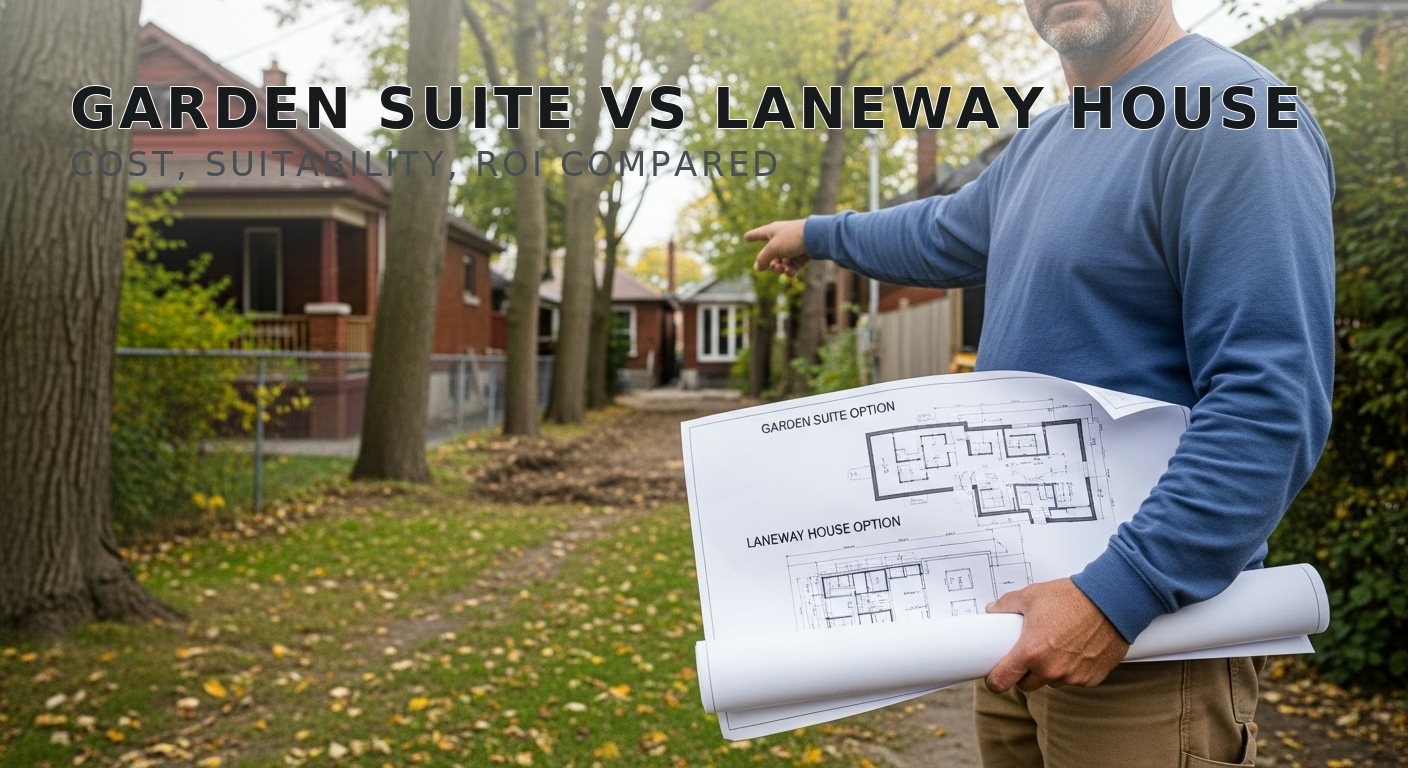
Garden suite rents typically run 8-15% below comparable laneway suite rents in the same neighbourhood, because tenants pay a premium for the direct laneway-side independence and street address.
ROI Worked Example: Roncesvalles 2BR Garden Suite
The benchmark scenario most Toronto agents and accountants model. 25 ft × 130 ft lot, 800 sqft 2BR garden suite, post-849-2025 design with a cantilevered second storey.
| Metric | Value |
|---|---|
| All-in construction cost | $475,000 |
| Monthly rent (2026 market) | $3,150 |
| Annual gross rent | $37,800 |
| Vacancy and collection (5%) | -$1,890 |
| Effective gross income | $35,910 |
| Property tax delta | -$3,500 |
| Insurance delta (additional rider) | -$1,200 |
| Maintenance reserve (8% of gross) | -$3,024 |
| Property management (8%, if used) | -$2,873 |
| NOI (self-managed) | $28,186 |
| NOI (managed) | $25,313 |
| Cap rate on cost (self-managed) | 5.93% |
| Cap rate on cost (managed) | 5.33% |
| Implied resale value at 5.5% cap rate | $460K to $511K |
| Property value uplift estimate | $285K to $320K |
| 10-year total return (rent + 2.5%/yr appreciation) | ~155-175% of cost |
| Payback period (rent alone) | 5.5 to 7.5 years |
The cap rate on construction cost (5.93%) is similar to GTA multi-residential cap rates (4.5-5.5%), with the garden suite's premium reflecting single-tenant operational simplicity and exit liquidity through the parent home's resale.
Cap Rate Comparison: Garden Suite vs Other Toronto Investments
| Investment Type | Typical Cap Rate (2026) | Capital Required |
|---|---|---|
| Single-family home (passive appreciation) | 1-2% (rent-only) | $1.5M+ |
| Condo investment (1BR downtown) | 3.5-4.5% | $700K-$900K |
| Basement apartment (legal) | 8-12% | $60K-$120K |
| Garden suite | 5.5-6.5% | $295K-$625K |
| Laneway house | 6-7% | $365K-$775K |
| Multiplex conversion (4-unit) | 4.5-5.5% | $400K-$1.5M (on top of acquisition) |
| Multiplex + ADU (5-unit MLI Select) | 5.5-7% | $975K-$2.21M |
Basement apartments win on cap rate but the absolute capital is small ($60K-$120K) so the dollar-amount return is much smaller. Garden suites and laneway houses produce meaningful absolute returns at moderate cap rates. The 5-unit multiplex stack wins on cash-on-cash through CMHC MLI Select financing.
Mortgage Helper Math
A garden suite's most powerful financial role is as a "mortgage helper": rental income that offsets the homeowner's primary mortgage payment, accelerating principal paydown and increasing affordability.
Worked scenario. Owner has $1.5M Toronto detached home with a $900K mortgage at 5.0% on a 25-year amortization. Monthly mortgage payment: $5,228.
Owner builds a $450K garden suite financed via refinance to 80% LTV, drawing $300K against the home's existing equity. New total mortgage: $1.2M, payment $6,966.
Garden suite rents at $3,150/month. Net rental income after expenses: $2,348/month.
| Cashflow Item | Pre-Garden Suite | Post-Garden Suite |
|---|---|---|
| Owner mortgage payment | -$5,228 | -$6,966 |
| Garden suite NOI (after all expenses) | $0 | +$2,348 |
| Net monthly housing cost | -$5,228 | -$4,618 |
| Monthly savings | $610 |
The owner is roughly $610/month better off after building the garden suite. Plus the suite is paying down the additional $300K of mortgage at $1,738/month versus the $0 it would otherwise pay. Plus the property value has gone up by $295K. Plus the suite continues appreciating with the underlying market.
In low-amortization scenarios (15-year mortgages or near-paid-off properties), the garden suite often generates positive cashflow on top of the mortgage payment. In high-amortization scenarios (recent 25-30 year mortgages with high rates), it acts purely as a mortgage helper with limited or zero positive cashflow but strong long-term equity build.
Financing Strategy 1: HELOC
Up to 65% LTV against existing property value. Variable rate at prime plus 0.5-1% (~6.7-7.2% in May 2026). Best for smaller, faster deployments.
Pros:
- Fast approval (often 2-4 weeks).
- No penalty on existing mortgage.
- Pay only what you draw.
- Full flexibility on repayment schedule.
Cons:
- Variable rate exposes you to rate-rise risk.
- 65% LTV cap may not cover full project cost.
- Interest-only payments don't pay down principal.
Best for: $200K to $400K projects on properties with substantial equity (>50% equity in current home).
Financing Strategy 2: Refinance to 80% LTV
Refinance the existing mortgage at 80% LTV using "as-improved" appraisal (i.e., lender appraises the property at post-construction value). 5-year fixed at ~4.7-5.2% in May 2026.
Need professional renovation?
Call RenoHouse at 289-212-2345 or get a free estimate today.
Get Free Estimate →Pros:
- Predictable rate.
- Larger draw available.
- Existing mortgage replaced; cleanup of structure.
Cons:
- Penalty on existing mortgage (typically 3 months interest or interest rate differential, whichever is greater).
- As-improved appraisal can be conservative; lenders sometimes lend on present value not future value.
- Requires a single refinance event; less flexibility.
Best for: $300K to $500K projects on properties with current rates above market or where the existing mortgage is small.
Financing Strategy 3: Construction Draw Mortgage
Big 5 banks (TD, RBC, BMO, Scotia, CIBC) offer construction draw mortgages with 4-5 stage draws and progress inspections. Rates: construction prime plus 1-2% during build, rolling to permanent mortgage at completion.
Stage draws typical schedule:
- Draw 1: foundation complete (~15% of construction cost)
- Draw 2: framing and roofing complete (~35%)
- Draw 3: rough-in mechanical complete (~55%)
- Draw 4: drywall and insulation complete (~75%)
- Draw 5: final completion and occupancy (~100%)
Pros:
- Designed for new construction.
- Pay interest only on drawn amount.
- Up to 75-80% LTV on as-improved.
Cons:
- Multiple inspections add 2-4 weeks of process overhead.
- Draws can be slow during peak construction periods.
- Bank requires extensive documentation (architectural drawings, permits, contractor agreement, insurance).
Best for: ground-up new builds where the homeowner has no existing equity to draw.
Financing Strategy 4: Equitable Bank Laneway House Mortgage
Launched August 2024. Specifically for laneway homes and garden suites in GTA, Greater Vancouver, and Calgary. Available through mortgage broker network only.
Pros:
- Designed specifically for ADU construction.
- Interest-only payments during construction.
- Works on free-and-clear properties or with a new/existing first mortgage.
- Minimum loan $200K; typically lent up to 75-80% LTV.
Cons:
- Higher rate than Big 5 (typically 1-2% above prime).
- First-position required (refinance any existing mortgage to EQB or pay off).
- Broker channel only; not available retail.
Best for: free-and-clear property owners or owners refinancing anyway.
Financing Strategy 5: CMHC MLI Select (the unlock)
Available for 5+ unit residential rental properties. The Toronto strategy: convert main house to fourplex (4 units) via By-law 474-2023 PLUS add a garden suite (1 unit) = 5 units. Total project crosses MLI Select threshold.
Benefits:
- Up to 95% loan-to-value (5% down).
- Up to 50-year amortization (with 0.25% surcharge per 5-year increment above 25; max 1.25% surcharge at 50).
- Forgivable grants up to $85K/unit for energy-efficient (NZE-ready) builds.
- Reduced mortgage insurance premiums on points scoring (affordability + energy + accessibility).
Cons:
- Multi-unit threshold (5+ units) means single garden suite alone doesn't qualify; you must build the multiplex first or simultaneously.
- Complex application; typically 6-9 months.
- Energy efficiency targets require Net Zero Ready or near it, adding 10-15% to construction cost.
- Tarion warranty and HCRA registration required.
Cash-on-cash returns at 95% MLI Select on a $1.5M 5-unit project: typically 12-18% in year one, growing as rents step up.
For the multiplex side of the stack, see Multiplex Conversion Toronto 2026 Complete Guide.
Property Tax Impact
MPAC is auto-notified by Toronto Building when occupancy is issued. Site review or desk reassessment within 6-18 months. Supplementary tax bill issued retroactively (often covers the part of the year the suite was completed plus the full following year).
Expected tax increase: $2,000 to $6,000 per year, depending on suite size and assessed value. A $475K 2BR garden suite typically triggers ~$3,500/year increase.
The retroactive bill is the surprise. If you occupied in March 2025 and reassessment lands in July 2026, you receive a bill for 16 months of additional tax in a single statement.
For more on permit-process surprises, see Garden Suite Permits Toronto: Full Process and Timeline.
Tax Treatment of Rental Income
Rental income is reported on Schedule T776 (Statement of Real Estate Rentals) of the homeowner's personal tax return. Deductible expenses:
- Mortgage interest (proportional to the rental portion of the property).
- Property tax (proportional).
- Repairs and maintenance.
- Utilities (if paid by landlord).
- Insurance (proportional).
- Advertising and tenant placement fees.
- Property management fees.
- Professional fees (accountant, legal).
- Some travel costs related to rental management.
Capital Cost Allowance (CCA) is technically deductible but most accountants advise against claiming CCA on rental ADUs, because:
- It triggers recapture on sale (taxable income at marginal rate).
- The accumulated depreciation can erase the principal residence exemption on the rental portion.
- The cash-flow benefit of CCA is small relative to the eventual recapture cost.
Capital Gains and Principal Residence Exemption
When the parent property sells:
- Principal Residence Exemption (PRE) applies to the main house portion.
- The garden suite portion is generally exempt if still under one parcel (PRE extends to ancillary structures on the same lot).
- HOWEVER, if the suite was used to earn rental income, CRA may attribute a portion of the gain to non-PRE use under change-in-use rules. Subsection 45(2) election can defer.
Practical guidance: consult a tax accountant before completing the suite. The election structures vary based on intent (rental from day one vs occupied first then rented vs flexible).
ROI Sensitivity Analysis
Rent and cost are the two biggest swing variables. A 10% swing in either changes the numbers meaningfully.
Rent Sensitivity (assuming $475K cost)
| Monthly Rent | Annual Gross | NOI | Cap Rate |
|---|---|---|---|
| $2,800 | $33,600 | $24,800 | 5.22% |
| $3,150 (base) | $37,800 | $28,186 | 5.93% |
| $3,500 | $42,000 | $31,572 | 6.65% |
| $3,800 | $45,600 | $34,475 | 7.26% |
Cost Sensitivity (assuming $3,150 rent)
| All-In Cost | NOI | Cap Rate |
|---|---|---|
| $400K | $28,186 | 7.05% |
| $475K (base) | $28,186 | 5.93% |
| $550K | $28,186 | 5.13% |
| $625K | $28,186 | 4.51% |
The cost discipline upstream matters more than the rent optimization downstream. A $50K cost reduction adds ~50 basis points of cap rate, equivalent to roughly $250/month of rent.
When Garden Suites Don't Work Financially
The 2019 Toronto Life case study of a Danforth/Greenwood laneway homeowner who built for $450K plus $90K in development charges (pre-DC-deferral era) and saw only ~$60K of incremental sale value above comparable. The lesson: in a rising market, the parent home appreciates regardless; the suite must generate rent or differentiated resale value to truly add return.
In 2026 the math is more favourable because:
- Development charges are now $0 for garden suites and laneway suites under the DC Deferral Program.
- The 849-2025 envelope expansion increases per-square-foot output.
- Rental rates have grown faster than construction costs since 2022.
- CMHC MLI Select unlocks 95% LTV financing at 5-unit threshold.
But the underlying lesson stands: a garden suite is a rental investment first and a home-improvement second. Build it for the rent, not for the resale uplift alone.
Get a Realistic ROI Model
RenoHouse provides a free ROI model with every site assessment, calibrated to your specific neighbourhood's rental rates, your property's appraisal, your existing mortgage structure, and your tax bracket. We model HELOC, refinance, construction draw, EQB, and MLI Select scenarios side-by-side.
Get a free site assessment at /services/multi-unit-aru-conversions/garden-suite-construction.
Sources & References
Authoritative sources cited in this guide:
- Toronto Garden Suite Bylaw 89-2022 — Toronto garden suite regulations
- Bill 23 — More Homes Built Faster Act — Provincial ARU enabling legislation
- Toronto Committee of Adjustment — Variance process
Continue Reading