RenoHouse

# Garden Suite Toronto: The Complete 2026 Guide
Quick answer. A garden suite is a detached, self-contained dwelling built in the rear yard of a Toronto residential lot. Since City Council passed By-law 89-2022 in February 2022, and especially after the July 2025 update under By-law 849-2025, garden suites are permitted as-of-right on virtually every R-zone lot in Toronto, with no parking minimum, no...A garden suite is a detached, self-contained dwelling built in the rear yard of a Toronto residential lot. Since City Council passed By-law 89-2022 in February 2022, and especially after the July 2025 update under By-law 849-2025, garden suites are permitted as-of-right on virtually every R-zone lot in Toronto, with no parking minimum, no zoning amendment, and no Committee of Adjustment hearing required for compliant designs. In 2026, a typical garden suite in the GTA costs between $295,000 and $625,000 all-in, generates $2,200 to $3,300 per month in rental income, and adds an estimated $285,000 to $320,000 in property value. The math is more favourable than any other residential renovation niche in Toronto.
This is the RenoHouse pillar guide for garden suite construction in 2026. We cover the regulatory framework (Bylaw 89-2022, Bylaw 849-2025, Bill 23, Ontario Regulation 462/24), eligibility on your specific lot, the full cost stack phase-by-phase, the 12 to 18 month idea-to-occupancy timeline, design archetypes from studio through 2BR, the financing landscape including the new Equitable Bank Laneway House Mortgage and CMHC MLI Select stack play, and the realistic ROI a Toronto homeowner can model.
If you have a public laneway abutting your lot, also read Laneway House Construction Toronto: Complete 2026 Guide. If you are considering a four-unit conversion of the existing house, see Multiplex Conversion Toronto: Complete 2026 Guide. The most aggressive 2026 stack is a 4-unit multiplex plus a garden suite, totalling 5 units and unlocking CMHC MLI Select financing.
What a Garden Suite Is, in Plain Terms
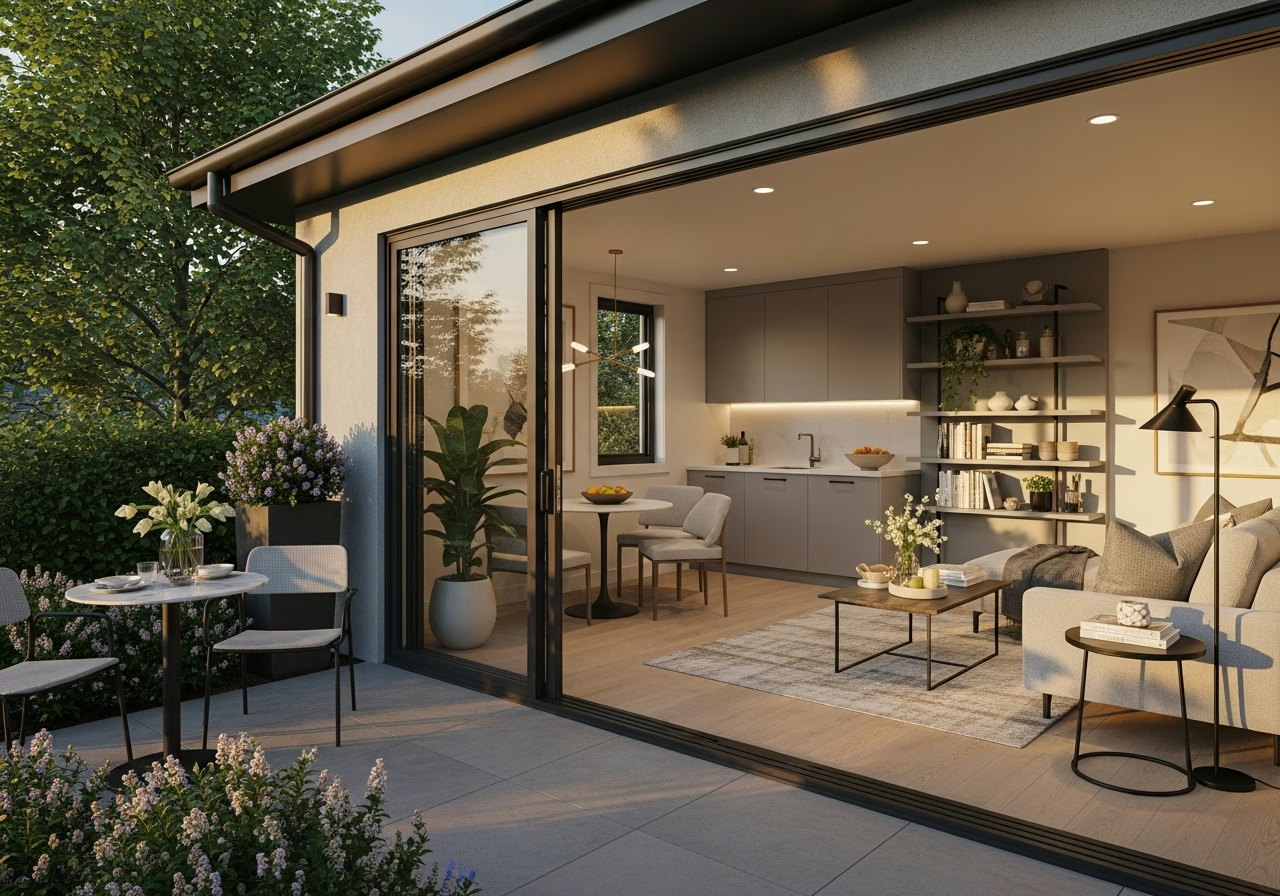
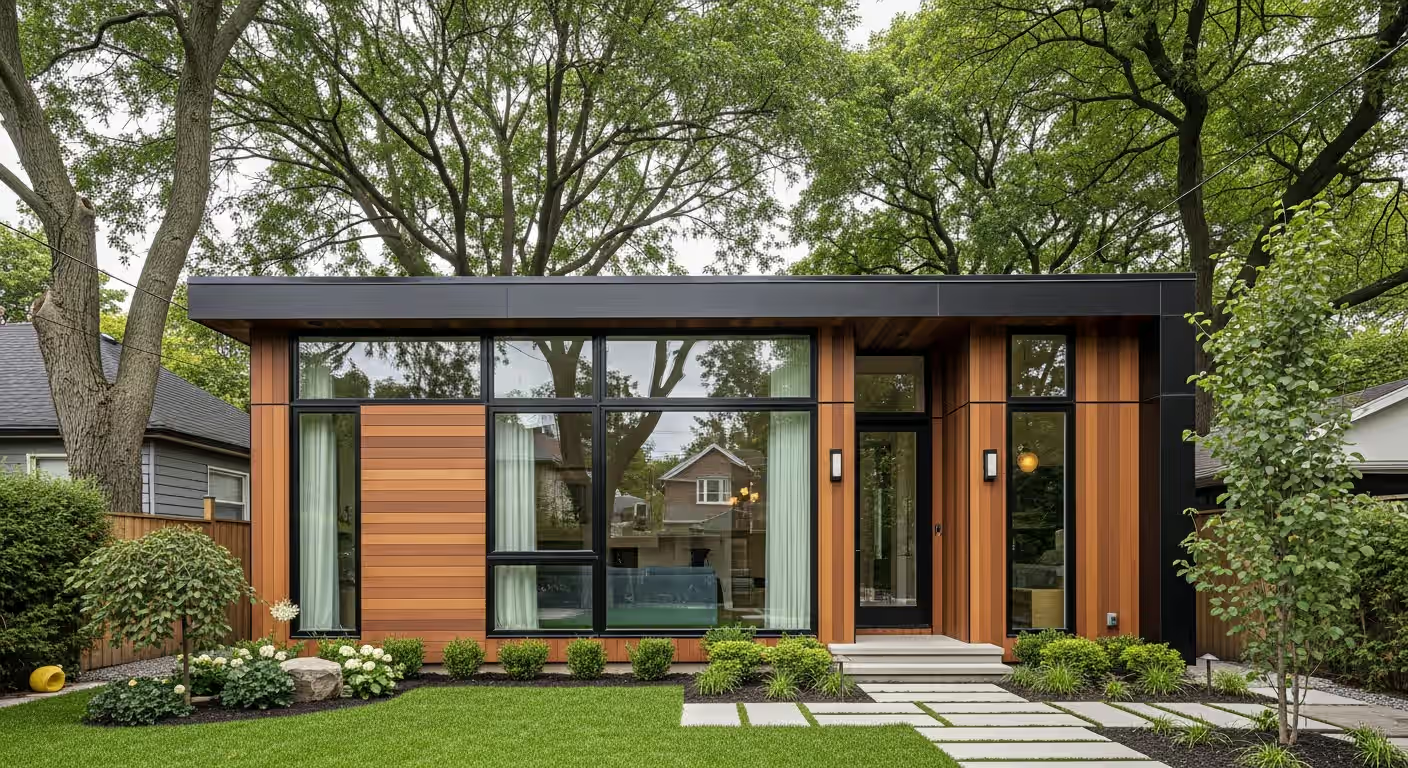
A garden suite is a detached habitable building, typically 600 to 1,200 square feet, located in the rear yard of a single-family, semi-detached, duplex, or row-house lot. It contains a kitchen, bathroom, and one or more bedrooms or sleeping areas. It cannot be physically attached to the main house. It cannot be severed onto its own legal lot. The main house must remain the principal dwelling on the property.
Garden suites are sometimes called backyard homes, ADUs (accessory dwelling units), in-law suites, granny flats, or coach houses. The legal term in Toronto's zoning bylaw is "garden suite." The term "laneway suite" specifically refers to a detached dwelling that abuts a public laneway, governed by a separate 2018 bylaw with similar but not identical rules.
The use cases that drive most garden suite projects in Toronto are:
- Long-term rental income. A 2BR garden suite rents for $2,500 to $3,300 per month in inner-city neighbourhoods.
- Multigenerational living. Aging parents, adult children, or extended family living independently on the same property.
- Home office or studio. Self-employed homeowners building a fully separate workspace.
- Future-proofing. Building now while construction costs are stable; renting later as life circumstances change.
For a deeper look at returns, see Garden Suite Rental Income Toronto: ROI and Mortgage Helper Math.
The Regulatory Framework: Bylaw 89-2022 to Bylaw 849-2025
Bylaw 89-2022 (February 9, 2022)
Toronto City Council adopted Official Plan Amendment OPA 627 and Zoning By-law 89-2022 in February 2022, extending the 2018 laneway-suite concept to ALL R zones (RD, RS, RT, RM) regardless of whether a public laneway abutted the lot. The bylaw was appealed to the Ontario Land Tribunal but the OLT dismissed the appeal in July 2022, making garden suites permitted as-of-right citywide.
Original 89-2022 provisions:
- Footprint limited to the lesser of 40% of rear yard OR 60 square metres (645 sqft).
- Maximum height 6.0 metres (19 feet 8 inches).
- 45-degree angular plane projected from 4.0 metres toward each lot line.
- Setbacks: 1.5 metres from rear and side lot lines; 5.0 metres from main house.
- Combined ancillary coverage limited to 20% of total lot area.
- Soft landscaping required across at least 50% of the rear yard.
- 1.0 metre minimum unobstructed path of travel for emergency access.
- Zero car parking required; 2 bicycle spaces required.
Bill 23 More Homes Built Faster Act (Royal Assent November 28, 2022)
Schedule 9 of Bill 23 amended the provincial Planning Act to require all Ontario municipalities to permit "as-of-right" up to three residential units per lot on any servicing-available lot. Toronto was already ahead of Bill 23, but the legislation locked in the ARU permissions and prevented future Council backsliding. Bill 23 also eliminated parking minimums for ARUs and reduced or eliminated development charges for second and third units on a lot.
Ontario Regulation 462/24 (November 20, 2024)
The Province filed O.Reg 462/24 under the Planning Act, prescribing maximum performance standards municipalities can impose on ARUs:
- Removed angular planes (overrides the 89-2022 45-degree rule).
- Capped minimum separation distances at 4.0 metres for single-storey and 7.5 metres for full-height; municipalities can no longer require more.
- Capped lot coverage and FSI restrictions.
By-law 849-2025 (July 24, 2025)
Toronto's response to O.Reg 462/24. By-law 849-2025 amends 569-2013 to:
- Eliminate the 45-degree angular plane entirely. Flat and shed roofs now permitted.
- Increase max height to 6.3 metres where the 7.5 metre separation distance from the main house is met.
- Allow second-storey cantilevers beyond the ground footprint, up to approximately 120 square metres total GFA.
- Streamline soft-landscaping rules.
- Allow garden suite GFA up to (but not exceeding) the GFA of the main dwelling.
- Permit basements counted in GFA only if they contain habitable space.
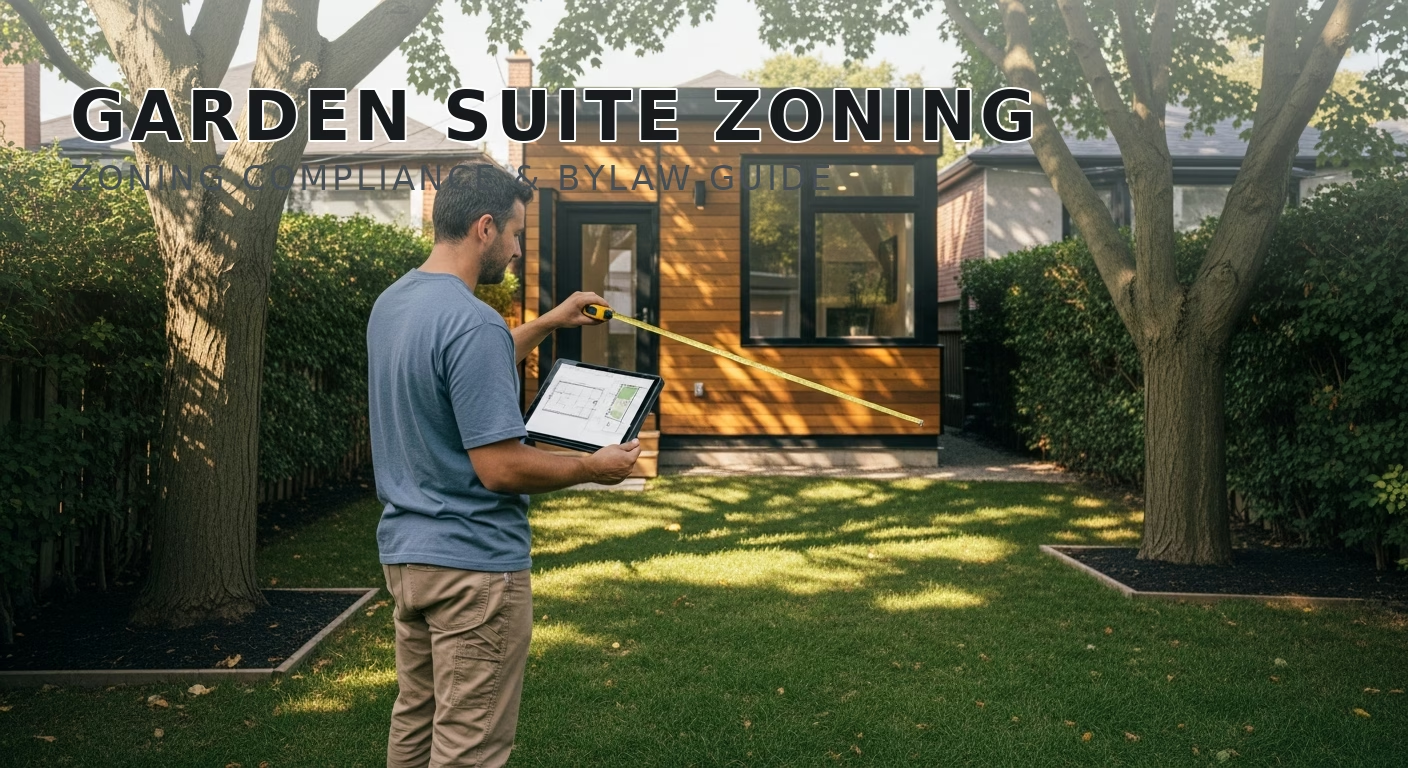
For a deep dive on the zoning rules, see Garden Suite Zoning Toronto: Decoding Bylaw 89-2022 and 849-2025.
Is My Lot Eligible?
The short answer for most Toronto homeowners is yes. Garden suites are permitted on:
- Any lot zoned R, RD, RS, RT, or RM under By-law 569-2013.
- Lots where the main building is detached, semi-detached, duplex, or row house. Triplexes and higher cannot add a garden suite under current rules.
- Lots NOT zoned Mixed-Use Commercial Residential (MCR) or Commercial Residential (CR).
The practical minimum lot size is roughly 25 feet of frontage by 100 feet of depth. Narrower or shallower lots can sometimes work but require more design care to meet setbacks, fire-access path width, and soft-landscaping minimums.
To verify your lot's specific zoning, use the City of Toronto Interactive Zoning Map at apply.toronto.ca and confirm: zone designation, Heritage Conservation District overlay, ravine protection, holding (H) symbols, lot frontage and lot area, and any Site & Area-Specific Policy (SASP) overlays.
Size, Height, and Massing Limits (Post-849-2025)
| Parameter | Limit |
|---|---|
| Ground floor footprint | Lesser of 40% of rear yard OR 60 m² (645 sqft) |
| Total GFA across two storeys | Up to 120 m² (1,290 sqft) via cantilevered second |
| Max GFA versus main house | Cannot exceed GFA of the main dwelling |
| Max height (7.5 m separation) | 6.3 m (was 6.0 m pre-849-2025) |
| Max height (4.0 m separation) | 6.0 m (single-storey only) |
| Angular plane | Eliminated |
| Combined ancillary coverage | 20% of total lot area |
| Soft landscaping in rear yard | At least 50% |
| Path of travel for emergency access | At least 1.0 m unobstructed |
| Car parking | Zero required |
| Bicycle parking | 2 spaces required |
Setbacks
| Element | Setback |
|---|---|
| Rear lot line | 1.5 m minimum |
| Side lot line (no openings) | Greater of 0.6 m OR 10% of lot frontage (max 3.0 m) |
| Side lot line (openings) | 1.5 m minimum |
| Main house (single-storey suite, ≤ 4.0 m height) | 4.0 m minimum |
| Main house (full-height suite, > 4.0 m) | 7.5 m minimum |
The Full Cost Breakdown (2026 Pricing)
A typical 800 to 900 square foot garden suite in Toronto in 2026 costs between $295,000 and $625,000 all-in, with the mid-range landing around $450,000. Hard construction is $400 to $650 per square foot. The breakdown by phase:
| Phase | Range |
|---|---|
| Pre-construction (design, permits, surveys, arborist, engineering) | $25K to $50K |
| Site prep and demolition (existing garage if any) | $5K to $15K |
| Excavation and foundation | $40K to $70K |
| Framing and structural | $30K to $60K |
| Roofing and cladding | $25K to $45K |
| Mechanical (plumbing, electrical, HVAC) | $40K to $80K |
| Servicing (water, sewer, hydro, gas runs) | $20K to $50K |
| Insulation, drywall, paint | $25K to $50K |
| Finishes (flooring, kitchen, bath, trim) | $50K to $120K |
| Site work and landscaping | $10K to $30K |
| Contingency (10-15%) | $25K to $55K |
| TOTAL ALL-IN | $295K to $625K |
Soft Costs Detail
Pre-construction soft costs that always appear:
- Topographic survey (OLS-stamped): $1,500 to $3,000
- Arborist report: $1,200 to $3,500
- Architectural design: $10K to $50K (or $0 with City pre-approved plans)
- Structural engineering: $3K to $8K
- Mechanical/electrical engineering: $2K to $6K
- Energy compliance (SB-12, Energy Star, Net Zero): $1K to $3K
- Permit fees (City + Zoning + Plumbing + ESA): $1.5K to $3K
- Tree permit (if applicable): $400 to $1,500
- Heritage permit (if HCD): $1,500 to $5,000
- Committee of Adjustment (if needed): $1,200 plus planner $3K to $8K
- Builder's risk insurance: 1-4% of project cost ($3K to $30K)
For a phase-by-phase cost guide, see Garden Suite Cost Toronto: Full 2026 Breakdown.
Cost Variations by Size
| Size | Garden Suite All-In | Notes |
|---|---|---|
| Studio (300-400 sqft) | $195K to $280K | Often single-storey; minimal kitchen |
| 1BR (450-650 sqft) | $275K to $380K | Sweet spot for rental |
| 1BR loft (650-800 sqft) | $330K to $460K | 1.5 storey config |
| 2BR (700-900 sqft) | $380K to $540K | Two storey |
| 2BR+ premium (900-1,200 sqft) | $480K to $650K | Cantilevered second; max GFA |
The 12 to 18 Month Timeline
A garden suite project, well-managed, runs from idea to occupancy in 12 to 18 months. Best case is roughly 7 months; worst case (Heritage District plus Committee of Adjustment plus tree complications) can stretch to 28 months.
| Phase | Best Case | Typical | Worst Case |
|---|---|---|---|
| Concept and designer engagement | 2 weeks | 6 weeks | 12 weeks |
| Permit drawings | 4 weeks | 8 weeks | 14 weeks |
| Tree, Heritage, or CoA approvals | 0 weeks | 8 weeks | 26 weeks |
| Plan review (Toronto Building) | 6 weeks | 12 weeks | 20 weeks |
| Construction | 16 weeks | 24 weeks | 36 weeks |
| Final inspections and occupancy | 1 week | 3 weeks | 6 weeks |
| Total | ~7 months | ~14 months | ~28 months |
For a step-by-step walkthrough of every permit stage, see Garden Suite Permits Toronto: Full Process and 8-12 Month Timeline.
Need professional renovation?
Call RenoHouse at 289-212-2345 or get a free estimate today.
Get Free Estimate →Design Archetypes
Studio (256-450 sqft)
Open plan with kitchen, living, and sleeping zone in a single volume; 3-piece bath. Single-storey, slab-on-grade. Best for home office, short-term family use, or a studio rental at $1,800 to $2,200 per month. Typical all-in cost $195K to $280K.
1BR (450-650 sqft)
Separate bedroom, 4-piece bath, full kitchen, living and dining. The rental sweet spot. Single-storey or partial second storey. All-in $275K to $380K. Rents at $2,200 to $2,800 per month.
1BR + Loft (650-900 sqft)
Ground-floor living, kitchen, and bath; mezzanine or full second-storey bedroom. Captures most of the GFA bonus 849-2025 enables. All-in $330K to $460K. Rents at $2,600 to $3,100.
2BR (700-1,200 sqft)
Two bedrooms, 4-piece bath, optional powder, full kitchen, and living. Full two storeys. All-in $380K to $650K. Rents at $2,800 to $3,500. Best for multigenerational use or premium rental.
For floor-plan ideas at every size, see Garden Suite Design Ideas: 1BR Toronto Layouts.
Foundation Choices
Toronto frost depth is 1.2 metres, so any garden suite foundation must extend below this. Three common approaches:
- Slab-on-grade with frost wall. Most common. $40K to $55K. Insulated slab with thickened-edge frost wall. No basement; mechanicals in mechanical closet or pony wall.
- Crawlspace. $45K to $70K. Useful where mechanicals need separation from living space, or where lot grading requires the suite to sit higher than slab-on-grade allows.
- Full basement. $60K to $100K. Adds storage and mechanical room; counts toward GFA only if habitable space. Increases project cost meaningfully and is often unnecessary.
For soil-bearing tests, drainage strategy, and choosing between options, see Garden Suite Foundation Options Toronto: Slab vs Crawlspace vs Basement.
Servicing: Water, Sewer, Hydro, Gas
Every garden suite must connect to:
- Water. Off the main house line or a new 3/4 inch service from the street ($8K to $30K).
- Sanitary sewer. Gravity-feed into main house line, or lift pump if elevation insufficient ($5K to $15K).
- Stormwater. Eavestrough to splash pad or rain barrel; rear yard drainage compliance.
- Hydro. New 100A service from main panel or separate Toronto Hydro service ($8K to $25K).
- Gas. Optional. Most 2026 designs use heat pumps and skip gas entirely, saving $5K to $10K and qualifying for federal rebates.
Total servicing cost typically lands $20K to $50K depending on distance from existing infrastructure and whether the existing main panel can be re-used.
The Committee of Adjustment Question
For compliant designs that meet the post-849-2025 limits exactly, NO Committee of Adjustment hearing is required. The City of Toronto monitoring report tracked over 2,800 garden suite applications since 2022, with the Committee of Adjustment posting an 80% approval rate on the minor variances that DO get filed.
You will need a Committee of Adjustment hearing if your design:
- Exceeds the 60 m² ground footprint or 120 m² total GFA.
- Exceeds 6.3 m height.
- Encroaches on the 1.5 m rear or side setback.
- Reduces soft landscaping below 50%.
- Reduces the path of travel below 1.0 m.
A Committee of Adjustment hearing adds 8 to 12 weeks and $4K to $10K (planner plus consultant fees plus the $1,200 application fee). If neighbours or the City object, the file can be appealed to the Toronto Local Appeal Body (TLAB), adding months.
Tree Protection (Toronto Municipal Code Chapter 813)
A bylaw-protected tree is any tree at least 30 cm in DBH (diameter at breast height) on private property, or any tree at least 10 cm DBH on City property. The Tree Protection Zone (TPZ) is a radius of 10 times DBH, or 1.0 m per 10 cm of DBH, whichever is greater.
You cannot inject roots, compact soil, or remove healthy bylaw-protected trees without a Tree Permit. The City may refuse a Tree Permit if the garden suite design forces removal of a healthy protected tree. If approved, replanting at a 3:1 ratio is standard, with a fee in lieu of $640 to $2,500 per tree. An arborist report is required for any garden suite construction within 6 metres of a protected tree.
Tree complications are the single most common cause of garden suite project delays in Toronto. Hire an ISA-certified arborist before locking down your design.
Heritage Conservation Districts
Toronto has 22 designated Heritage Conservation Districts (HCDs) including Cabbagetown, Riverdale, Wychwood Park, and parts of Riverside. Garden suites in HCDs require a Heritage Permit on top of the Building Permit. The Heritage Permit is reviewed for compatibility with the district's character: massing, materials, fenestration, roof form. Approval typically adds 4 to 6 weeks and design changes that lean toward brick, fibre-cement cladding, traditional roof pitches, and historically-appropriate window proportions.
The City is piloting a streamlined Heritage Permit framework for garden suites in Cabbagetown and Riverdale, with broader rollout expected late 2026.
Pre-Approved City Plans
The City of Toronto launched 24 free pre-approved Garden Suite and Laneway Suite plans in 2025: 4 base designs (studio, 1BR, 1BR loft, 2BR) with 6 variations each. They are Ontario Building Code compliant and save $10K to $20K in custom architectural fees plus 2 to 4 weeks of design time.
Pre-approved plans still require site-specific drawings: lot grading, arborist report (if applicable), servicing plan, and mechanical/electrical layout. They are best for standard rectangular lots without protected trees, Heritage District constraints, or unusual geometry. Custom design is still the better choice for inner-city tight lots, HCD properties, design-forward owners, or combined main-house renovations.
Financing: Construction, HELOC, Refinance, Equitable Bank, CMHC MLI Select
Construction Draw Mortgages
Big 5 banks (TD, RBC, BMO, Scotia, CIBC) offer construction draw mortgages with 4-5 stage draws and progress inspections. Rates run construction prime plus 1-2% during build, then roll to a permanent mortgage at completion. LTV up to 75-80% of as-improved appraisal.
HELOC
Up to 65% LTV on the existing property. Variable rate at prime plus 0.5-1% (~6.7-7.2% in May 2026). Best for smaller projects ($200K to $400K range) where speed of deployment matters more than rate predictability.
Refinance to 80% LTV
Refinance the existing mortgage at 80% LTV using as-improved appraisal. 5-year fixed at ~4.7-5.2%. Predictable, large draws available. Penalties on the existing mortgage can erode the benefit; check breakage costs first.
Equitable Bank Laneway House Mortgage
Launched August 2024. Specifically for laneway homes and garden suites in GTA, Greater Vancouver, and Calgary. Minimum loan $200K. Interest-only payments during construction. First-position required; works on properties free-and-clear or with a new/existing first mortgage held by EQB. Available through mortgage broker network only, not retail.
CMHC MLI Select (the unlock)
Available for 5+ unit residential rental properties. The Toronto strategy: convert main house to fourplex (4 units) plus add a garden suite (1 unit) = 5 units, eligible for MLI Select. Benefits include up to 95% LTV, up to 50-year amortization, forgivable grants up to $85K per unit for energy-efficient (NZE-ready) builds, and reduced mortgage insurance premiums. This is the single most powerful financial play in the Toronto ADU space in 2026.
For mortgage helper math and refinance strategies, see Garden Suite Rental Income Toronto: ROI and Mortgage Helper Math.
Realistic ROI
A worked example for a typical Roncesvalles 25 ft × 130 ft lot, 800 sqft 2BR garden suite:
| Metric | Value |
|---|---|
| All-in cost | $475,000 |
| Monthly rent (2026) | $3,150 |
| Annual gross rent | $37,800 |
| Vacancy and collection (5%) | -$1,890 |
| Property tax delta | -$3,500 |
| Insurance delta | -$1,200 |
| Maintenance reserve (8% gross) | -$3,024 |
| NOI (self-managed) | $28,186 |
| Cap rate on cost | 5.93% |
| Property value uplift | $285K to $320K |
| 10-year total return | ~155-175% of construction cost |
| Payback period | 5.5 to 7.5 years on rent alone |
The garden suite outperforms a basement apartment on absolute return, but the basement wins on speed-to-cash and lower capital requirement. The garden suite outperforms the laneway house on cost only; a laneway in a premium corridor can return more on uplift. The multiplex+garden suite stack outperforms all of the above on financing efficiency via CMHC MLI Select.
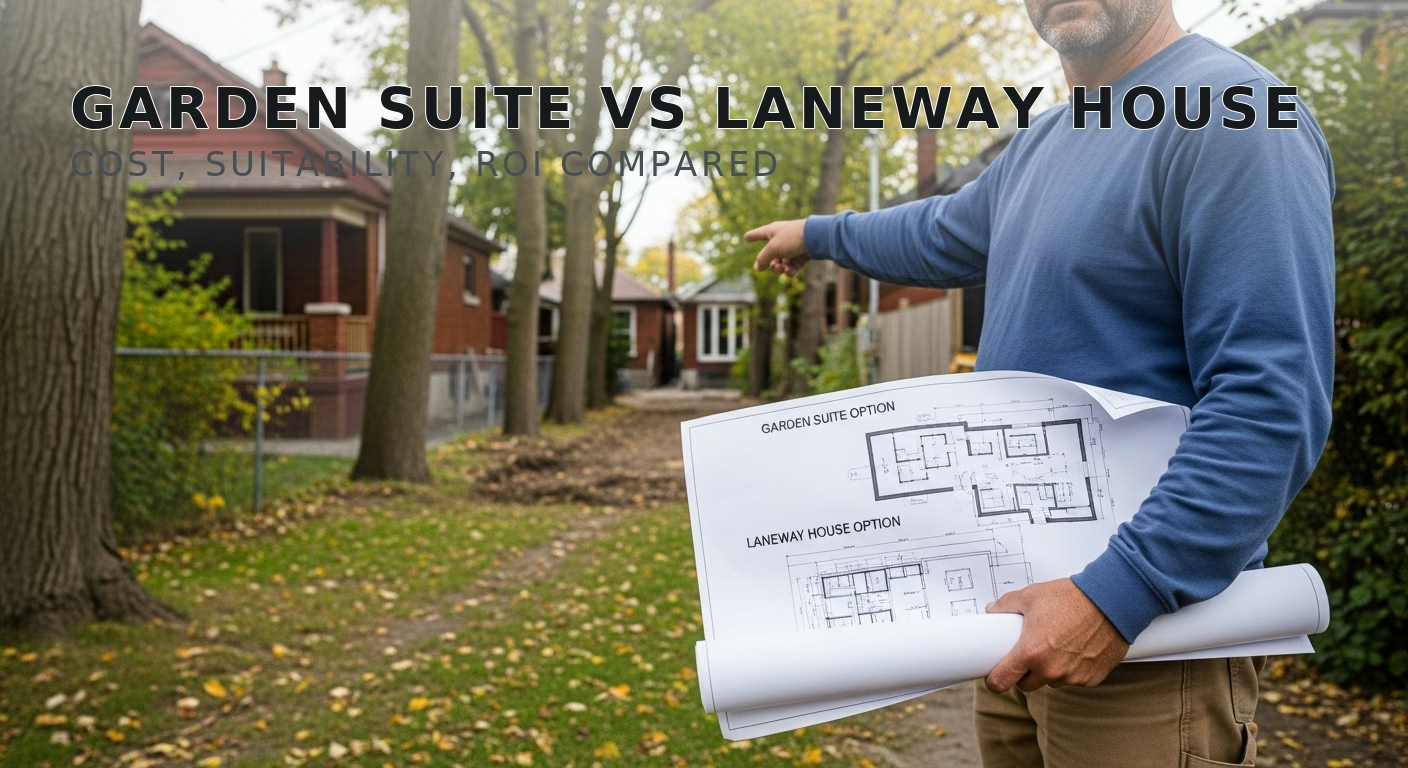
For the comparison versus laneway, see Garden Suite vs Laneway House Toronto: Side-by-Side Comparison.
Common Pitfalls (the 10 Most Costly)
- 1. Tree Protection Zone violation. Permit denied because the design encroaches on the TPZ of a bylaw-protected tree. Hire an arborist before drawings.
- 2. Heritage Conservation District overlay missed. Owner doesn't know the lot is in an HCD; permit set rejected. Heritage Permit adds 4-6 weeks.
- 3. Servicing capacity insufficient. Existing 100A service can't power main house plus garden suite. Upgrade to 200A ($5K-$10K) or separate Hydro service ($15K-$25K).
- 4. Survey out of date. OLS-stamped survey older than 5 years rejected. Order new survey ($1.5K-$3K).
- 5. Easement on title. Underground sewer or hydro easement crosses proposed footprint. Title search early; design around easement.
- 6. Soft landscaping shortfall. Drawings show less than 50% rear yard soft; rejected. Permeable pavers help close the gap.
- 7. GFA over-runs main dwelling. 849-2025 caps suite GFA at or below main house GFA. Reduce suite or finish main house basement first.
- 8. Property tax surprise. MPAC supplementary bill comes 12 to 24 months after occupancy with retroactive tax. Budget $2K to $6K per year increase from day one.
- 9. Insurance lapse during construction. Standard homeowner policy excludes construction. Builder's Risk / Course of Construction policy required from day one.
- 10. STR (Airbnb) ineligibility. Garden suite cannot be a standalone short-term rental; must be the operator's principal residence. Long-term residential rental only.
Why a General Renovation Builder Beats a Niche Specialist
The top of the Toronto SERP for garden suite queries is dominated by architecture firms (Lanescape, Williamson Williamson, SUSTAINABLE.TO, Solares LNWY) and boutique design-build specialists (MBC Homes, BVM Contracting, Maserat, Konstruction, NovaCon, 21 Inc, Acadia DC). They do excellent work and own the design-led tier of the market.
But a general renovation builder with deep regulatory expertise and a broader project portfolio offers homeowners three things specialists struggle to match:
- 1. Whole-house thinking. A garden suite often pairs with main-house upgrades (basement underpinning, kitchen renovation, roof replacement). A general builder can sequence these as a single project with one contract and one trade roster, saving 10-20% on overhead and timeline.
- 2. Financial modelling depth. Refinance, HELOC, construction draw, Equitable Bank, CMHC MLI Select. A specialist sees one flavour. A general builder works across the full financing landscape and aligns the design and budget to the financing the homeowner can actually access.
- 3. Post-build operations. Property management, tenant turnover, maintenance, future-proofing. A specialist hands you a finished suite. A general renovation firm stays in the relationship as the property evolves.
RenoHouse builds garden suites across Toronto with full-stack regulatory, design, build, and post-build support.
Frequently Asked Questions
How much does a garden suite cost in Toronto in 2026? $295K to $625K all-in for a typical 800 to 900 sqft 2BR build. The mid-range is $450K. Studios start at $195K; premium 2BR builds top out near $650K. How long does a garden suite take from idea to occupancy? 12 to 18 months typical. Best case 7 months, worst case 28 months (Heritage District plus tree complications plus Committee of Adjustment). Do I need a Committee of Adjustment hearing? No, as long as your design meets the post-849-2025 limits exactly. Variances trigger a hearing that adds 8 to 12 weeks and $4K to $10K. Do I need parking? No. Zero car parking is required. Two bicycle parking spaces are required. Can I Airbnb my garden suite? No. The garden suite cannot be a standalone short-term rental. STR rules require the operator's principal residence. Long-term residential rental only. Can I sever the garden suite onto its own lot? No. The garden suite is appurtenant to the parent lot and cannot be severed. What is the maximum size? 60 square metres (645 sqft) ground footprint and up to 120 square metres (1,290 sqft) total GFA across two storeys. Are garden suites allowed in Heritage Conservation Districts? Yes, but a Heritage Permit is required on top of the Building Permit. Adds 4-6 weeks and design constraints. Will my property tax go up? Yes. Expect a $2,000 to $6,000 per year increase, retroactive to occupancy date. Do I qualify for the Multigenerational Home Renovation Tax Credit? No. Detached garden suites do NOT qualify for MHRTC. Only attached additions and within-envelope secondary suites qualify.Get Started With RenoHouse
We design and build garden suites across Toronto, from Roncesvalles and Leslieville to Etobicoke, North York, and Scarborough. Free site assessment, pre-approved plan options, custom design, full permit management, and post-build property management referrals.
Get a quote at /services/multi-unit-aru-conversions/garden-suite-construction.
Sources & References
Authoritative sources cited in this guide:
- Toronto Garden Suite Bylaw 89-2022 — Toronto garden suite regulations
- Bill 23 — More Homes Built Faster Act — Provincial ARU enabling legislation
- Toronto Committee of Adjustment — Variance process
Continue Reading