RenoHouse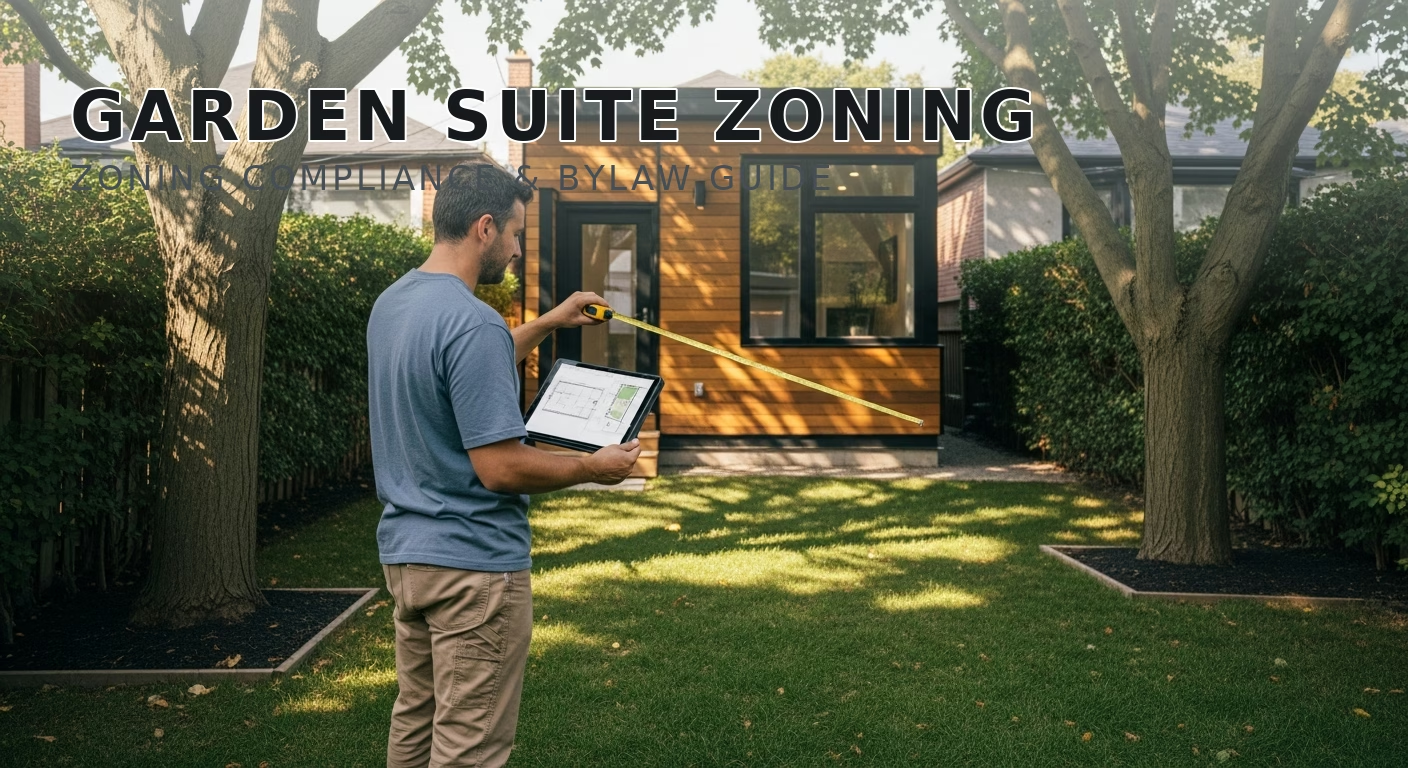

# Garden Suite Zoning Toronto: Decoding Bylaw 89-2022 and 849-2025
Quick answer. Toronto's garden suite zoning rules sit at the intersection of three documents: City of Toronto By-law 89-2022 (passed February 2022, effective after the OLT dismissed appeals in July 2022), Ontario Regulation 462/24 (filed November 2024), and Toronto's update By-law 849-2025 (passed July 2025).Toronto's garden suite zoning rules sit at the intersection of three documents: City of Toronto By-law 89-2022 (passed February 2022, effective after the OLT dismissed appeals in July 2022), Ontario Regulation 462/24 (filed November 2024), and Toronto's update By-law 849-2025 (passed July 2025). Together they govern footprint, GFA, height, setbacks, soft landscaping, lot coverage, and emergency access on every R-zone lot in the city.
This guide decodes the rules into the parameters a homeowner actually needs to design within. For the full pillar context, see Garden Suite Toronto 2026 Complete Guide. For the permit walkthrough that runs after zoning, read Garden Suite Permits Toronto.
The Three Bylaws That Govern Your Garden Suite
By-law 89-2022 (February 9, 2022)
City Council adopted Official Plan Amendment OPA 627 and Zoning By-law 89-2022, extending the 2018 laneway-suite concept to all R zones (RD, RS, RT, RM) regardless of laneway abutment. The bylaw was appealed to the Ontario Land Tribunal, which dismissed the appeal in July 2022, making garden suites permitted as-of-right citywide.
Original rules:
- Footprint: lesser of 40% of rear yard OR 60 m² (645 sqft).
- Height: 6.0 m (~19 ft 8 in).
- 45-degree angular plane projected from 4.0 m height toward each lot line.
- Setbacks: 1.5 m from rear and side; 5.0 m from main house.
- Combined ancillary coverage: 20% of total lot area maximum.
- Soft landscaping: at least 50% of rear yard.
- Path of travel: 1.0 m unobstructed for emergency access.
- Parking: zero cars; 2 bicycle spaces required.
Ontario Regulation 462/24 (November 20, 2024)
The Province filed O.Reg 462/24 under the Planning Act, prescribing maximum performance standards municipalities can impose on Additional Residential Units (ARUs):
- Removed angular planes (overrides 89-2022's 45-degree rule).
- Capped minimum separation distances at 4.0 m for single-storey and 7.5 m for full-height; municipalities can no longer require more.
- Capped lot coverage and FSI restrictions.
- Applies only to lots with 3 or fewer residential units total (so doesn't help 4-plex+ADU stacking).
By-law 849-2025 (July 24, 2025)
Toronto's response to O.Reg 462/24. By-law 849-2025 amends 569-2013 to:
- Eliminate the 45-degree angular plane entirely (flat and shed roofs now permitted).
- Increase max height to 6.3 m where 7.5 m separation distance from main house is met.
- Allow second-storey cantilevers beyond the ground footprint, up to ~120 m² total GFA.
- Streamline soft-landscaping rules.
- Allow garden suite GFA up to (but not exceeding) the GFA of the main dwelling.
- Permit basements counted in GFA only if they contain habitable space.
The cumulative effect: the regulatory envelope that Toronto homeowners can build within is meaningfully larger in 2026 than it was in 2022, particularly for two-storey designs with cantilevered upper floors.
Eligibility Checklist
Your lot is eligible for a garden suite if ALL of these are true:
- Zoned R, RD, RS, RT, or RM under By-law 569-2013.
- Main building is detached, semi-detached, duplex, or row house. Triplexes and higher cannot add a garden suite.
- Not zoned Mixed-Use Commercial Residential (MCR) or Commercial Residential (CR).
- Lot can accommodate the required setbacks, soft landscaping, and 1.0 m emergency access path.
- Main house remains the principal dwelling on the lot.
- Garden suite is not physically attached to the main house.
The practical minimum lot size is roughly 25 ft frontage × 100 ft depth. Lots narrower than 25 ft can sometimes work, but require careful design to meet side setbacks and soft landscaping.
To verify zoning, use the City of Toronto Interactive Zoning Map at apply.toronto.ca and order a Zoning Applicable Law Certificate (Zoning Review) for $214.79 (covers up to 3 review rounds).
Size and Massing Rules (Post-849-2025)
| Parameter | Limit |
|---|---|
| Ground floor footprint | Lesser of 40% of rear yard OR 60 m² (645 sqft) |
| Total GFA across two storeys | Up to 120 m² (1,290 sqft) via cantilevered second |
| Max GFA versus main house | Cannot exceed GFA of main dwelling |
| Max height (with 7.5 m separation from main house) | 6.3 m |
| Max height (with 4.0 m separation) | 6.0 m, single-storey only |
| Angular plane | Eliminated |
| Combined ancillary coverage | 20% of total lot area |
| Soft landscaping in rear yard | At least 50% |
| Path of travel for emergency access | At least 1.0 m unobstructed |
| Car parking | 0 required |
| Bicycle parking | 2 required |
The footprint cap of "lesser of 40% of rear yard OR 60 m²" is the binding constraint on most Toronto inner-city lots. A 25 ft × 130 ft lot has roughly 25 ft × 50 ft = 116 m² of rear yard after main house and side yards; 40% of that is 46 m². So the 40% cap binds before the 60 m² cap on narrower lots. Wider lots (30+ ft frontage) bind on the 60 m² cap.
The 120 m² total GFA cap allows a cantilevered second storey up to 60 m² beyond the ground footprint. In practice, most designs use the cantilever to push the second storey forward (toward the main house) or sideways to gain bedroom space without expanding the ground footprint into the rear yard.
Setback Rules in Detail
| Element | Setback |
|---|---|
| Rear lot line | 1.5 m minimum |
| Side lot line (no openings on that face) | Greater of 0.6 m OR 10% of lot frontage (max 3.0 m) |
| Side lot line (with openings) | 1.5 m minimum |
| Main house, single-storey suite (≤ 4.0 m height) | 4.0 m minimum |
| Main house, full-height suite (> 4.0 m) | 7.5 m minimum |
| Adjacent occupied dwelling on neighbouring lot | Per setback above; angular plane no longer applies |
The 7.5 m separation from the main house is the binding constraint that most determines whether your garden suite can be two-storey or must be single-storey. On a 130 ft (40 m) deep lot with a 35 ft (11 m) deep main house and 25 ft (7.5 m) front setback, you have roughly 22 m of rear yard. Subtract the 7.5 m main-house separation and the 1.5 m rear setback and you have 13 m of buildable depth, which is more than enough for a 6 m × 8 m two-storey suite.
On a shallower lot (100 ft / 30 m), the same math leaves only 8 m of buildable depth, which still works but requires careful design.
Soft Landscaping (the Often-Missed Constraint)
At least 50% of the rear yard must be soft landscaping. "Soft" means permeable: lawn, garden beds, gravel, mulched planting beds. Pavers (concrete or stone) count as hard landscaping; permeable pavers (open joints with grass infill) count as soft.
The path of travel for emergency access is 1.0 m wide minimum and cannot be obstructed by fences, garbage bins, or planting. It also cannot be paved over completely; permeable pavers are acceptable.
Need professional renovation?
Call RenoHouse at 289-212-2345 or get a free estimate today.
Get Free Estimate →The 50% soft rule is calculated against the rear yard area only (not the total lot). If your suite footprint plus your existing patio plus your garage plus the path of travel sum to more than 50% of the rear yard, you fail. Many first-time designs miss this; the fix is to convert hard pavers to permeable pavers or shrink the suite footprint.
Bicycle Parking Requirement
Every garden suite must have 2 bicycle parking spaces. Class 1 (secure, weather-protected, accessible only to occupants) is preferred. Class 2 (accessible, weather-protected) is also acceptable. The spaces can be inside the suite, in a separate bike shed, or in a covered exterior rack. Practical implementation: a wall-mounted rack inside a mechanical closet or under a roof overhang.
Zero car parking is required. The City removed parking minimums citywide in February 2022 for all residential uses.
Compliant vs Minor Variance: When You Need the Committee of Adjustment
A "compliant" garden suite design meets every parameter above exactly. No Committee of Adjustment hearing is required. Permit review takes 6-12 weeks for a well-prepared submission.
A "minor variance" design exceeds one or more parameters and requires Committee of Adjustment approval. The most common variances filed in Toronto:
| Variance Type | Reason | Typical Approval Rate |
|---|---|---|
| Ground footprint > 60 m² | Owner wants larger 1-storey suite | High (75-85%) |
| Total GFA > 120 m² | Owner wants larger 2-storey suite | Moderate (60-70%) |
| Height > 6.3 m | Roofline aesthetic | Moderate (60-70%) |
| Setback < 1.5 m rear | Yard depth too shallow | Variable (50-70%) |
| Setback < 7.5 m from main house | Yard depth too shallow | Variable (50-70%) |
| Soft landscaping < 50% | Existing patio/driveway | High (75-85%) |
| Path of travel < 1.0 m | Tight side yard | LOW (NOT eligible) |
The 1.0 m path of travel for emergency access is NOT subject to minor variance. It cannot be relaxed by the Committee of Adjustment. This is the single most common reason laneway and garden suite proposals fail at the zoning review stage.
The Committee of Adjustment hearing process:
- Filing fee: $1,200.
- Planner consultant: $3K to $8K.
- Public notice posted on the lot 14 days before hearing.
- Neighbours can object in writing or at the hearing.
- City of Toronto monitoring data shows 80% approval rate on garden-suite-related minor variances filed since 2022.
- If approved, decision is final after a 20-day appeal window (during which neighbours can appeal to TLAB).
For when and how to use Committee of Adjustment, see Garden Suite Permits Toronto: Full Process and Timeline.
Toronto Local Appeal Body (TLAB)
If the Committee of Adjustment denies your variance, or if a neighbour appeals an approval, the file goes to the Toronto Local Appeal Body. TLAB hearings typically take 6-12 months to schedule and run, during which the project is on hold. Filing fee: $400 to file an appeal. Cost of TLAB: typically $15K-$40K including planner, lawyer, and expert witness fees.
For a garden suite project, TLAB is a worst-case outcome. The fix is design discipline upstream: stay compliant with all post-849-2025 limits.
Heritage Conservation Districts
Toronto has 22 designated Heritage Conservation Districts (HCDs), including Cabbagetown, Riverdale, Wychwood Park, and parts of Riverside, Cabbagetown North, Distillery, Garden District, and others. Garden suites in HCDs require a Heritage Permit on top of the Building Permit.
The Heritage Permit reviews compatibility with district character: massing, materials, fenestration, roof form. Approval typically adds 4-6 weeks and design changes leaning toward brick, fibre-cement cladding, traditional roof pitches, and historically-appropriate window proportions.
The City is piloting a streamlined Heritage Permit framework for garden suites in Cabbagetown and Riverdale, with broader rollout expected late 2026.
Tree Protection Zone (Toronto Municipal Code Chapter 813)
A bylaw-protected tree is any tree at least 30 cm in DBH (diameter at breast height) on private property, or any tree at least 10 cm DBH on City property. The Tree Protection Zone (TPZ) is a radius equal to 10 times DBH, or 1.0 m per 10 cm DBH, whichever is greater.
You cannot inject roots, compact soil, or remove healthy bylaw-protected trees without a Tree Permit. The City may refuse a Tree Permit if the garden suite design forces removal. If approved, replanting at a 3:1 ratio is standard, with fees in lieu of $640-$2,500 per tree.
An arborist report (RTC) is required for any garden suite construction within 6 metres of a protected tree. ISA-certified arborist fee: $1,200-$3,500.
Tree complications are the single most common cause of garden suite project delays in Toronto. Get an arborist consult BEFORE locking down design.
Bill 23 More Homes Built Faster Act Context
Schedule 9 of Bill 23 (Royal Assent November 28, 2022) amended the provincial Planning Act to require all Ontario municipalities to permit "as-of-right" up to three residential units per lot on any servicing-available lot. Toronto was already ahead of Bill 23, but the legislation locked in ARU permissions and prevented future Council backsliding.
Other Bill 23 provisions:
- No parking minimums for ARUs.
- Reduced or eliminated development charges for ARUs.
- Cuts to planning fees and conservation authority approvals.
- Streamlined site plan approval.
Bill 23 is what gives Toronto's garden suite bylaws their long-term durability. Even if a future Council wanted to tighten the rules, Provincial law mandates the minimum permission.
Future Outlook (2026+)
Active Council and Province initiatives that may further loosen garden suite rules:
- Sixplexes downtown. Council adopted recommendations in late 2024 to permit 6-plexes in the downtown core; final bylaw expected late 2026.
- Major Streets multiplex. City Planning is studying allowing 6-8 unit multiplexes along major arterial streets.
- As-of-right ADUs in Heritage Districts. Streamlined Heritage Permit framework in pilot in Cabbagetown and Riverdale.
- Provincial GO Transit ARU bonuses. Bill 23 successor legislation may double permitted ARUs near major transit stations.
Designing Within the Envelope
The practical design implications of all this for a typical Toronto homeowner:
- 1. Two-storey designs are now the default under post-849-2025 rules. The cantilever allowance unlocks the 120 m² GFA cap.
- 2. Flat or shed roofs are permitted. This expands usable interior volume by ~15% versus a pitched roof.
- 3. The 7.5 m main-house separation is the most-binding constraint on most lots. Plan the suite footprint backwards from this constraint.
- 4. Soft landscaping at 50% requires planning hard surfaces carefully. Consider permeable pavers for any paved area.
- 5. Get the arborist consult first. Tree-driven design changes are the most expensive surprise late in design.
- 6. Confirm Heritage District status before designing. HCD adds 4-6 weeks and material constraints.
Compare to Laneway House Rules
The laneway house bylaw (2018, amended 2025) is similar but not identical. Key differences:
- Laneway needs at least 3.5 m of public laneway abutment.
- Laneway has a 0.0 m setback option from interior lot lines (with no openings on that face).
- Laneway facade has higher visibility requirements (brick or fibre-cement, not vinyl).
- Laneway servicing is harder (most lanes have no underground utilities).
For the side-by-side, see Garden Suite vs Laneway House Toronto.
Get a Compliant Design
RenoHouse designs garden suites that meet the post-849-2025 envelope without minor variance. Free zoning review on every site visit; if your lot has tree, Heritage, or unusual-geometry constraints, we identify them before you commit to design fees.
Get a free site assessment at /services/multi-unit-aru-conversions/garden-suite-construction.
Sources & References
Authoritative sources cited in this guide:
- Toronto Garden Suite Bylaw 89-2022 — Toronto garden suite regulations
- Bill 23 — More Homes Built Faster Act — Provincial ARU enabling legislation
- Toronto Committee of Adjustment — Variance process
Continue Reading