RenoHouse

# Level 2 vs Level 1 EV Charger Toronto: Which Do You Actually Need?
Quick answer. Every new EV owner in the GTA hits the same fork in the road within a month of taking delivery: keep using the Level 1 mobile cord that came in the trunk, or pay $2,500–$4,500 to install a permanent Level 2 charger? The honest answer for most Toronto households is Level 2 is worth it once you cross 50 km of daily driving — but the lin...Every new EV owner in the GTA hits the same fork in the road within a month of taking delivery: keep using the Level 1 mobile cord that came in the trunk, or pay $2,500–$4,500 to install a permanent Level 2 charger? The honest answer for most Toronto households is Level 2 is worth it once you cross 50 km of daily driving — but the line is not where most marketing material suggests, and a meaningful slice of GTA households genuinely do not need Level 2 at all.
This guide breaks down the real-world charging math for Toronto commute patterns, the cost difference, the ESA requirements for each, and the specific scenarios where Level 1 is genuinely sufficient versus where Level 2 pays for itself inside two years. For the broader pricing picture across all install tiers, see our pillar guide EV Charger Installation Toronto: Complete 2026 Guide.
What Level 1 Actually Delivers in a Toronto Garage
Level 1 charging uses a standard 120-volt household outlet — the same outlet that runs your toaster. Output is capped at 12 amps continuous on a 15-amp circuit, or 16 amps continuous on a 20-amp circuit. In real terms:
- Standard 15-amp outlet: about 1.4 kW, or roughly 6–8 km of range per hour.
- 20-amp outlet (rare in older Toronto homes): about 1.9 kW, or 9–11 km of range per hour.
- Overnight charge window (7pm–7am, 12 hours): 70–95 km of range added.
That 70–95 km figure is the entire question. If your daily Toronto commute is under that, Level 1 covers you indefinitely with no install cost. If it is above, you start every morning with a deficit that compounds over the week.
What Level 2 Delivers
Level 2 uses 240 volts on a dedicated 40-amp or 60-amp circuit. Output:
- 40-amp circuit, 32-amp continuous charger (most common): about 7.7 kW, or 38–45 km of range per hour.
- 60-amp circuit, 48-amp continuous charger (Tesla Wall Connector hardwired): about 11.5 kW, or 55–65 km of range per hour.
- Overnight 12-hour window: 450–780 km of range added — meaning the car is full from any state of charge.
Level 2 functionally removes range anxiety from the equation for any household driving under 600 km per day, which covers essentially every GTA commuter.
The Toronto Commute Math That Decides It
Toronto's average daily driving distance varies sharply by neighbourhood. Pulled from 2025 GTA travel surveys:
| Neighbourhood Type | Average Daily Driving | Level 1 Coverage? |
|---|---|---|
| Downtown / Liberty Village | 18–28 km | Yes — easily |
| Inner suburbs (East York, Leaside) | 35–55 km | Borderline |
| Outer suburbs (Scarborough, Etobicoke) | 55–80 km | No — Level 2 needed |
| 905 commuters (Mississauga, Markham) | 70–110 km | No — Level 2 strongly needed |
| Two-vehicle / multi-driver households | 100–180 km combined | No — Level 2 essential |
The breakpoint is roughly 50 km daily. Below that, Level 1 keeps up indefinitely. Above that, you fall behind by Wednesday.
Need professional electrical services?
Call RenoHouse at 289-212-2345 or get a free estimate today.
Get Free Estimate →Cost Comparison
Level 1 cost: $0. The charging cable comes with the car.
Level 2 cost (Toronto 2026):
- Tier 1 plug-in NEMA 14-50: $1,800–$3,200 all-in.
- Tier 2 hardwired: $2,400–$4,500 all-in.
- Tier 3 with 200A panel upgrade: $5,500–$9,500 all-in.
For the full pricing breakdown by tier, see EV Charger Cost Toronto: Tier-by-Tier Installation Pricing.
The ESA Question
Level 1 does not require an ESA permit because it uses an existing 120V receptacle on an existing branch circuit. No new wiring, no new breaker.
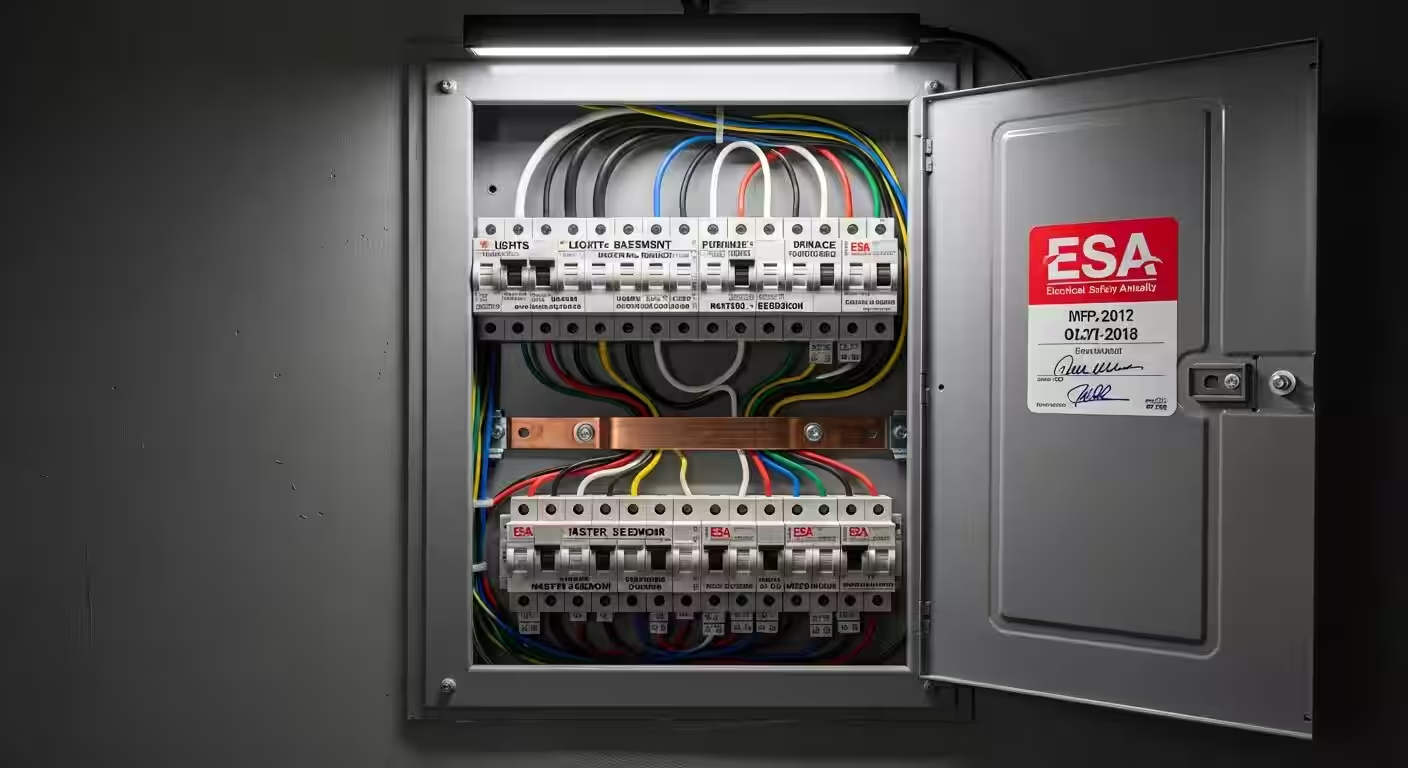
Level 2 always requires an ESA permit pulled by a Licensed Electrical Contractor. There is no DIY or grey-market path. The permit is non-negotiable for insurance and resale purposes.
For the full ESA process, see EV Charger Load Calculation and ESA Permit Toronto.
Five Scenarios Where Level 1 Is Actually Enough
- 1. Downtown condo dweller, single car, 20 km daily commute. Level 1 from a parking spot outlet (where allowed) covers the use case. Plus most commuting can be done by transit anyway.
- 2. Retiree household, mostly local errands, 30 km/day. Level 1 keeps up.
- 3. Plug-in hybrid (PHEV) with small battery. A Toyota RAV4 Prime or Ford Escape PHEV has an 18 kWh battery. Level 1 fully recharges it overnight regardless of commute.
- 4. Second car used 2–3 times weekly. A weekend-only EV does not need Level 2.
- 5. Renter who will move within 12–18 months. Install cost is harder to recover.
Five Scenarios Where Level 2 Pays Off Fast
- 1. 905 commuter, 80+ km daily. Level 1 falls behind every weekday. Level 2 pays back in fuel savings inside 24 months.
- 2. Two-EV household, both daily drivers. Cumulative daily charge demand exceeds Level 1 capacity. Often paired with dual-charger load sharing — see Dual EV Chargers for Two Cars Toronto.
- 3. Long-range EV (Tesla Model S, Lucid, Rivian). Battery is 100+ kWh. Level 1 takes 4–5 days to fully recharge from low state of charge.
- 4. Time-of-use pricing optimization. Toronto Hydro off-peak ultra-low rates require charging within an 8-hour overnight window — only Level 2 fills the battery in that window.
- 5. Resale-conscious detached homeowner. GTA listings with hardwired Level 2 see measurable closing-price premium and reduced days-on-market.
When Level 1 Becomes the Wrong Choice
Even if your daily commute is under 50 km, Level 1 starts failing the moment any of these happen:
- You take a weekend round trip to cottage country (Muskoka run is 400+ km).
- You buy a second EV for the household.
- A teenager starts driving the EV to extracurriculars.
- You shift to remote work but use the EV for client visits.
- Cold winter weather drops range by 25–35% (typical Toronto January effect).
What About the Hybrid Approach? Level 1 Plus Public Charging
A common pattern: keep Level 1 at home, top up at public Level 3 DC fast chargers when needed. The math:
- Public Level 3: 35–55 cents per kWh in 2026.
- Toronto Hydro off-peak home: 2.4 cents per kWh on EV ultra-low rate.
Difference is roughly 15x. For a household using 30 kWh per week of public charging, that is $50/week or $2,600/year extra cost — more than the install cost of a Level 2 over two years.
For the full home-vs-public economics, see EV Charger ROI vs Public Charging Toronto.
What to Ask Yourself Before Deciding
- 1. What is my realistic daily driving distance, including weekends?
- 2. Will I own this EV for more than 24 months?
- 3. Will I add a second EV in the next 5 years?
- 4. Is my home detached with 200A service, or will I need a panel upgrade?
- 5. Am I willing to pay public charging premiums in winter?
- 6. Is resale value a factor for this property?
If any answer pushes you toward Level 2, the install almost always pays back inside 24 months for the GTA market.
What to Ask Your Electrician When Going Level 2
- 1. Will my existing panel handle a 40-amp or 60-amp circuit?
- 2. If not, what is the panel upgrade cost?
- 3. What is the run length from panel to charger location?
- 4. What gauge wire is required for that run?
- 5. Hardwired or NEMA 14-50?
For the panel-side answer, see 200 Amp Panel Upgrade for EV Charger Toronto. For pre-install panel inspection, see our Pre-EV Charger Panel Scan service.
---
Deciding between Level 1 and Level 2 for your GTA home? RenoHouse runs free in-home assessments with a Master Electrician — we look at your panel, your driving patterns, and your budget, then give you an honest recommendation. Book a consultation on our EV charger bundle service page.
Sources & References
Authoritative sources cited in this guide:
- Electrical Safety Authority (ESA) — Ontario electrical regulator
- Ontario Electrical Safety Code — OESC Section 26 / latest amendments
- Canadian Electrical Code Part I (CSA C22.1) — CEC standard
- NRCan — Electric Vehicle Resources — NRCan EV/charging programs
Continue Reading