RenoHouse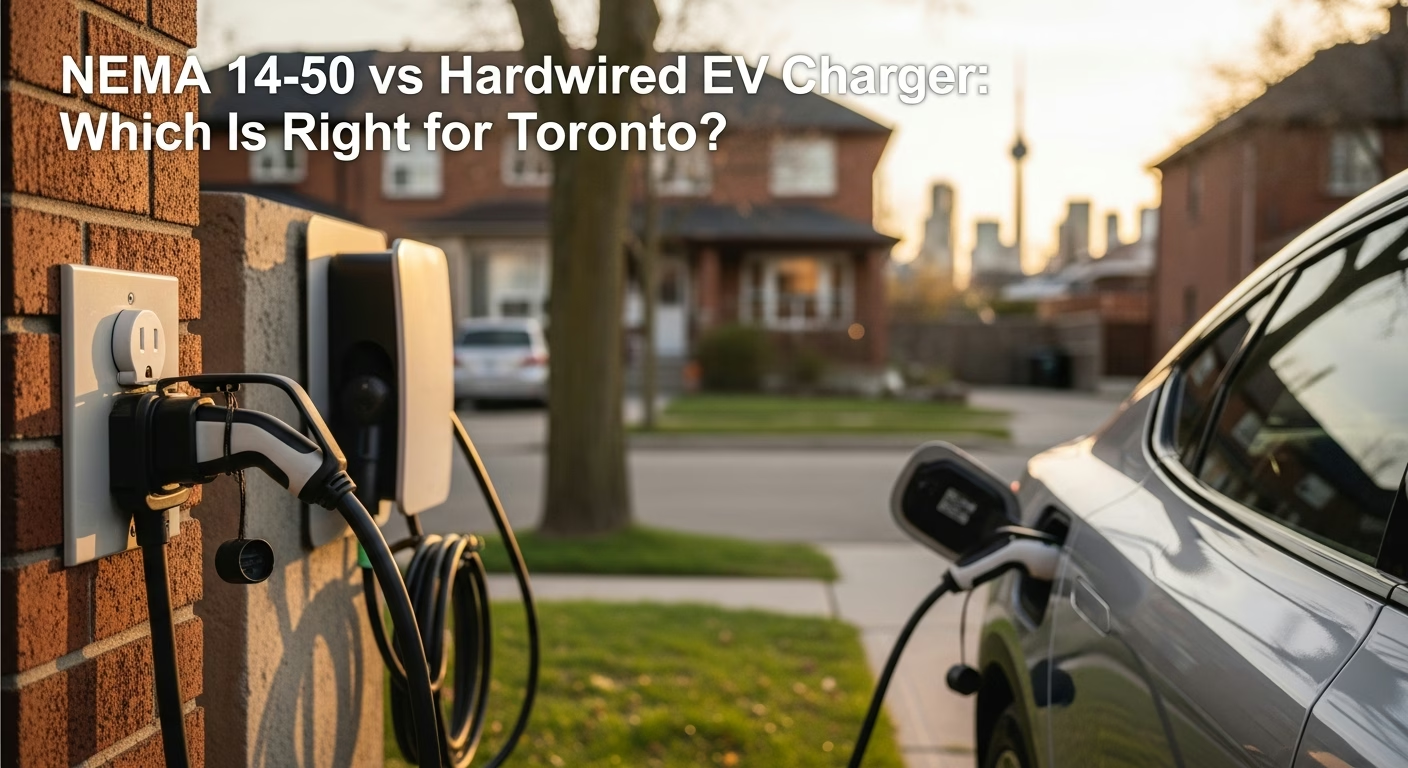

# NEMA 14-50 vs Hardwired EV Charger: Which Is Right for Toronto?
Quick answer. After the panel-amperage decision, the second-biggest technical fork in any Toronto Level 2 EV charger install is whether to terminate the circuit in a NEMA 14-50 receptacle (the charger plugs in) or to hardwire the charger directly to the conductor (no plug, no receptacle).After the panel-amperage decision, the second-biggest technical fork in any Toronto Level 2 EV charger install is whether to terminate the circuit in a NEMA 14-50 receptacle (the charger plugs in) or to hardwire the charger directly to the conductor (no plug, no receptacle). The choice affects charging speed, weather tolerance, code compliance, portability, and total cost — and the right answer depends on which charger you bought, where you are mounting it, and whether you might move it.
This guide breaks down the practical differences for GTA homeowners. For the wider install context, see our pillar EV Charger Installation Toronto: Complete 2026 Guide, and for the specific charger-brand decision see Tesla Wall Connector vs Universal EV Charger Toronto.
What NEMA 14-50 Is
NEMA 14-50 is a 240-volt receptacle rated for 50 amps — the same outlet used for electric ranges and welder plugs in North America. It is a 4-prong configuration (two hot, neutral, ground). Originally designed for kitchen ranges, it became the default EV charger plug because it is widely available, well-understood by electricians, and inexpensive.
In an EV install, the receptacle is mounted on or near the wall where the charger will live, the charger plugs in, and the unit is portable.
What Hardwired Means
Hardwiring eliminates the plug. The conductor from the breaker runs through conduit directly into a knockout on the bottom or back of the charger. The charger is permanently attached to the wall and cannot be unplugged.
Most premium chargers (Tesla Wall Connector Gen 3, ChargePoint Home Flex hardwired version, Wallbox Pulsar Plus 48A) are hardwired-only or hardwired-by-default.
Continuous Current Capacity: Why It Matters
ESA (and the Canadian Electrical Code) requires that a circuit be sized at 125% of the continuous load. So:
- A 50-amp NEMA 14-50 circuit can handle a charger drawing 40 amps continuous (50A × 80% = 40A).
- A 60-amp hardwired circuit can handle a charger drawing 48 amps continuous (60A × 80% = 48A).
Translating to charging speed:
- NEMA 14-50 plug-in: max 7.7 kW, about 38–45 km range per hour.
- Hardwired 48A: max 11.5 kW, about 55–65 km range per hour.
The 48A hardwired path is roughly 50% faster than the 40A plug-in path. For most Toronto households this difference is invisible — both fully charge any EV overnight. For long-range EVs (Tesla Model S Long Range, Lucid Air, Rivian R1S) on tight overnight windows, the 48A speed matters.
Need professional electrical services?
Call RenoHouse at 289-212-2345 or get a free estimate today.
Get Free Estimate →Receptacle Quality: The Hidden NEMA 14-50 Issue
The cheap consumer-grade NEMA 14-50 receptacles sold at Home Depot and Lowe's are rated for occasional range or welder use — not for the daily 8-hour continuous load of an EV charger. Tesla, ChargePoint, and the ESA all recommend industrial-grade receptacles (Hubbell HBL9450A or Bryant 9450FR) for EV duty.
Why this matters: cheap receptacles develop loose internal contacts under thermal cycling, which produces resistive heating, which melts the plastic, which has caused several documented house fires across North America. The industrial Hubbell or Bryant receptacle costs $90–$160 versus $25–$45 for the consumer version. The ESA inspector will look for the industrial unit on a 2026 GTA install.
When NEMA 14-50 Is the Right Choice
- 1. You bought a charger that comes as plug-in only. Grizzl-E Classic ships with a 14-50 plug; Tesla Mobile Connector ships with a 14-50 adapter.
- 2. You want portability. You expect to move within 5 years and want to take the charger with you.
- 3. 40-amp output is enough. Your EV is a Hyundai Ioniq 5, Kia EV6, Ford Mustang Mach-E, or any common EV that maxes at 11 kW from the AC port — and you are fine with overnight charging at 7.7 kW.
- 4. The receptacle is indoors in a heated garage. Plug-in connections are slightly more vulnerable to moisture-induced contact corrosion than hardwired terminations.
- 5. Single-car household with predictable charging windows.
When Hardwired Is the Right Choice
- 1. You bought a 48A charger. Tesla Wall Connector Gen 3, ChargePoint Home Flex hardwired, Wallbox Pulsar Plus 48A — all require hardwiring for full output.
- 2. The charger is outdoors or in an unheated detached garage. Hardwired terminations are more weather-resistant.
- 3. You want maximum charging speed. 48A at 11.5 kW is the Level 2 ceiling.
- 4. Two-EV household with dual-charger load sharing. Most dual-charger systems require hardwiring.
- 5. Code requires it locally. Some Toronto suburb municipalities now require hardwiring for outdoor installs (check your specific bylaw).
Cost Comparison
NEMA 14-50 install cost (Tier 1 in our pillar):
- Industrial-grade receptacle: $90–$160.
- Receptacle box and cover: $30–$60.
- AWG 6 copper, 30–50 ft: $180–$340.
- Total receptacle line items: $300–$560.
Hardwired install cost (Tier 2):
- Hardwired termination kit: $30–$80.
- AWG 4 copper for 48A continuous, 30–60 ft: $260–$520.
- Total hardwire line items: $290–$600.
In raw line items, the cost is similar. The bigger difference is in the conductor: AWG 4 copper for 48A costs about 40% more than AWG 6 copper for 40A. Total install difference is typically $200–$500 in favor of NEMA 14-50, but this is more than offset by the 50% faster charging speed of the 48A hardwired path.
For full pricing details, see EV Charger Cost Toronto: Tier-by-Tier Installation Pricing.
Code and ESA Considerations
Both NEMA 14-50 and hardwired pass ESA inspection when properly installed. Specific code points:
- NEMA 14-50 must be GFCI-protected on the breaker side per current Canadian Electrical Code. This means a GFCI breaker (about $120–$180) instead of a standard double-pole breaker. Some chargers have internal GFCI and are exempted, but the breaker-side GFCI is the safe default.
- Hardwired chargers do not strictly require breaker-side GFCI if the charger has internal GFCI (most modern chargers do), but some inspectors still require it.
- Outdoor NEMA 14-50 installs require weather-resistant in-use covers (a clamshell cover that allows the cord to remain plugged in while the cover closes). These run $60–$120.
- Hardwired outdoor installs require NEMA 4 enclosures and watertight conduit fittings.
The Toronto-Specific Wrinkle: Cold Weather
Toronto winters drop to minus 25 Celsius and below. Two effects:
- Plug contacts contract at low temperatures, which over years of thermal cycling can loosen. Hardwired terminations have no plug to contract.
- Cable strain relief at the charger gets brittle. NEMA 14-50 plug-in chargers have an additional connection point at the plug that gets stiff in cold weather and is more prone to user-induced wear.
For homeowners in unheated detached garages or exterior installs, the hardwired path is meaningfully more durable over a 10-year horizon.
For weather-specific guidance, see Outdoor EV Charger Installation Toronto: Weather and Durability.
What Tesla Owners Should Do
If you drive a Tesla and own only Teslas: hardwired Tesla Wall Connector. Lowest-cost premium charger, full 48A speed, native power sharing for multi-Tesla households, best app integration.
If you drive a Tesla but might switch brands in the next 5 years: hardwired ChargePoint Home Flex with NACS adapter, or Wallbox Pulsar Plus.
What Non-Tesla Owners Should Do
Two clean paths:
- Plug-in Grizzl-E Classic on NEMA 14-50: lowest cost, durable, no app dependency.
- Hardwired ChargePoint Home Flex 48A: highest speed, app-driven, futureproof for any EV brand.
For brand-specific details, see Tesla Wall Connector vs Universal EV Charger Toronto. For pre-install panel diagnostics that affect either path, see our Pre-EV Charger Panel Scan service.
---
Choosing between hardwired and NEMA 14-50 for your GTA install? RenoHouse runs free in-home consultations to identify which path matches your charger, garage, and panel. Book on our EV charger bundle service page.
Sources & References
Authoritative sources cited in this guide:
- Electrical Safety Authority (ESA) — Ontario electrical regulator
- Ontario Electrical Safety Code — OESC Section 26 / latest amendments
- Canadian Electrical Code Part I (CSA C22.1) — CEC standard
- NRCan — Electric Vehicle Resources — NRCan EV/charging programs
Continue Reading