RenoHouse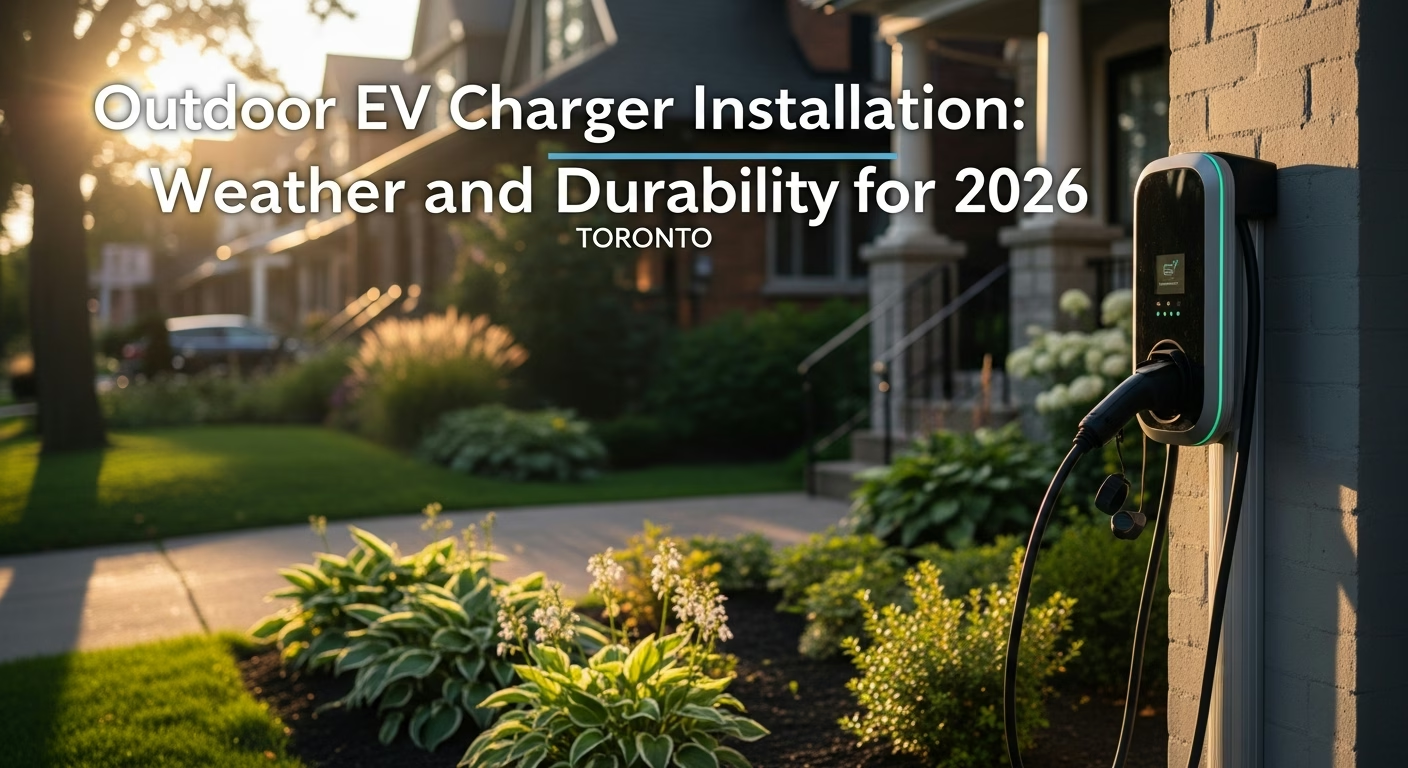

# Outdoor EV Charger Installation Toronto: Weather and Durability for 2026
Quick answer. A meaningful share of GTA EV charger installs end up outdoors — on a driveway pad, in a carport, on the side of a townhome, or in an unheated detached garage that is functionally indoor-outdoor in winter.A meaningful share of GTA EV charger installs end up outdoors — on a driveway pad, in a carport, on the side of a townhome, or in an unheated detached garage that is functionally indoor-outdoor in winter. Toronto weather throws genuine challenges at these installs: minus 25 Celsius cold snaps, freezing rain, salt-slush splash from the road, summer humidity in the upper 30s, and UV exposure that degrades cable jackets over time. The right hardware and the right install technique handle all of it; the wrong choices fail inside 18 months.
This guide covers outdoor and partial-exterior installs for the GTA: NEMA enclosure ratings, conduit choices, mounting orientation, cold-weather cable performance, and the small details that matter for 10-year durability. For the wider install context, see our pillar EV Charger Installation Toronto: Complete 2026 Guide.
When an Install Counts as "Outdoor"
The clear cases:
- Mounted on an exterior wall, fully exposed.
- In a carport with no walls, only a roof.
- On a driveway pedestal, freestanding.
The less clear cases that still require outdoor-rated hardware:
- Inside a detached garage with no insulation and a poorly-sealed door (effectively outdoor air infiltrates throughout winter).
- Inside a partially-finished basement walkout where the charger is near the exterior door.
- In a garage where the parking is partial and the charger is mounted near the open bay door area.
Any install where the temperature can drop below 0 Celsius or where wind-driven rain or snow can reach the charger should use NEMA 3R or NEMA 4 components.
NEMA Enclosure Ratings: What They Mean
NEMA enclosure ratings are the standard for environmental protection of electrical equipment. The relevant ones:
| Rating | Protection | Typical Use |
|---|---|---|
| NEMA 1 | Indoor only | Heated finished spaces |
| NEMA 3R | Rain-resistant | Carports, sheltered exterior |
| NEMA 4 | Watertight, hose-down resistant | Fully exterior, exposed |
| NEMA 4X | Same as 4 plus corrosion-resistant | Coastal or industrial |
| NEMA 6 | Submersible | Below grade |
For Toronto outdoor installs:
- Charger itself: most premium chargers (Tesla Wall Connector, ChargePoint Home Flex, Wallbox Pulsar Plus, FLO Home X5, Grizzl-E) are NEMA 3R or NEMA 4 rated as shipped. Verify before purchase.
- Conduit fittings: must be NEMA 4 weatherproof for any portion exposed to weather.
- Junction boxes: NEMA 4 rated.
- Receptacles (if NEMA 14-50 outdoor): require weather-resistant in-use covers (clamshell or flip-up that allows the cord to remain plugged in while the cover protects).
Charger Mounting: Orientation Matters
Outdoor charger mounting is not just about height — it is about preventing water entry over years of weather cycling.
Optimal orientation: charger vertical, connector cup face-down when stored in holster. Any moisture drains out of the connector by gravity. Avoid: mounting the charger upside-down or sideways. Any orientation where water can pool in the connector cup or in the unit's seams will eventually leak in through condensation cycles. Mounting height: 48-54 inches off the finished surface (paving or concrete pad). Same as indoor. Wall protection: if mounted on a wood-sided exterior wall, install a backing board (treated plywood with weather-resistant flashing) behind the charger to prevent water entry into the wall cavity at the mounting screws. Roof or eave: ideal placement is under a small overhang or eave. This dramatically reduces direct rain exposure on the charger and on the cable connector when stored.Cold-Weather Cable Performance
Toronto cables see minus 20 to minus 30 Celsius for several weeks each winter. At those temperatures, all charging cables stiffen — but some stiffen drastically more than others.
Cables that stay flexible cold:- Tesla Wall Connector cable (proprietary blend, designed for cold).
- FLO Home X5 cable (Quebec-engineered, rated to minus 40).
- Grizzl-E cable (Ontario-made, rated to minus 30).
- ChargePoint Home Flex cable.
- JuiceBox cable.
- Generic budget chargers.
The practical effect of a stiff cable: harder to plug in cold mornings, more force on the connector pins, faster wear on the strain relief. None of these cause immediate failure, but over 5-10 years the cumulative wear is meaningful.
For brand-specific cold-weather details, see Tesla Wall Connector vs Universal EV Charger Toronto.
Need professional electrical services?
Call RenoHouse at 289-212-2345 or get a free estimate today.
Get Free Estimate →Cable Storage: Out of the Snow
Outdoor or partially-exterior installs need a cable storage strategy that keeps the connector cup out of accumulating snow:
- Holster mounted under eave or overhang: prevents direct snow accumulation. Best practical solution.
- Connector storage cover: $15-30 soft cover that fits over the connector when stored. Prevents snow ingress.
- Heated holster: rare but available — a low-wattage heated holster prevents ice accumulation in the connector. Adds about $80-120 to the install.
The most common winter charging fault in the GTA is snow ingress into the J1772 or NACS connector cup, which freezes overnight and prevents charging the next morning. Prevention is meaningfully cheaper than the morning hassle.
Conduit and Wire for Outdoor Runs
Code-compliant outdoor conduit:
- Above grade exterior: rigid PVC (Schedule 40 or 80) or rigid metallic conduit (RMC). EMT is allowed but PVC is more common for outdoor.
- Below grade burial: PVC Schedule 80 or direct-burial cable rated for the soil conditions.
- Penetrations through building envelope: must be sealed with weatherproof flashing and listed sealants.
Wire:
- Same gauge requirements as indoor (AWG 6 for 40A, AWG 4 for 48A).
- THWN-2 or RWU90 insulation for wet locations.
Surge Protection: More Important Outdoors
Outdoor chargers face higher lightning and grid-surge exposure than indoor units. A whole-panel surge protector ($180-320 added to the install) provides meaningful protection. Some outdoor chargers also support a dedicated surge module installed at the charger.
For Toronto exurbs (Caledon, parts of Aurora, Pickering rural) where lightning strikes are more common, surge protection is strongly recommended.
Salt and Road Slush Considerations
GTA roads see heavy winter salting, and the salt-slush splash from passing vehicles can reach driveway-mounted chargers. Two effects:
- Cosmetic: salt residue stains the charger housing. Clean periodically.
- Functional: salt is corrosive to exposed terminals if any seam is compromised. Verify NEMA 4 or 4X rating for any pedestal-mount charger near the street.
For pedestal installs more than 15 feet from the curb, salt exposure is minimal. For installs within 5 feet of the curb (some townhome side-mount scenarios), NEMA 4X is the safer rating.
Detached Garage Scenarios: The Common Toronto Case
A meaningful share of GTA detached homes have unheated detached garages. These installs are functionally indoor-outdoor in winter — the garage temperature tracks within 10 Celsius of outside air. Specific considerations:
- Charger should be NEMA 3R or NEMA 4.
- Cable should be cold-rated (Tesla, FLO, or Grizzl-E preferred).
- Holster should be under a covered area to prevent snow accumulation when the garage door is open.
- If running conduit between the house panel and the detached garage, the underground feeder must be sized for the run length and depth.
Underground feeder runs to detached garages typically add $400-1,200 to the install cost depending on distance and trenching difficulty.
Pedestal Installs: Freestanding Driveway Chargers
Some GTA homes (particularly older properties without attached or detached garages) install the charger on a freestanding pedestal mounted in concrete on the driveway. Considerations:
- Pedestal must be code-compliant: typically galvanized steel or stainless, set in concrete footing 36-42 inches deep (below frost line).
- Pedestal cost: $400-900 depending on material and aesthetic.
- Concrete footing and trenching for the underground feeder: $300-700 additional labour.
- NEMA 4 rated charger and all components.
- Wind-rated mounting: pedestal must withstand 100+ km/h wind loads.
Total premium for pedestal install vs garage-wall install: $700-1,500.
Snow Removal and Driveway Maintenance
Practical winter operation for outdoor chargers:
- Keep the area in front of the charger shovelled to allow safe access.
- Avoid throwing snow directly at the charger when shovelling.
- Do not use ice melt salt on concrete near the pedestal (over years it contributes to corrosion of the footing).
- After freezing rain events, check the connector cup before plugging in.
The Honest Take: Indoor Garage Is Always Better When Available
If your home has an attached heated garage, install the charger there. Indoor heated garage is the easiest, most durable, lowest-maintenance scenario. Outdoor and unheated installs are a workable second-best — they handle Toronto weather fine with the right hardware — but they do require more attention to component selection and ongoing maintenance.
For pre-install panel-side prep that applies to any install location, see our Pre-EV Charger Panel Scan service. For installation mistakes that compound outdoors, see EV Charger Installation Mistakes Toronto Homeowners Make.
---
Installing an outdoor EV charger in the GTA? RenoHouse handles full weather-rated installs with NEMA 4 components, cold-rated cables, and proper underground feeder runs to detached garages and pedestals. Book on our EV charger bundle service page.
Sources & References
Authoritative sources cited in this guide:
- Electrical Safety Authority (ESA) — Ontario electrical regulator
- Ontario Electrical Safety Code — OESC Section 26 / latest amendments
- Canadian Electrical Code Part I (CSA C22.1) — CEC standard
- NRCan — Electric Vehicle Resources — NRCan EV/charging programs
Continue Reading