RenoHouse

# Underpinning During Multiplex Conversion Toronto: Bill 23 Projects 2026
Quick answer. Toronto's multiplex permissions under Bill 23 (2022 More Homes Built Faster Act) and subsequent City zoning amendments have created a new project category: converting existing single-family or duplex Toronto homes into three or four legal residential units.Toronto's multiplex permissions under Bill 23 (2022 More Homes Built Faster Act) and subsequent City zoning amendments have created a new project category: converting existing single-family or duplex Toronto homes into three or four legal residential units. For pre-1970s housing stock — the bulk of Toronto's eligible inventory — basement underpinning is almost always part of the multiplex scope. The basement unit cannot exist without legal ceiling height, and the basement unit is what makes the multiplex math work.
This article covers how underpinning integrates into a Toronto multiplex conversion in 2026, the structural sequencing, the permit pathway, and the combined cost framework. For multiplex specifics outside the underpinning scope, see our Multiplex Conversion Toronto: 2026 Complete Guide. For the pure underpinning context, see our Basement Underpinning Toronto: Complete 2026 Guide.
Why Underpinning Is Part of Most Toronto Multiplex Projects
The economics of multiplex conversion typically include:
- Main floor unit — the existing house's main floor reconfigured as a one or two-bedroom unit.
- Second floor unit — the existing second floor reconfigured.
- Third floor unit (in homes with three above-grade levels) or basement unit.
- Sometimes a fourth unit in larger homes.
For a typical pre-1970s Toronto house, the main floor and second floor are above OBC ceiling-height minimums. The basement is not — typical existing height is 6'2" to 6'8" raw. To make the basement unit legal, the basement must be lowered to OBC 9.10 minimums (1.95 metres / 6'5" finished height).
Without underpinning, the multiplex project loses one rental unit. The math falls apart.
For some larger Toronto homes, third-floor conversions allow the multiplex math to work without basement underpinning — but these projects typically still benefit from a finished basement for storage, mechanical, or limited tenant amenity, even if not as a legal habitable unit.
Multiplex Project Scope That Affects Underpinning
A typical Bill 23 multiplex conversion involves several scope items beyond the basement that affect the underpinning design:
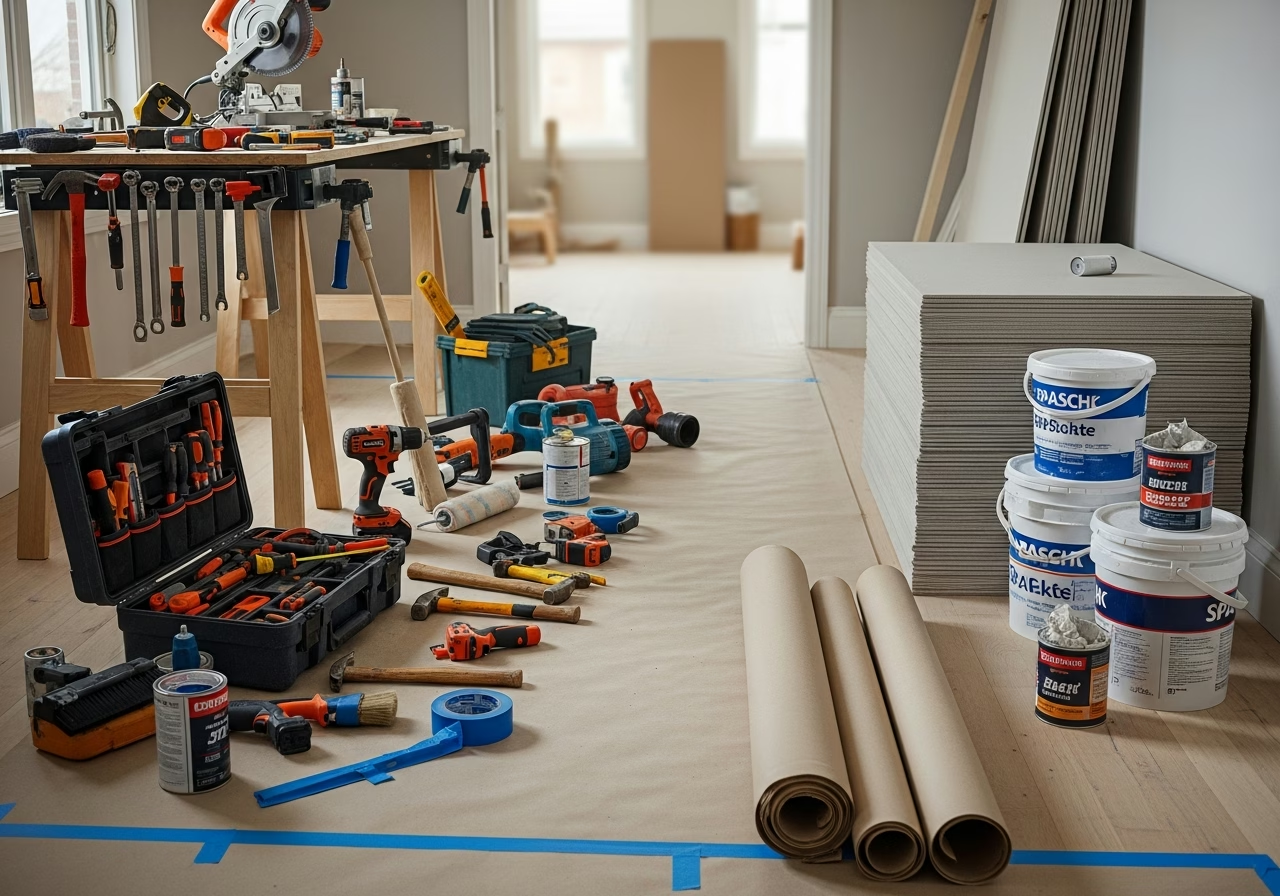
The interconnection of these scopes is why multiplex conversion is a 6 to 12 month construction project, not a 3 to 4 month project.
Engineering Scope for Multiplex Underpinning
Multiplex underpinning engineering is more comprehensive than single-family underpinning. Typical scope:
- Full structural design of the underpinning — pin sequence, depth, concrete spec, shoring.
- Floor opening design for new stair openings.
- Beam additions to carry main-floor loads where bearing walls are removed.
- Fire separation structural detailing — rated wall assemblies that meet structural and fire requirements.
- Lateral system review — multi-unit conversions sometimes reduce lateral stiffness; the engineer confirms or specifies bracing.
- Mechanical penetration coordination — significant penetrations through the new slab and walls require structural review.
- Soil and bearing-capacity review — multiplex projects increase total building load; the engineer confirms the foundation supports the new total.
For Toronto multiplex projects, Verner Polak Engineering is our most-frequent recommendation — multi-unit conversion experience, good City coordination, fluent with Bill 23 framework. Glogowski Architectural is also a strong fit when the project bundles underpinning with second or third-storey reconfiguration. See Underpinning Structural Engineer Toronto PEng.
Engineering fees for multiplex underpinning: $8,500 to $18,000 for design and stamped drawings, plus $3,500 to $7,500 for site visits during construction.
Need professional home renovation?
Call RenoHouse at 289-212-2345 or get a free estimate today.
Get Free Estimate →Permit Pathway for Multiplex Conversion
The Toronto Building Permit pathway for multiplex projects is more complex than for single-family underpinning:
1. Zoning verification. Bill 23 multiplex permissions are as-of-right in most Toronto residential zones (effective 2023), but specific lot configurations, parking requirements, and unit-count caps still apply. Pre-application zoning consultation with City Planning is recommended — typically free, takes 2 to 4 weeks. 2. Architectural set. Multiplex projects require a complete architectural set showing all units, exterior alterations (new entrances, stair towers, exterior modifications), and accessibility considerations. Architectural fees: $15,000 to $35,000 for a typical Toronto multiplex. 3. Mechanical, plumbing, electrical drawings. Per-unit mechanical scope must be drawn and submitted. Mechanical fees: $6,500 to $14,000. 4. Structural engineering. As described above. $8,500 to $18,000. 5. Building Permit submission. The combined package is submitted online or in-person. Plan review for multiplex projects typically takes 10 to 16 weeks in 2026, longer than single-family underpinning. 6. Permit issuance. Permit fees for multiplex projects: $8,000 to $18,000 depending on unit count and project value. 7. Construction. Inspections at footing, pre-pour, post-pour, slab, framing, insulation, fire separation, mechanical, electrical, plumbing, final per unit. 8. Per-unit final inspection and registration. Each unit is inspected and signed off; the property is registered as multi-tenant under Toronto Municipal Code provisions.Total permit timeline from project start to permit-in-hand for multiplex: 16 to 24 weeks (vs 11 to 19 weeks for single-family underpinning).
Cost Framework for Multiplex Underpinning Project
A typical Toronto Bill 23 multiplex conversion (single-family detached converted to four units: main floor, second floor, third floor or upper level, basement) in 2026:
Pre-construction:- Architectural design: $15,000 to $35,000
- Structural engineering: $8,500 to $18,000
- Mechanical engineering: $6,500 to $14,000
- Soil report: $2,500 to $5,500
- Permit fees: $8,000 to $18,000
- Subtotal: $40,500 to $90,500
- Demo and excavation: $14,000 to $24,000
- Underpinning concrete: $35,000 to $58,000
- Waterproofing and drainage: $8,000 to $14,000
- New slab: $6,500 to $11,000
- Basement entrance structural: $8,500 to $22,000
- Subtotal: $72,000 to $129,000
- New beam(s) and bearing-wall removal on main floor: $14,000 to $32,000
- Floor openings and new stair structures: $12,000 to $28,000
- Lateral bracing where required: $4,500 to $14,000
- Subtotal: $30,500 to $74,000
- Plumbing: $35,000 to $65,000 (four units)
- Electrical: $32,000 to $60,000 (four units, separate panels or sub-panels)
- HVAC: $28,000 to $58,000 (four units, separate or zoned)
- Ventilation (HRV per unit or central): $12,000 to $24,000
- Subtotal: $107,000 to $207,000
- Insulation, framing, drywall, fire separation: $55,000 to $95,000
- Flooring (four units): $28,000 to $54,000
- Kitchens (four units, mid-tier): $80,000 to $160,000
- Bathrooms (four to five total): $42,000 to $90,000
- Trim, doors, paint: $30,000 to $55,000
- Fixtures, hardware, finish carpentry: $20,000 to $40,000
- Subtotal: $255,000 to $494,000
- New entrances, walkways, retaining walls: $25,000 to $55,000
- Exterior alterations (siding, windows, trim): $18,000 to $45,000
- Landscape restoration: $8,000 to $18,000
- Subtotal: $51,000 to $118,000
- 8 to 12 percent of subtotal typical: $50,000 to $130,000
The wide range reflects the variability — a smaller home with three units rather than four, simpler exterior, and standard finishes can land at the lower end. A larger home with four units, premium finishes, and complex exterior work runs to the upper end.
Sequencing — How the Project Actually Happens
Multiplex projects are sequenced carefully to avoid simultaneous structural disturbance and to allow trades to work efficiently:
Months 1-3: design, engineering, permit. No site work. Month 4: project mobilization. Site setup, scaffolding, temporary protection. DSS and abatement coordination if needed. Month 5: demolition. Existing finishes removed, mechanical disconnected, debris hauled. Month 6: structural work above grade — temporary support, beam additions, new floor openings. Months 7-8: underpinning. Pin-by-pin underpinning sequence with engineer site visits. Month 9: new basement slab, exterior basement entrance structure. Months 10-11: mechanical rough-in across all units. Plumbing, electrical, HVAC. Month 12: insulation, framing of partition walls, fire separation. Months 13-14: drywall, taping, painting prep. Months 15-16: flooring, kitchens, bathrooms, finish carpentry, paint. Month 17: fixtures, appliances, final mechanical commissioning. Month 18: inspections, deficiencies, final occupancy clearance per unit.Total project: 15 to 20 months from concept to legal occupancy of all units. The on-site construction is roughly 12 to 14 months of that timeline.
ROI on Multiplex Conversion
The financial case for multiplex conversion is the strongest of any Toronto residential renovation when the project is well-located and well-executed:
Typical four-unit project:- Project cost: $700,000 to $1,000,000 mid-range.
- Total monthly rent: $9,000 to $14,000 (four units, mix of one and two-bedroom).
- Annual gross rent: $108,000 to $168,000.
- Net annual rent (after operating costs): $75,000 to $115,000.
- Property valuation by income capitalization (5 percent cap rate): $1,500,000 to $2,300,000.
- Equity gain on completion (vs purchase plus renovation cost): typically $500,000 to $1,200,000 in mid-premium Toronto.
The simple payback on rental income alone is 6 to 9 years. The combined return including equity gain is closer to 3 to 5 years.
This is why multiplex conversion is the highest-AOV interior project category in Toronto in 2026.
Common Multiplex-Specific Underpinning Issues
Issues that emerge specifically on multiplex projects:
Bench Footing in Multiplex — Generally Not Recommended
For multiplex projects, bench footing is generally not the right choice. Reasons:
- Bench geometry creates a 4 to 6 foot perimeter zone with sub-code height. For a basement legal apartment, this loses 200 to 350 square feet of legal living space.
- Apartment furniture wants the perimeter wall area.
- The bench geometry signals "renovated basement" rather than "apartment" to inspectors and tenants.
- The bench geometry is harder to detail with fire-rated wall assemblies meeting unit-separation requirements.
Some multiplex projects use partial underpinning plus bench — full underpin on the side of the basement unit's main living spaces, bench on the side facing the utility room or storage. Hybrid approach saves $20,000 to $40,000 versus full perimeter underpin.
Toronto Multiplex Pilot Programs and Incentives
In 2026, Toronto offers several multiplex-supportive programs:
- Multiplex zoning permission — as-of-right in most residential zones, no Committee of Adjustment for typical four-unit conversions.
- Toronto Multiplex Builders Forum — coordination and support for new multiplex builders and renovators.
- Affordable housing incentives — for some projects that include below-market rental units, additional density or fee waivers may apply.
- Development charge phasing — multiplex projects under Bill 23 may benefit from reduced or phased development charges.
Specific programs change regularly. The City Planning department is the authoritative source.
Insurance for Multiplex Projects
Multiplex conversion has higher insurance significance than single-family underpinning. Considerations:
- Contractor general liability sized for multiplex scope ($10 million typical).
- Engineer professional liability confirmed.
- Builder's risk all-risk policy for the construction period.
- Owner's home insurance notified specifically of multiplex conversion. Once units are occupied, the policy converts to multi-tenant residential coverage.
We carry general liability appropriate to multiplex scope and provide certificates to the homeowner.
How RenoHouse Approaches Multiplex Projects
Multiplex conversion is a major project with high coordination complexity. Our approach:
- 1. Pre-project feasibility — site review, zoning confirmation, preliminary unit-count and budget assessment.
- 2. Engineer engagement — typically Verner Polak or Glogowski for the structural scope.
- 3. Architect engagement — full architectural set for all units, exterior alterations, and code compliance.
- 4. Permit submission — coordinated submission of architectural, structural, mechanical packages.
- 5. Construction management — full GC scope with trade coordination across the 12 to 14 month construction timeline.
- 6. Per-unit handover — inspection, deficiency correction, registration, tenant-readiness handover.
Our role is the project owner on the ground. The engineer is the structural authority. The architect is the design authority. The City is the regulator.
Next Steps
If you are considering a Toronto multiplex conversion, the path is:
- 1. Property feasibility assessment — current zoning, lot configuration, building condition, target unit count.
- 2. Preliminary project budget — based on unit count, neighbourhood, finish target.
- 3. Pro-forma financial analysis — rental income, project cost, financing, ROI.
- 4. Architect and engineer engagement if the project pencils.
- 5. Permit pathway and construction.
Sources & References
Authoritative sources cited in this guide:
- Ontario Building Code — OBC official text
- Toronto Building Permits — City permit portal
- Tarion New Home Warranty — Ontario new-build warranty regulator
- HCRA — Home Construction Regulatory Authority — Ontario builder/vendor licensing
Continue Reading