RenoHouse

# Cold-Climate Heat Pumps Toronto: Performance at -25C
Quick answer. The single biggest source of skepticism about heat pumps in Toronto is the cold-snap question. Will the heat pump actually heat the house at -22C on January 14? Will it default to expensive electric strip heat? Will it freeze up and stop working? In 2026, with cold-climate heat pump (CCHP) technology in its fifth generation, the honest an...The single biggest source of skepticism about heat pumps in Toronto is the cold-snap question. Will the heat pump actually heat the house at -22C on January 14? Will it default to expensive electric strip heat? Will it freeze up and stop working? In 2026, with cold-climate heat pump (CCHP) technology in its fifth generation, the honest answer is: yes it heats the house, no you do not need strip heat in most Toronto winters, and the defrost cycle is a 3-7 minute event you barely notice. But model selection matters — a budget air-source heat pump and a Mitsubishi H2i are not in the same category.
This post covers the cold-climate performance data Toronto homeowners need to evaluate heat pump conversion honestly. For the full conversion guide, see Heat Pump Conversion Toronto: The Complete 2026 Guide. For brand head-to-head, see Mitsubishi vs Daikin vs Lennox: Cold-Climate Comparison.
How RenoHouse Approaches the Cold-Climate Question
RenoHouse coordinates heat pump retrofits with TSSA-G2-licensed gas fitters and HVAC-licensed installers who handle the refrigerant work, commissioning, and final tie-ins. Our role on the cold-climate question is to verify the model the installer is quoting actually has the published capacity at -25C — not a marketing summary, but the manufacturer's extended performance table at low ambient. Below is what we check.
The Capacity Curve: What Cold-Climate Actually Means
Every air-source heat pump rates its capacity at three temperatures: 47F (8.3C), 17F (-8.3C), and 5F (-15C). Standard heat pumps stop publishing data below 5F because their capacity collapses. Cold-climate heat pumps publish data at -13F (-25C) and sometimes -22F (-30C).
A typical 3-ton (36,000 BTU nominal) cold-climate heat pump in Toronto:
- At 8C: 38,000 BTU output, COP 3.8.
- At -8C: 33,000 BTU output, COP 2.9.
- At -15C: 28,000 BTU output, COP 2.4.
- At -25C: 22,000-25,000 BTU output, COP 1.9-2.1.
- At -30C: 17,000-20,000 BTU output, COP 1.6-1.8.
Compare that to a standard 3-ton air-source heat pump:
- At 8C: 36,000 BTU output, COP 3.5.
- At -8C: 24,000 BTU output, COP 2.3.
- At -15C: 14,000 BTU output, COP 1.7.
- At -25C: collapses to electric strip heat — COP 1.0, output limited by aux strips (typically 5-10 kW).
The gap between the two categories at -25C is the entire ballgame. A cold-climate model continues to deliver real heat at COP near 2.0 — meaning each kWh of electricity yields nearly 2 kWh of heat. A standard model is essentially running as a $20,000 electric resistance heater.
What "Hyper-Heating" Inverter Technology Does Differently
Three technical features distinguish CCHP units:
- 1. Vapor injection / EVI (Electronic Vapor Injection). A second compression stage that injects refrigerant vapor mid-cycle, increasing mass flow and maintaining capacity as outdoor temp drops. Mitsubishi H2i, Lennox Quantum, and Daikin Aurora all use variants.
- 2. Larger displacement compressor with wider modulation. CCHP compressors run from 20% to 120% of nameplate (vs 60-100% for standard units). At -25C the compressor pushes to 120% to maintain output.
- 3. Refrigerant choice. R-454B, R-32, and (legacy) R-410A behave differently at low temp. R-32 has better low-temp performance than R-410A; R-454B has the best low-GWP environmental profile. By 2026, R-454B is dominant in new units; the EPA AIM Act and Canada equivalent regulations are phasing R-410A out for new equipment.
The Defrost Cycle: What Actually Happens
When outdoor temperature is between -5C and +5C with high humidity, frost builds on the outdoor coil. The unit reverses the refrigerant flow briefly to defrost. For 3-7 minutes the indoor unit blows room-temperature air (some units modulate aux heat strips during defrost; CCHP units typically do not need to). Most homeowners do not notice unless they are standing at a register.
Defrost frequency in a typical Toronto winter: 1-3 times per day on humid days near freezing; rarely below -8C (too dry for frost); never below -15C (no moisture in air to deposit).
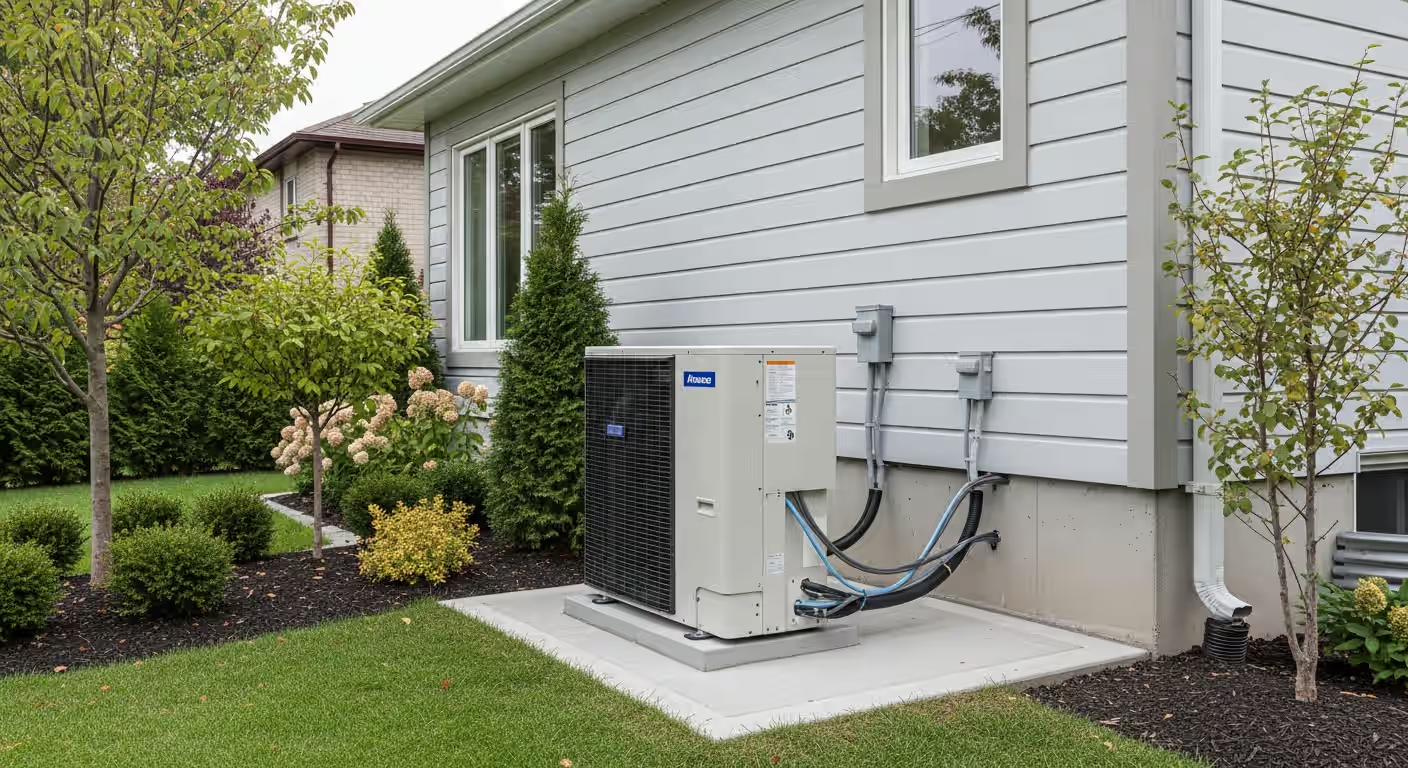
A correctly installed outdoor unit:
Need professional renovation?
Call RenoHouse at 289-212-2345 or get a free estimate today.
Get Free Estimate →- Sits on a riser pad 6-12 inches above grade (above typical snow accumulation).
- Drains defrost condensate to a gravel pit or grade slope away from the foundation.
- Has 18-24 inches clearance on the coil-side and 36 inches on the discharge side.
For drainage detail, see Heat Pump Condensate Drainage Toronto Winter: Avoiding Ice Dams at the Outdoor Unit.
Toronto Real-World Winter Profile
Pearson Airport climate normals (2026 update, 1991-2020 baseline):
- Average daily low January: -7.3C.
- Average daily low February: -6.5C.
- Number of days/year below -15C: 8-14.
- Number of days/year below -20C: 1-4.
- Coldest day in typical year: -22C.
- Coldest day in 1-in-10 year cold snap: -27C.
What this means for a CCHP install: 95%+ of heating hours occur at temperatures where the heat pump is at COP 2.5 or higher. The 1-3 days/year at -25C run at COP 1.9-2.1 — still cheaper to operate than electric strip heat, and roughly cost-equivalent to gas at current Enbridge rates.
Model Selection: What Holds Up at -25C
The five lines we recommend for Toronto cold-climate work:
- Mitsubishi Hyper-Heating Inverter (H2i) — 100% nameplate at -15C, 76% at -25C, rated to -30C. Strong dealer network. Premium price.
- Daikin Aurora / Daikin Fit / Daikin Atmosphera — rated to -25C, integrates with Daikin One+ thermostat for hybrid management.
- Lennox Quantum (formerly SL25XPV) — rated to -30C, top-tier modulation 25-100%, premium price, strong cold-climate AHRI ratings.
- Carrier Infinity 24VNA9 / Greenspeed — rated to -22C, excellent modulation, deep Ontario dealer network, strong value.
- Bosch IDS 2.0 / 3.0 — rated to -22C, value tier with credible cold-climate performance, good warranty.
Avoid for Toronto: builder-grade 14-16 SEER air-source heat pumps from any manufacturer; older R-410A units approaching phase-out.
For the head-to-head, see Mitsubishi vs Daikin vs Lennox.
NRCan ENERGY STAR Cold-Climate List
Models that qualify for the Greener Homes Loan and Ontario HRS rebate must appear on the NRCan ENERGY STAR Most Efficient cold-climate list. The list is updated annually. As of 2026, criteria include:
- HSPF2 of 8.1 or higher.
- COP at -15C of 2.1 or higher.
- COP at +8C of 3.0 or higher.
Verifying your quoted model on the NRCan list is mandatory before signing the install contract. RenoHouse pulls the AHRI certificate for every quoted unit and confirms it appears on the current NRCan list.
Backup Heat Strategy
Three approaches to cold-snap backup, ranked by Toronto suitability:
- 1. No backup — pure CCHP. Works if Manual J load at design temp (-22C) is within heat pump capacity at that temp. Most 1990s+ Toronto homes with R-40+ attic insulation qualify.
- 2. Electric strip aux heat (5-10 kW). Built into most air handlers. Engages below a programmed cutover (typically -18C to -22C). Adds ~$300-$700 to install. Operates 1-3 days/year in a typical Toronto winter.
- 3. Hybrid (dual fuel) with existing gas furnace. Heat pump primary, gas furnace cutover at -10C to -15C. Best for homes already on gas, lowest cold-snap risk, qualifies for partial HRS rebate. Loses some Greener Homes Loan optimization.
For the hybrid decision in detail, see Dual Fuel Heat Pump + Furnace Toronto.
Indoor Comfort at Low Outdoor Temp
Heat pump supply-air temperature drops as outdoor temp drops. At -25C outdoor, supply air may be 88-92F instead of the 100-105F at +5C outdoor. Two implications:
- Register feel. Air feels neutral rather than warm. Some homeowners interpret this as the system "not heating." It is — just at lower delta-T and higher CFM.
- Run time. Heat pumps run nearly continuously in cold snaps. This is correct behaviour, not malfunction. Continuous low-modulation run is more efficient than cycling.
Programmable thermostat strategy: set 21C constant rather than 21C/18C setback. The heat pump cannot rapidly recover from a deep setback at -20C — better to maintain.
Pairing With Envelope Work
A leaky envelope makes cold-climate performance harder. Before committing to a heat pump-only path, the building envelope should hit at minimum:
- Attic R-50 or higher.
- Walls R-12 or higher (fill where possible).
- Air leakage 3.5 ACH50 or lower (blower door verified).
- Windows U-0.30 or lower (modern double or triple glazed).
For the envelope checklist, our Insulation Thermal Audit (FLIR) service finds the leaks before they become a heat pump performance complaint.
What to Verify Before Signing the Install Contract
A short pre-install checklist for the cold-climate question:
- 1. AHRI certificate for the exact model+air handler combination.
- 2. NRCan ENERGY STAR cold-climate list verification (current year).
- 3. Manufacturer extended performance table showing capacity at -25C.
- 4. Manual J heating load at -22C indoor design.
- 5. Equipment capacity at -22C >= 1.0x Manual J load (or backup strategy documented).
- 6. Refrigerant type (R-454B preferred for new installs in 2026).
- 7. Outdoor unit placement plan with snow clearance and drainage.
- 8. Defrost condensate management plan.
Next Steps
If cold-snap performance is your main concern about heat pump conversion, the right answer is not to skip the project — it is to specify a real cold-climate unit and verify its published capacity at -25C against your Manual J load. RenoHouse coordinates this verification with the HVAC sub before quote.
Book a scoping visit at /services/hvac-energy/heat-pump-conversion. For the full conversion path, see Heat Pump Conversion Toronto: The Complete 2026 Guide. For sizing detail, see Heat Pump vs Gas Furnace Toronto Comparison and Heat Pump Installation Mistakes Toronto.
Sources & References
Authoritative sources cited in this guide:
- NRCan — Heating and Cooling — NRCan heating/cooling guidance
- Canada Greener Homes Loan — Federal energy retrofit financing
- CSA F326 (Mechanical Ventilation) — Residential HRV/ERV standard
- Enbridge Home Renovation Savings (HRS) program — Provincial heat pump rebate
- TSSA Fuel Safety — Ontario fuel/gas regulator
Continue Reading