RenoHouse

# Heat Pump vs Gas Furnace: Toronto 2026 Comparison
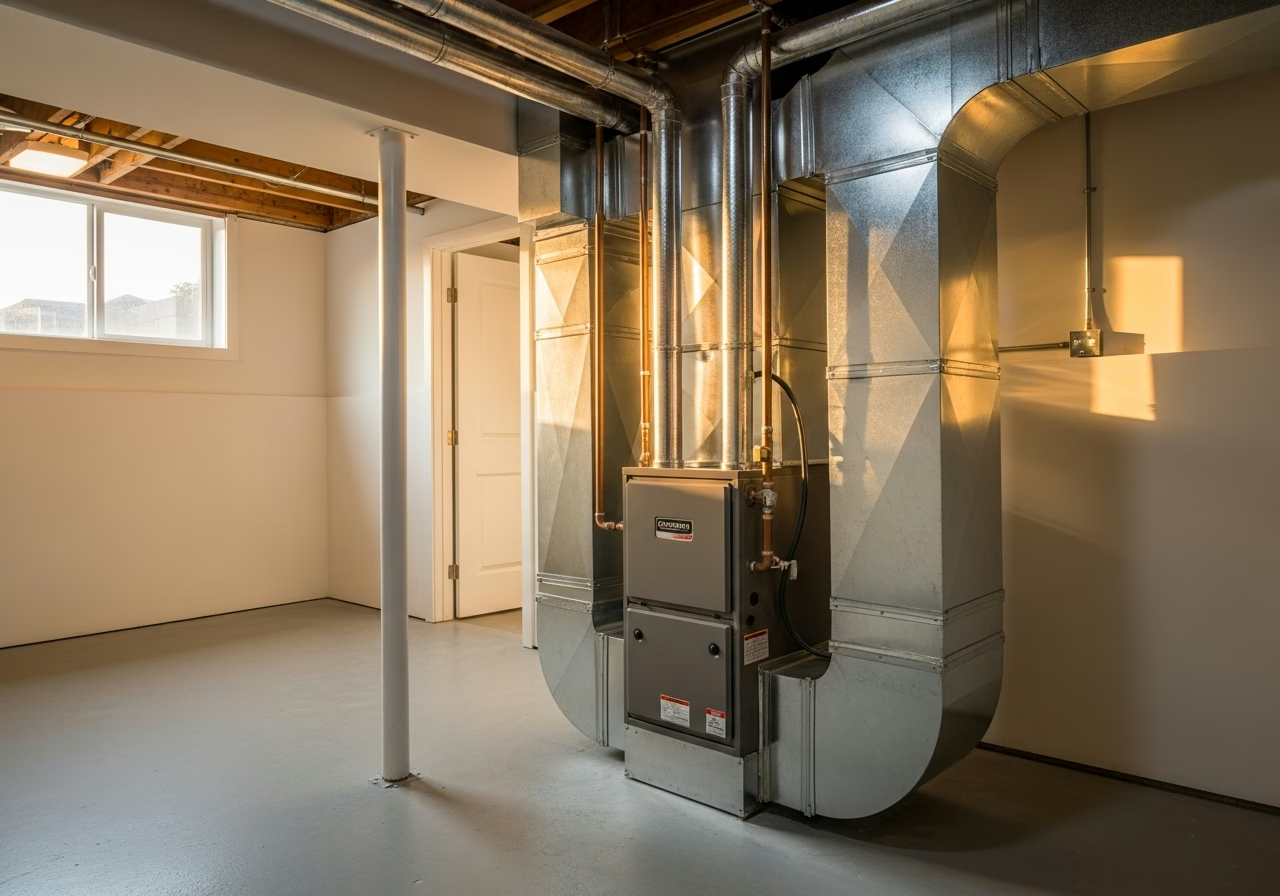
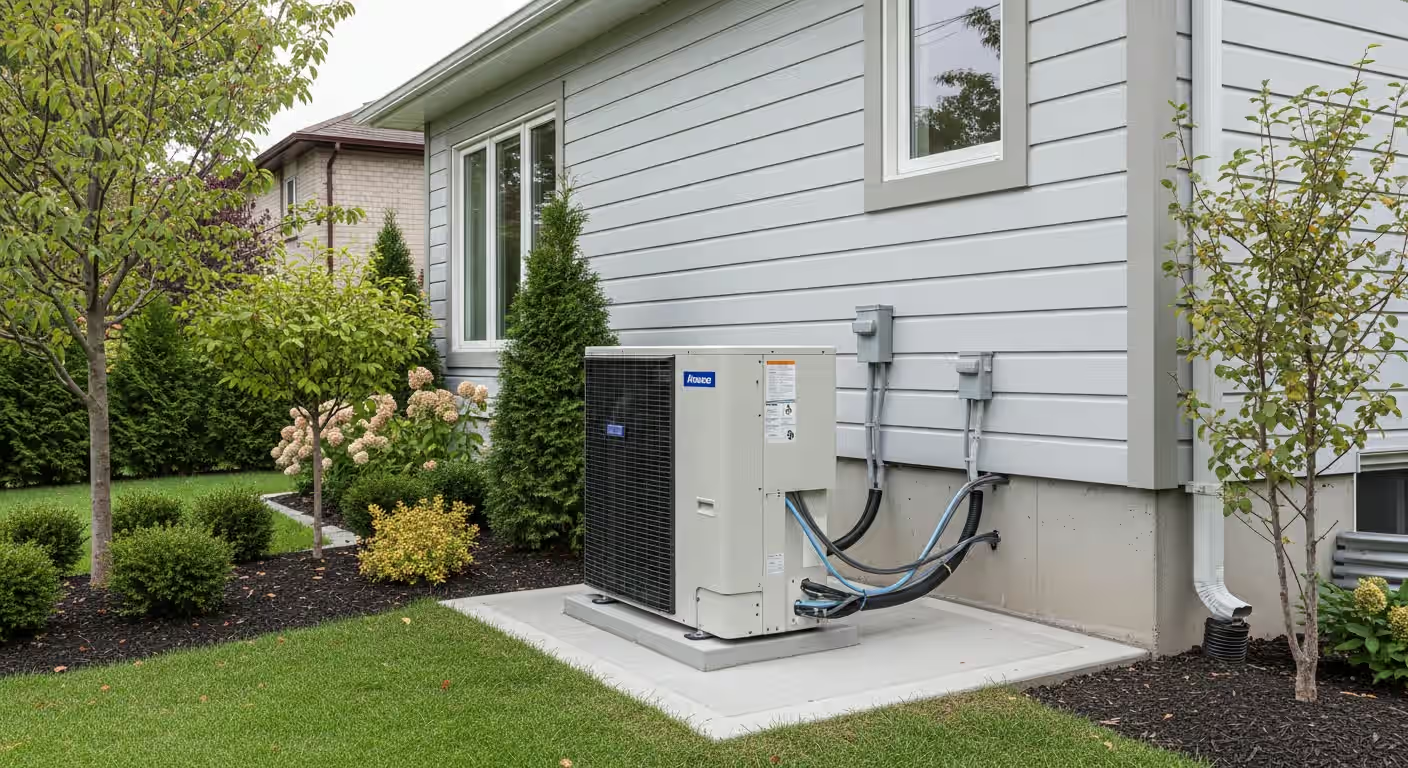
Quick answer. For a Toronto homeowner whose furnace is approaching end-of-life, 2026 is the first year where the heat pump vs gas furnace decision is genuinely close on operating cost, with the heat pump winning on capital cost (after rebates and the Greener Homes Loan), capital risk, and 15-year carbon exposure.For a Toronto homeowner whose furnace is approaching end-of-life, 2026 is the first year where the heat pump vs gas furnace decision is genuinely close on operating cost, with the heat pump winning on capital cost (after rebates and the Greener Homes Loan), capital risk, and 15-year carbon exposure. This post compares the two paths honestly across capital, operating, comfort, lifespan, and environmental dimensions for a typical Toronto detached or semi.
For the full conversion guide, see Heat Pump Conversion Toronto: The Complete 2026 Guide. For ROI and payback math, see Heat Pump ROI & Payback Toronto vs Natural Gas.
RenoHouse Positioning
We coordinate heat pump retrofits with TSSA-G2-licensed gas fitters and HVAC-licensed installers who handle refrigerant, gas, and electrical tie-ins. Our role is project coordination across HVAC, electrical, insulation, and rebate paperwork. The mechanical and electrical sign-off is by certified specialists.
The Two Reference Cases
For an apples-to-apples Toronto comparison, we use two reference systems:
A 2,000 sqft semi-detached Toronto home built 1970, with R-30 attic post-retrofit, R-12 walls, and existing forced-air ductwork.
Capital Cost Comparison
| Item | Case A (Furnace + AC) | Case B (Heat Pump) |
|---|---|---|
| Equipment | $4,800 furnace + $3,200 AC | $11,500 heat pump |
| Install labour | $2,500-$3,500 | $3,000-$4,500 |
| Permit + inspection | $300-$500 | $400-$700 |
| Smart thermostat | $250-$450 | $250-$450 |
| Electrical panel work | $0-$800 | $800-$3,500 |
| Total before rebates | $9,500-$13,500 | $19,500-$23,500 |
| Greener Homes Loan (0%, 10-yr) | Not eligible | -$19,500 financed |
| HRS rebate | $0-$300 | -$5,000-$7,100 |
| HRS rebate | $0-$500 | -$1,500-$2,500 |
| Net out-of-pocket | $9,200-$13,000 | ~$0 (after stack) |
Case B nets to roughly zero out-of-pocket via the Greener Homes Loan plus rebate stack. Case A pays cash. This is the headline of the 2026 conversation.
Operating Cost: Toronto ULO Math
Toronto Hydro Ultra-Low Overnight (ULO) rate plan as of 2026:
- Overnight (11pm-7am): 2.4 cents/kWh.
- Mid-peak (7am-4pm, 9pm-11pm): 9.5 cents/kWh.
- On-peak (4pm-9pm weekday): 28.4 cents/kWh.
Plus delivery and regulatory: roughly 4-5 cents/kWh blended fixed.
Enbridge gas residential rate 2026:
- Commodity + delivery + carbon levy + transportation: ~32-38 cents/m3 blended.
For our 2,000 sqft semi:
Need professional renovation?
Call RenoHouse at 289-212-2345 or get a free estimate today.
Get Free Estimate →- Annual heating load: ~85 GJ.
- Annual cooling load: ~14 GJ.
- Heating: 85 GJ / 0.96 = 88.5 GJ gas in. At 38.6 MJ/m3, that is 2,295 m3/year. At 35 cents/m3 blended = $803/year heating.
- Cooling: 14 GJ / SEER 14 = ~1,000 kWh/year. At 13 cents/kWh blended Tier rate = $130/year cooling.
- Total: $933/year.
- Combined heating + cooling: ~99 GJ thermal.
- At seasonal COP 2.9 (Toronto-specific): 99 GJ / 2.9 = 9,500 kWh/year.
- With ULO + pre-conditioning, blended rate ~6-7 cents/kWh = $665/year.
- Plus standing fixed delivery: $200/year shared.
- Total: ~$665-$865/year.
What Tilts the Operating Math
Three factors push toward the heat pump:
- 1. ULO discipline. Pre-conditioning the home overnight (raise 2C between 4-7am) and coasting through the 4-9pm peak shifts 60-70% of consumption to overnight rates.
- 2. Carbon levy trajectory. Federal carbon levy adds 5-7 cents/m3 to gas annually through 2030 under current schedule. Heat pump avoids this.
- 3. Gas commodity price volatility. Enbridge commodity is unhedged; ULO electricity is regulated.
Three factors push toward the gas furnace:
- 1. Cold-snap weeks. Heat pump COP drops to 1.9-2.1 at -25C; gas furnace efficiency holds.
- 2. Static occupancy schedule. Households home all day cannot exploit ULO peak avoidance as effectively.
- 3. Electrical panel cost. If a 200A panel upgrade is required, the capital advantage of Case B narrows.
Comfort Comparison
Gas furnace:- Supply air 130-150F. Air feels warm at the register.
- On-off cycling on most single-stage and many two-stage units. Temperature swings 1-2C between cycles.
- Drier indoor air in winter (combustion air takeup).
- Supply air 95-105F. Air feels neutral or warm.
- Continuous low-modulation run. Temperature stable within 0.3C.
- Slightly higher indoor humidity in winter (no combustion makeup air).
- Same equipment also air-conditions in summer with better dehumidification than a fixed-speed AC.
For most homeowners, the heat pump's even temperature and humidity control is the unsung win after install.
Lifespan and Reliability
Both technologies are mature. Service life expectations:
- High-efficiency gas furnace: 15-18 years; secondary heat exchanger occasionally fails at 12-15 years.
- 14-16 SEER AC: 12-15 years; compressor failure dominant mode.
- Cold-climate heat pump: 15-18 years; inverter board occasionally fails at 8-12 years.
Manufacturer warranties:
- Most gas furnaces: 10-year heat exchanger, 5-year parts.
- Cold-climate heat pumps: 10-12 year compressor, 10-year parts; some lines (Mitsubishi, Lennox premium) offer 12-year extended.
Reliability footprint is similar. The heat pump replaces two pieces of equipment (furnace + AC) with one, reducing failure surface area.
Environmental Footprint
A typical Toronto gas furnace burns 2,300 m3/year of natural gas, emitting ~4.4 tonnes CO2 equivalent annually. Over a 15-year service life: 66 tonnes.
A cold-climate heat pump on Ontario grid (90%+ non-emitting via nuclear and hydro): ~0.4 tonnes CO2 equivalent annually from electricity. Plus ~0.3 tonnes one-time embodied refrigerant emission risk over equipment life. Over 15 years: ~7 tonnes.
The heat pump path avoids ~59 tonnes of CO2 equivalent over 15 years vs gas. Whether that matters to you is a personal call. It will increasingly matter to buyers when you sell — energy-efficient homes already trade at a 1-2% MLS premium in Toronto.
When Gas Furnace Still Wins
Cases where Case A is still the right call in 2026 Toronto:
- Pre-1920 home with no usable ductwork and no envelope plan.
- Owner planning to sell within 18 months.
- 100A panel with no upgrade budget and no envelope tightening planned.
- Cottage or rental property where capital is limited and tenant pays utilities.
- Off-grid or unstable electrical supply (rare in Toronto proper).
In most owner-occupied Toronto detached and semi homes, the heat pump path is now competitive or better.
When Heat Pump Decisively Wins
- Existing AC also at end-of-life (heat pump replaces both).
- Owner commits 15+ years.
- Plans to add EV charger or induction range (electrical infrastructure pre-built).
- Greener Homes Loan eligible and willing to do EnerGuide audit.
- Envelope already tight or planning insulation work in parallel.
The Hybrid Path
A growing share of Toronto retrofits choose hybrid (dual-fuel): keep the gas furnace as backup, install a heat pump as primary, cutover at -10C to -15C. Best-of-both for cold-snap reliability, but smaller HRS rebate and dual maintenance.
For the dual-fuel decision detail, see Dual Fuel Heat Pump + Furnace Toronto.
Decision Framework
Three quick questions:
- 1. Is your AC also at end-of-life within 5 years? If yes, heat pump is the strong pick (you replace two with one).
- 2. Will you do any envelope work (insulation, windows, air-sealing) in the next 24 months? If yes, the deep-retrofit Greener Homes Loan stack is open to you.
- 3. Will you live in this home another 8+ years? If yes, payback math works.
Two of three yes: heat pump.
Cost Summary Table
| Metric | Gas Furnace + AC | Cold-Climate Heat Pump |
|---|---|---|
| Capital (gross) | $9,500-$13,500 | $19,500-$23,500 |
| Capital (net after rebates+loan) | $9,200-$13,000 | ~$0 out of pocket |
| Annual operating | $933 | $665-$865 |
| Service life | 15-18 yr | 15-18 yr |
| 15-year CO2 | 66 tonnes | 7 tonnes |
| Comfort (steady-state) | Good | Better |
| Cold-snap reliability | Excellent | Good (CCHP) |
| Resale impact (MLS) | Neutral | +1-2% premium |
Next Steps
A heat pump quote is the right next step regardless of which way you lean — it gives you the capital and operating numbers for your specific home, not a generic average. Book a scoping visit at /services/hvac-energy/heat-pump-conversion. For the full conversion guide, see [Heat Pump Conversion Toronto: The Complete 2026 Guide](/blog/heat-pump-conversion-toronto-2026-complete-guide). For cold-snap detail, see Cold-Climate Heat Pumps Toronto: Performance at -25C.
Sources & References
Authoritative sources cited in this guide:
- NRCan — Heating and Cooling — NRCan heating/cooling guidance
- Canada Greener Homes Loan — Federal energy retrofit financing
- CSA F326 (Mechanical Ventilation) — Residential HRV/ERV standard
- Enbridge Home Renovation Savings (HRS) program — Provincial heat pump rebate
- TSSA Fuel Safety — Ontario fuel/gas regulator
Continue Reading