RenoHouse

# Gas BBQ Line Installation Cost Toronto 2026
Quick answer. A permanent natural gas line to a backyard barbecue is the most popular outdoor gas project in Toronto. It eliminates propane tank exchanges, removes the fire-hazard storage problem, and connects your BBQ to the same Enbridge supply that runs your furnace and water heater.A permanent natural gas line to a backyard barbecue is the most popular outdoor gas project in Toronto. It eliminates propane tank exchanges, removes the fire-hazard storage problem, and connects your BBQ to the same Enbridge supply that runs your furnace and water heater. The downside: it has to be done by a TSSA G2 licensed gas-fitter, with a documented pressure test, and (often) a City of Toronto plumbing permit.
This RenoHouse cluster post covers what a Toronto BBQ gas line actually costs in 2026, what drives the price, and what a homeowner should expect from a coordinated quote.
Our role. RenoHouse is a project coordination firm. We coordinate TSSA G2 licensed gas-fitter subcontractors for every outdoor gas project. We do not employ in-house gas fitters. The G2 sub does the install; we coordinate permits, scheduling, Enbridge if needed, and finish work.The Headline Number: $1,500 – $2,500 for a Typical Toronto BBQ Line
For a typical Toronto detached or semi-detached home, a permanent BBQ gas line off the existing meter, with a 15 to 25 foot run to a single shut-off and quick-connect at a deck or patio location, falls in the $1,500 to $2,500 CAD all-in range in 2026. This includes:
- TSSA G2 sub labour
- Schedule 40 black iron or CSST pipe (whichever the G2 sub specifies)
- Approved fittings
- Outdoor shut-off ball valve at the building exit (CSA-rated)
- Quick-connect tee at the BBQ location
- Pressure test (air or nitrogen, 1.5x operating pressure, minimum 10-minute hold)
- City of Toronto plumbing permit where required
- TSSA notice of work
- Basic trench and backfill (lawn or simple finish)
- Final leak test at the appliance and commissioning
Jobs that fall above this band are usually long runs (over 30 feet), runs through hard finishes (interlock, concrete patios, decks that are already built), or jobs where an Enbridge meter upgrade is needed (extra schedule time, no extra cost from Enbridge but the gas-fitter's coordination time is billable).
What Drives the Price
The five biggest cost levers on a BBQ gas line:
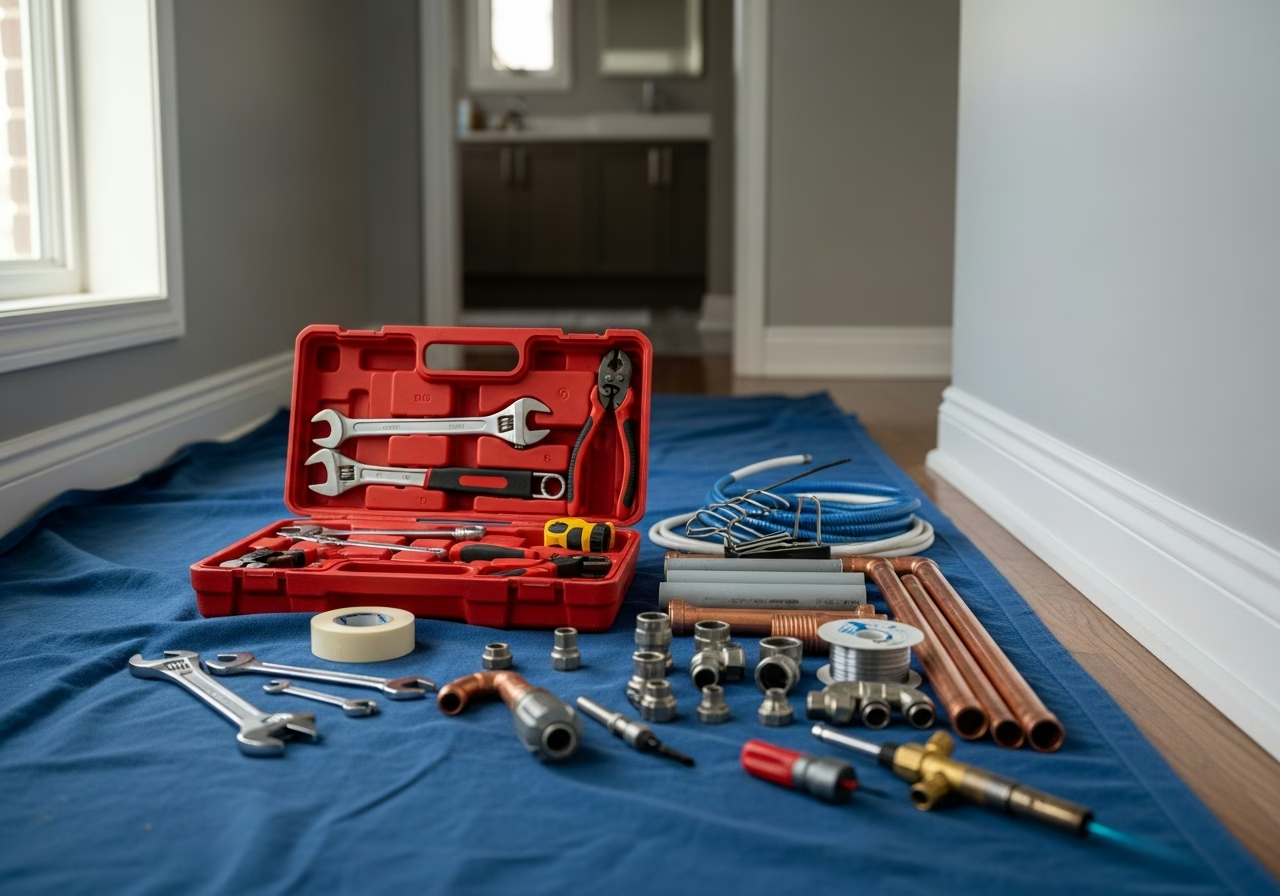
- 1. Run length from the meter (or from a convenient existing tap point). Each additional 10 feet beyond 25 feet adds approximately $150 to $300 in labour and materials. A 60-foot run through a complex backyard easily reaches $3,000.
- 2. Pipe material — CSST vs Schedule 40 black iron. Black iron costs less per foot but threading and fitting up dozens of joints on a long run is labour intensive. CSST (Gastite, FlashShield, OmegaFlex TracPipe, Gas-Flo) costs more per foot but installs in long continuous runs with few fittings. For runs over 40 feet, CSST is typically cheaper all-in. For short straight runs, black iron is usually cheaper.
- 3. Trench condition. Soft topsoil through a lawn — fast and cheap. Compacted clay — moderate. Tree roots, rock, or frozen winter ground — slow and expensive. Interlock or concrete that has to be lifted and re-laid — adds $400 to $1,200 depending on area.
- 4. Permit and inspection scope. A simple tee onto an existing properly permitted exterior line may not require a fresh City permit. A new line through the building wall, a new shut-off arrangement, or any structural penetration always does. Permit fee in Toronto is in the low hundreds of dollars; the bigger cost is the scheduling delay if the inspector visit is held up.
- 5. Enbridge meter capacity. If your existing furnace, water heater, range, dryer, and the new BBQ together exceed your meter's rated capacity (most residential meters are 250 cfh / 250,000 BTU/h), Enbridge has to swap the meter. The swap is free but the coordination adds 2 to 6 weeks to the schedule.
What is NOT Included in the Headline Range
A few items often thought of as "part of the BBQ line" but typically priced separately:
Need professional plumbing?
Call RenoHouse at 289-212-2345 or get a free estimate today.
Get Free Estimate →- The BBQ itself. Most homeowners supply their own BBQ. Conversion from propane to natural gas (orifice change kit) is usually $80 to $200 in parts plus 30 minutes of G2 labour if needed.
- Quick-connect kit specific to the BBQ model. Some BBQs come with a natural gas quick-connect; some need to be ordered. Around $60 to $150.
- Hardscape damage and restoration. If a stone wall, retaining wall, or built-in planter has to be modified for the line route, that is a separate scope (often coordinated with the same crew but priced separately).
- Multiple appliances on a manifold. A BBQ + side burner + outdoor fridge becomes an outdoor kitchen project — see Outdoor Kitchen Gas Line Toronto.
The TSSA G2 Requirement Is Not Optional
A homeowner cannot legally install a permanent BBQ gas line themselves in Ontario. A handyman without a TSSA card cannot do it either. Only a TSSA G2 (or G1) licensed gas-fitter can. Every reputable Toronto contractor will produce the G2 card on request. Insurance claims related to gas leaks, fires, or explosions on unpermitted, unlicensed work are routinely denied.
For full TSSA permit detail, see TSSA G2 Permit Outdoor Gas Toronto.
Pressure Test and Backfill Sequencing
CSA B149.1 Section 6.21 requires a documented pressure test at 1.5x operating pressure (or a minimum specified value) for at least 10 minutes with no measurable drop. The test must be done before backfill. If a contractor backfills the trench before the pressure test, you have no way to verify the test was done correctly — and that is a TSSA red-tag situation. RenoHouse photographs the gauge reading at start and end of every pressure test on every project.
Common Add-Ons on a BBQ Project
Toronto homeowners frequently bundle a BBQ line with:
- Gas fire pit on the same trench run. See Gas Fire Pit Installation Toronto.
- Patio heater stub. See Gas Patio Heater Installation Toronto.
- Composite deck rebuild that buries the line cleanly. See Composite Decking Toronto 2026.
Coordinating these together saves trenching costs and one mobilization visit each.
Realistic Schedule
From signed quote to BBQ commissioning:
- Permit and TSSA notice: 3 to 10 business days
- Trench and install: 1 day for short runs, 2 to 3 days for complex routes
- Pressure test and inspection: same day as install or next business day
- Backfill and finish: 1 day
- Total: typically 1 to 3 weeks if no Enbridge upgrade is needed; add 4 to 8 weeks if a meter or service upgrade is required
For a ballpark and a coordinated quote, head to /services/plumbing/outdoor-gas-line-installation, or read the full pillar at Outdoor Gas Line Installation Toronto 2026: Complete Guide.
Sources & References
Authoritative sources cited in this guide:
- Toronto Sewer Use Bylaw 681 — Toronto plumbing/sewer regulations
- Ontario Building Code 7 (Plumbing) — OBC plumbing standards
- Health Canada — Drinking Water — Health Canada drinking water guidelines
- CSA B149.1 Natural Gas Code — Canadian gas installation code
Continue Reading

- Outdoor Gas Line Installation Toronto 2026: Complete Guide
- Outdoor Kitchen Gas Line Toronto 2026
- TSSA G2 Permit Outdoor Gas Toronto 2026
Frequently Asked Questions
How much does natural gas BBQ line installation cost Toronto?
A permanent natural gas line to a BBQ in Toronto costs $1,500–$2,500 for short runs under 50 feet. This covers materials, labor, meter installation if needed, and safety testing. Longer distances or obstacles like concrete push costs to $3,000–$4,500. Get quotes from multiple TSSA G2-certified contractors before committing.
Do I need a permit for gas BBQ line installation?
Yes. In Toronto, a permanent natural gas installation requires a municipal Building Permit and TSSA inspection. Your contractor—who must hold a valid G2 gas-fitter license—handles permit applications. Expect $200–$400 in permit fees. Installation without permits violates building code and voids insurance claims. The TSSA safety inspection is non-negotiable.
How long does gas BBQ line installation take?
Most installations complete in one day for short runs. Your TSSA G2 contractor arrives, runs the line, connects to your supply, pressure-tests it, and schedules TSSA's final safety inspection—usually within 5–10 business days. Complex jobs requiring concrete cutting or long trenches take 2–3 days of labor. The permit approval process adds 1–3 weeks before work begins.
What factors increase natural gas line installation costs?
Distance from your existing gas supply is primary. Each additional 20 feet adds $300–$500. Obstacles matter: concrete patios require cutting ($400–$800), rocky soil needs excavation equipment ($200–$600), and building through foundation walls adds complexity and cost. If your existing meter is undersized, an upgrade ($800–$1,500) becomes necessary. Accessibility and yard layout are the biggest cost drivers after distance.