 RenoHouse
Whole-Home Standby Generator Installation — Toronto GTA
Professional standby generator installation services in Toronto and the Greater Toronto Area. Licensed, insured, and trusted by homeowners across the GTA.
Projects Completed
Years Experience
Client Satisfaction
Google Rating
How It Works
A simple, stress-free process from start to finish.
Send Your Request
Call or WhatsApp us 24/7. Send photos, video, comments about what needs to be done, and your location.
Remote Estimate
We review everything, discuss details, and provide a clear estimate — often within hours, no visit needed.
Repair Process
Our licensed team arrives on the agreed date and completes your standby generator installation to the highest standards.
Handover & Warranty
Final walkthrough with you, full cleanup, and warranty documentation provided.
Send Your Request
Call or WhatsApp us 24/7. Send photos, video, and a description of the work + your location.
Remote Estimate
We review everything, clarify details, and give you a price — often within hours.
Repair Process
Licensed team arrives on schedule and completes your standby generator installation professionally.
Handover & Warranty
Final walkthrough, full cleanup, and warranty documentation.
Standby Generator Installation in Toronto GTA
RenoHouse coordinates whole-home natural-gas standby generator installations for Toronto and GTA homeowners — Generac, Kohler, Cummins, and Briggs & Stratton units paired with automatic transfer switches (ATS), gas-line connections, and ESA-permitted electrical tie-in. Our scope is general-contractor-led project management: we coordinate certified TSSA G2 gas-fitter partners for the natural-gas connection, ECRA/ESA Master Electrician partners for the transfer-switch and panel work, pull building and ESA permits, manage Enbridge service review when meter or service-line upsize is required, prepare the concrete pad and equipment placement, and finish the construction work the install triggers — landscape reinstatement, fence work, soffit and exterior penetration sealing. We do NOT perform gas or electrical work in-house — TSSA G2 gas-fitter and ECRA/ESA Master Electrician licensing rests with our certified subcontractor partners.
Why standby generators matter in Toronto
Toronto has experienced cascading grid-reliability events: 2013 ice storm (300,000+ Toronto Hydro customers without power, some for 8+ days), 2018 windstorm (200,000+ customers), 2022 derecho (650,000 GTA customers), August 2024 thunderstorms with 200,000+ Toronto customers losing power for 24–72 hours. Toronto Hydro's SAIDI (System Average Interruption Duration Index) trended worse over 2018–2024. Climate-driven storm frequency continues to rise. For homeowners with home offices, sump-pump-protected basements (loss of power during a storm = flooded basement), medical equipment, freezer-stocked food, EV chargers, or aging-in-place residents, the cost of one extended outage often justifies the generator. Pairs naturally with our backwater-valve-sump-pump-bundle service (battery backup sump + generator = bulletproof flood protection during power loss) and our EV-charger and smart-home services.
Generator sizing and equipment
7.5 kW small standby (essential circuits only — fridge, sump, furnace blower, lights): $7,000–$10,000 installed. 14–18 kW mid-tier (most home loads, partial AC): $10,000–$13,000. 20–24 kW whole-home (all loads including central AC, EV charger): $13,000–$15,000. 26 kW premium (large homes, multiple AC zones): $15,000+. Common Toronto installs: Generac Guardian 16/22/24/26 kW (market leader, smart Mobile Link monitoring, 5-year warranty), Kohler 14RESA / 20RESA / 26RESA (premium build, quietest at 65 dB, 5-year warranty), Cummins QuietConnect 13/20/22 kW (heavy-duty diesel-engine heritage, premium), Briggs & Stratton 20/26 kW (budget-friendly mid-tier). Sizing is by Manual J load calculation per CSA C282 and the manufacturer's load-management features.
Automatic transfer switch (ATS)
The ATS isolates your home from the utility grid when power fails and connects your panel to the generator within 10–30 seconds — without it, the generator would back-feed the grid (a serious safety hazard for Toronto Hydro line crews) and could not start automatically. Whole-home 200A ATS: $1,200–$2,500. Sub-panel managed-load ATS (powers only essential circuits, smaller generator): $800–$1,500. Smart load-management modules (sheds AC or EV charger to keep generator within capacity): +$400–$900. ESA permit and Section 26 inspection required.
Gas-line and Enbridge coordination
Most Toronto homes have natural-gas service adequate for a 16–22 kW generator on standard 1/2" or 3/4" supply. Larger 24–26 kW units may require a meter or service-line upsize from Enbridge — adds $1,200–$3,500 and 6–12 weeks. Our certified TSSA G2 gas-fitter partner sizes the gas line per the manufacturer's BTU draw and CSA B149.1 (Natural Gas and Propane Installation Code), and we coordinate the Enbridge service review when an upsize is needed. Gas-line trenching, exterior pad, and connection to the generator are TSSA G2 scope. The TSSA permit is filed by the gas-fitter; we receive a copy for the homeowner record.
Honest scope — TSSA G2 gas + ESA electrical
Standby generator installation involves three regulated trades: (1) TSSA G2 gas-fitter to size, install, and pressure-test the gas line and connect the generator's gas inlet; (2) ECRA/ESA Master Electrician to install the transfer switch, tie into the main panel, run the generator output cable, and file the ESA Section 26 permit and inspection; (3) HVAC mechanic in some installs that integrate with whole-home ventilation. RenoHouse holds NONE of these licences in-house. We coordinate certified subcontractor partners — typically a TSSA-licensed firm and an ECRA Master Electrician with generator experience — pull the building permit, manage the ESA inspection schedule, and perform the site work (concrete pad, landscape reinstatement, exterior penetration sealing, soffit and trim repairs after gas-line installation). The TSSA-permitted gas-fitter signs off on gas; the ECRA Master Electrician signs off on ESA Section 26.
Common pitfalls we manage
(1) Setback compliance — Toronto Zoning By-Law and CSA B149.1 set minimum distances from windows, doors, mechanical-air intakes, and property lines (typically 1.5–3.0 m). We confirm setbacks at the site assessment. (2) Noise — modern liquid-cooled standby gensets run 65–72 dB at 7 m; municipal noise bylaws (Toronto Bylaw 591-2017) restrict overnight operation; our installs include weekly self-test scheduling within permitted hours. (3) Concrete pad — generators require a poured pad (4" reinforced concrete) sized to manufacturer specification; we form and pour as part of project scope. (4) Exhaust direction — must vent away from windows, away from neighbour windows where setbacks are tight, and not into the prevailing wind path. (5) Annual maintenance — manufacturer warranty requires annual oil and filter service; we offer a maintenance contract through our HVAC partner ($200–$400/year) or homeowners can engage their own service contractor.
Pairing with other resilience services
Generator + battery backup sump pump + backwater valve = full flood-and-outage protection (our flood-protection bundle covers backwater valve and sump pump under the new $6,650 Toronto subsidy). Generator + EV charger + smart-home panel = whole-home resilience stack (Tesla Powerwall is sometimes paired as a hybrid for first-30-minute coverage and quiet running, with the gas generator carrying multi-day outages). We coordinate the bundle as a single project.
Serving Toronto, Mississauga, Brampton, Vaughan, Markham, Richmond Hill, Oakville, Burlington, Etobicoke, Scarborough, North York, and all GTA communities. Call 289-212-2345 for a free generator-feasibility consultation.

HRV and ERV installation in 2026 GTA — the IAQ fix for tight Toronto homes
Modern Toronto construction is air-tight by code mandate. New builds under Ontario Building Code 2024 Tier 1 (effective January 1, 2025) typically test below 1.5 ACH50 (air changes per hour at 50 Pascals depressurization); deep-retrofit older Toronto homes after attic blown-in cellulose, basement spray foam, and triple-pane window replacement frequently hit 2.0 – 3.5 ACH50 — tight enough that natural air leakage no longer ventilates the building. Without mechanical ventilation, tight homes accumulate humidity (window condensation, attic mould, hardwood-floor cupping), VOCs (off-gassing furniture, paint, cleaning products), CO2 (drowsy occupants, headaches, sleep complaints — typical closed bedroom hits 1,500–2,500 ppm overnight vs. ambient 420 ppm), radon (Etobicoke and Scarborough have elevated radon zones on the City of Toronto map), and combustion gases (gas range without proper exhaust, gas furnace with cracked heat exchanger). HRV and ERV solve this by mechanically exhausting stale air from kitchens, bathrooms, and laundry rooms while simultaneously bringing in fresh outdoor air through a heat-exchange core that recovers 70–85 percent of the heat (HRV) or heat plus humidity (ERV).
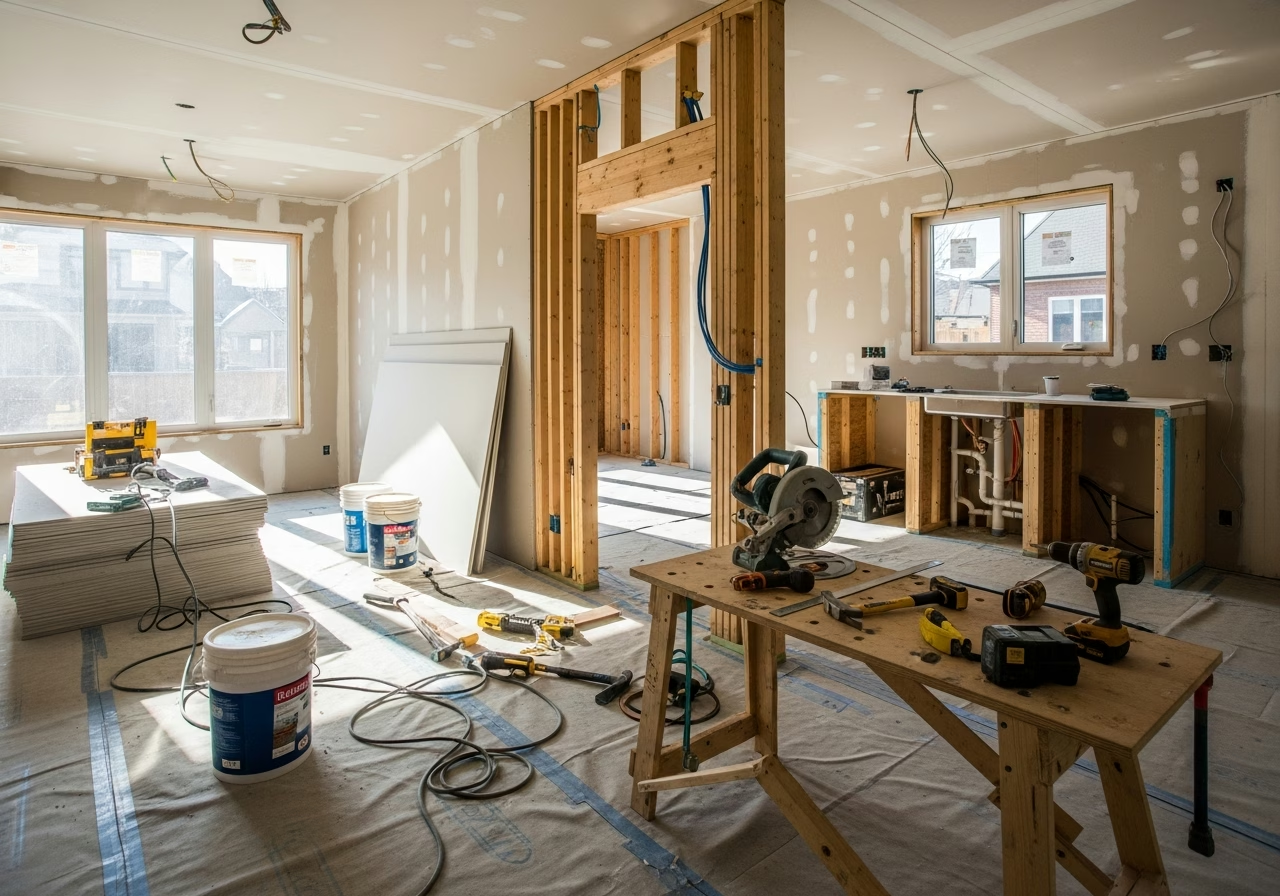
Toronto's heating-dominated climate with cold, dry winters favours HRV in most retrofit cases — recovering heat is the priority and you generally want to keep winter humidity from getting too low. ERV is preferred for very tight new-construction homes, waterfront condos and townhouses near Lake Ontario, basement-sensitive humidity loads, or homes with hot tubs, indoor pools, or aquariums driving high interior humidity that should be moderated rather than dumped outdoors. RenoHouse coordinates HRV/ERV installation through HRAI-member HVAC partners (with CSA F326-trained ventilation designers) and handles permits, MVDS drawings, electrical tie-in coordination, and the construction wrap (drywall around new ducting, soffit boxing in finished basements, paint, trim).
2026 GTA pricing tiers (installed)
- Floor — basic HRV unit with existing-ductwork integration ($2,800 – $4,500 installed): Lifebreath RNC10 (100 CFM), vanEE V100H (100 CFM), or Broan AI-Series 100 CFM HRV core mounted to the existing forced-air ductwork via dedicated supply and exhaust runs to the furnace return plenum. Single dehumidistat wall control. Right for 1,200–1,800 sq ft bungalows and townhouses with existing forced-air heating where ductwork integration is straightforward.
- Standard — mid-tier HRV/ERV with dedicated ducting ($4,500 – $7,800 installed): Lifebreath RNC155 (155 CFM), Panasonic Intelli-Balance 100 (100 CFM, premium ECM motor and quiet operation), Venmar AVS HEPA (with built-in HEPA filtration), Broan AI-Series 200 CFM, Fantech VHR. Dedicated stale-air pickup ducting in kitchen, bathrooms, and laundry; dedicated fresh-air supply to bedroom returns or main-floor living. Boost switch in main bathroom for shower humidity spikes. Premium control package — CO2 sensor, smart thermostat integration (Ecobee, Nest, Honeywell T9), Wi-Fi monitoring. Right for 1,800–3,200 sq ft homes; volume sweet spot in 2026 retrofit market.
- Premium — high-efficiency Passive-House-grade ERV ($7,800 – $14,500 installed): Zehnder ComfoAir Q350 / Q450 / Q600, Lifebreath Max XTR 175 ECM, Renewaire EV Premium L. Counterflow heat-exchange core with 90 percent-plus sensible recovery. MERV 13 standard, optional HEPA. Full dedicated supply and exhaust ductwork to every habitable room. Integrated dehumidistat, CO2 sensor, VOC sensor, and smart-home tie-in. Right for new builds aiming at Passive House certification, deep-retrofit homes pursuing Net Zero, and homeowners with severe allergy or asthma concerns where IAQ is a medical priority.
Compliance, code, and CSA F326
- Ontario Building Code 2024 Tier 1 (Section 9.32.3) requires balanced mechanical ventilation in all new dwelling units. Existing-home retrofits trigger the requirement when air-sealing brings the building below approximately 1.5 ACH50 (the threshold where natural ventilation is insufficient). Major renovations touching over 50 percent of the habitable floor area also trigger current-code compliance.
- CSA F326 (Residential Mechanical Ventilation Systems) is the Canadian standard for sizing, installing, and commissioning HRV/ERV systems. Total continuous airflow is 0.30 L/s per square metre of floor area, plus principal-room and intermittent rates. Balanced exhaust-to-supply flow within ±10 percent. Post-install airflow measurements with a flow hood are mandatory; balance report delivered at close-out. CSA F326 also specifies condensate drainage, defrost control for Toronto cold-climate operation (below -25°C), and minimum filtration (MERV 8 baseline).
- MVDS — Mechanical Ventilation Design Summary — a single-page or multi-page drawing submitted with building permits showing total ventilation rate by floor area and bedroom count, exhaust pickup locations, fresh-air supply distribution, balanced flow verification, and equipment specifications. Mandatory at permit submission for new builds under OBC 2024; strongly recommended for retrofits. Our CSA F326-trained HVAC partner prepares the MVDS; we manage the submission.
- ECRA/ESA permit required for the dedicated 15A circuit feeding the HRV/ERV unit, the dehumidistat low-voltage wiring, and any smart-thermostat integration.
- TSSA permit is NOT required for HRV/ERV installation itself (no gas involvement), but may apply if the same project includes furnace replacement or gas line modifications.
Rebates and energy programs (2026)
- Canada Greener Homes Grant up to $750 for an eligible Energy Star Most Efficient HRV/ERV installation, when bundled with one other eligible energy measure (insulation, heat pump, windows). Requires pre-retrofit and post-retrofit EnerGuide audits by NRCan-Registered Energy Advisor.
- Ontario Home Renovation Savings (HRS) program — supports the EnerGuide audit cost (typically $600 toward audit fees) and includes HRV/ERV in the bundled-measure rebate stack when paired with heat pump or major envelope upgrades.
- IESO Save On Energy programs continue to evolve in 2026; the energy-efficient home retrofit pathway sometimes covers HRV/ERV as part of an integrated retrofit — check current status at time of contract.
Toronto/GTA neighbourhood considerations
- Forest Hill / Rosedale / Lawrence Park (heritage 1920s+): Pre-1950 heritage balloon-frame homes typically lack any factory mechanical ventilation. Retrofit scope is significant — dedicated supply and exhaust ductwork through plaster-lath walls and finished-ceiling cavities requires careful routing through cold-roof or rim-joist penetrations. Lifebreath RNC200 ECM or Zehnder ComfoAir Q450 (heritage-grade premium scope). Dedicated stale-air pickup in bathrooms and kitchen; fresh-air supply at bedroom returns. Typical $5,200 – $8,800 installed; new dedicated ductwork through finished plaster adds $1,800 – $3,800.
- North York / Scarborough / Etobicoke (post-war 1950s-70s): Many 1960s-70s homes have a builder-grade HRV stub-out (a 1970s/1980s leftover) or an existing 1990s-vintage Vanee 70H V or Broan AI 200 that's reached end-of-life. Typical scope is replacement-in-place to Lifebreath RNC155 ECM or Broan AI 200 ERV — $2,800 – $4,400 installed. Integration with the existing forced-air furnace ductwork.
- Mississauga / Brampton / Vaughan (1990s+ subdivisions): 1990s-2000s builder HRV (Lifebreath RNC 95, Vanee V80H) is now 20-plus years old and dead or dying. Typical upgrade to Lifebreath RNC155 ECM or Broan AI-Series 200 ERV — $2,400 – $3,800 installed. Smart thermostat (Ecobee Smart or Nest Learning) integration adds $180 – $380. CSA F326 balance check on the new unit.
- Caledon / King City / Aurora (rural / well water / large lot): Rural detached homes with hydronic radiant heating typically have NO existing ventilation — radiant doesn't move air. Standalone HRV with dedicated ducting throughout the home: Lifebreath Max XTR 175 ECM, Zehnder ComfoAir Q350, or Renewaire EV Premium. Typical $6,800 – $14,000 installed including new ductwork. Often paired with whole-home Aprilaire steam humidifier on the radiant-heat side.
- Downtown condos (King West / Liberty Village / Yorkville): High-rise condo suites have vertical-stack fan-coil HVAC and typically no dedicated HRV — building-managed make-up air provides outdoor air to the corridor. Suite-level option is a small in-bathroom or in-kitchen ERV (Panasonic FV-04VE1 InVent, Lunos e2 paired) installed as a replacement for the existing exhaust fan. Form 1 condo board approval required when exterior penetration is added. Typical $1,400 – $3,200 per suite.
When HRV vs. ERV — the decision rule
- HRV (heat only): Toronto retrofit homes (dry winter air, want to retain it), homes with low occupant density per square foot, basements with humidity issues, homes pre-air-seal where winter humidity drops below 30 percent.
- ERV (heat + humidity): New tight construction (1.5 ACH50 or less), waterfront condos with humid lake influence, homes with hot tubs, indoor pools or aquariums, homes with 4+ occupants in 1,800-2,200 sq ft (high humidity generation per square foot), homes where winter humidity already runs 40-plus percent and you want to retain it.
Our certified HVAC partner makes the HRV-vs-ERV recommendation at the site visit based on blower-door air-tightness test, occupant density, and humidity profile.
Bottom line — HRV/ERV is the IAQ insurance policy for any tight Toronto home
Once a home is air-sealed to under 2.0 ACH50, mechanical ventilation is no longer optional — it's the only way to deliver fresh air, control humidity, and prevent condensation, mould, and CO2 buildup. The mid-tier standard install at $4,500 – $7,800 is the volume sweet spot in 2026 GTA. Window condensation typically eliminates within 24–48 hours of commissioning; indoor CO2 drops from 1,500–2,500 ppm (closed bedrooms overnight) to 600–800 ppm; VOC levels drop 50–70 percent within two weeks. Pair the HRV/ERV install with a heat pump retrofit to capture the Greener Homes Grant rebate stack in a single project visit. Call 289-212-2345 for a free site assessment — we run a blower-door test, evaluate existing ductwork, size the unit per CSA F326, and quote inside one week.
Why Choose RenoHouse?
Same-Day Service Available
We respond quickly to standby generator installation requests. Most projects start within 24-48 hours of your call.
Licensed Professionals
Every technician on our team is fully licensed, insured, and background-checked. We maintain strict quality standards on every job.
Upfront Pricing
Honest quotes for standby generator installation with no surprises. Free estimates, flexible payment options.
Sound Familiar?
These are the most common problems our clients face.
Watched your sump pump fail during the last ice-storm power outage and basement flood?
Toronto Hydro reliability getting worse — multiple multi-hour outages this year alone?
Home office and can't afford to lose power for video calls or productivity?
Worried about your aging-in-place parents during a multi-day winter outage?
Confused about generator sizing — 14kW vs 22kW vs 26kW for your home?
Need TSSA G2 gas-fitter and ESA Master Electrician but no contractor offers both under one contract?
Ready to get started?
Free estimate, no obligation. We respond within 1 hour.
What Our Clients Say
“RenoHouse replaced all our windows in just two days. The new windows are beautiful, energy-efficient, and the team left everything spotless. Highly recommend!”

Michael R.
Oakville
“New windows transformed our home. Quieter, warmer, and our energy bill dropped noticeably. Excellent installation crew.”

David K.
Vaughan
“Professional from start to finish. They replaced 8 windows in one day and cleaned up perfectly. Highly recommend RenoHouse!”

Sandra W.
Burlington
Our Standby Generator Installation Work
Professional standby generator installation results from RenoHouse projects across the Toronto GTA.
Standby Generator Installation
Toronto GTA
Quality Workmanship
Licensed & Insured
Like what you see? Let's talk about your project.
🧮 Standby Generator Installation — Cost Estimator
GTA / Ontario — 2026 market pricing
⚙️ Add-ons & Options
📊 Where the cost goes (typical breakdown)
📋 What affects your price:
💡 Estimates use 2026 GTA/Ontario market data. Actual cost depends on site conditions, material selections, and project scope. Book a free in-home quote for a precise number.
Frequently Asked Questions About Standby Generator Installation
7.5 kW small standby (essential circuits only): $7,000–$10,000 installed. 14–18 kW mid-tier (most home loads, partial AC): $10,000–$13,000. 20–24 kW whole-home (all loads including central AC, EV charger): $13,000–$15,000. 26 kW premium (large homes, multiple AC zones): $15,000+. Pricing includes generator, transfer switch, gas line, concrete pad, ESA permit and inspection, and our project management. Excludes Enbridge service-line upsize when needed (+$1,200–$3,500).
Through our certified subcontractor partners we install: Generac Guardian 16/22/24/26 kW (market leader, Mobile Link smart monitoring, 5-year warranty), Kohler 14RESA / 20RESA / 26RESA (premium build, quietest at 65 dB, 5-year warranty), Cummins QuietConnect 13/20/22 kW (heavy-duty heritage, premium tier), Briggs & Stratton 20/26 kW (budget-friendly mid-tier). Most Toronto installs are 20–22 kW Generac because of price-to-feature ratio and parts availability. We size by Manual J load calculation per CSA C282.
No. Generator installation involves three regulated trades: (1) TSSA G2 gas-fitter to size, install, and pressure-test the gas line and connect the generator's gas inlet; (2) ECRA/ESA Master Electrician to install the transfer switch, tie into the main panel, run the generator output cable, and file the ESA Section 26 permit and inspection. RenoHouse holds NEITHER licence in-house. We coordinate certified subcontractor partners — typically a TSSA-licensed firm and an ECRA Master Electrician with generator experience. RenoHouse signs the construction contract, pulls the building permit, manages the project, performs the site work (concrete pad, landscape, exterior sealing), and warrants the wrap. The TSSA-permitted gas-fitter signs off on gas; the ECRA Master Electrician signs off on ESA Section 26.
Usually yes for 16–22 kW units on a standard residential 1/2" or 3/4" gas service — but verification is required. Larger 24–26 kW units often need a meter or service-line upsize from Enbridge, adding $1,200–$3,500 and 6–12 weeks. Our certified TSSA G2 gas-fitter partner sizes the gas line per the manufacturer's BTU draw and CSA B149.1 (Natural Gas and Propane Installation Code). We coordinate the Enbridge service review at the site-assessment stage so there are no schedule surprises.
An automatic transfer switch (ATS) isolates your home from the utility grid when power fails and connects your panel to the generator within 10–30 seconds — without it, the generator would back-feed the grid (a serious safety hazard for Toronto Hydro line crews) and could not start automatically. Whole-home 200A ATS: $1,200–$2,500. Sub-panel managed-load ATS (essential circuits only, smaller generator): $800–$1,500. Smart load-management modules (sheds AC or EV charger to keep generator within capacity): +$400–$900. ESA Section 26 inspection required.
Typical project: 4–8 weeks from contract signing to commissioning. Site assessment and equipment selection 1 week. Permit and Enbridge review (when needed) 2–6 weeks. Equipment delivery and concrete-pad pour 1–2 weeks. Install (gas-line trenching, ATS, panel tie-in): 3–5 days. ESA inspection and TSSA pressure-test 1 week. Commissioning, load-bank test, customer training: half-day. Larger installs requiring Enbridge service-line upsize add 6–12 weeks.
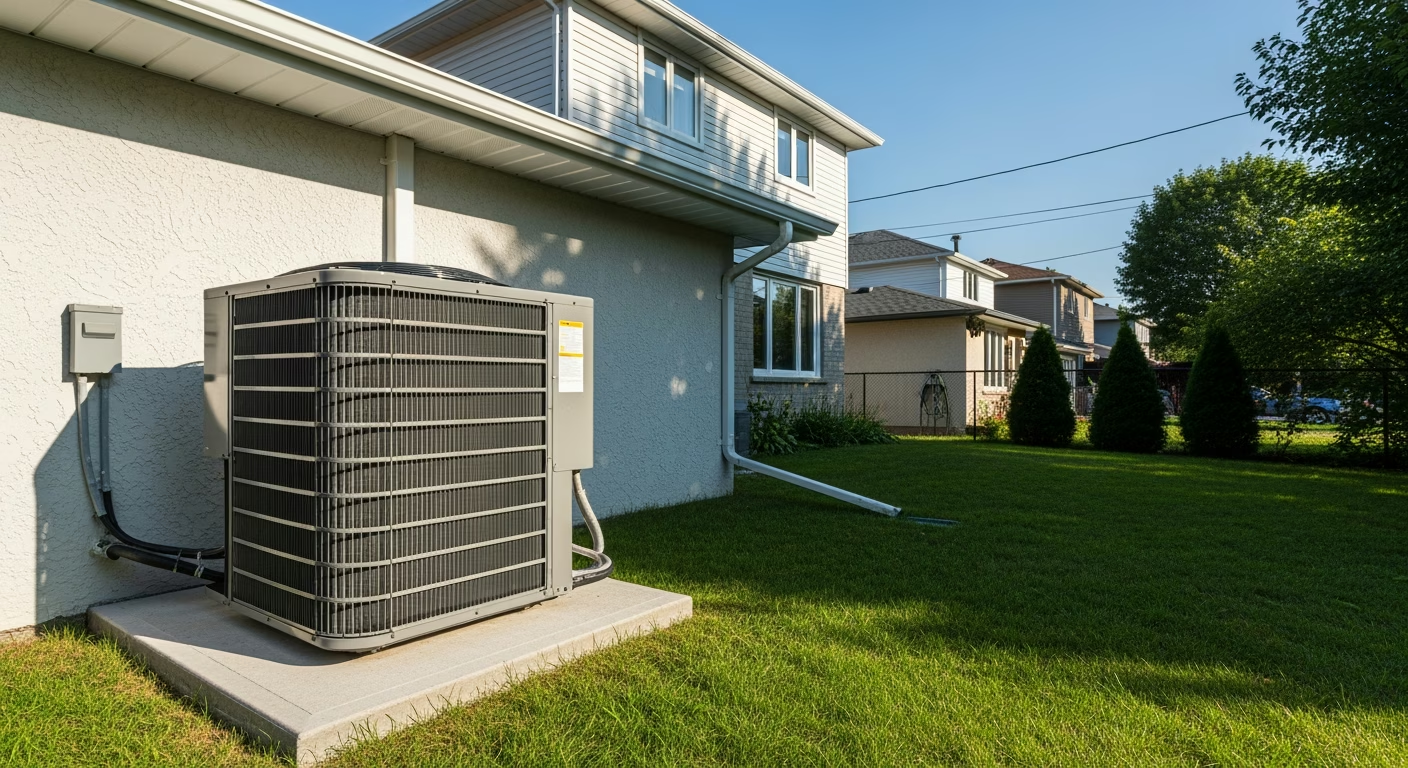
Toronto Zoning By-Law and CSA B149.1 set minimum distances from windows, doors, mechanical-air intakes, and property lines — typically 1.5–3.0 m depending on the equipment and configuration. Generators must be on a poured concrete pad (4" reinforced), oriented with exhaust away from windows and neighbour windows, and accessible for annual service. Most Toronto installs go on a side yard or back yard pad. We confirm setbacks and exhaust direction at the site assessment.
Modern liquid-cooled standby gensets run 65–72 dB at 7 m during full load — comparable to a quiet dishwasher next door. Toronto Noise Bylaw 591-2017 restricts continuous noise above 50 dB at the property line during overnight hours; weekly self-tests are scheduled within permitted daytime windows (typically 7am–7pm). Kohler 14RESA and 20RESA are the quietest at 65 dB, Generac Guardian 22 kW runs 67 dB, Briggs & Stratton typically 70–72 dB. Sound-dampening enclosures are standard on all premium models.
Manufacturer warranty (typically 5 years) requires annual oil and filter service plus a load-bank test every 2–3 years. Service cost: $200–$400/year through our HVAC partner or any qualified generator service contractor. Modern Generac/Kohler units self-test weekly and email diagnostic codes via Mobile Link / OnCue — homeowner sees impending faults months before failure. Battery replacement every 3–5 years (~$150).
Yes — Powerwall + standby generator hybrid is a common Toronto premium configuration. Powerwall covers the first 8–24 hours of an outage silently (no generator noise overnight) and the gas generator carries multi-day outages. Combined whole-home resilience stack: Powerwall ($14,000–$18,000 installed) + 22 kW generator ($13,000–$15,000) + smart automatic transfer logic = $30,000–$40,000 turnkey. Both Powerwall and Tesla certified install partners coordinate with us through the same project framework. ESA Section 26 covers both.


You Might Also Need
Customers who looked at standby generator installation also asked us about these complementary services.




We Serve All GTA
Professional standby generator installation services available across the Greater Toronto Area.
“Heat pump conversion + 200A panel upgrade in our 1970s East York bungalow. Coordinated HVAC sub and ESA electrician under one contract. Greener Homes Loan paperwork submitted correctly first time. Heating bills down ~40%.”
— James & Linda H., East York
Get a Free Standby Generator Installation Estimate
Contact us today for a free, no-obligation quote for your standby generator installation project in Toronto GTA. We'll get back to you within 1 hour.