RenoHouse

# Lead and Galvanized Water Service Replacement Toronto: The Complete 2026 Guide
Quick answer. If your Toronto home was built before 1955, the underground pipe that brings drinking water from the city main to your basement may be made of lead. If it was built between roughly 1900 and 1960, the same pipe may be galvanized steel. Both materials have known limitations against current drinking water standards.If your Toronto home was built before 1955, the underground pipe that brings drinking water from the city main to your basement may be made of lead. If it was built between roughly 1900 and 1960, the same pipe may be galvanized steel. Both materials have known limitations against current drinking water standards. This pillar guide explains, in plain language, how Toronto homeowners assess, replace, and finance the change in 2026, and how RenoHouse coordinates the project alongside a licensed plumber and Toronto Water.
This is a long guide because the topic has several moving parts: Health Canada's national guideline, Ontario's drinking water standards, the City of Toronto's Lead Service Replacement Program, the difference between the city-side and owner-side portions of the service line, the choice between open-cut excavation and trenchless pipe-bursting, and the practical matter of permits and restoration work. We cover each section so you can read the part you need and skip the parts you do not.
Honest Positioning: Who Does What on a Service Line Replacement
We need to be clear up front. RenoHouse is a renovation contractor and project coordinator. A water service replacement requires a licensed plumber and a Toronto Water service connection permit. Our role is to coordinate the project: scoping the work, organizing the City application for the city-side portion, sequencing the trenching or pipe-bursting crew, managing the restoration work (driveway, lawn, hardscape) and any interior plumbing tie-ins, and bundling the project with related work such as a backwater valve or sump pump where it makes sense.
The plumbing license, the Toronto Water permit, and the final pressure-test sign-off are held by the licensed plumber on the project. We do not represent ourselves as the permit holder. That division of labour is how we keep the technical work compliant and the project timeline honest.
What the Service Line Is and Why It Matters
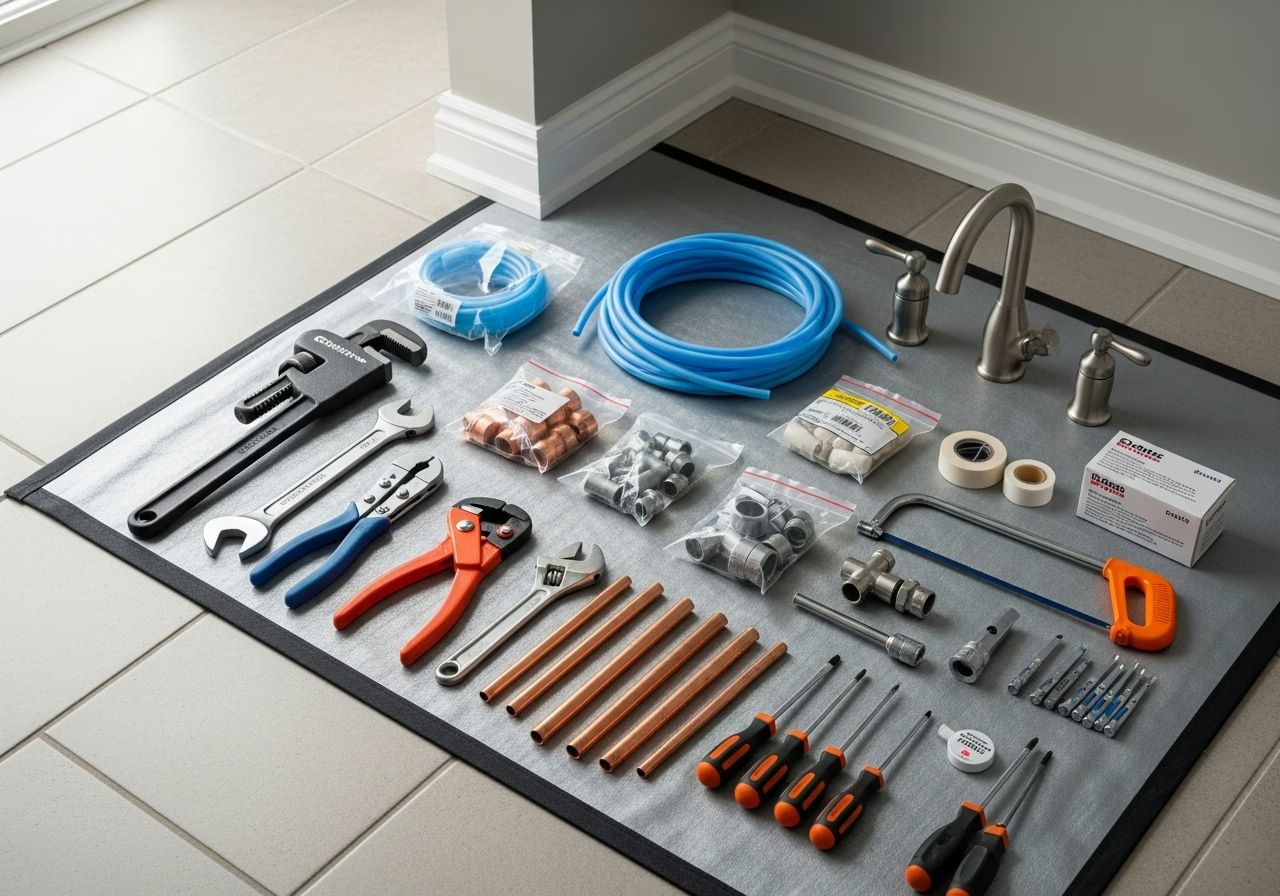
The water service line is the underground pipe that runs from the City of Toronto water main (under the road) to the water meter inside your basement. It has two halves:
- City-side portion: from the water main under the road to the property line at the curb stop or shut-off valve.
- Owner-side portion: from the property line to the building, terminating at the water meter.
The owner-side length depends on lot setback. A typical Toronto lot has 5 to 30 feet of owner-side pipe under the front yard. Some deep-set heritage lots have 40 feet or more.
The materials matter because the pipe is in continuous contact with drinking water. Three materials are common in older Toronto homes:
- Lead (pre-1955 installations). Soft grey metal. Banned for residential service line installation in 1955.
- Galvanized steel (1900s through 1960). Steel pipe coated with a thin zinc layer. Internal corrosion progressively narrows the pipe diameter over decades, reducing flow.
- Copper (1950s onward, became standard 1960s). Type K rigid copper is the modern residential standard for buried service lines.
Newer materials used in 2026 replacement work include cross-linked polyethylene (PEX) and high-density polyethylene (HDPE). HDPE in particular is the standard for trenchless pipe-bursting installs.
Health Canada and Ontario: The Regulatory Layer
In March 2019, Health Canada lowered the national maximum acceptable concentration (MAC) for lead in drinking water from 0.010 mg/L to 0.005 mg/L, measured at the tap after a representative draw. The 2019 revision aligned the Canadian guideline more closely with current scientific consensus on lead exposure at low concentrations.
Ontario's drinking water quality standards are codified in Ontario Regulation 169/03 under the Safe Drinking Water Act. The province adopted the 0.005 mg/L MAC for lead following the federal revision.
Health Canada's position, stated plainly: there is no demonstrated safe threshold for lead exposure. The 0.005 mg/L number is a regulatory target, not a biological "safe" line. The practical implication for homeowners is straightforward — if your home has a confirmed lead service line, the recommended path is replacement of the full line, not partial mitigation.
Galvanized pipe is not regulated under the lead MAC, but it has its own concern: internal corrosion. Older galvanized service lines that previously sat downstream of lead can absorb lead onto the corroded interior surface, then continue to release it into drinking water even after the upstream lead section is replaced. This is one reason the City's program addresses both materials, and why a partial replacement (city-side only, leaving the owner-side galvanized or lead in place) is not the recommended outcome.
The City of Toronto Lead Service Replacement Program
Toronto Water operates one of the more active lead service replacement programs in North America. The core feature for homeowners: the City replaces the city-side portion of a confirmed lead service line at no charge to the homeowner. The owner-side portion remains the property owner's responsibility.
Key elements of the program in 2026:
- Free city-side replacement when a lead service line is confirmed.
- Capital Replacement Program: when the City schedules road or watermain reconstruction in your area, lead city-side portions on that block are replaced as part of the capital project at no charge.
- Priority replacement: pre-1955 neighbourhoods are prioritized.
- Coordination with owner-side work: when you replace the owner-side portion, the City can schedule the city-side replacement to occur at the same time, avoiding two separate excavations.
The coordination point is critical. Replacing only the owner-side and leaving a lead city-side in place is not advisable — partial replacement can temporarily increase lead release at the tap. Toronto Water and Health Canada both note this. The standard approach is full-line replacement coordinated between the homeowner's plumber and Toronto Water.
For program details, eligibility, and the application process, see Toronto Lead Service Replacement Program: How the Free City-Side Works.
How to Identify What You Have
Before you commit to replacement, you want to know what material the line actually is. There are three practical methods:
1. Visual inspection at the water meter. Look at the pipe just before the meter inside your basement.- Lead: dull grey, soft, often slightly bulged at fittings, scratches easily with a coin to reveal a shiny silver underlayer.
- Galvanized: silver-grey, hard, threaded fittings, magnetic.
- Copper: orange-brown, hard, soldered joints, non-magnetic.
The scratch test (coin on metal) and the magnet test (fridge magnet sticks to galvanized steel, not to lead or copper) are the two simplest at-home checks.
2. Year-of-construction proxy. Pre-1955 detached and semi housing in Toronto has a meaningful probability of lead. 1900-1960 housing has galvanized as a likely material. 1960s onward is most often copper. 3. Toronto Water records. The City maintains historical records of service material for many addresses. A service inquiry through 311 or the Toronto Water customer portal can return the recorded material if the data exists for your address.For a step-by-step identification walkthrough, see Lead Pipe in Pre-1955 Toronto Homes: How to Identify Your Service Line and the visual material guide in Signs of Galvanized Pipe Corrosion in Toronto Homes.
Need professional plumbing?
Call RenoHouse at 289-212-2345 or get a free estimate today.
Get Free Estimate →Tap Water Lead Testing
Even before any pipe work, you can test the water itself. Toronto Public Health and Toronto Water provide tap-water testing options:
- Toronto Public Health periodically distributes free residential lead test kits, particularly in priority neighbourhoods. The kit collects two samples — a "first-draw" sample after stagnant overnight water and a "flushed" sample after running the tap. Both go to the City laboratory.
- Private laboratories accredited under the Standards Council of Canada accept residential samples on a fee-for-service basis (typical $35 to $80 per sample in 2026).
Result interpretation:
- Below 0.005 mg/L on both samples: result is at or below the Health Canada guideline.
- Between 0.005 and 0.010 mg/L on first-draw, below 0.005 flushed: water sitting in the line absorbs lead, indicating the line itself is a contributor.
- Above 0.010 mg/L on first-draw: clear indication that further investigation and replacement of the service line should be considered.
For testing logistics, see Lead in Tap Water Testing Toronto: How and Where and the regulatory background in Health Canada's 0.005 mg/L Lead Drinking Water Guideline.
Replacement Methods: Open-Cut vs Trenchless Pipe-Bursting
There are two mainstream methods for replacing a residential water service line in Toronto.
Open-cut excavationA trench is dug from the building foundation to the property line (and onward to the curb stop if the city-side is being replaced at the same time). The old pipe is removed and a new copper or HDPE line is laid in the trench. The trench is backfilled, compacted, and the surface (lawn, walkway, driveway) is restored.
- Typical cost (owner-side only): $7,000 to $12,000 for a standard Toronto lot in 2026.
- Pros: full visual inspection of the pipe path, simple equipment, any pipe-route adjustment is possible.
- Cons: significant surface restoration cost where the trench crosses driveways, paver walkways, or mature landscaping.
A bursting head is pulled through the existing pipe path on a steel cable. The head fractures the old pipe outward into the surrounding soil and pulls a new HDPE pipe in behind it. Two small access pits are excavated — one at the building entry and one near the property line — but the run between them is undisturbed.
- Typical cost (owner-side only): $5,000 to $9,000 for a standard Toronto lot in 2026.
- Pros: minimal surface disturbance — driveways, paver walks, mature trees, landscape beds are preserved.
- Cons: not feasible if the existing line has severe bends or has collapsed; requires specialty equipment (often subcontracted).
For a side-by-side comparison and decision criteria, see Pipe-Bursting Trenchless vs Open-Cut for Toronto Service Lines.
Owner-Side Cost Components
A Toronto owner-side replacement project is more than just the pipe. The cost components in 2026:
- Plumbing labour and pipe: $3,000 to $6,000 depending on length, material (Type K copper vs HDPE), and method.
- Excavation or pipe-bursting equipment: $1,500 to $3,500.
- Toronto Water permit and inspection: $300 to $600 in 2026 fee schedule.
- Restoration: lawn re-sod $300 to $800; concrete walkway repair $500 to $1,500; asphalt driveway patch $800 to $2,000; interlock/paver re-lay $1,000 to $3,500 depending on pattern and area.
- Interior tie-in: new shut-off valve, dielectric union to existing copper, water meter re-set $200 to $500.
A typical all-in owner-side project on a standard Toronto lot, with reasonable restoration, lands at:
- Trenchless bundle: $5,000 to $9,000
- Open-cut bundle: $7,000 to $12,000
These are 2026 ranges. Heritage homes, deep setbacks, and complex restoration can push above. For a detailed line-item breakdown, see Lead Water Service Replacement Cost Toronto: 2026 Breakdown.
Pipe Material Choice on the Replacement
Two mainstream choices for the new owner-side pipe:
- Type K copper: the long-standing residential standard. Soft, annealed copper rated for buried service. Joints are brazed or compression-fit.
- HDPE (high-density polyethylene): standard for trenchless pipe-burst installs. Pulled in a continuous coil, no joints in the run, excellent corrosion resistance.
Some installations use PEX (cross-linked polyethylene) for the interior tie-in after the meter, but the buried service portion is most commonly copper or HDPE. PEX-A 1006 is becoming more common for interior runs.
For the material decision, see PEX vs Copper for Replacement Pipe in Toronto.
Permits, Inspection, and What to Expect on Site
Toronto Water requires a service connection permit for any modification of the water service line. The permit is held by the licensed plumber on the project. The permit covers:
- Application drawings and route description.
- Inspection by Toronto Water of the new line before backfill.
- Pressure test of the new line at City-specified pressure.
- Final connection to the water meter.
Typical project timeline:
- Day 0: permit application and City coordination (1 to 3 weeks lead time).
- Day 1: site setup, locates marked, excavation or pit prep.
- Day 2: pipe install (trenchless) or trench-and-lay (open-cut).
- Day 3: City inspection and pressure test.
- Day 4: backfill and surface restoration begins.
- Day 5-7: final restoration (sod, asphalt, interlock).
For the permit walkthrough, see Water Service Replacement Permit and Toronto Water Process.
Toronto Neighbourhoods with Concentrated Lead and Galvanized
Pre-1955 housing stock is concentrated in specific Toronto neighbourhoods. The City's priority areas for lead service replacement include:
- Old East York and the East York stretch along Coxwell, Donlands, and Pape.
- Riverdale, Cabbagetown, and the South Riverdale area.
- Leslieville and the Beaches.
- Roncesvalles, High Park, and Bloor West Village.
- The Junction and Junction Triangle.
- Parts of Parkdale and Little Portugal.
- Heritage stretches of Etobicoke (Mimico, New Toronto).
For the neighbourhood-by-neighbourhood breakdown, see Lead Water Service in Toronto Neighbourhoods: Where Pre-1955 Housing Concentrates.
Common Mistakes Homeowners Make
After coordinating service line projects across Toronto, the recurring mistakes:
- Replacing only the owner-side, leaving a lead city-side in place. Partial replacement can temporarily increase lead at the tap. Coordinate with the City for a full-line replacement.
- Skipping the pressure test. The Toronto Water inspection is not optional. Skipping it voids the permit and creates a future title issue.
- Hiring an unlicensed installer. The work requires a licensed plumber with Toronto Water authorization. An unlicensed install will fail inspection.
- Not planning the restoration. Quoting "the pipe" without a specific line-item for asphalt, interlock, or sod re-lay leads to surprise costs.
- Skipping the post-replacement flush. After replacement, the building's interior plumbing should be flushed for several minutes per fixture to clear any sediment.
For the full list, see Water Service Replacement Mistakes Toronto Homeowners Make.
After Replacement: Whole-Home Filtration
Replacing the service line removes the lead source from the buried pipe, but interior fixtures, solder joints, and faucets installed before 1986 can still be minor sources. Many homeowners pair service line replacement with a whole-home water filter, point-of-use filtration at the kitchen tap, or NSF/ANSI 53-certified faucet filters.
For the post-replacement filtration discussion, see Whole-Home Water Filter After Lead Replacement.
Bundling with Other Plumbing Upgrades
When the front yard is already opened for a service line replacement, several other upgrades become economical to do at the same time:
- Backwater valve and sump pump: the backwater valve and sump pump bundle is eligible for the City of Toronto basement flooding protection subsidy. Combining this with a service line replacement reduces total restoration cost.
- Outdoor hose bibb relocation or addition.
- New pressure-reducing valve at the building entry if water pressure is consistently above 80 psi.
- Whole-home shut-off valve replacement if the existing valve is corroded.
Coordination matters — a single open trench or restoration cycle is much cheaper than three separate projects.
How RenoHouse Coordinates the Project
Our role on a typical Toronto service line project:
- 1. Initial assessment: visual inspection at the meter, year-of-construction check, recommendation on testing.
- 2. Plumber pairing: introducing the project to a licensed plumber on our network with Toronto Water authorization.
- 3. City coordination: helping the homeowner submit the application for the City-side replacement under the Lead Service Replacement Program where eligible.
- 4. Sequencing: aligning excavation date with City inspection availability, restoration crew availability, and any related plumbing work.
- 5. Restoration management: lawn, driveway, walkway, paver re-lay handled by our restoration trades.
- 6. Final walkthrough: post-flush, post-test, full documentation for the homeowner's records.
The plumbing license and the Toronto Water permit remain with the licensed plumber. We coordinate everything else.
Next Steps
If you suspect or have confirmed a lead or galvanized service line, the practical sequence is:
- 1. Identify the material visually at the meter.
- 2. Test the tap water if you want quantitative data.
- 3. Contact Toronto Water to confirm the City's record for your address.
- 4. Get a coordinated quote covering owner-side replacement, City coordination, and restoration.
- 5. Schedule the project — typically 4 to 8 weeks from quote to completion.
To start the project, visit our service page at /services/plumbing/lead-galvanized-water-service-replacement for a coordinated quote.
Related Guides in This Series
Continue reading our complete coverage of this niche:
Sources & References
Authoritative sources cited in this guide:
- Toronto Sewer Use Bylaw 681 — Toronto plumbing/sewer regulations
- Ontario Building Code 7 (Plumbing) — OBC plumbing standards
- Health Canada — Drinking Water — Health Canada drinking water guidelines
- CSA B149.1 Natural Gas Code — Canadian gas installation code
Continue Reading