RenoHouse

# Lead Water Service in Toronto Neighbourhoods: Where Pre-1955 Housing Concentrates
Quick answer. Lead water service lines were standard residential installations in Toronto from the late 1800s until 1955, when the material was banned for new residential service. Pre-1955 housing concentrates in specific neighbourhoods, which are also the neighbourhoods where the City of Toronto's Lead Service Replacement Program is most active.Lead water service lines were standard residential installations in Toronto from the late 1800s until 1955, when the material was banned for new residential service. Pre-1955 housing concentrates in specific neighbourhoods, which are also the neighbourhoods where the City of Toronto's Lead Service Replacement Program is most active. This article walks through those neighbourhoods and what residents should know.
For full project context, see our pillar guide at Lead and Galvanized Water Service Replacement Toronto: The Complete 2026 Guide.
Honest Positioning
RenoHouse coordinates lead and galvanized service line replacement projects across the Toronto neighbourhoods listed below. The neighbourhood-level information here reflects general patterns of housing-stock age based on public records; for any specific property, the Toronto Water service inquiry through 311 confirms the actual material on file.
Why Neighbourhoods Matter
The probability that a given Toronto home has a lead service line is largely a function of:

- Year of construction (pre-1955 is the threshold).
- Whether the line has been replaced in the past several decades.
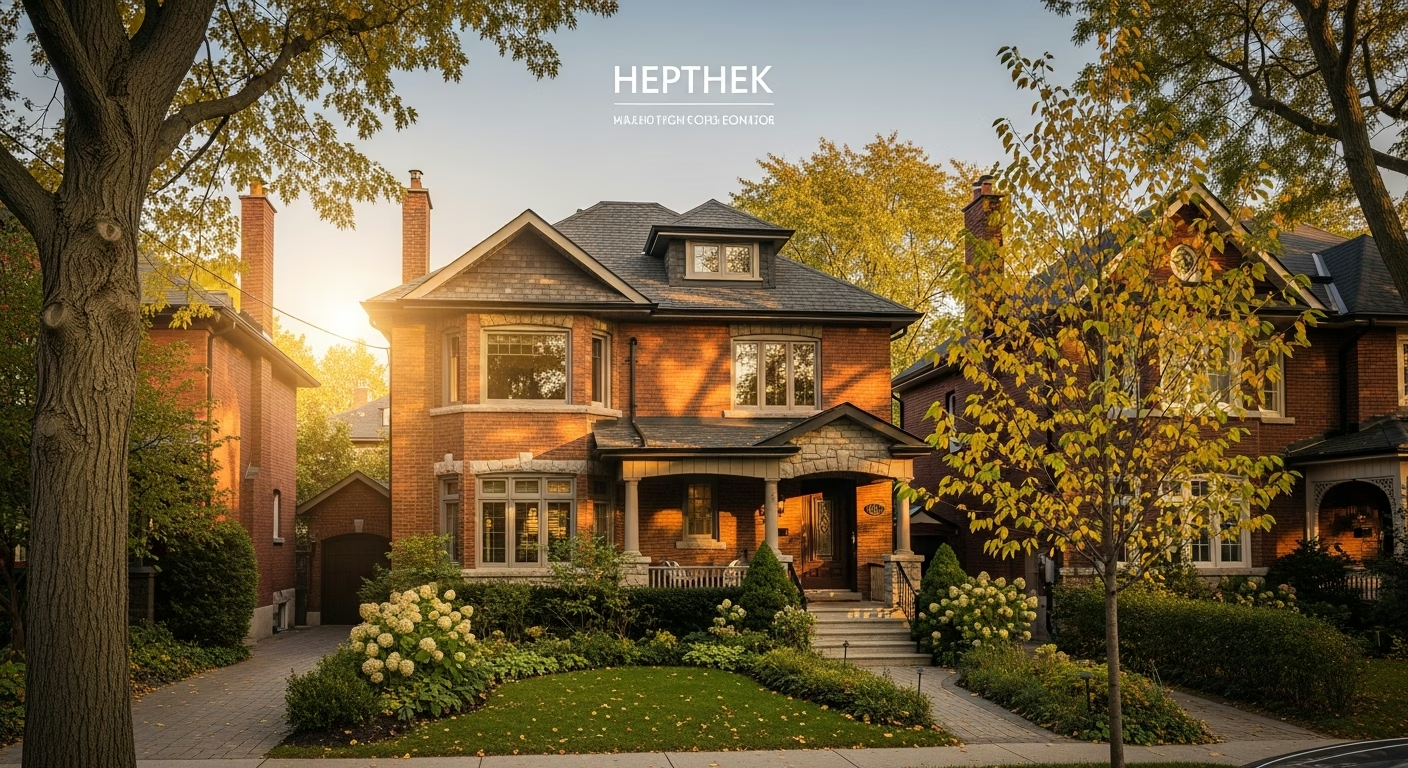
Pre-1955 housing concentrates in specific neighbourhoods because of how Toronto grew. The streetcar suburbs of the 1900s through 1940s — Riverdale, Cabbagetown, Leslieville, Roncesvalles, High Park, the Beaches, parts of East York, parts of Etobicoke — have substantial pre-1955 housing stock. Post-war suburban expansion (Scarborough, Etobicoke north of Bloor, North York) is largely 1955 onward and has minimal lead service lines.
Old East York and the East York Stretch
Old East York, the area roughly bounded by O'Connor Drive, Coxwell, the Don Valley, and Danforth, has substantial pre-1955 housing — small detached and semi-detached homes built between 1910 and 1950. The corridor along Coxwell, Donlands, and Pape includes streets where most original housing dates to the 1920s and 1930s.
Lead service line probability: high in homes built pre-1955 that have not had documented service line replacement. The City's Lead Service Replacement Program has been active in East York priority areas.
Riverdale, Cabbagetown, and South Riverdale
Riverdale (the residential blocks east of the Don Valley between Bloor and Queen) and Cabbagetown (south of Bloor, west of the Don Valley) are largely pre-1900 to pre-1930 housing. The Victorian and Edwardian homes throughout these neighbourhoods almost universally had lead service lines installed.
South Riverdale (Queen East, Carlaw, Pape area) has similar age distribution.
Lead service line probability: very high in original housing stock. Many homes in Cabbagetown and central Riverdale have had partial or full service line replacements over the past several decades, but a substantial fraction still have lead lines.
Leslieville and the Beaches
Leslieville (the Queen East corridor from Carlaw to Coxwell) and the Beaches (east of Coxwell to Victoria Park, south of Kingston Road) are predominantly 1900s through 1940s housing. Detached and semi-detached homes on the residential streets between Queen and Lake Shore are largely pre-1955.
Lead service line probability: high.
The Beaches in particular has dense pre-1930 housing on streets like Lee, Beech, Hammersmith, Glen Manor, and Wineva.
Roncesvalles, High Park, and Bloor West Village
Roncesvalles Village (south of Bloor, west of Lansdowne to Roncesvalles), High Park area (around the park itself, Junction-adjacent blocks), and Bloor West Village (Bloor West from Runnymede to Jane) are pre-1940s housing predominantly.
Lead service line probability: high in original housing stock.
Need professional plumbing?
Call RenoHouse at 289-212-2345 or get a free estimate today.
Get Free Estimate →The streetcar suburbs character of these neighbourhoods is reflected in the housing pattern: long blocks of detached and semi-detached homes, similar age across the block.
The Junction and Junction Triangle
The Junction (around Dundas West and Keele) and the Junction Triangle (between the rail corridors west of Dundas West) are predominantly pre-1940s housing. The Junction's main residential blocks include early 1900s detached and semi-detached homes; the Junction Triangle has a mix of pre-1940s housing and some post-war infill.
Lead service line probability: high in pre-1955 housing.
Parts of Parkdale and Little Portugal
Parkdale (south of Queen, west of Dufferin, east of Roncesvalles) and Little Portugal (Dundas West around Dovercourt) have substantial pre-1940s housing. The grand Victorian and Edwardian homes of South Parkdale, the row houses of Little Portugal, and the smaller worker housing on the side streets are all candidates for lead service lines.
Lead service line probability: high in pre-1955 housing.
Heritage Etobicoke (Mimico, New Toronto)
The Mimico and New Toronto stretches of southern Etobicoke (along Lake Shore from the Humber River west to Brown's Line) include substantial pre-1940s housing. These were independent municipalities with their own water and sewer infrastructure before amalgamation, and their original housing stock is contemporaneous with central Toronto streetcar suburbs.
Lead service line probability: moderate to high in pre-1955 housing.
Other Toronto Areas with Pre-1955 Housing
Beyond the neighbourhoods above, scattered pre-1955 housing exists in:

- Annex and Yorkville (mixed pre- and post-war housing).
- Forest Hill and Casa Loma (predominantly pre-1940s housing in Forest Hill South and Casa Loma).
- Lawrence Park (1920s-1930s housing predominantly).
- Long Branch (similar to Mimico/New Toronto profile).
- Weston (the original village core has pre-1940s housing).
In each case, the pre-1955 housing stock is the lead-line probability driver.
Areas with Minimal Lead Service Lines
For context, neighbourhoods with predominantly post-1955 housing have minimal lead service line probability:
- Don Mills (1950s onward).
- Scarborough (largely post-war).
- North York (largely post-war).
- Etobicoke north of Bloor (largely post-war).
- Mississauga, Brampton, Vaughan, Markham (post-war).
Properties in these areas are unlikely to have lead service lines unless built on pre-1955 lots that retained the original line through redevelopment.
What This Means for Homeowners
Living in a pre-1955 neighbourhood does not mean a property has a lead service line — many have been replaced over the years — but it does mean the probability is high enough to warrant verification.
The verification sequence:
- 1. Visual identification at the meter: see Lead Pipe in Pre-1955 Toronto Homes: How to Identify Your Service Line.
- 2. Toronto Water service inquiry: contact 311 for the City's record on the city-side material.
- 3. Tap-water test: see Lead in Tap Water Testing Toronto: How and Where.
City Program Activity by Neighbourhood
The City of Toronto's Lead Service Replacement Program has been most active in:
- Capital Replacement projects on streets undergoing road or watermain reconstruction (varies year by year).
- Coordinated Replacement requests from homeowners in the priority neighbourhoods listed above.
The program covers the city-side replacement at no charge to the homeowner regardless of neighbourhood — the neighbourhood concentration reflects where the lines actually are, not a program restriction.
For the program walkthrough, see Toronto Lead Service Replacement Program: How the Free City-Side Replacement Works.
Capital Replacement Project Awareness
When the City schedules road reconstruction or watermain renewal on a block, all confirmed lead city-side service lines on that block are replaced as part of the capital project. Homeowners receive notice in advance.
The notice is the cue to consider coordinating an owner-side replacement during the same disturbance window. The savings come from:
- Restoration cost: the boulevard and road are already being restored as part of the City work.
- Mobilization cost: the contractor's set-up cost is amortized across more work.
If a Capital Replacement notice arrives in your mailbox, the practical next step is a quote from a licensed plumber for owner-side replacement during the same window.
Pre-Sale Considerations
For homeowners in pre-1955 neighbourhoods considering a sale:
- A confirmed lead service line is sometimes flagged in pre-sale home inspections.
- A documented replacement (with permit and inspection records) reassures buyers.
- The owner-side replacement cost is often lower as a coordinated project than as an emergency post-sale remediation by the new buyer.
For homebuyers in pre-1955 neighbourhoods:
- Ask the seller's lawyer for documentation of any service line replacement.
- Build the inspection contingency to include service line material identification at the meter.
- Budget for owner-side replacement if the line is confirmed lead.
Bundling Opportunity
In pre-1955 Toronto neighbourhoods, the backwater valve and sump pump bundle is also commonly relevant — older housing has older drainage and is more vulnerable to basement flooding events. Bundling water service replacement with flood protection is efficient when the front yard is open.
Next Steps
If you live in a pre-1955 Toronto neighbourhood and have not yet verified your service line material, the practical sequence is visual identification at the meter, Toronto Water service inquiry, and (if confirmed lead) program application and licensed plumber quote.
To start the project, visit our service page at /services/plumbing/lead-galvanized-water-service-replacement.
Sources & References
Authoritative sources cited in this guide:
- Toronto Sewer Use Bylaw 681 — Toronto plumbing/sewer regulations
- Ontario Building Code 7 (Plumbing) — OBC plumbing standards
- Health Canada — Drinking Water — Health Canada drinking water guidelines
- CSA B149.1 Natural Gas Code — Canadian gas installation code
Continue Reading