RenoHouse

# Outdoor Gas Line Installation Toronto 2026: Complete Guide
Quick answer. Running a permanent natural gas line to a backyard barbecue, a built-in fire pit, an outdoor kitchen, a pool heater, or a patio heater is one of the most popular Toronto outdoor renovation upgrades of the past five years. It is also one of the most regulated plumbing tasks a homeowner can commission.Running a permanent natural gas line to a backyard barbecue, a built-in fire pit, an outdoor kitchen, a pool heater, or a patio heater is one of the most popular Toronto outdoor renovation upgrades of the past five years. It is also one of the most regulated plumbing tasks a homeowner can commission. Every metre of pipe, every fitting, every shut-off valve, and every appliance connection is governed by the Technical Standards and Safety Authority (TSSA), the CSA B149.1 Natural Gas and Propane Installation Code, and the City of Toronto's plumbing and zoning bylaws.
This RenoHouse pillar guide walks Toronto homeowners through the full 2026 picture: who is legally allowed to install the line, what permits and inspections are involved, when Enbridge needs to be brought in, how CSST compares to black iron, what burial depth the code requires, what a realistic pressure test looks like, and what current CAD pricing is for the most common outdoor gas projects in the GTA.
A note on our role. RenoHouse is a project coordination firm. We are not a TSSA-licensed gas-fitting contractor, and we do not employ in-house gas fitters. Every outdoor gas installation we coordinate is performed by a TSSA G2 licensed gas-fitter working as our certified subcontractor. We coordinate the design, the City of Toronto permits, the Enbridge service-call coordination if a meter or regulator upgrade is needed, the pressure test, and the post-test backfill and finish work. This honest division of labour is the only legal way outdoor gas work can be done in Ontario, and it is how every reputable Toronto renovation firm structures these projects.Why Outdoor Gas Is Heavily Regulated in Ontario
Natural gas is delivered to Toronto homes by Enbridge Gas at roughly 7 inches water column (about 0.25 psi) on the residential low-pressure side, or up to 2 psi on the medium-pressure side where it is regulated down at the appliance. Either way, an undetected leak in a buried, exterior, or enclosed line can accumulate to an explosive concentration with very little warning. Outdoor lines have specific failure modes — frost heave, lawn aerator strikes, lawn mower blade strikes when shallow, root pressure, settling, and corrosion at the soil-air interface — that interior lines do not face.
Ontario's regulatory response is a layered set of requirements:
- TSSA Act and Regulation 215/01 (Fuel Industry Certificates): Only a person holding a valid TSSA gas technician licence (G3, G2, or G1) may install, alter, or repair a fuel system. A G2 licence covers up to 400,000 BTU/h input — sufficient for almost every residential outdoor application. G1 is required for higher-input systems and most commercial work.
- CSA B149.1 Natural Gas and Propane Installation Code: The technical bible. Specifies pipe sizing, materials, fittings, supports, burial depth, shut-off valve location, leak testing, and appliance clearances.
- CSA B149.2 Propane Storage and Handling Code: Covers tank placement, distance to ignition sources, and tank refill requirements for propane installations.
- City of Toronto Building Permit: Required for any new gas line installed inside or on a building, and for outdoor lines tied into the building system. Plumbing inspector verifies the work.
- Toronto Bylaw 681 (Sewer Use): Imposes minimum horizontal and vertical separation between gas lines and sanitary or storm sewer connections — a frequently missed detail in older lots.
- Enbridge Service Call: Required when the new outdoor load (combined BTU input of all new and existing appliances) exceeds the capacity of the existing meter or service regulator. Enbridge dispatches a technician to verify and, if needed, swap the meter or regulator at no charge to the homeowner.
A homeowner who runs an outdoor gas line without a TSSA-licensed gas fitter exposes themselves to: voided home insurance, a TSSA stop-work order, a Toronto Building permit violation, refused inspection on subsequent renovation work, and (in the event of a leak or fire) potential criminal negligence charges. There is no DIY exemption for permanent outdoor gas work in Ontario.
The Five Most Common Outdoor Gas Projects in Toronto
Across the projects we coordinate in the GTA, five end-uses account for the overwhelming majority of outdoor gas work:
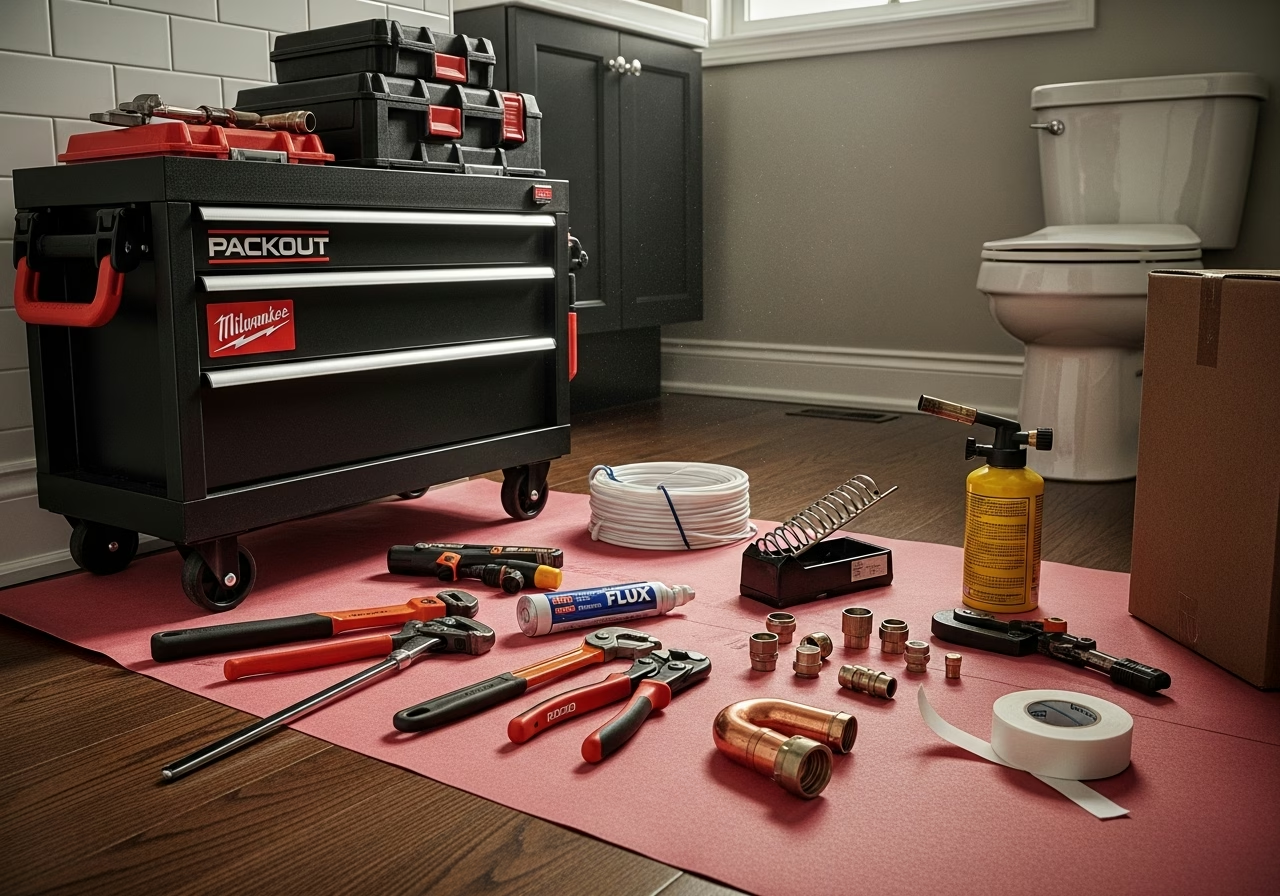
- 1. Permanent BBQ gas line — the simplest and cheapest project. Replaces propane tank exchanges with a hard-piped natural gas connection at a designated patio location. Typical input: 50,000 to 90,000 BTU/h. See Gas BBQ Line Installation Cost Toronto.
- 2. Built-in fire pit or fire bowl — a CSA-rated outdoor decorative appliance with a dedicated gas line, often with a key valve and an electronic ignition. Typical input: 60,000 to 150,000 BTU/h. See Gas Fire Pit Installation Toronto.
- 3. Outdoor kitchen — multiple appliances on a single manifold: BBQ, side burner, pizza oven, sometimes a fridge with an ice maker. Typical combined input: 120,000 to 250,000 BTU/h. See Outdoor Kitchen Gas Line Toronto.
- 4. Pool heater — high-input appliance often on a long pipe run from the meter to a pool equipment pad. Typical input: 200,000 to 400,000 BTU/h. See Gas Pool Heater Line Toronto.
- 5. Patio heater (permanent freestanding or wall-mounted) — common on three-season terraces and rooftop patios. Typical input: 30,000 to 50,000 BTU/h. See Gas Patio Heater Installation Toronto.
Each of these has its own pipe-sizing math, its own appliance clearance requirements, and its own typical cost band — covered in the cluster posts linked above and detailed later in this guide.
TSSA G2 vs G1: Which Licence Does Your Job Need?
The TSSA gas technician licensing structure is straightforward but often misunderstood:
- G3: Apprentice level. Limited to specified equipment categories under direct G2/G1 supervision.
- G2: Up to 400,000 BTU/h input per appliance. Covers nearly all residential outdoor applications, including pool heaters and outdoor kitchens.
- G1: No BTU limit. Required for very large pool heaters above 400,000 BTU/h, commercial outdoor kitchens, and most large multi-family or commercial work.
For 99 percent of Toronto residential outdoor gas projects, a TSSA G2 licensed gas-fitter is the correct credential. RenoHouse coordinates G2 subs by default and escalates to G1 only when a project's combined input exceeds 400,000 BTU/h on a single appliance.
How to verify a gas-fitter's licence: ask for the TSSA certificate number and look it up at the TSSA Public Register (free online). The certificate must be current — not expired, suspended, or restricted. A homeowner has the right to ask for and copy this card before any work begins. RenoHouse provides our subcontractor's TSSA card at the project kick-off meeting.
CSA B149.1 — The Code That Governs Every Detail
CSA B149.1 is the technical standard adopted into law by Ontario through TSSA. The 2025 edition (with 2026 amendments) is the current reference. The code is several hundred pages long; the sections most relevant to outdoor residential work are:
- Section 6: Pipe sizing and capacity tables. Gas-fitters use these tables to determine the diameter required to deliver a given BTU/h load over a given distance with the available inlet pressure.
- Section 8: Pipe and tubing materials. Covers Schedule 40 black iron, Type L copper (limited applications), and CSST (corrugated stainless steel tubing) such as Gastite, FlashShield, OmegaFlex TracPipe, and Gas-Flo.
- Section 9: Joining methods. Threaded fittings for black iron with approved pipe dope (or PTFE tape rated for gas), mechanical fittings for CSST per the manufacturer's instructions.
- Section 6.18 and 6.19: Underground piping and burial depth.
- Section 6.21: Pressure and leak testing.
- Section 5: Appliance connections, shut-off valves, and clearances.
The TSSA G2 sub coordinates all code compliance. The homeowner's job is to make sure the licence is real, the permit is pulled, and the inspection happens before the trench is backfilled.
Burial Depth: 18 Inches Minimum, More for Vehicular Traffic
CSA B149.1 specifies a minimum burial depth of 18 inches (450 mm) of cover above the top of the pipe in residential, non-vehicular areas. Where vehicular traffic crosses the line — driveways, parking pads, side-yard access strips — the minimum cover increases to 24 inches (600 mm), and the line must be sleeved or protected by a concrete slab where it crosses under driveways.
Additional burial requirements:
- A continuous yellow polyethylene tracer tape must be laid 6 to 12 inches above the pipe so that future excavation locates it before a shovel strikes the line.
- A #14 AWG insulated tracer wire is required for non-metallic CSST jacket runs (most CSST products) so that an electronic locator can find the line.
- The trench bottom must be free of rocks larger than 2 inches; bedding sand is required around any CSST jacket to prevent point-load damage.
For full burial detail, see Gas Line Burial Depth Toronto Code.
CSST vs Black Iron: The Material Choice
The two dominant outdoor gas pipe materials in Ontario are Schedule 40 black iron and CSST (corrugated stainless steel tubing). Each has trade-offs:
Black iron pipe (Schedule 40)- Strongest material; resists damage and rodent chew.
- Threaded joints; every joint is a potential leak point if not made up correctly.
- Heavy and slow to install; many fittings on a long run.
- Galvanized black iron is not permitted for buried gas in Ontario — only coated or wrapped Schedule 40 in approved jacket.
- Lower material cost per foot but higher labour cost.
- Flexible; long runs with few fittings; faster install.
- Yellow or black PE jacket; FlashShield and arc-resistant variants add a metallic mesh shield for lightning bonding.
- Must be bonded to the home's grounding electrode system per CSA C22.1 (Electrical Code) Section 10 to prevent lightning-induced arc damage.
- Higher material cost per foot but significantly lower labour cost on long, complex runs.
- Mechanical fittings only — must be installed exactly per the manufacturer's instructions.
For outdoor runs, RenoHouse's coordinated G2 subs typically use Schedule 40 black iron for short, straight runs (under 30 feet from meter to BBQ) and CSST jacketed in approved underground sleeve for long, multi-direction runs (under decks, around pool equipment, to outdoor kitchens). For the full comparison and code citations, see CSST vs Black Iron Pipe Outdoor Toronto.
Need professional plumbing?
Call RenoHouse at 289-212-2345 or get a free estimate today.
Get Free Estimate →The Outdoor Shut-Off Valve
CSA B149.1 requires a manual shut-off valve at the building exit for any outdoor gas line, and a second shut-off valve at the appliance. The exit valve must be:
- CSA-rated for natural gas service (or propane if applicable).
- Accessible — within arm's reach, not buried in vegetation, not behind permanent finishes.
- Quarter-turn ball valve preferred for ease of identification and emergency shut-off.
- Labeled with a permanent tag identifying the appliance(s) it serves.
A second shut-off valve is required at each appliance — at the BBQ, fire pit, pool heater, etc. This is so that any one appliance can be serviced or removed without draining the whole line. For full shut-off valve detail, see Outdoor Gas Shut-Off Valve Toronto.
Pressure Testing: Mandatory Before Backfill
Section 6.21 of CSA B149.1 requires a pressure test of every new gas line section before it is put into service and before any trench is backfilled. The test parameters:
- Test pressure: 1.5 times the maximum operating pressure, or a minimum specified value depending on the system. For low-pressure residential (7 inches water column), the typical test pressure is 14 inches of water column or a minimum of 1.5 psi using air or inert gas (never natural gas).
- Test medium: air or nitrogen — never the natural gas itself.
- Test duration: 10 minutes minimum with no measurable pressure drop on a calibrated gauge. Many municipal jurisdictions and TSSA inspectors require longer holds on larger systems.
- Test gauge: minimum 0.1 psi resolution or 0.1 inch water column for low-pressure tests.
A failed pressure test means a leak — every joint and fitting is then soap-tested or pressure-bracketed until the leak is found and corrected. Only after a passing pressure test, witnessed and documented by the gas-fitter (and inspected by the City inspector if required), can the trench be backfilled and the line put into service.
A skipped or undocumented pressure test is the single most common reason TSSA red-tags an outdoor gas job. Do not let any contractor backfill a trench without showing you the pressure test result.
TSSA G2 Permit and City of Toronto Permit
There are two separate permits for many outdoor gas jobs in Toronto:
- 1. City of Toronto Building / Plumbing Permit — required when the gas line is connected to or alters the building gas system, when piping is run inside or on the building, or when the project triggers a structural penetration. The City permit is pulled by the homeowner or the contractor. Inspection is by a Toronto plumbing inspector.
- 2. TSSA Gas Permit (Notice of Work) — the TSSA-licensed contractor files a notice with TSSA for any gas work performed under their licence. This is the contractor's documentation; it is not a homeowner permit per se but is a legal requirement for the contractor.
Some smaller projects (e.g., adding a 50,000 BTU BBQ tee onto an existing exterior gas line that already has a permitted shut-off) may not require a fresh City permit but always require TSSA-licensed work and TSSA documentation. The G2 sub determines which permits are needed for each project. For the full permit walkthrough, see TSSA G2 Permit Outdoor Gas Toronto.
Enbridge Service Coordination
Enbridge Gas owns the meter, the regulator, and the service line up to the building. When a new outdoor load is added, the gas-fitter calculates the combined BTU input of all existing and new appliances, plus a diversity factor for simultaneous use, and compares it to the rated capacity of the existing meter and regulator.
If the combined load exceeds the meter's rated capacity (typical residential meters: 250 cfh = 250,000 BTU/h on natural gas), Enbridge dispatches a technician to swap the meter at no charge to the homeowner. If the service regulator is undersized, that is also swapped. In rare cases (very large pool heaters, multiple appliances, or homes with already large existing loads), a service line upgrade is needed — Enbridge may need to dig from the street to the meter to install a larger service line. This is also at no cost to the homeowner if it is a capacity issue, but it adds 4 to 12 weeks to the project timeline depending on Enbridge scheduling.
The G2 sub initiates the Enbridge service call. RenoHouse coordinates the timing so the trench is open and ready when Enbridge arrives, minimizing project drag. For full Enbridge coordination detail, see Enbridge Gas Connection Coordination Toronto.
Toronto Bylaw 681 — Sewer Separation
Toronto Municipal Code Chapter 681 (Sewer Use) imposes a minimum 1 m horizontal separation between any new gas line and existing sanitary or storm sewer connections, and a 150 mm vertical separation where a gas line crosses over or under a sewer. The reason is leak migration: if a gas line leaks below grade, the gas can travel along a sewer trench into the building.
In practice, this affects projects where the planned gas trench runs parallel to the lateral sewer connection from the house to the street. The G2 sub and the homeowner's site plan need to confirm sewer locations (Toronto Water locates are free) before the trench is dug.
Propane vs Natural Gas
Natural gas is the dominant Toronto fuel because Enbridge service is available on virtually every residential street within the City of Toronto. Outside the City — parts of Halton, Durham, York Region, and rural areas — propane remains common where natural gas is not available.
Propane has different code requirements (CSA B149.2 for storage and handling, larger orifice sizes on appliances, different pressure drop calculations). A natural gas BBQ cannot run on propane without an orifice change kit, and vice versa. Most modern outdoor appliances are dual-fuel rated but require the correct orifice for the supplied fuel.
For full comparison, conversion costs, and the case for each fuel, see Propane vs Natural Gas BBQ Toronto.
Realistic 2026 CAD Pricing
Pricing varies by run length, pipe material, complexity, and whether an Enbridge upgrade is needed. The following are typical RenoHouse-coordinated CAD prices for the GTA in 2026, all-in (TSSA G2 sub labour, materials, permit, pressure test, basic backfill, and finish patch where applicable):
- BBQ line off existing meter, 15–25 ft run, single appliance: $1,500 – $2,500
- BBQ line, 30–60 ft run, through deck or under interlock: $2,000 – $3,500
- Gas fire pit, 25–50 ft run, single appliance: $1,800 – $3,000
- Outdoor kitchen with 2 to 4 appliances, manifold, 30–60 ft run: $3,500 – $5,500
- Pool heater, 40–80 ft run, larger pipe size: $2,500 – $4,000
- Patio heater (permanent), 20–40 ft run: $1,400 – $2,400
- Enbridge meter upgrade: $0 (no charge if Enbridge determines capacity issue)
- Enbridge service line upgrade: $0 to homeowner if capacity-driven; 4–12 week add to schedule
Add $500 – $1,500 for difficult excavation (rock, tree roots, frozen winter ground, hard interlock removal and re-lay), and $300 – $800 for additional shut-off valves or appliance taps beyond the basic single-appliance scope.
For BBQ-specific pricing detail, see Gas BBQ Line Installation Cost Toronto.
Common Mistakes Toronto Homeowners Make
Five recurring mistakes we see when homeowners come to us after a previous job went wrong:
- 1. Hiring an unlicensed handyman. No TSSA card means the work is illegal and uninsured.
- 2. Skipping the permit on an "easy" BBQ job. Insurance companies have begun demanding documented permits and TSSA paperwork for outdoor gas claims. A leak-related fire on an unpermitted line will likely be denied.
- 3. Burying the line shallower than 18 inches. A few seasons of frost heave, and the line bends or fittings loosen.
- 4. Forgetting the outdoor shut-off valve at the building exit. Code violation and a serious safety issue if the outdoor system is ever damaged.
- 5. Backfilling before the pressure test is documented. No paperwork means the test was either not done or was done quickly without a proper hold time.
Full mistake-by-mistake walkthrough: Outdoor Gas Line Mistakes Toronto.
Outdoor Gas Fireplace vs Fire Pit
A common decision point: gas fireplace (vertical, often built into a stone wall or pergola pillar) versus gas fire pit (low, wide, table or pad mounted). Both are CSA-rated decorative appliances; both require a TSSA G2 install; both require the same code-compliant gas line and shut-off arrangement. Differences are aesthetic, BTU input, footprint, and material cost. See Gas Fireplace vs Fire Pit Outdoor Toronto for the full comparison.
Coordinating Outdoor Gas with Decks, Interlocking, and Generators
Outdoor gas projects almost always overlap with other RenoHouse work. The trench for a gas line under a deck is often dug in the same week as the deck footings. Interlock removal and re-lay is usually scheduled as part of the same crew rotation. And if you are adding a gas standby generator, the generator's gas line is typically tied into the same outdoor manifold.
Two cross-references that frequently apply on outdoor gas projects:
- Composite Decking Toronto 2026 — coordinate your deck framing so the gas line, shut-off, and BBQ tee land in the right location before the decking goes down.
- Standby Generator Installation Toronto 2026: Complete Guide — natural gas standby generators (Generac, Kohler, Cummins) tie into the same outdoor gas manifold and frequently trigger the same Enbridge meter upgrade conversation.
What RenoHouse Does on an Outdoor Gas Project
Our coordination scope on a typical outdoor gas job:
- 1. Site visit and load calculation. Confirm meter rating, existing appliances, and proposed new BTU load.
- 2. TSSA G2 sub assignment. Verified licence, insurance, and references.
- 3. Permit pull. City of Toronto plumbing permit where required; TSSA notice of work by the sub.
- 4. Enbridge coordination. Service call if a meter or regulator upgrade is required.
- 5. Trenching and routing. Coordinated with deck, interlock, fence, or generator scope.
- 6. Pipe install. Material selection (CSST, black iron, or hybrid) per code and scope.
- 7. Pressure test. Documented air or nitrogen test, photographed gauge readings, signed off by the G2 sub.
- 8. Inspection. City inspector signs off; TSSA notice closed out.
- 9. Backfill and finish. Tracer tape and tracer wire installed; trench backfilled; lawn, interlock, or deck finish restored.
- 10. Appliance commissioning. BBQ, fire pit, pool heater, etc. connected, leak-tested at the appliance, fired and verified.
Get a Coordinated Outdoor Gas Quote
If you are planning a BBQ line, a fire pit, an outdoor kitchen, a pool heater, or a patio heater anywhere in Toronto, RenoHouse coordinates a TSSA G2 licensed gas-fitter, the City permit, the Enbridge service call where needed, the trench, the pressure test, and the finish work — under one quote, one schedule, one point of contact.
Start your outdoor gas project at /services/plumbing/outdoor-gas-line-installation.
Sources & References
Authoritative sources cited in this guide:
- Toronto Sewer Use Bylaw 681 — Toronto plumbing/sewer regulations
- Ontario Building Code 7 (Plumbing) — OBC plumbing standards
- Health Canada — Drinking Water — Health Canada drinking water guidelines
- CSA B149.1 Natural Gas Code — Canadian gas installation code
Continue Reading