RenoHouse

# Water Service Replacement Mistakes Toronto Homeowners Make
Quick answer. After coordinating water service replacement projects across Toronto, the same mistakes recur. This article catalogues them so homeowners can recognize them in their own quotes, contracts, and decisions before they become expensive.After coordinating water service replacement projects across Toronto, the same mistakes recur. This article catalogues them so homeowners can recognize them in their own quotes, contracts, and decisions before they become expensive.
For full project context, see our pillar guide at Lead and Galvanized Water Service Replacement Toronto: The Complete 2026 Guide.
Honest Positioning
RenoHouse coordinates these projects with licensed plumbers who hold the Toronto Water permit. The mistakes below are based on patterns we have observed across many residential projects in 2026. Most are fixable in the planning phase if the homeowner asks the right questions before signing.
Mistake 1: Skipping the City Coordination on a Confirmed Lead Line
The City of Toronto's Lead Service Replacement Program covers the city-side portion at no charge to the homeowner when the line is confirmed lead. A surprisingly common mistake: a homeowner accepts a quote that includes both halves at full owner cost, paying the City portion that would have been free.
Why this happens:
- Some contractors quote the full project as a single number without distinguishing city-side from owner-side.
- The homeowner does not contact Toronto Water to verify the city-side material before accepting the quote.
- The contractor schedules and excavates without coordinating with the City crew.
The fix: contact Toronto Water through 311 or the customer portal to verify the city-side material on file, and submit the Lead Service Replacement Program application before scheduling work. See Toronto Lead Service Replacement Program: How the Free City-Side Replacement Works.
The cost of this mistake: $7,000 to $15,500 in unnecessary city-side replacement cost.
Mistake 2: Partial Replacement Leaving Lead in Place
The homeowner replaces only the owner-side portion and leaves the city-side lead pipe in place. Or vice versa — the City replaces the city-side under a capital project, and the homeowner leaves the owner-side lead in place.
Why this happens:
- Cost concerns ("we'll do the city-side later when budget allows").
- Misunderstanding of the lead release dynamics ("the new section will protect us").
The technical issue: partial replacement disturbs the existing lead pipe at the connection point and dislodges the internal scale that has built up over decades. Lead release into the water can spike for weeks to months after a partial replacement, before stabilizing at a new equilibrium that may be no better than before.
Health Canada and Toronto Water both note this. The recommended approach is full-line replacement, coordinated between the homeowner's plumber and the City crew. The City's free city-side program is specifically designed to enable this.
For the regulatory background, see Health Canada's 0.005 mg/L Lead Drinking Water Guideline.
Mistake 3: Hiring an Unlicensed Installer
Water service line replacement requires a licensed plumber authorized to apply for a Toronto Water service connection permit. An unlicensed installer cannot pull the permit, cannot pass the City inspection, and cannot legally do the work.
Why this happens:
- Lower quotes from unlicensed installers (significantly below market for licensed work).
- Recommendations from acquaintances who used the same installer.
- Online marketplace listings that do not verify licensing.
The downstream consequences:
- Failed inspections with re-do costs.
- Title issues at resale (a buyer's lawyer or home inspector flags the unpermitted work).
- No insurance coverage if the installation fails.
- Stop-work orders from the City.
The fix: verify the plumber's license with the Province of Ontario. Ask for the permit number once the application is submitted. See Water Service Replacement Permit and Toronto Water Process.
Mistake 4: Restoration Scope Creep
The quote says "we'll restore the lawn and driveway" without specifying what that means. After the work is done, the homeowner discovers:
- The lawn restoration is grass seed, not sod.
- The driveway "patch" is a small asphalt cold patch, not a full hot-mix re-lay.
- The interlock walkway is reset with mismatched pavers.
Why this happens:
- The contractor does not want to spend the time itemizing each restoration scope.
- The homeowner does not push for itemization in the quote.
- "Standard restoration" means different things to different contractors.
The fix: insist that the quote itemize:
Need professional plumbing?
Call RenoHouse at 289-212-2345 or get a free estimate today.
Get Free Estimate →- Lawn area (square feet) and finish (seed vs sod vs no-touch existing).
- Concrete walkway repair (linear feet, finish to match existing or new finish).
- Asphalt driveway repair (square feet, hot-mix vs cold-patch, sealed or unsealed).
- Interlock or paver re-lay (square feet, pattern, replacement pavers if needed).
- Mature plant replacement (specific plants and locations).
A specific quote is comparable across contractors. A vague quote is not.
Mistake 5: Not Pulling Locates Before Excavation
Ontario One Call locates are mandatory before any excavation. Locates mark gas, hydro, telecom, and water utilities so the excavator avoids them.
Why this happens:
- Aggressive scheduling skipping the locate lead time.
- Assumption that "the plumber knows where utilities are."
- Cost pressure to start work immediately.
The downstream consequences:
- Hitting a gas line: emergency response, gas line repair cost, and a regulatory incident report.
- Hitting a hydro feed: similar.
- Hitting a telecom line: service outage to the property and potential to the block, with associated repair cost.
The fix: locates are a non-negotiable line in the project schedule. Ontario One Call legislated turnaround is up to 5 business days; plumbers typically request locates 1 to 2 weeks before scheduled excavation.
Mistake 6: Backfilling Before Inspection
Toronto Water inspects the new line before backfill. Closing the trench or pit before the inspector arrives results in re-opening the trench at the homeowner's cost.
Why this happens:
- Schedule pressure to finish the work day.
- Misunderstanding of the inspection sequence.
The fix: the licensed plumber confirms the inspection time and holds the trench open until the inspector signs off. This is part of the licensed plumber's process and should not require homeowner intervention.
Mistake 7: Skipping the Pressure Test
The pressure test confirms the new line and connections hold pressure without leaks. Toronto Water specifies test pressure (typically 100 to 150 psi) and duration (typically 15 to 30 minutes).
Why this happens:
- Time pressure to finish the project.
- Equipment unavailability (a contractor without a calibrated pressure gauge).
- Implicit assumption that "the line is fine."
The downstream consequences:
- A failed pressure test caught later at the meter results in re-excavation.
- A latent leak in the buried run produces a higher water bill and eventual settling or sinkhole at the surface.
The fix: the pressure test is part of the City inspection. Confirmed pass is documented. Any contractor who skips the pressure test is doing something they should not be doing.
Mistake 8: Not Flushing Interior Plumbing After Replacement
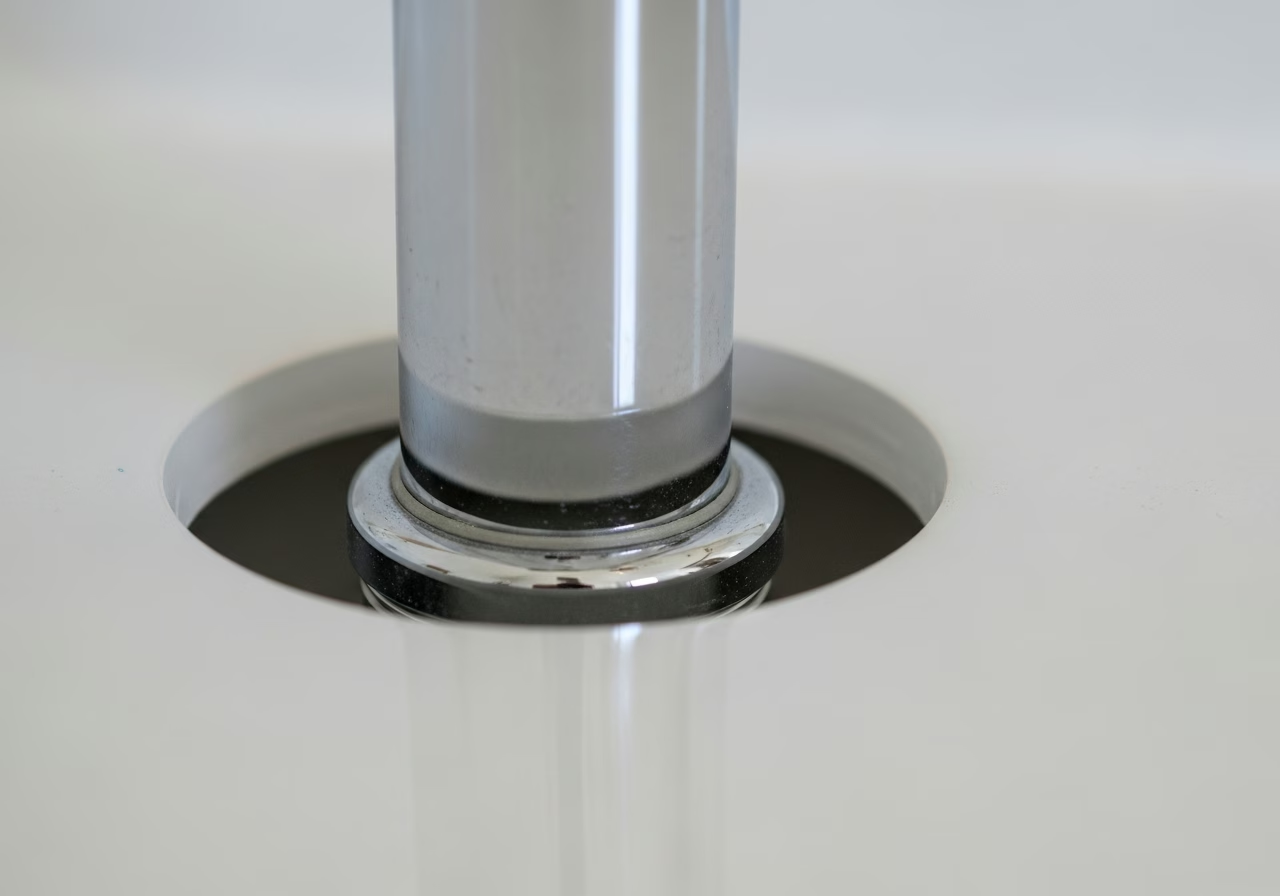
After the new line is installed and pressurized, the building's interior plumbing should be flushed for several minutes per fixture to clear any sediment from the construction work.
Why this happens:
- The plumber considers the buried work complete and the interior is "the homeowner's problem."
- The homeowner does not know to flush.
The downstream consequences:
- Sediment lodges in faucet aerators and shower heads on the day after replacement, requiring cleaning.
- Sediment in toilet fill valves can interfere with operation.
The fix: flush each fixture for 5 minutes the day after replacement. Remove and clean aerators after flushing.
Mistake 9: Multiple Separate Trips for Plumbing Work
A homeowner does the service line replacement this year, the backwater valve next year, the sump pump the year after. Each trip means separate excavation, separate restoration, and separate mobilization costs.
Why this happens:
- Budget timing.
- Not knowing what the home needs upfront.
The fix: a comprehensive plumbing assessment at the time of the service line replacement identifies opportunities to bundle. The backwater valve and sump pump bundle is a natural pairing because:
- Both projects share excavation and restoration costs.
- The backwater valve is eligible for the City of Toronto basement flooding protection subsidy.
- The sump pump and backwater valve work in concert against basement flooding.
Bundling can reduce total cost by 20 to 30 percent compared to three separate projects.
Mistake 10: Skipping Tap-Water Testing
A homeowner replaces a confirmed lead service line without ever testing the tap water for lead. Replacement is the right call for a confirmed lead line, but the test:
- Establishes a pre-replacement baseline.
- Reveals other potential lead sources (fixtures, solder).
- Provides documentation for resale.
- Is sometimes available free through Toronto Public Health.
Why this happens:
- The homeowner sees "lead service line" and goes straight to replacement.
- Testing feels like an extra step.
The fix: a tap-water test is cheap (free through Toronto Public Health when available, $35 to $80 through private accredited labs) and provides useful data. See Lead in Tap Water Testing Toronto: How and Where.
Mistake 11: Ignoring the Interior Plumbing After Replacement
The service line is replaced, but interior fixtures, brass valves, and lead-tin solder joints (legal until 1986) can still contribute to lead exposure.
Why this happens:
- Replacement focus on the buried portion only.
- "The line is the source" oversimplification.
The fix: a post-replacement tap-water test confirms the new exposure level. If lead is still detectable above the 0.005 mg/L Health Canada guideline, interior fixtures are the next investigation target. Whole-home or point-of-use filtration can address remaining sources. See Whole-Home Water Filter After Lead Replacement.
Mistake 12: No Documentation Retained
The work is done, the City inspector signs off, and the homeowner files no paperwork.
Why this matters:
- At resale, the buyer's lawyer asks for documentation of the lead replacement.
- A future home inspector benefits from knowing the date of replacement.
- Insurance claims related to water damage benefit from documented work.
The fix: keep a folder with the permit, the inspection sign-off, the pressure test result, the as-built sketch, the contractor invoice, and the City's confirmation of the city-side replacement (if applicable). The licensed plumber should provide all of this at project completion.
Pre-Project Checklist
Before signing a quote:
- City record check on file material (Toronto Water, 311).
- License verification on the plumber.
- Itemized restoration scope in the quote.
- Permit number visible (after application).
- City coordination application submitted (for confirmed lead lines).
- Locate request scheduled.
- Pressure test specified in the contract.
- Documentation deliverables specified (permit, inspection, pressure test, as-built).
Next Steps
For a coordinated quote with itemized restoration and full documentation, visit our service page at /services/plumbing/lead-galvanized-water-service-replacement.
Sources & References
Authoritative sources cited in this guide:
- Toronto Sewer Use Bylaw 681 — Toronto plumbing/sewer regulations
- Ontario Building Code 7 (Plumbing) — OBC plumbing standards
- Health Canada — Drinking Water — Health Canada drinking water guidelines
- CSA B149.1 Natural Gas Code — Canadian gas installation code
Continue Reading