 RenoHouse
Attic Conversion & Dormer Addition — Toronto GTA
Professional attic conversion & dormer addition services in Toronto and the Greater Toronto Area. Licensed, insured, and trusted by homeowners across the GTA.
Projects Completed
Years Experience
Client Satisfaction
Google Rating
How It Works
A simple, stress-free process from start to finish.
Send Your Request
Call or WhatsApp us 24/7. Send photos, video, comments about what needs to be done, and your location.
Remote Estimate
We review everything, discuss details, and provide a clear estimate — often within hours, no visit needed.
Repair Process
Our licensed team arrives on the agreed date and completes your attic conversion & dormer addition to the highest standards.
Handover & Warranty
Final walkthrough with you, full cleanup, and warranty documentation provided.
Send Your Request
Call or WhatsApp us 24/7. Send photos, video, and a description of the work + your location.
Remote Estimate
We review everything, clarify details, and give you a price — often within hours.
Repair Process
Licensed team arrives on schedule and completes your attic conversion & dormer addition professionally.
Handover & Warranty
Final walkthrough, full cleanup, and warranty documentation.
Attic Conversion & Dormer Addition in Toronto GTA
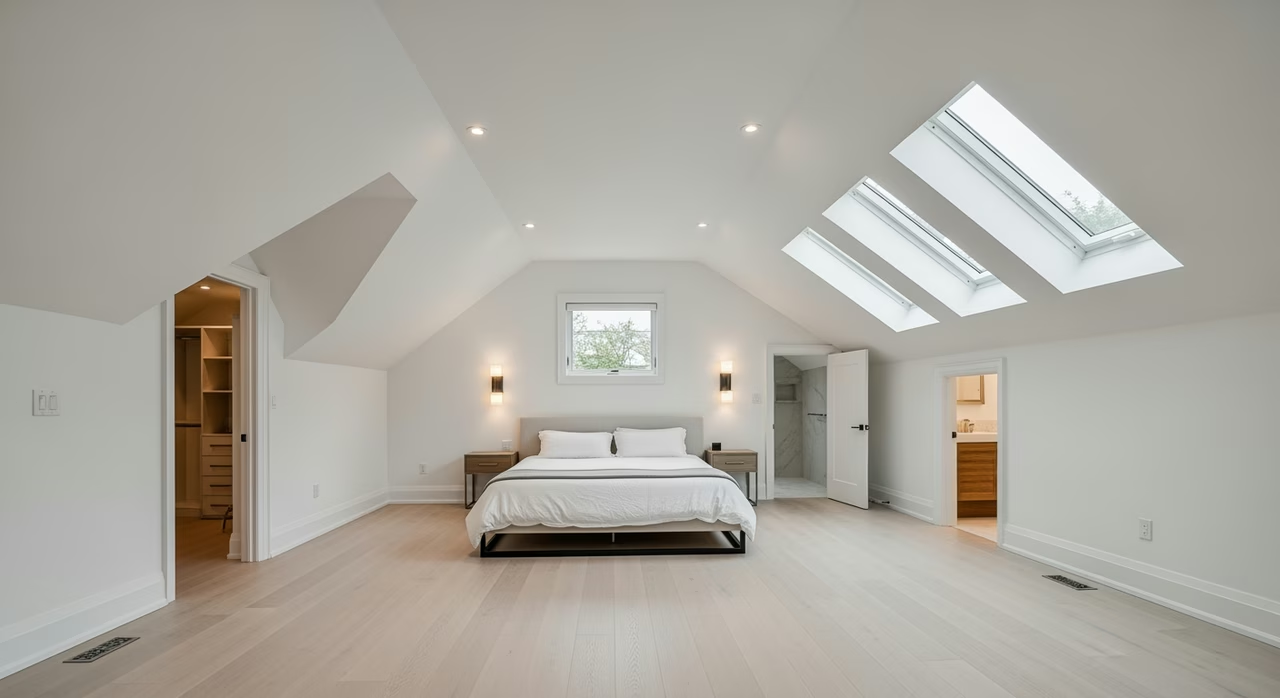
RenoHouse coordinates attic conversion and dormer addition projects for Toronto and GTA homeowners turning unfinished, low-ceiling attic space into legal habitable rooms — primary or secondary bedrooms, home offices, en-suite ensuites, kids' play lofts, and (in larger Edwardian and 2.5-storey houses) full third-floor master suites. Our scope is general-contractor-led project management: design coordination with architectural and structural partners, Toronto Building Permit submission, full construction (framing, dormer cut-and-frame, structural reinforcement, insulation to OBC R-60, electrical, plumbing, drywall, hardwood, paint), and final occupancy permit. We do NOT stamp engineering drawings — that rests with our PEng partners — but we run the project end-to-end with one contract.
Where attic conversions make sense in Toronto
The classic candidates are 1.5-storey and 2.5-storey houses built between 1900 and 1940 — short kneewalls, shallow rafters, and 6'8" peak ceilings that are uninhabitable until a dormer raises the headroom. Highest-density neighbourhoods for the work: the Beaches, the Junction, Mimico, Long Branch, New Toronto, Roncesvalles, High Park, Bloor West Village, parts of East York and Leslieville, and pockets of Cabbagetown and Riverdale. These streets are dominated by Edwardian semi-detached and worker's-cottage stock with usable attic footprint that just needs the right structural intervention to become 300–700 sq ft of premium living space at $200–$400 per sq ft of new finished area — a fraction of an addition's cost.
Project value and scope
Light attic finish (no dormer, existing 7'6"+ peak headroom, finishing only — insulation, drywall, electrical, finish carpentry): $40,000–$70,000. Single rear shed dormer to add headroom across the back half of the attic + finish: $80,000–$130,000 typical Toronto semi. Front gable dormer (heritage-character implications, more architectural scope) + finish: $100,000–$160,000. Full third-floor master suite with rear shed dormer, en-suite bath, walk-in closet, and L-shaped staircase upgrade: $150,000–$200,000+. These ranges include design, structural engineering, permits, framing, insulation, electrical, plumbing rough-in (if a bathroom is added), drywall, flooring, paint, and trim. Excluded: any second-storey load-path reinforcement triggered by extra dead load (added to scope after structural assessment).
Honest scope — engineering, permits, heritage
Attic conversions with a dormer are structural work. Required: (1) Professional Engineer (PEng) of record — a licensed Ontario structural engineer designs the new floor framing if loads are upgraded, sizes the new dormer header and rafter modifications, and signs sealed drawings. RenoHouse does NOT employ a PEng — we coordinate named partner firms (Glogowski Engineering, Cunningham + Rivard, BGE, or similar; typical fee $3,500–$8,000 for a dormer + finish design package). (2) Architect or BCIN-qualified designer — drawings for permit must meet Toronto Building submission standards; for simpler shed dormers a BCIN designer is often sufficient, for front gable dormers and any heritage-character work we recommend a registered architect. (3) Toronto Building Permit — required for any dormer, framing change, new bathroom, or new bedroom. (4) Designated Substance Survey (Reg 278/05) — almost universally required because pre-1980 houses are involved; vermiculite attic insulation in particular is common and may require Type 2 abatement before framing. (5) Committee of Adjustment — front-yard dormers, dormers that exceed zoning side-yard projections, or any massing change in a Heritage Conservation District (Cabbagetown, Riverdale, the Annex, Wychwood, parts of Leslieville and the Beaches) typically require a Committee of Adjustment hearing or Heritage Permit, adding 8–16 weeks to the project clock.
OBC habitable-attic basics
Ontario Building Code Section 9.5 requires habitable rooms to have minimum 2.30 m (7'6") clear ceiling height over at least 50% of the required floor area, with the remaining floor area allowed to slope down to 1.40 m (4'7") at the perimeter. Glazing must equal at least 5% of the room's floor area for natural light, and at least 2.5% must be openable for natural ventilation. A bedroom requires an OBC 9.9.10 egress window (minimum 0.35 m² openable area, no dimension less than 380 mm, sill no higher than 1.0 m above the floor) — for attic rooms this is almost always achieved through the new dormer, since gable-end or roof-slope skylight windows usually don't meet the egress dimensions. Insulation must be R-60 in the new sloped ceiling and any new flat-ceiling sections (current OBC SB-12). Smoke alarms hardwired and interconnected to the rest of the house. CO alarm if a fuel-burning appliance shares the floor.
Front vs. rear dormer — Toronto zoning reality
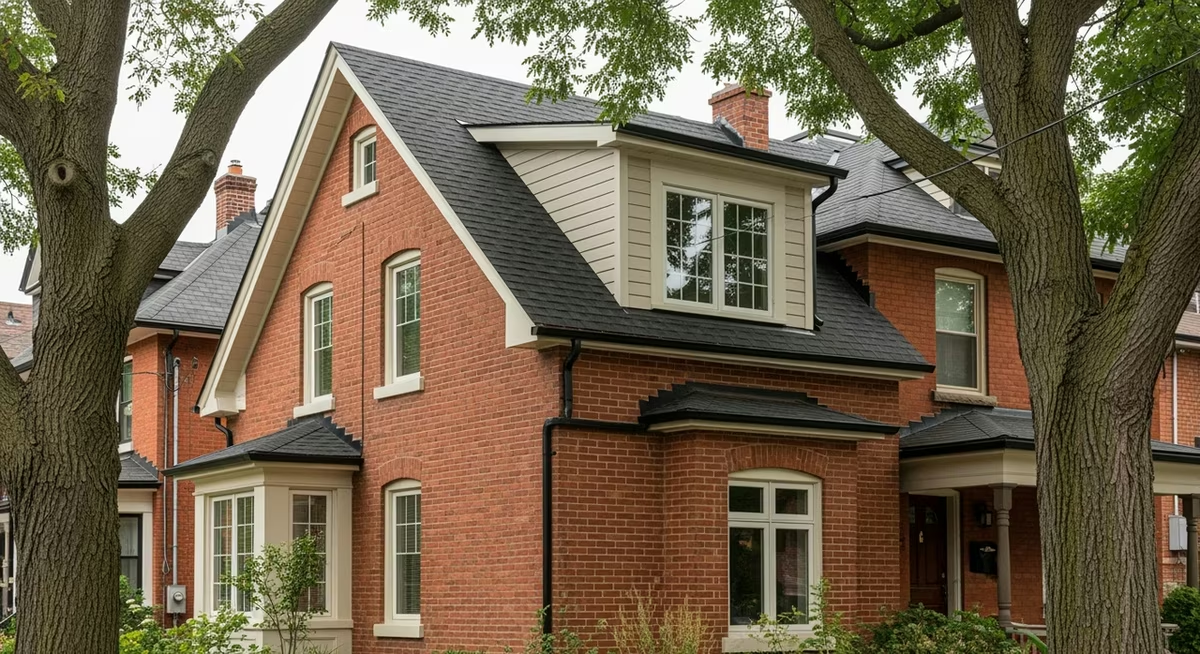
Rear shed dormers (added to the back roof slope) are usually approvable as-of-right under Toronto zoning bylaw 569-2013 — they don't change the streetscape character and rarely encroach into side or front yards. Front gable dormers (added to the front roof slope, visible from the street) are more controversial — they alter heritage-character frontage and frequently trigger Committee of Adjustment review or Heritage Permit. In Heritage Conservation Districts (HCDs) any visible exterior change requires a Heritage Permit, which can take 8–16 weeks and often results in design constraints on dormer proportions, materials, and window styles. RenoHouse defaults to rear shed dormers wherever the layout supports it; we coordinate the heritage permit process when a front dormer is essential to the design.
Staircase realities
Most pre-war Toronto homes have a steep, narrow main staircase running to the second floor; getting code-compliant access to the new attic floor frequently requires either (a) a new straight-run continuation of the existing stair, (b) an L-shaped landing that eats some second-floor closet space, (c) a winder turn at the top, or (d) (in tight footprints) a spiral staircase — though OBC 9.8 restricts spirals to secondary egress. Stair design is one of the trickiest parts of an attic conversion in tight Toronto semis; we work through the layout at the design stage with the architect to find space-efficient solutions and we tell you honestly when the stair location is the limiting factor.
Sequencing — pair with full-home renovation
Attic conversions deliver the best value when bundled with kitchen, bathroom, or whole-floor renovations — drywall, electrical, paint, hardwood refinish, and HVAC duct extension can be sequenced to avoid double mobilization. Stand-alone attic projects also work but typically run 25–35% more expensive than the same scope bundled into a fuller renovation.
Serving Toronto, Mississauga, Brampton, Vaughan, Markham, Richmond Hill, Oakville, Burlington, Etobicoke, Scarborough, North York, and all GTA communities. Call 289-212-2345 for a free attic-feasibility consultation.

Converting an unfinished attic into a third-floor master suite or adding a dormer to a Toronto semi or detached home is one of the highest-return renovations in the 2026 GTA market. A well-executed attic conversion adds 400 to 800 square feet of usable living space without expanding the home's footprint, satisfies Toronto Building's zoning bylaws without requiring a Committee of Adjustment variance in most cases, and consistently returns 75 to 100 percent of the renovation cost in resale value. RenoHouse's 2026 pricing tiers are: a light-finish attic conversion at $60,000 to $80,000, a rear shed dormer plus full finish on a typical Toronto semi at $140,000 typical mid, and a full third-floor master suite with rear shed dormer, ensuite bathroom, walk-in closet, and continuation staircase at $200,000 to $250,000-plus.
The cost and feasibility of an attic conversion are driven primarily by the existing peak height and the existing structural framing. Homes with a 7-foot-6-inch existing peak (the minimum OBC habitable-space requirement) can sometimes be finished without any dormer addition. Homes with a 6-foot or 6-foot-6 peak require a dormer to gain head height. Homes with a 4-foot or 5-foot peak almost certainly require a full second-storey replacement, not an attic conversion.
What an attic conversion actually involves
A standard mid-tier RenoHouse attic conversion runs through the following sequence: feasibility assessment including peak-height measurement, floor-joist load capacity calculation, and access-route review (the existing staircase must continue or a new staircase must be designed to OBC 9.8 requirements — clear width, headroom, riser height, tread depth); engineered drawings by a P.Eng. with sealed structural design for any floor-joist reinforcement and the new beam-and-rafter framing of the dormer; Toronto Chapter 363 building permit application (review timeline typically four to twelve weeks); Heritage Permit application where the home is in a Heritage Conservation District (adds 8 to 16 weeks); MOL Reg 278/05 DSS asbestos survey (vermiculite attic insulation is the most common finding in pre-1990 Toronto homes and requires Type 2 abatement before any work in the attic); asbestos abatement and disposal under licensed contractor; reinforcement of the existing floor framing — typically sistering 2x10 LVL beside the existing 2x8 joists, or installing a new 2x12 joist system depending on the P.Eng. design; structural framing of the new dormer walls and roof; tying the new framing into the existing roof structure with engineered ridge-board and rafter connections; roof sheathing, ice-and-water shield, underlayment, and architectural-shingle install on the new dormer surfaces; new dormer windows (typically casement or fixed-picture style) and exterior cladding to match the existing house siding; insulation install — OBC 9.36 requires R-60 for attics and R-22 to R-31 for the dormer walls depending on framing depth, typically achieved with closed-cell spray foam in the rafter bays plus dense-packed cellulose; HRV or ERV ventilation install where the new envelope tightness triggers OBC 9.32 ventilation rate requirements; drywall and skim-coating; new staircase installation (continuation of the existing run, L-landing, winder, or spiral) per OBC 9.8 design specifications; flooring; ensuite bathroom rough-in by a 306A plumber if included; electrical rough-in by a 309A Master Electrician under ECRA/ESA notification; HVAC ductwork extension by a TSSA G2 gas-fitter where the existing furnace serves the new space; trim, casing, and paint; and finally a thorough clean.
Toronto permits, OBC compliance, and Heritage Permit considerations
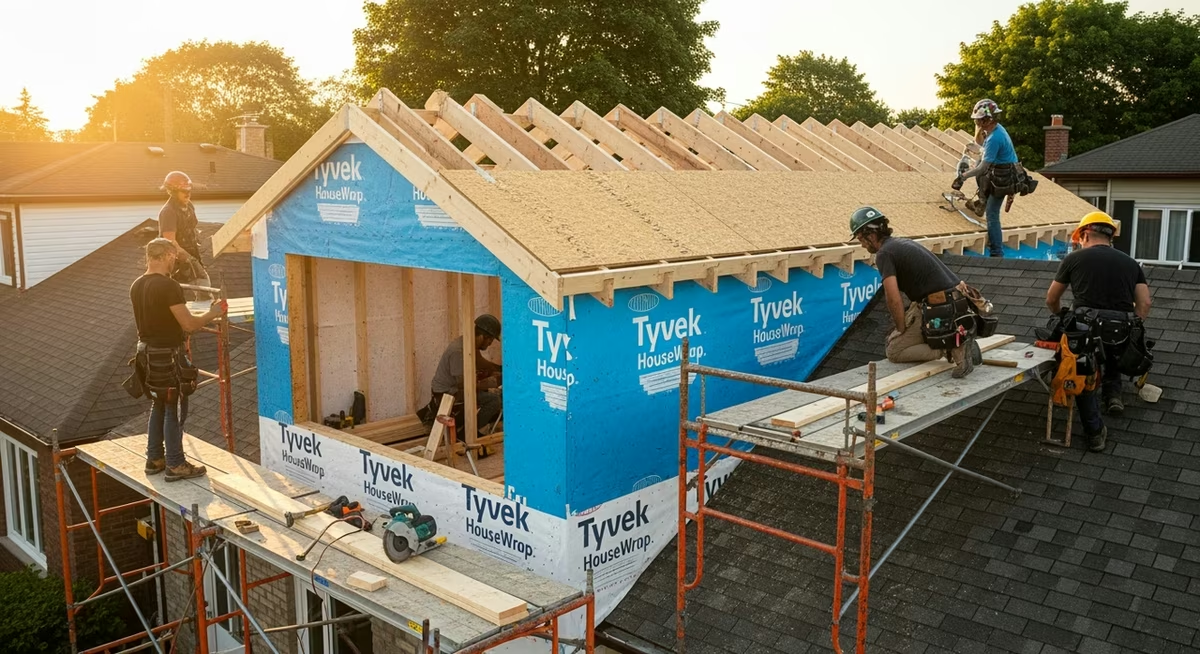
Toronto Chapter 363 building permit is required for every attic conversion. The application includes architectural drawings showing the new floor plan and dormer geometry, structural drawings sealed by a P.Eng., a site plan, and the permit application form. Toronto Zoning Bylaw 569-2013 applies — most attic conversions on existing detached and semi-detached homes do not require a zoning variance because the work stays within the building envelope, but homes with restrictive height limits or in narrow lots may require a Committee of Adjustment variance.
Heritage Conservation District homes (parts of Cabbagetown, Riverdale, Annex, Yorkville, Rosedale, Wychwood Park, and elsewhere) require a Heritage Permit under Section 41/42 of the Ontario Heritage Act. The Heritage Preservation Services staff at Toronto Building review the design for compatibility with the heritage character of the district, often requiring specific cladding materials, window styles, and dormer proportions. Heritage review adds 8 to 16 weeks to the permit timeline.
OBC Part 9 governs the work. Relevant sections include 9.36 (energy efficiency, especially R-60 attic insulation), 9.32 (ventilation, especially HRV/ERV requirements for tight envelopes), 9.25 (vapour and air barriers), 9.10 (fire safety, especially fire-resistance ratings between the new attic space and the floors below), and 9.8 (stairs).
Inspections happen at framing, roofing, insulation, drywall, and final. ESA inspections at electrical rough-in and final. TSSA inspections at gas connection.
Cost factors, dormer types, and scope drivers
The biggest cost drivers on a Toronto attic conversion are existing peak height (homes with 7-foot-6-inch existing peak don't need a dormer at all and land at the floor), dormer type (light finish with no dormer at floor, rear shed dormer mid, front gable dormer or full third-floor master suite premium), the structural reinforcement required for the existing floor framing, whether an ensuite bathroom is included, the depth of HVAC extension (a new mini-split heat pump is often the most efficient option versus extending existing ductwork), and Heritage Conservation District status. A $200,000 to $250,000 project is typically a full third-floor master suite with rear shed dormer, ensuite bathroom, walk-in closet, continuation staircase, and a mini-split heat pump.
On rebates, RenoHouse helps clients access the Canada Greener Homes Loan (up to $40,000 interest-free) for the envelope and mechanical components, Enbridge Home Efficiency Rebate Plus for the insulation and air sealing work, and Save on Energy rebates for any heat-pump or smart-thermostat installation.
Why RenoHouse builds attic conversions across the GTA
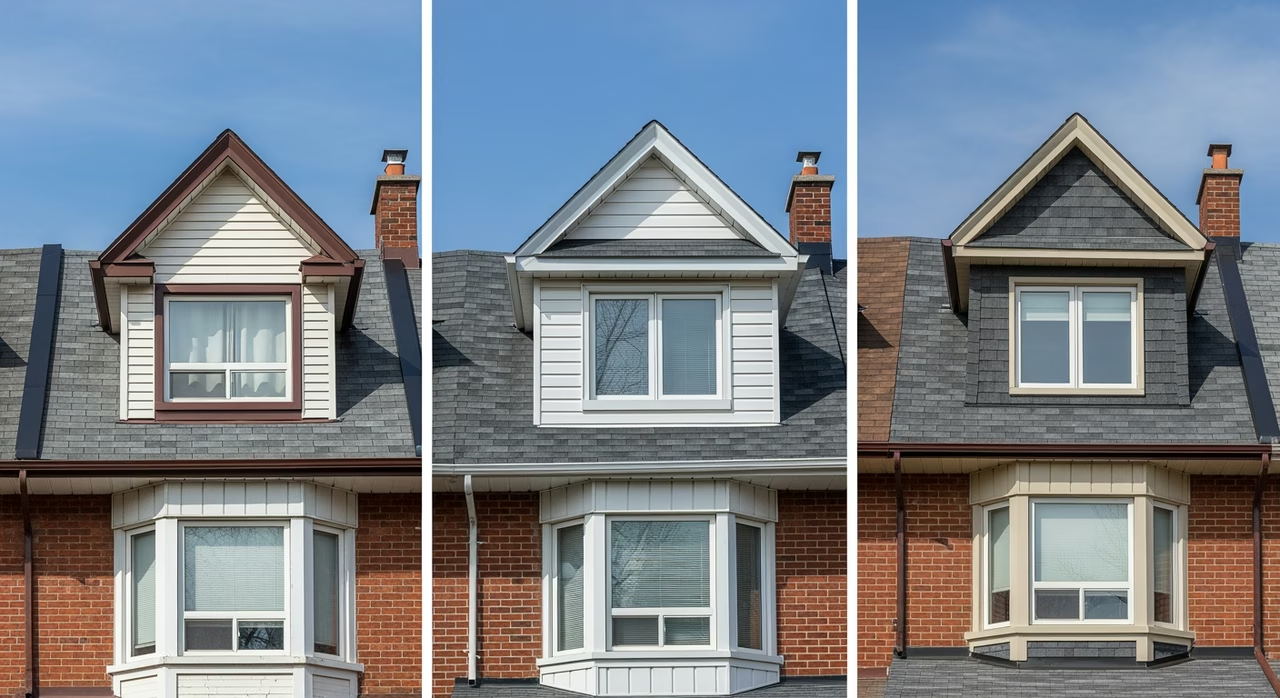
We have completed attic conversions in Toronto (Cabbagetown, Riverdale, Annex, Forest Hill, Lawrence Park, Junction, Bloor West, Leaside, Wychwood Park, North York, Etobicoke, Scarborough), Mississauga, Vaughan, Markham, Richmond Hill, Oakville, Burlington, Aurora, King City, Caledon, and Brampton. Every project carries a $5 million liability policy, full WSIB coverage, a fixed-price written scope with P.Eng. structural review, manufacturer warranties on roofing (typically Owens Corning, IKO, or GAF), windows (typically Pella, Marvin, or Andersen), and insulation, and a two-year workmanship warranty.
Our typical timeline runs 60 days for a light finish attic conversion (no dormer), 90 to 120 days for a rear shed dormer plus full finish, and 120 to 180 days or more for a full third-floor master suite with extensive structural work. Call 289-212-2345 to schedule a feasibility assessment, peak-height measurement, and fixed-price written scope.
Toronto/GTA neighborhood considerations
- Forest Hill / Rosedale / Lawrence Park (heritage): Heritage Permit Section 33 OHA mandatory for any dormer visible from public realm — typically denied on front elevation, approved on rear with matching slate/clay-tile + heritage soffit profile. Pre-1940 attic rafters 2x6 @ 24" o.c. — insufficient for habitable floor load (40 psf LL per OBC 9.4.3.1); structural reinforcement $9K-$18K added. Total dormer add $90K-$180K.
- North York / Scarborough / Etobicoke (60s-70s): 1960s-70s 1.5-storey postwar — ideal candidate for full shed dormer rear elevation. Typical scope: shed dormer + 2 windows + 1 bedroom + 1 4-pc bath + dormer width 18-24 ft = $60K-$110K. Permit Toronto 569-2013 zoning bylaw setback compliance + OBC 9.36.5 effective thermal resistance (RSI 8.81 ceiling).
- Mississauga / Brampton / Vaughan (90s+): Engineered truss roofs in 90s+ stock — dormer requires truss-modification by PEng (Truss Modification Drawing TMD); cost $1.2K-$2.8K plus structural cost $14K-$32K added. Best ROI: convert pre-roughed-in attic loft (45% of 90s subdivisions had attic-rough-in built standard).
- Caledon / King City / Aurora (rural large-lot): Estate-grade dormer additions — slate/copper roofing match + 2-3 dormers (eyebrow, shed, gable mix). Septic system review by ECA Part 8 if bedroom count rises — $1.2K-$3.4K septic upgrade common. Total $140K-$340K.
- Downtown condos: N/A (no attic conversions in high-rise concrete-slab construction).
Permits + standards: OBC 9.7 Windows (dormer minimum 0.35 sqm openable for egress where bedroom), 9.10.19 Smoke Alarms (interconnected hardwired + battery backup), 9.36 Energy (RSI 8.81 ceiling, RSI 4.31 wall framed cavity insulation), 9.32 Ventilation (mechanical heat-recovery ventilator HRV required for any new bedroom > 1 sleeping room per dwelling). Toronto Heritage Permit Section 33 OHA if HCD.
Why Choose RenoHouse?
Same-Day Service Available
We respond quickly to attic conversion & dormer addition requests. Most projects start within 24-48 hours of your call.
Licensed Professionals
Every technician on our team is fully licensed, insured, and background-checked. We maintain strict quality standards on every job.
Upfront Pricing
Honest quotes for attic conversion & dormer addition with no surprises. Free estimates, flexible payment options.
Sound Familiar?
These are the most common problems our clients face.
Pre-1940 Beaches/Junction/Mimico 1.5-storey with usable but un-headroom attic?
Need a third bedroom or home office and don't want to lose backyard for an addition?
Confused about rear shed dormer (as-of-right) vs front gable dormer (Committee of Adjustment)?
Heritage Conservation District home and worried about Heritage Permit timelines?
Vermiculite (Zonolite) attic insulation and need Reg 278/05 Type 2 abatement before framing?
Want a third-floor master suite with ensuite but staircase location is the limiter?
Ready to get started?
Free estimate, no obligation. We respond within 1 hour.
What Our Clients Say
“RenoHouse replaced all our windows in just two days. The new windows are beautiful, energy-efficient, and the team left everything spotless. Highly recommend!”

Michael R.
Oakville
“New windows transformed our home. Quieter, warmer, and our energy bill dropped noticeably. Excellent installation crew.”

David K.
Vaughan
“Professional from start to finish. They replaced 8 windows in one day and cleaned up perfectly. Highly recommend RenoHouse!”

Sandra W.
Burlington
Our Attic Conversion & Dormer Addition Work
Professional attic conversion & dormer addition results from RenoHouse projects across the Toronto GTA.
Attic Conversion & Dormer Addition
Toronto GTA
Quality Workmanship
Licensed & Insured
Like what you see? Let's talk about your project.
🧮 Attic Conversion & Dormer Addition — Cost Estimator
GTA / Ontario — 2026 market pricing
⚙️ Add-ons & Options
💰 Subsidies & Rebates Available
Subsidies require eligibility verification, pre/post audits, and proper documentation. Stacking rules apply.
📊 Where the cost goes (typical breakdown)
📋 What affects your price:
💡 Estimates use 2026 GTA/Ontario market data. Actual cost depends on site conditions, material selections, and project scope. Book a free in-home quote for a precise number.
Frequently Asked Questions About Attic Conversion & Dormer Addition
Light attic finish (no dormer, existing 7'6"+ peak): $40,000–$70,000. Rear shed dormer + finish: $80,000–$130,000 typical Toronto semi. Front gable dormer + finish: $100,000–$160,000. Full third-floor master suite with rear shed dormer, en-suite, walk-in closet, and staircase upgrade: $150,000–$200,000+. Includes design, PEng structural, permits, framing, R-60 insulation, electrical, drywall, flooring, paint, trim. Excludes any second-storey load-path reinforcement triggered by added dead load.
Ontario Building Code Section 9.5 requires habitable rooms to have minimum 2.30 m (7'6") clear ceiling height over at least 50% of the required floor area, with the rest allowed to slope down to 1.40 m (4'7") at the perimeter. Glazing 5% of floor area, 2.5% openable. A bedroom requires an OBC 9.9.10 egress window — typically achieved through the new dormer. Most pre-war Toronto attics need a dormer to hit the 50%/7'6" rule. We assess feasibility at the site visit.
Rear shed dormers (added to the back roof slope) are usually approvable as-of-right under Toronto zoning bylaw 569-2013 — they don't change the streetscape and rarely encroach into yards. Front gable dormers (visible from the street) often trigger Committee of Adjustment or Heritage Permit because they alter heritage-character frontage. In Heritage Conservation Districts (Cabbagetown, Riverdale, Annex, Wychwood, parts of the Beaches) any visible exterior change needs a Heritage Permit (8–16 weeks). We default to rear shed dormers when the layout supports it.
No. Attic conversions with a dormer are structural work that requires a Professional Engineer (PEng) of record — a licensed Ontario structural engineer who sizes the new dormer header, designs any floor-framing upgrades, and signs sealed drawings. RenoHouse does NOT employ a PEng — we coordinate named partner firms (Glogowski Engineering, Cunningham + Rivard, BGE, or similar; typical fee $3,500–$8,000). RenoHouse holds the construction contract and runs the project end-to-end.
Front-yard dormers, dormers that exceed zoning side-yard projections, increased height, or any massing change in a Heritage Conservation District typically trigger Committee of Adjustment review or Heritage Permit. Adds 8–16 weeks. Pure rear shed dormers within the existing roof footprint are usually approvable as-of-right under Bylaw 569-2013. We screen for triggers at the design stage and tell you honestly which path your project is on.
Almost always yes for pre-1980 Toronto houses. Ontario Regulation 278/05 mandates a Designated Substance Survey (DSS) before renovation/demolition that may disturb materials in any pre-1990 building. The most common attic finding is vermiculite insulation (Zonolite-era) which contains tremolite asbestos and requires Type 2 abatement before framing. Pipe wrap on old steam/hot-water lines and vinyl floor tile under existing finished sections are also common. We coordinate DSS and abatement with HCRA-licensed firms; we do NOT remove asbestos in-house.
Design + permit phase: 8–14 weeks (longer if Committee of Adjustment or Heritage Permit applies). Construction (rear shed dormer + finish): 10–14 weeks. Construction (full third-floor master suite with en-suite): 14–20 weeks. Total clock: 20–30 weeks contract-to-occupancy for typical Toronto semi; 30–45 weeks if heritage permits or Committee of Adjustment apply. Inspections (rough framing, electrical, plumbing, insulation, final) add scheduling holds.
Most pre-war Toronto homes have steep, narrow main staircases that don't extend up to the attic. Code-compliant access to the new attic floor typically requires either (a) a new straight-run continuation, (b) an L-shaped landing eating some second-floor closet space, (c) a winder turn, or (d) a spiral (OBC 9.8 restricts spirals to secondary egress). Stair design is one of the trickiest parts of an attic conversion in tight semis. We work through layout at the design stage and tell you honestly when the stair is the limiting factor.
Strongly recommended. Drywall, electrical, paint, hardwood refinish, and HVAC duct extension to the new floor sequence cleanly with main-floor or whole-home renovations. Stand-alone attic projects run 25–35% more expensive than the same scope bundled into a fuller renovation because of duplicated mobilization, separate permits, and a second drywall/paint cycle. We help you scope the bundle when a full-home reno is in the plan.
Current OBC SB-12 requires R-60 in new sloped ceilings and any new flat-ceiling sections — typically achieved with closed-cell spray foam to R-30 against the roof deck plus R-30 batt below to limit thermal bridging, or with full-fill open-cell foam to ~R-50 plus a continuous interior insulation layer. Vapour and air barrier continuity is critical at the new floor-to-knee-wall and knee-wall-to-roof transitions. Mechanical ventilation (HRV) is increasingly required when the new floor pushes the building below 1.5 ACH50 — we coordinate during the design stage.



You Might Also Need
Customers who looked at attic conversion & dormer addition also asked us about these complementary services.


We Serve All GTA
Professional attic conversion & dormer addition services available across the Greater Toronto Area.
“Renovated our entire main floor — kitchen, living room, flooring, paint, lighting. They coordinated everything perfectly. One contractor for the whole project.”
— Anthony G., North York
Get a Free Attic Conversion & Dormer Addition Estimate
Contact us today for a free, no-obligation quote for your attic conversion & dormer addition project in Toronto GTA. We'll get back to you within 1 hour.