RenoHouse

# Acoustic Treatment vs Soundproofing Toronto: The Difference 2026
Quick answer. The single biggest source of wasted money in residential acoustics in 2026 is the confusion between soundproofing and acoustic treatment. These are two completely different problems with two completely different solutions, and most homeowners — and a surprising number of contractors — use the terms interchangeably.The single biggest source of wasted money in residential acoustics in 2026 is the confusion between soundproofing and acoustic treatment. These are two completely different problems with two completely different solutions, and most homeowners — and a surprising number of contractors — use the terms interchangeably. The most common form of the confusion is gluing acoustic foam panels to a bedroom wall and being surprised that it does not stop the upstairs neighbour's footsteps. The foam works exactly as designed; it just was never designed for that problem.
This post sorts out the distinction with Toronto-specific examples for 2026, covers what each one actually does, and gives the budget split for projects that legitimately need both. For pillar context see Acoustic Soundproofing Renovation Toronto.
Honest Positioning
Standard renovation and finishing work. Both soundproofing and acoustic treatment use mainstream construction materials. RenoHouse coordinates both as part of a unified scope where they apply.
The Two Problems
Soundproofing = preventing sound from passing through a wall, floor, or ceiling between rooms. The goal is isolation. The metric is STC (airborne) and IIC (impact). The solution is mass + decoupling + damping + sealing — the wall itself becomes acoustically opaque.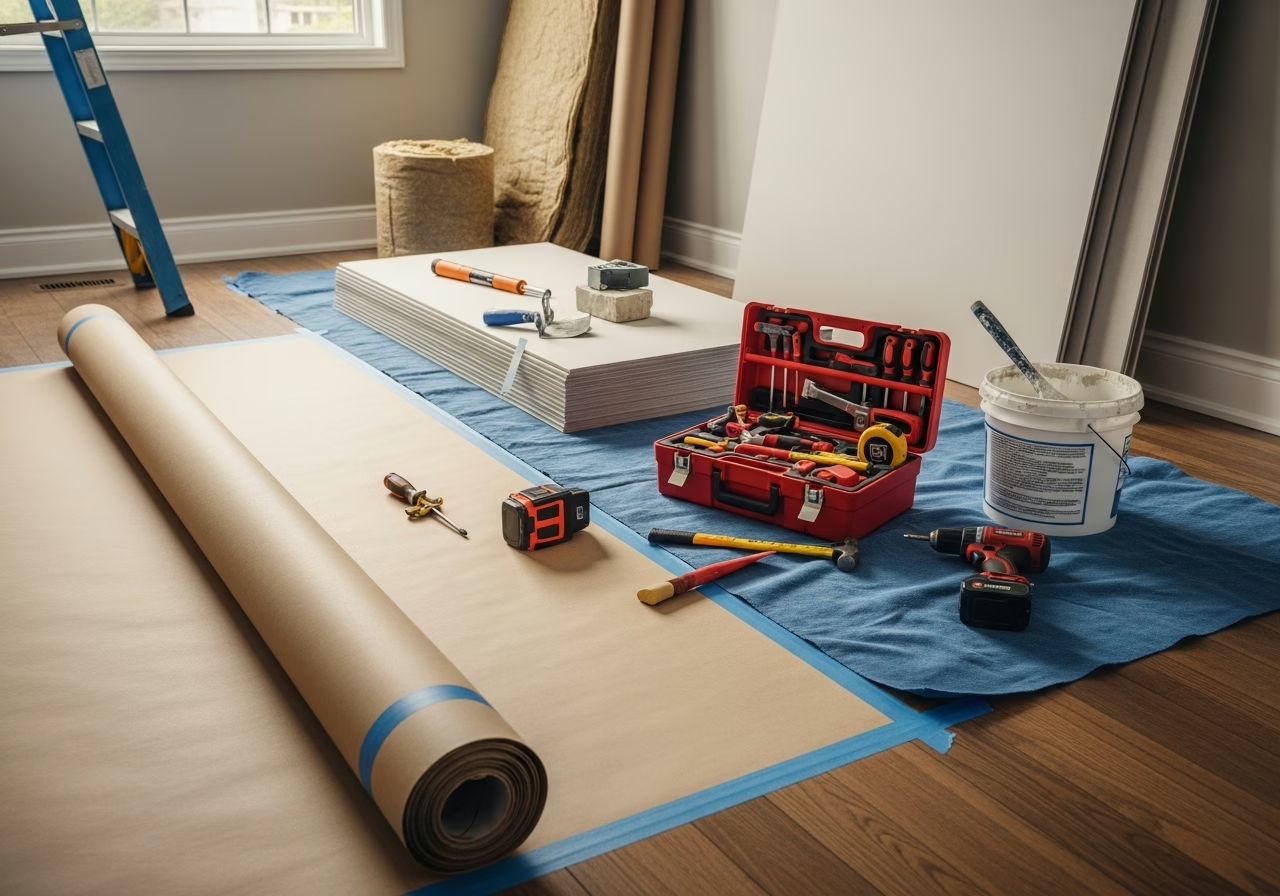
These are different physics. A wall can be excellent at soundproofing (STC 60+) and terrible at acoustic treatment — a heavy, hard, reflective wall blocks transmission to the next room and bounces every sound back into the room of origin. A wall can be excellent at acoustic treatment (high NRC) and terrible at soundproofing — a thin foam-paneled wall absorbs sound on the surface but lets the rest pass through.
What Each Looks Like in a Toronto Home
Soundproofing scopes (block transmission to/from another room):
- Condo upstairs neighbour problem.
- Multiplex demising walls (OBC 9.11 STC 50).
- Bedroom backing onto living room.
- Home theatre keeping sound inside the room.
- Recording studio keeping outside sound out.
- Traffic-facing window upgrade.
Solutions: stone wool insulation in the cavity, double drywall with Green Glue, AcoustiClips for decoupling, Mass Loaded Vinyl, gasketed electrical boxes, sealed perimeter, solid-core doors with seals, triple-pane laminated windows. See pillar.
Acoustic treatment scopes (improve room sound quality):
- Home theatre with echo and slap-back.
- Recording or podcast room with boomy or harsh sound.
- Open-concept living room with hard surfaces causing harsh reverberation.
- Restaurant-like echo in a Toronto loft conversion.
- Zoom-call room where the microphone picks up too much reverb.
Solutions: acoustic foam panels (broadband absorbers), rockwool absorbers in fabric-wrapped frames, bass traps in corners, diffusers (BAD panels, QRD diffusers), upholstered furniture, area rugs, heavy curtains. None of these block sound to the next room — they only absorb energy that was going to bounce off the surface back into the room.
The Material Confusion
Acoustic foam panels (the wedge-shape, pyramid-shape, or eggcrate panels you see in YouTube studio setups) are absorption panels, not soundproofing panels. Their job is to absorb mid-and-high-frequency reflections inside a room. Their NRC (Noise Reduction Coefficient) is typically 0.7-0.9, meaning 70-90% of incident high-frequency sound is absorbed.
Need professional home renovation?
Call RenoHouse at 289-212-2345 or get a free estimate today.
Get Free Estimate →What they do not do: block sound from passing through to the next room. The mass of a 2-inch foam panel is roughly 0.05 lb/sqft. A wall needs 5-10 lb/sqft to deliver STC 50. The foam panel is 100x too light to be a soundproofing element.
The branding does not always make this clear. Many products are marketed with phrases like "soundproof your room" when what they actually do is reduce echo. The honest test: if the product is light, soft, and porous, it is absorption (acoustic treatment). If it is heavy, dense, and limp (mass loaded vinyl, double drywall sandwiches, lead sheets), it is mass for soundproofing.
When You Need Both
A home theatre legitimately needs both:
- Soundproofing to keep the action movie inside the theatre. Tier 3 room-within-room construction. See Home Theatre Soundproofing Toronto.
- Acoustic treatment to make the theatre sound clean inside. Bass traps in corners, broadband absorbers at first-reflection points, diffusers on the back wall.
A serious recording or podcast space needs both. A condo bedroom usually only needs soundproofing — it is already small and full of soft furnishings, the inside-the-room sound quality is fine. A traffic-facing home office needs primarily soundproofing (window + door + HVAC) — the inside acoustic is rarely the issue.
Budget Allocation for Combined Scopes
For a 10x14 home theatre with a $50,000 acoustic budget, a typical split:
- Soundproofing (room-within-room construction): $35,000-45,000 (70-85% of budget). This is the heavy infrastructure work.
- Acoustic treatment (panels, bass traps, diffusers): $5,000-15,000 (10-25% of budget). Done after the soundproofing shell is complete.
- Acoustic measurement and tuning: $1,000-3,000 (rare; usually done by the AV integrator).
The order matters: do the soundproofing first as part of the construction phase, then add acoustic treatment as a finishing layer once the room is closed in. Treatment installed before soundproofing is often torn out during the soundproofing work.
For a Zoom-call home office, the split flips:
- Soundproofing (door, HVAC silencer, gasketed boxes): $1,500-3,000 (60% of budget).
- Acoustic treatment (a few absorber panels behind the camera, area rug, soft curtain): $500-1,500 (20-30% of budget).
- Microphone/headset upgrade: $200-1,000 (10-15% of budget). Often the cheapest meaningful improvement to a Zoom call.
What Acoustic Treatment Looks Like Done Right
For a small-to-medium Toronto room (home office, podcast room, listening space):
- Bass traps in two corners (preferably opposite corners): 4-inch rockwool in fabric frames, ~$300-600 each. Addresses room modes below 200 Hz.
- First-reflection absorbers on the side walls at the listener's level: 2-inch acoustic panels, ~$150-300 each. Addresses early reflections that smear stereo image.
- Ceiling cloud above the listener: 2-4 inch panel suspended 2-4 inches off the ceiling, ~$300-600. Addresses ceiling slap.
- Back-wall absorbers or diffusers: 2-inch absorber or commercial diffuser, ~$200-800 per panel.
Total acoustic treatment for a small room: $1,500-4,000. Total for a serious home theatre or recording space: $5,000-15,000.
These are NOT a substitute for any soundproofing. They are an addition.
What to Skip
- Egg-crate mattress foam marketed as acoustic treatment. Cheap, ineffective at low frequencies, looks bad, fire-hazard.
- Acoustic foam glued directly to a wall as a "soundproofing" measure. Foam doesn't block transmission.
- Acoustic curtains marketed as soundproofing. Marginal absorption, no transmission benefit.
- Custom foam art panels that prioritize aesthetics over acoustic performance. The shape matters less than the material density and thickness.
Next Step
If your problem is sound from another room (upstairs neighbour, party wall, adjacent unit), you need soundproofing — start with the pillar Acoustic Soundproofing Renovation Toronto and the relevant cluster post.
If your problem is room sound quality (echo, harshness, boom), you need acoustic treatment — typically a smaller scope that RenoHouse handles as a finishing add-on or as part of a home theatre buildout.
If you have both problems, the soundproofing scope comes first, and the treatment is added after the room is closed in. Book a scoped consultation through the home renovation service page, or read sibling posts Home Theater Soundproofing Toronto, Home Office Soundproofing Toronto Zoom, and Soundproofing Mistakes Toronto Renovation.
Sources & References
Authoritative sources cited in this guide:
- Ontario Building Code — OBC official text
- Toronto Building Permits — City permit portal
- Tarion New Home Warranty — Ontario new-build warranty regulator
- HCRA — Home Construction Regulatory Authority — Ontario builder/vendor licensing
Continue Reading