RenoHouse

# Attic Conversion Toronto 2026: Complete Guide for 1.5-Storey Homes
Quick answer. If you live in a Toronto 1.5-storey house — the small dormered cottages and Cape Cod-style homes that fill the Beaches, the Junction, Mimico, East York, Riverdale, and parts of Cabbagetown — you're sitting on the single most under-used renovation opportunity in the city.If you live in a Toronto 1.5-storey house — the small dormered cottages and Cape Cod-style homes that fill the Beaches, the Junction, Mimico, East York, Riverdale, and parts of Cabbagetown — you're sitting on the single most under-used renovation opportunity in the city. The half-storey under your roof is usually framed as living space, but in most pre-1960 homes it was finished only as a low-ceiling bedroom or storage area. With a properly engineered shed dormer, full-depth insulation, and an Ontario Building Code (OBC) compliant stair, you can turn that 400 to 700 square feet into a master suite, a home office plus bathroom, or a teenager's retreat — without buying more land and without going through a full second-storey addition.
In 2026, a typical Toronto attic conversion runs $120,000 to $200,000 for a full master suite with a shed dormer, depending on the size of the dormer, the complexity of the structural beam, the ensuite scope, and whether you're inside a Heritage Conservation District. Smaller scope-only conversions — finishing what's already there with new flooring, drywall, and a knee-wall storage system — can be done for $40,000 to $70,000 if the existing roof structure already gives you legal headroom.
This is RenoHouse's pillar guide for 2026 attic conversions in Toronto. We'll cover real CAD pricing, the three dormer types (shed, gable, eyebrow), OBC 9.9.10 egress requirements, headroom rules, stair geometry, the structural-engineer requirement, Toronto Building Permit process, Heritage Conservation District restrictions, asbestos screening, insulation strategy, ROI on resale, and how to decide between an attic conversion and a full second-storey addition.
If you're cost-shopping, jump to Attic Conversion Cost Toronto: Full Comparison or Dormer Addition Cost Toronto by Type. If you're choosing dormer geometry, see Shed vs Gable vs Eyebrow Dormer: Toronto Comparison. For permits specifically, jump to Attic Conversion Permits Toronto: Process Step-by-Step.
Why 1.5-Storey Toronto Homes Are Prime Candidates
Toronto's 1.5-storey housing stock is concentrated in five neighbourhoods that share the same building era and roof typology:
- The Beaches. Hundreds of cottage-style homes from the 1910s to 1940s with steep front-gable roofs. Most have unfinished or semi-finished attics with 1.5m to 1.8m of central headroom — short of the 1.95m OBC habitable minimum without a dormer.
- The Junction and Junction Triangle. Workers' cottages and small two-bedroom homes from the 1900s to 1930s. Narrow lots, but generous attic depth front-to-back.
- Mimico and New Toronto. Postwar bungalows and 1.5-storey homes with simple gable roofs. Excellent shed-dormer candidates because the roof slope is uncomplicated by valleys or hips.
- East York (Pape Village, Topham Park, Woodbine Heights). Late-1940s and 1950s 1.5-storey homes with finished but tight attics. Most need a rear shed dormer to hit habitable headroom over more than 50% of the floor area.
- Riverdale and Cabbagetown. Older Edwardian and Victorian homes with steeper roofs but smaller footprints. Cabbagetown is partly inside a Heritage Conservation District (HCD), which adds a Heritage Permit step before a Building Permit can be issued.
What these homes share: a roof with enough rise to capture meaningful floor area once a dormer pushes the wall plate up, an existing stair location (even if the stair geometry needs to be replaced), and a footprint that already meets zoning, so the conversion is "within the existing envelope" plus a dormer rather than a full addition.
What an Attic Conversion Actually Includes
A real Toronto attic conversion is far more than drywall and flooring. A complete 2026 scope includes:
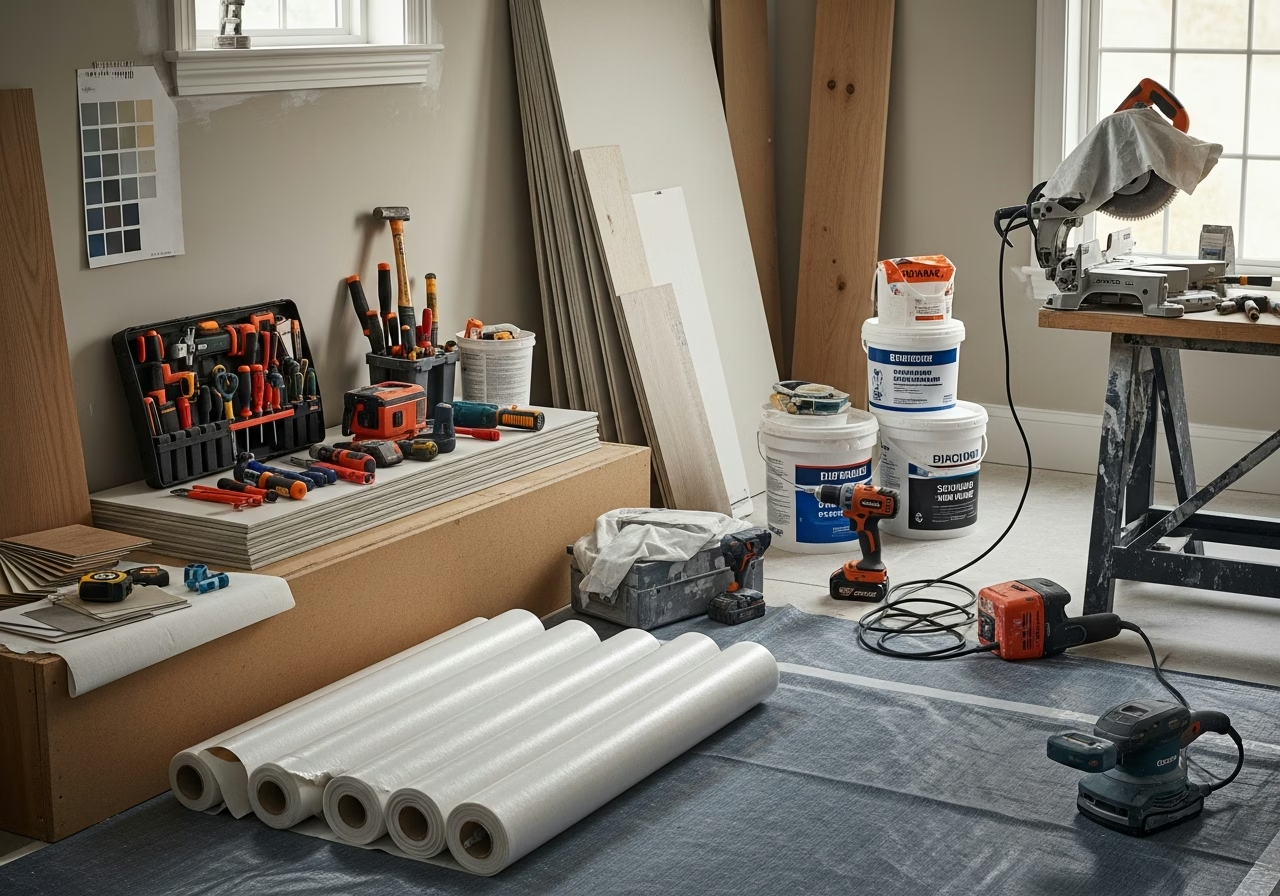
- Pre-work inspection. Asbestos testing of any pre-1990 vermiculite or pipe-wrap, knob-and-tube wiring assessment, roof-deck moisture and rot check, structural assessment of existing rafters and ceiling joists.
- Structural engineering. A licensed Professional Engineer (P.Eng) must design and stamp the beam that supports the new dormer ridge and wall plate, plus any reinforcement of existing ceiling joists that will become the new floor system. This is non-negotiable for any Toronto Building Permit involving a dormer.
- Permit drawings. Architectural drawings showing existing and proposed plans, sections, elevations, OBC 9.9.10 compliance (egress window or skylight), stair geometry, and headroom diagrams.
- Building Permit. Issued by Toronto Building under OBC Part 9. Plan-review timelines run 4 to 10 weeks in 2026 depending on the district office.
- Heritage Permit (if applicable). Required for exterior alterations in a Heritage Conservation District. Cabbagetown North and South, Old Riverdale, Wychwood Park, and Casa Loma HCDs all require Heritage Preservation Services review before a Building Permit can be issued. See Dormer Heritage Permit Toronto: HCD Restrictions.
- Demolition. Strip existing attic finishes, remove old insulation, expose framing.
- Structural work. Cut roof opening for dormer, install P.Eng-stamped beam, frame dormer walls and roof, sister or replace floor joists.
- Roof and envelope. New roof shingles or membrane on dormer, new sheathing and vapour-permeable membrane on dormer walls, integration with existing siding.
- Egress. A new operable window or skylight that meets OBC 9.9.10.1 — minimum 0.35 m clear opening area, no dimension less than 380 mm, sill no higher than 1.5 m above the floor.
- Insulation. R60 in the dormer roof and any flat ceiling, R31+ in the sloped ceiling cavities (with continuous exterior or interior rigid foam to compensate for thinner rafters), R24 in the knee walls.
- Mechanicals. New HVAC supply and return for the new floor (the existing furnace usually has spare capacity for one floor's worth of new load), new electrical sub-panel feeders if needed, new plumbing rough-in for ensuite.
- Stair. Legal residential stair: 200 mm rise maximum, 220 mm tread minimum, 860 mm minimum width, headroom 1.95 m measured plumb above the nosing line. Pull-down ladder stairs are not legal for habitable space — see Attic Stairs vs Pull-Down: Toronto Code Comparison.
- Finishes. Drywall, trim, flooring, paint, doors, ensuite tile, vanity, fixtures.
- Final inspection. Toronto Building inspector verifies framing, insulation, plumbing, electrical, and final occupancy.
OBC 9.9.10 Egress and Headroom: The Two Rules That Kill Marginal Conversions
Two OBC rules decide whether your attic can become a legal bedroom or office:
Headroom (OBC 9.5.3). A habitable room requires 1.95 m (6'5") of clear headroom over at least 50% of the required floor area, measured to the lowest point of the finished ceiling. In a 1.5-storey Toronto home with an unmodified roof, you typically have 1.95 m only along a narrow ridge band. Without a dormer, the qualifying floor area is usually too small to count as a bedroom. A shed dormer running 60% of the rear roof slope will often get you to 70 to 85% qualifying floor area. Egress (OBC 9.9.10). Every bedroom must have a window or door that allows escape in a fire. The window must have an unobstructed opening of at least 0.35 m squared, with no dimension less than 380 mm, and a sill no higher than 1.5 m above the floor. Skylights can satisfy egress if they meet the same opening dimensions and are reachable. In a dormered attic, the dormer window itself usually serves as the egress — design the dormer width with this in mind.For a deeper walk-through of the bedroom rules specifically, see Attic Bedroom Conversion: OBC 9.9.10 Compliance.
The Three Toronto Dormer Types
Shed Dormer — $15,000 to $30,000
A shed dormer has a single flat or low-slope roof. It's the workhorse of Toronto attic conversions because it adds the most usable floor area per dollar. A shed dormer runs the length of the rear roof slope, pushing the rear wall plate up to roughly 2.4 m, which gives you full standing headroom across most of the new room. Simple framing, simple roofing, and the only structural complexity is the new ridge beam that carries the existing roof load above the cut.
Best for: Master suites, large home offices, or any conversion where usable floor area matters more than street-side aesthetics. Typically built on the rear of the home so it's invisible from the street, which keeps Heritage Conservation District reviews simpler.Gable Dormer — $20,000 to $40,000
A gable dormer has a peaked roof matching the slope of the main house roof. It's the traditional aesthetic choice and is usually what's required when the dormer faces the street in a Heritage Conservation District. Gable dormers add less floor area than shed dormers because the side walls follow the gable, so usable space is narrower. Toronto homes often use two or three gable dormers across a front roof rather than one wide shed dormer.
Best for: Front-facing dormers in HCDs, traditional Edwardian or Victorian homes where street-side appearance matters, or any project where the look of the house must remain consistent with neighbours.Eyebrow Dormer — $30,000 to $60,000
An eyebrow dormer has a curved roof that arcs out of the main roof slope without a vertical wall. It's an architectural feature, not a space-maximization tool — eyebrow dormers add minimal floor area and are chosen for visual softness and curb appeal. Custom curved framing and curved roofing make them the most expensive dormer type per square foot of new floor area.
Best for: Heritage homes where a flat-faced dormer would clash with the existing architecture, or premium custom builds where the eyebrow becomes a signature design element.For a side-by-side comparison including framing, roofing complexity, and resale impact, see Shed vs Gable vs Eyebrow Dormer: Toronto Comparison.
Need professional home renovation?
Call RenoHouse at 289-212-2345 or get a free estimate today.
Get Free Estimate →The Three Toronto Conversion Tiers
Tier 1: Cosmetic Conversion (No Dormer) — $40,000 to $70,000
If your existing attic already has 1.95 m headroom over 50% of the floor area (rare, but possible in homes with very steep roofs), you can do a cosmetic conversion: new flooring, drywall, insulation upgrade, electrical, an OBC-compliant stair if the existing one is non-compliant, and an egress window in an existing gable end. No dormer, no P.Eng beam.
Realistic for: Homes with steep 12/12 or steeper roofs and at least 1.5 m wall plates. Most Toronto 1.5-storey homes do not qualify and need at least one dormer.Tier 2: Single Shed Dormer Master Suite — $120,000 to $170,000
The Toronto sweet spot. A 6 to 9 m wide shed dormer across the rear roof, full insulation upgrade, new stair, master bedroom, ensuite (3-piece or 4-piece), and walk-in closet. P.Eng beam, full Building Permit, no Heritage Permit (rear-only, not visible from street).
Tier 3: Full Attic Suite with Multiple Dormers — $170,000 to $230,000
Two shed dormers (one rear, one side) or one shed plus one or two front gable dormers. Adds a second bedroom, larger ensuite, possible second bathroom, and home office. May require Heritage Permit if any dormer is visible from the street and the home is in an HCD. Often combined with a structural reinforcement of the existing second-floor ceiling joists to handle the new live load.
For a tier-by-tier cost breakdown, see Attic Conversion Cost Toronto: Full Comparison.
Permits, Engineering, and Honest Positioning
Three professionals are non-negotiable for a Toronto attic conversion with a dormer:
- 1. Architect or BCIN-qualified designer — produces the permit drawings.
- 2. Professional Engineer (P.Eng) — designs and stamps the structural beam supporting the new dormer ridge, plus any floor joist reinforcement. This is required by Toronto Building any time you cut into a load-bearing roof structure.
- 3. General Contractor with Toronto experience — handles the permit submission, scheduling, and trades coordination.
You will need a Toronto Building Permit. If your home is inside a Heritage Conservation District (Cabbagetown North, Cabbagetown South, Old Riverdale, Wychwood Park, Casa Loma, and several smaller HCDs), you will also need a Heritage Permit before the Building Permit can be issued. Heritage Preservation Services typically reviews exterior alterations within 6 to 12 weeks. For HCD-specific guidance, see Dormer Heritage Permit Toronto: HCD Restrictions.
Before any demolition, always test for asbestos. Pre-1990 Toronto attics commonly contain vermiculite insulation (which may be Zonolite-brand and contaminated with tremolite asbestos), asbestos pipe-wrap on old plumbing risers, and asbestos-containing ceiling textures. A two-sample test runs $300 to $500 and takes 2 to 3 business days. Disturbing asbestos without proper Type 2 abatement is a Ministry of Labour offence and a serious health risk. For full abatement guidance, see our pillar Asbestos Abatement Toronto 2026 Complete Guide.
Insulation: R60 Roof, R31+ Sloped, R24 Knee Walls
Insulation in an attic conversion is harder than a flat-attic top-up because most of the new ceiling is sloped or kneewalled. The 2026 OBC and energy code targets:
- Flat ceiling areas (under the dormer roof and any remaining flat ceiling): R60.
- Sloped ceiling cavities (between rafters): R31 minimum, often achieved with R24 closed-cell spray foam plus a continuous interior layer of rigid foam to address thermal bridging through the rafters.
- Knee walls (the short vertical walls between the floor and the sloped ceiling): R24 with continuous rigid foam on the cold side.
- Floor over unconditioned space (if any portion of the new floor sits over unheated space): R31.
Most Toronto attic conversions use closed-cell spray foam in the sloped cavities (it acts as both insulation and air barrier in one product), blown cellulose or fiberglass in the flat dormer ceiling, and batt-plus-rigid in the knee walls. For deep coverage of insulation strategy specifically, see Attic Insulation During Conversion: Toronto Strategy. For the broader attic insulation context, see our pillar Attic Insulation Toronto 2026.
Stairs: Get the Geometry Right
The OBC residential stair rules for habitable space:
- Maximum rise per step: 200 mm (7-7/8")
- Minimum tread depth: 220 mm (8-5/8")
- Minimum stair width: 860 mm (34")
- Minimum headroom: 1.95 m measured plumb above the nosing line
- Handrail required on at least one side, 865 to 1070 mm above nosing
- Maximum 14 risers between landings
Pull-down attic ladders are explicitly not permitted for access to habitable rooms — they're allowed only for access to unfinished storage attics. Spiral stairs are permitted only as a secondary egress, never as the primary stair to a bedroom. For the full comparison, see Attic Stairs vs Pull-Down: Toronto Code Comparison.
Common Mistakes That Cost Toronto Homeowners
The five most expensive mistakes we see in Toronto attic conversions:
- 1. Skipping the asbestos test. A demo crew rips out vermiculite, contaminates the entire house, and the homeowner pays $20,000 to $40,000 in emergency Type 3 abatement plus relocation costs.
- 2. Designing a dormer without a P.Eng. Permit gets rejected, designer redoes drawings, project loses 8 to 12 weeks.
- 3. Forgetting the Heritage Permit. Homeowner submits a Building Permit application, gets a 6-week wait, then learns the property is in an HCD and needs Heritage review first. Adds 2 to 4 months.
- 4. Insulating without addressing thermal bridging. Sloped ceilings get R20 between 2x6 rafters, the rafters themselves bridge cold to the interior, and condensation forms inside the assembly. Result: hidden mold within 3 to 5 years.
- 5. Ignoring the existing floor joists. The pre-1960 ceiling joists below your attic were sized for an attic load (0.5 kPa), not a bedroom load (1.9 kPa). Without sister joists or replacement, the floor sags and bounces. P.Eng review catches this; non-engineered conversions don't.
For a longer list with case examples, see Attic Conversion Mistakes Toronto.
ROI on Resale
Toronto Real Estate Board data and our own client outcomes from 2022 to 2025 suggest attic conversions return 65% to 85% of cost on resale, with several adjustments:
- Master suite conversions in Beaches, Riverdale, and East York achieve 75% to 90% recovery.
- Bedroom-only conversions without ensuites recover 55% to 70%.
- Heritage-district conversions with proper permits recover at the high end of the range because buyers value documentation.
- Unpermitted conversions can actively reduce home value because buyer's lawyers and home inspectors flag them — count on a 5% to 10% price hit plus a "remove or legalize" condition.
For tier-by-tier ROI math, see Attic Conversion ROI Toronto: Resale Analysis.
Attic Conversion vs Second-Storey Addition
If you need significantly more space than an attic can provide, a full second-storey addition may be the better choice. Quick decision matrix:
- Attic conversion wins when: you need 400 to 700 sqft of new space, the existing roof has reasonable rise, you want minimal disruption to the lower floors, your budget is $120K to $230K, and you're not adding bedrooms beyond one or two.
- Second-storey addition wins when: you need 800 to 1,400 sqft of new space, you want to redesign the second floor entirely, you need three or more new bedrooms, and your budget is $400K to $800K+.
For the full decision framework, see Attic Conversion vs Second-Storey Addition: Toronto Comparison.
Cross-Cutting Trades
An attic conversion typically intersects with three other RenoHouse pillar topics:
- Load-bearing wall removal. If the conversion changes the second-floor layout to accommodate the new stair, you may need to remove a load-bearing wall on the floor below. See Load-Bearing Wall Removal Toronto 2026 Complete Guide.
- Asbestos abatement. Triggered by any pre-1990 attic with vermiculite, pipe-wrap, or textured ceilings. See Asbestos Abatement Toronto 2026 Complete Guide.
- Attic insulation. Even after a conversion, the remaining unconverted attic space (if any) and the new dormer assemblies need proper R-value. See Attic Insulation Toronto 2026.
Next Steps
If you own a 1.5-storey home in the Beaches, Junction, Mimico, East York, Riverdale, or Cabbagetown and you're considering converting your attic, the right first step is a feasibility visit: 60 to 90 minutes on site, headroom and footprint measurements, photographs of existing framing, asbestos visual assessment, and a written feasibility memo with a tier-and-budget recommendation.
Book an attic conversion feasibility visit — RenoHouse handles design, P.Eng, permits, Heritage review where needed, and full build-out.Related Guides in This Series
Continue reading our complete coverage of this niche:
- 1.5-Storey Homes Toronto: Attic Conversion Potential by Neighbourhood
- Attic Master Suite Design Toronto: Layouts, Ensuites, and Storage
Sources & References
Authoritative sources cited in this guide:
- Ontario Building Code — OBC official text
- Toronto Building Permits — City permit portal
- Tarion New Home Warranty — Ontario new-build warranty regulator
- HCRA — Home Construction Regulatory Authority — Ontario builder/vendor licensing
Continue Reading