RenoHouse

# Condo Soundproofing Toronto: Stop the Upstairs Neighbour
Quick answer. Most Toronto condo noise complaints are not what people think. They are not voices, not music, not parties — they are footsteps, chair drags, dog claws on hard flooring, and dropped objects.Most Toronto condo noise complaints are not what people think. They are not voices, not music, not parties — they are footsteps, chair drags, dog claws on hard flooring, and dropped objects. These are all impact events that travel through the structural concrete slab and re-radiate as audible thumps, scrapes, and bass-frequency rumbles in the unit below. Treating them is a fundamentally different problem from blocking voices through a wall, and the Toronto condo market in 2026 is full of well-meaning soundproofing attempts that did almost nothing because they targeted the wrong physics.
This is the practical guide for Toronto condo owners dealing with upstairs-neighbour noise. We cover the IIC vs STC distinction, what your strata corporation will and will not approve, the realistic options ranked from cheapest to most effective, and 2026 cost expectations for buildings in Liberty Village, CityPlace, King West, Yorkville, and Mimico. For the full pillar context see Acoustic Soundproofing Renovation Toronto.
Honest Positioning
RenoHouse handles this as standard renovation work — drywall, framing, insulation, finishing. No specialist licence needed. We do not perform field acoustic certification testing; that is an acoustic consultant's role on the rare project that requires one. For a condo-scale upstairs-noise renovation, the consultant is almost never engaged.
Impact Noise vs Airborne Noise
A 90s and 2000s Toronto concrete-slab condo typically has:
- Slab thickness: 6-8 inches reinforced concrete.
- Airborne STC of the bare slab: STC 50-55. This is already at the OBC mandate. Voices, TV, music — the slab handles them well by itself.
- Impact IIC of the bare slab with hard flooring above: IIC 25-35. Far below the OBC 50 minimum and far below the IIC 55-60 that most condo boards now require for hard-surface flooring approval.
Translation: when you can hear your upstairs neighbour and the noise is footsteps, chair drags, or dog claws, the slab itself is fine. The problem is the flooring assembly above the slab — usually a hardwood or vinyl-plank installation done without an acoustic underlayment, or with an inadequate underlayment that does not meet the building's IIC bylaw.
When you can hear voices, TV at normal volume, or music at moderate volume through the ceiling, that is a different and rarer problem. It usually points to a flanking path — typically the ceiling-to-wall joint, a plumbing chase, or an HVAC duct — rather than direct slab transmission.
What Your Strata Will and Will Not Allow
Before any work, read the renovation bylaw and submit a renovation request. Most Toronto condo corporations enforce:
Need professional home renovation?
Call RenoHouse at 289-212-2345 or get a free estimate today.
Get Free Estimate →- No structural penetration of the slab. The slab is common element, not unit. Drilling into it more than the permitted depth (often 1-1.5 inches max for fasteners) requires board approval.
- Hard-surface flooring requires minimum IIC. Typical bylaw: IIC 55, sometimes IIC 60 in newer buildings. The underlayment must be a tested-listed product (Pliteq GenieMat, Maxxon Acousti-Mat, Regupol Sonus, Quiet Walk Plus, Felt-Right) installed per manufacturer spec.
- Hours of work restricted. Typically 9 AM-5 PM weekdays only.
- Renovation deposit and certificate of insurance required.
- Door and unit-entry restrictions for material movement.
The implication for upstairs noise: you cannot legally fix it from above unless the upstairs unit owner agrees to redo their flooring with proper underlayment — and even then, your strata will require the upstairs owner to submit their own renovation request. In practice, most Toronto upstairs-noise solutions are implemented from below, on the complaining owner's side, by decoupling and adding mass to the ceiling of their own unit.
The Three Realistic Options From Below
Option 1: Acoustic Caulk and Box Gaskets — $300-800
The cheapest first move. Identify every penetration through the ceiling — pot lights, smoke detector boxes, HVAC registers, plumbing chases, the perimeter of the ceiling at the wall — and seal them with acoustic sealant. Replace any non-IC-rated pot lights with sealed IC-AT rated fixtures. Gasket the boxes.
Outcome: small but measurable improvement on flanking noise paths. Will not fix direct impact noise. Worth doing as a first step or alongside larger work.
Option 2: Decoupled Drop Ceiling — $4,500-9,000 for a typical bedroom
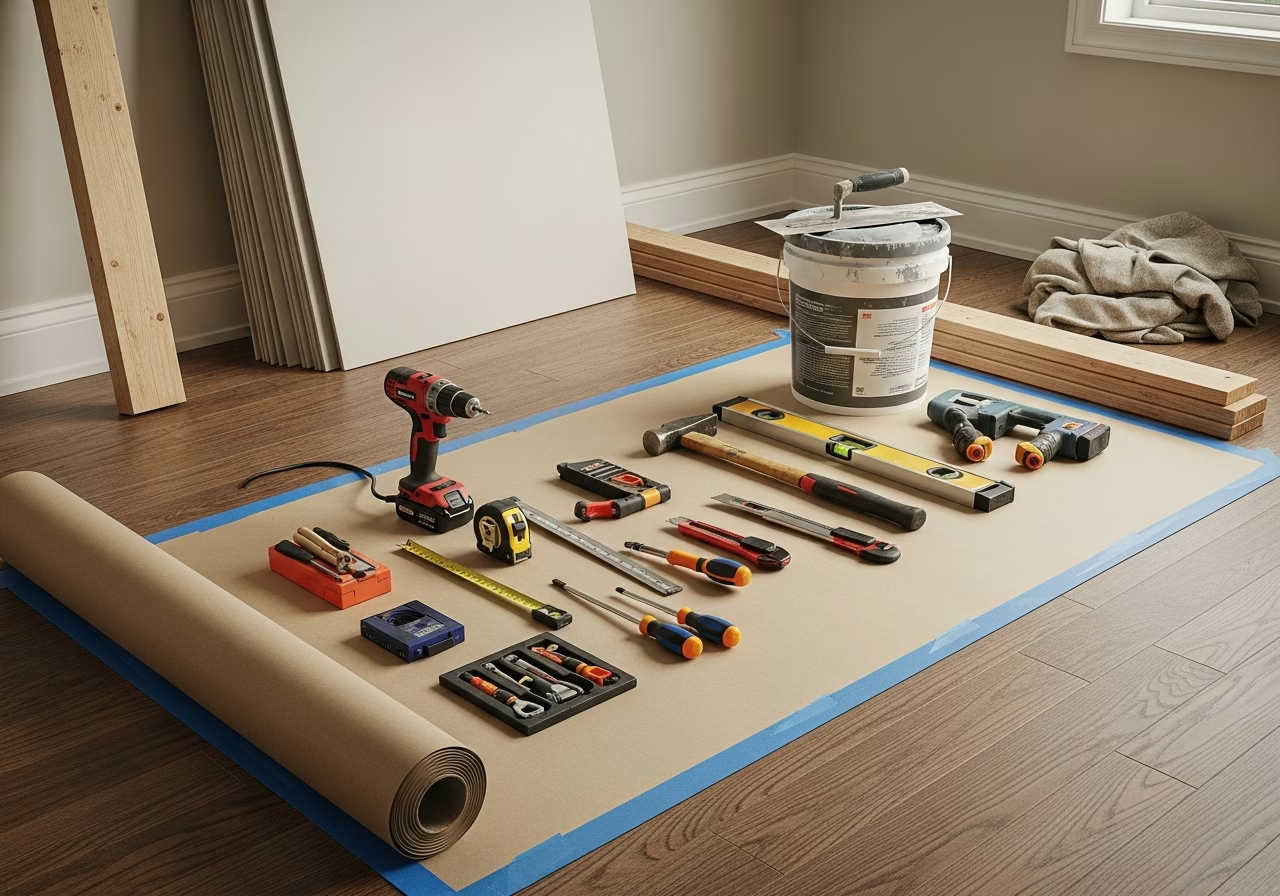
The volume tier. Build a new ceiling 2-4 inches below the existing ceiling, hung from AcoustiClips or RSIC-1 isolation clips that screw into the existing ceiling drywall (not the slab) with hat channel between. Fill the new cavity with Roxul Safe'n'Sound batts. Hang two layers of 5/8 inch Type-X drywall with Green Glue Noiseproofing Compound between the layers (two tubes per sheet). All electrical boxes are mounted in the new ceiling, not in the old one. Acoustic sealant at the perimeter.
Outcome: 8-15 IIC point improvement on impact noise. Realistic IIC 45-55 against an originally IIC 30 bare slab condition. This is the right answer for most Toronto condo upstairs-noise problems when the budget allows.
The reason it works: the AcoustiClips decouple the new ceiling from the structure, so impact energy reaching the old ceiling does not directly drive the new one. The Green Glue between the two drywall layers damps the resonance that otherwise lets the new ceiling re-radiate. The Roxul absorbs cavity reflections.
Important constraint: this assembly costs 2-4 inches of headroom. In a condo with already-low 8-foot ceilings that takes you to 7'8". Most owners accept this; some don't. Walk through the bedroom imagining the lower ceiling before committing.
Option 3: Mass-Loaded Vinyl Layer Behind New Drywall — $2,500-5,000
A budget alternative when full decoupling is not feasible. Strip the existing ceiling drywall, staple a layer of 1 lb or 2 lb Mass Loaded Vinyl (MLV) to the joists or to the underside of the slab via direct-mount fasteners, hang a single new layer of 5/8 Type-X drywall.
Outcome: 4-7 IIC point improvement. Cheaper than the decoupled option, less effective. Works best as a secondary layer on top of an existing ceiling rather than as a sole solution.
What Does Not Work (And Why)
- Egg-crate foam panels glued to the ceiling. These are absorption, not soundproofing. They reduce echo inside your room but do nothing for transmission from above. See Acoustic Treatment vs Soundproofing.
- A single layer of new drywall over the old ceiling. Mass alone, without decoupling and damping, gains 1-3 IIC points. Not worth the disruption.
- Carpet or area rugs in the upstairs unit alone. Helpful, but rarely sufficient on its own. Hardwood under a thin rug is still hardwood under a thin rug. The underlayment matters more than the rug.
Neighbourhood Patterns
Patterns we see across Toronto condo soundproofing requests in 2026:
- Liberty Village (mostly 2005-2015 buildings): generous IIC requirements in the original construction, but many owners did flooring renovations in 2015-2020 without proper underlayment. Decoupled drop ceiling is the typical fix.
- CityPlace (2008-2018 buildings): thinner slabs in some towers; flanking paths through HVAC ducts more common; full ceiling rebuild plus duct lining sometimes needed.
- King West / Queen West (older 1980s-2000s buildings): wood-joist transfer in mixed-use podiums; the noise is sometimes from a commercial tenant, not residential.
- Yorkville (1960s-2010s, mixed): higher-end buildings often have premium IIC 60+ floor assemblies in the original construction; complaints in these buildings usually point to flanking, not direct slab transmission.
- Mimico / South Etobicoke (2010s newer towers): standard IIC 50 base; underlayment compliance varies.
When to Bring in an Acoustic Consultant
Most condo upstairs-noise projects do not need a consultant. A consultant is justified when:
- Multiple ceiling treatments have already failed.
- The noise has clear flanking signature (audible at the wall edges, not the centre of the room).
- A legal dispute with the strata or upstairs owner is in play and you need a documented sound-level measurement.
In those cases, RenoHouse coordinates with a Toronto-area acoustic consultant for the measurement, then implements whatever the diagnostic indicates.
Next Step
If you are dealing with upstairs noise in a Toronto condo, the practical workflow is: read your strata renovation bylaw, decide between Option 2 and Option 3 based on budget and headroom tolerance, get a renovation permit/approval from the corporation, and execute. RenoHouse handles the renovation execution end to end. Book a consultation through the home renovation service page. For broader context, see the pillar guide Acoustic Soundproofing Renovation Toronto, the floor-side companion Floor Soundproofing Toronto, and the strata-rules deep dive Soundproofing Condo Strata Rules Toronto.
Sources & References
Authoritative sources cited in this guide:
- Ontario Building Code — OBC official text
- Toronto Building Permits — City permit portal
- Tarion New Home Warranty — Ontario new-build warranty regulator
- HCRA — Home Construction Regulatory Authority — Ontario builder/vendor licensing
Continue Reading