RenoHouse

# Egress Window Installation Toronto: Complete 2026 Guide
Quick answer. An egress window is the single piece of construction that legally turns a Toronto basement room into a bedroom — and a Toronto basement into a legal secondary suite. In 2026, a typical egress window installation in the GTA ranges from $4,000 for a straightforward replacement in a poured-concrete foundation to **$9,000+ for a full enla...An egress window is the single piece of construction that legally turns a Toronto basement room into a bedroom — and a Toronto basement into a legal secondary suite. In 2026, a typical egress window installation in the GTA ranges from $4,000 for a straightforward replacement in a poured-concrete foundation to $9,000+ for a full enlargement that includes foundation cutting, a code-compliant window well, drainage tied to weeping tile, and a structural lintel. Without an egress window, the basement bedroom you finished is not a bedroom — it is unfinished space the City of Toronto will not register, an insurance company will not cover as living space, and a future buyer's agent will list as "den." With one, the same room is rental income at $1,500 to $3,000 per month in most Toronto neighbourhoods.
This is the RenoHouse pillar guide for egress window installation in Toronto for 2026. We cover the Ontario Building Code (OBC) Section 9.9.10 dimensional requirements that govern every legal basement bedroom and apartment in the province, realistic CAD pricing tier-by-tier, the City of Toronto Building Permit pathway, the structural engineering coordination required for any foundation cut (a PEng-stamped detail is required), the window well sizing and drainage rules, the comparison between casement and slider operating styles, and the cluster of decisions that surround the work — basement apartment legalization, multiplex conversion sequencing, condo feasibility, and the fire-code logic that drives the whole specification.
For OBC dimensional rules in detail, see OBC 9.9.10 Egress Requirements Toronto. For cost specifics, see Egress Window Cost Toronto Installation. For the legal-basement-bedroom angle specifically, see Egress Window for Basement Bedroom Legal. If egress is part of a basement apartment legalization, see Basement Apartment Legalization Toronto. If it is part of a multiplex conversion, see Multiplex Conversion Toronto: 2026 Complete Guide. For the underpinning context that often accompanies egress on the same project, see Basement Underpinning Toronto: Complete 2026 Guide.
Why Egress Windows Matter in Toronto
Toronto's housing stock skews old. The pre-1980 detached and semi-detached homes that dominate the inner suburbs and the central core were built with basement windows that are roughly the size of a microwave — 24 inches wide by 16 inches tall is typical, and many are even smaller. Those windows were sized to admit daylight to a furnace room and let some ventilation reach the laundry tub. They were never sized to let a sleeping adult escape during a fire, and they were never sized to let a Toronto Fire Services firefighter enter with breathing apparatus to perform a rescue.
The Ontario Building Code's egress provisions exist for that single reason. Every habitable bedroom in a single-family home, every bedroom in a secondary suite, and every sleeping room in a registered basement apartment is required to have at least one window or door that can be opened from the inside without keys, tools, or special knowledge — and that opening must be large enough for a firefighter in full gear to enter and a person to exit. The dimensions in OBC 9.9.10 — minimum 0.35 square metres of unobstructed openable area, minimum 380 millimetres in any dimension, and a maximum sill height of 1.0 metres above the finished floor — were derived directly from the geometry of an SCBA-equipped firefighter and the practical reach of an interior ladder.
Toronto adds a second layer on top of OBC. Toronto Bylaw 569-2013 governs zoning for legal secondary suites, and the bylaw cross-references the OBC for habitability. A basement apartment cannot be registered with the city's Multi-Tenant House Licensing or its Secondary Suite registration without OBC-compliant egress in every sleeping room. That is why nearly every basement-apartment project we run at RenoHouse includes an egress window scope — usually one window per legal bedroom plus a verification that the existing common-area window (often a basement laundry-room window) is also code-compliant or unaffected by the egress requirement.
What an Egress Window Actually Is
An egress window is a window that meets four simultaneous tests: size, accessibility, operability, and clearance. A window that meets only some of those tests — for example, a large picture window that does not open — is not an egress window even if it dwarfs the code-required dimensions. A window that opens fully but is mounted six feet up the wall with no permanent platform is not an egress window because the sill height is wrong. A window that meets all the dimensional rules but sits at the bottom of a window well too small to climb out of is not an egress window because the well kills the egress.
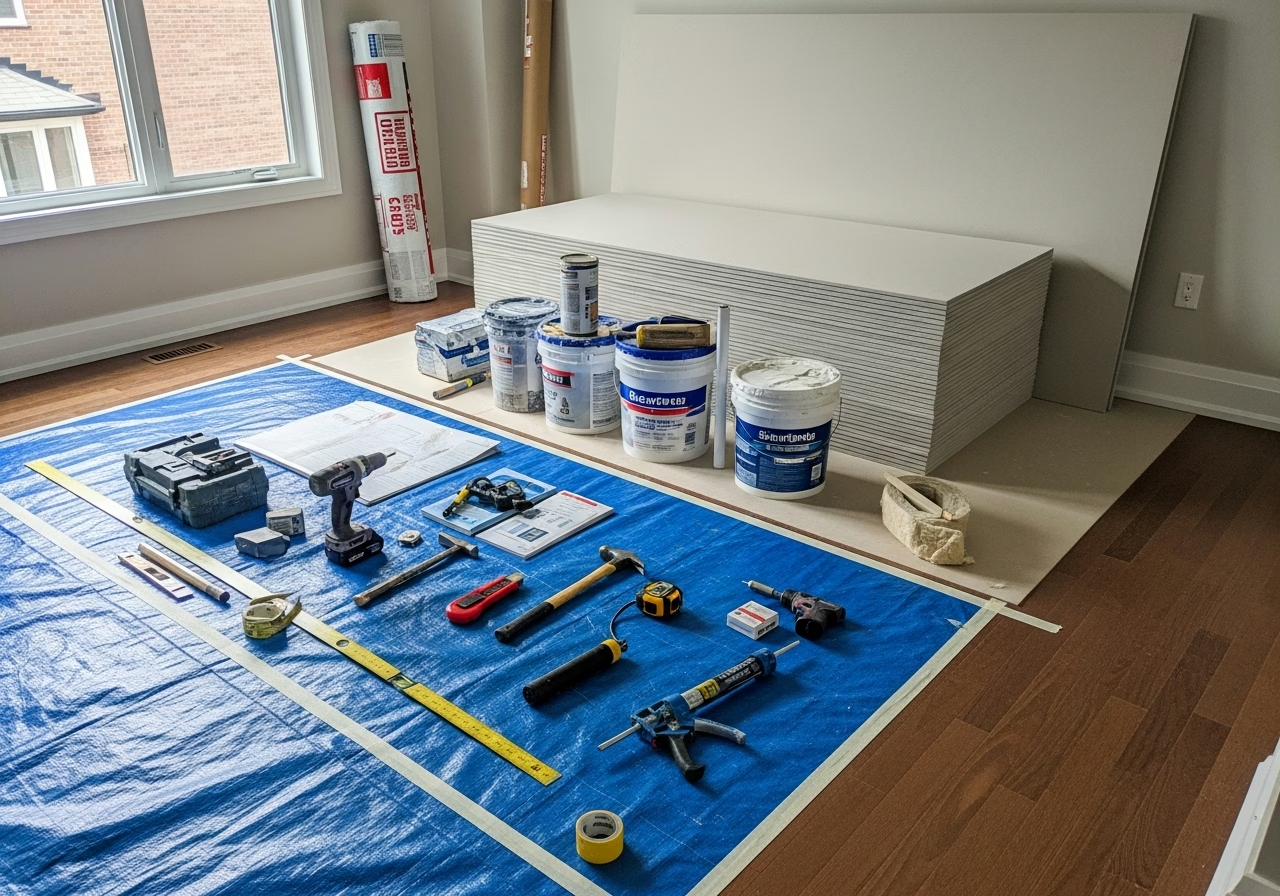
The four tests in plain language:
- Size. The clear opening — measured through the frame when the sash is fully opened — must be at least 0.35 square metres (3.77 square feet). The minimum dimension in any direction (height or width through the open sash) must be at least 380 millimetres (15 inches).
- Accessibility. The window must open from the inside without a key, tool, or special knowledge. A standard latch-and-crank casement satisfies this. Security bars do not — and this is one of the most common reasons a Toronto basement window fails inspection.
- Operability. The sash must be able to be held open by its own hardware. A casement that won't stay open against gravity, or a slider with a broken track, fails. Egress windows are tested in the open position.
- Clearance. The sill of the openable portion must be no more than 1.0 metres (39 inches) above the finished floor. Above-grade windows almost always satisfy this; below-grade windows need a window well, and the well itself must be sized so a person can stand inside it and reach the opening, with a permanent ladder or steps if the well depth exceeds 1.0 metre.
The fire-code logic chains these requirements together. A bedroom occupant wakes to smoke. They roll out of bed, take three steps to the window, open it without thinking about hardware, climb through the opening, stand in the well, and either step out at grade or climb the ladder to grade. The whole sequence is designed to take fewer than thirty seconds in zero visibility with a child or a pet in tow. Every test in OBC 9.9.10 is calibrated to that scenario.
OBC 9.9.10 — The Numbers That Govern Every Project
The dimensional rules in OBC 9.9.10 are the spine of every egress window scope. The 2026 version of the Code, in force across Ontario, prescribes:
- Minimum unobstructed openable area: 0.35 square metres (3.77 sq ft).
- Minimum dimension of the opening (height or width): 380 millimetres (15 inches), often rounded to 1 foot 3 inches in trade conversation.
- Maximum sill height above finished floor: 1.0 metre (39.4 inches).
- Window well requirement when the window is below grade: the well must extend at least 550 millimetres (22 inches) horizontally from the foundation wall, must allow the window to swing fully open without obstruction, and must include a means of egress (ladder or steps) if the depth from grade to the bottom of the well exceeds 1.0 metre.
- Bars, grilles, and security devices: permitted only if they can be released from inside without keys, tools, or special knowledge, and the released device must allow the full required opening.
Two practical corollaries follow from those numbers. First, the minimum 380-millimetre dimension means that a small-but-tall opening (380 mm × 920 mm = 0.35 sq m) is technically compliant — but no Toronto building inspector we work with will pass a window that narrow on a real basement. Inspectors expect a dimension closer to 600 to 750 millimetres on the constrained dimension and a corresponding height that produces clear comfortable egress. The Code is a floor, not a target. Second, the 1.0-metre sill height drives whether a permanent step is needed inside the bedroom. On many Toronto basements where the floor was lowered through underpinning, the sill that used to be at 1.6 metres is now at 1.4 metres — still non-compliant. Cutting the foundation lower to drop the sill is a structural job, not a cosmetic one.
For the full dimensional walkthrough including sill diagrams and worked examples, see OBC 9.9.10 Egress Requirements Toronto.
The Real Cost of an Egress Window in Toronto in 2026
Pricing for egress windows in Toronto in 2026 falls into three tiers based on the scope of cutting required.
Tier 1: Replacement in an existing rough opening — $4,000 to $5,500. This applies when the existing basement window is already close to the egress dimensions but does not quite meet them, or when a previous owner installed a non-egress window in an opening that could legally hold an egress one. The work is window removal, frame upgrade, new code-compliant casement, exterior trim, sealing, and a window well upgrade if needed. No foundation cutting required. About 15% of our egress jobs fall in this tier. Tier 2: Foundation enlargement on a poured-concrete foundation — $5,500 to $7,500. This is the most common Toronto scenario. The existing window is far too small. We cut the poured-concrete foundation wall to enlarge the opening, install a structural steel lintel above the new opening to carry the load that used to bridge the old smaller opening, install the new code-compliant window, build the window well to OBC dimensions, tie the well drain to the weeping tile, and finish exterior and interior trim. The PEng-stamped lintel detail is part of the permit drawings. About 60% of our egress jobs fall in this tier. Tier 3: Foundation enlargement on a block or rubble foundation — $7,500 to $9,500. Older Toronto homes (pre-1940 in many neighbourhoods) have foundations of concrete block or rough rubble. Cutting these requires more careful structural work because the wall does not have the monolithic continuity of poured concrete — load transfer above the new opening must be re-established through a properly bedded lintel and sometimes through reinforcement of adjacent block courses. The window well work is the same; the foundation work is more involved. About 25% of our egress jobs fall in this tier.Costs across all tiers include:
- Permit and drawings: $600 to $1,200.
- Structural engineer (PEng) lintel detail: $800 to $1,500 (we coordinate with engineers we work with regularly; we are not the engineer of record).
- Concrete saw cutting and dumpster: $200 to $500 for the cut, plus $400 to $700 for the dumpster.
- Lintel (structural steel angle or galvanized lintel with PEng spec): $300 to $800 material.
- Window unit (casement, code-compliant size, vinyl or fibreglass frame): $900 to $2,200.
- Window well (Boman Kemp galvanized or composite, sized to code): $400 to $900.
- Drainage tie-in to weeping tile: $300 to $700.
- Exterior siding, brick trim, parging repair: $400 to $1,000.
- Interior drywall, trim, paint patch: $300 to $700.
- Labour for cutting, framing, install, finishing: $1,500 to $3,500.
For a full cost framework with worked examples, see Egress Window Cost Toronto Installation.
The Toronto Building Permit for an Egress Window
Yes — every egress window cut into a foundation in Toronto requires a Building Permit. The exception is a like-for-like replacement that does not enlarge the opening; that is a window-replacement permit (lighter scope) or, on some properties, no permit at all. Cutting the foundation always triggers a full structural permit.
The permit pathway:
Need professional home renovation?
Call RenoHouse at 289-212-2345 or get a free estimate today.
Get Free Estimate →- 1. Site assessment. RenoHouse measures the existing wall, sill height, joist locations, soil grade, and identifies any obstructions (gas lines, hose bibs, electrical service entry).
- 2. Engineer coordination. We send the field measurements to a Toronto-area structural PEng who produces the lintel detail. The detail specifies the lintel size (commonly an L-angle steel or a precast concrete lintel), the bearing length on each side, and any reinforcement to adjacent foundation sections.
- 3. Drawings. Site plan, elevation showing existing and proposed window, foundation section showing the cut and the new lintel, and a note on the weeping-tile drainage tie-in. RenoHouse produces these from the engineer's detail and from our site survey.
- 4. Permit application. Submitted through the Toronto Building Online portal. Typical approval time in 2026 is 2 to 4 weeks for a single-window scope. Faster than most renovation permits because the scope is well-defined.
- 5. Inspections. Two inspections on most jobs: a foundation/lintel inspection after the cut and lintel are in place but before backfilling, and a final inspection after the window and well are complete.
For the full permit walkthrough including portal screenshots and timing tips, see Egress Window Permit Toronto Process.
Foundation Cutting — The Most Specialized Step
Cutting an opening into a Toronto foundation wall is the highest-skill step in the project. Done wrong, it produces a wall that cracks two years later as the house settles around the modified load path. Done right, it is invisible structurally — the new lintel transfers the load that used to be carried by the cut-out concrete, and the wall behaves as if the modified opening had always been there.
The mechanics:
- Saw and blade. A wet-cutting concrete saw with a 14-inch or 18-inch diamond blade is the standard tool. The wet cut suppresses dust (silica is a serious health hazard) and cools the blade to extend life.
- Cut sequence. The opening is cut in segments — sides first, then top, with the bottom cut last. The cut depth on each pass is increased gradually. On block foundations the cut follows mortar joints where possible.
- Rebar. Poured-concrete foundations contain rebar at typical spacings of 12 to 16 inches. The rebar is cut as encountered. The PEng detail will specify whether any of the cut rebar must be re-engaged in the new lintel bearing — most of the time the lintel itself replaces the structural function of what was removed.
- Lintel install. Once the cut is complete and the spoil is removed, the lintel is set on bedding mortar with the bearing lengths specified by the PEng. On poured-concrete walls the lintel typically bears 6 to 8 inches each side; on block walls the bearing courses are reinforced.
- Backfill and parging. The exterior face is parged smooth and the area around the new well is backfilled with free-draining material that ties into the existing perimeter drainage.
For the engineering and execution details, see Egress Window Foundation Cutting Toronto.
Window Well Sizing and Drainage
The window well is half the egress system. The window can be perfectly compliant and the well can kill the egress if it is too small, too deep without a ladder, or full of water from a clogged drain.
OBC and best-practice sizing:
- Horizontal projection from foundation: 550 mm minimum (OBC). 750 mm is common best practice and produces a noticeably more usable well.
- Width: at least the window width plus 150 mm on each side; commonly the width of a stock Boman Kemp unit (48 to 60 inches typical).
- Depth from grade to bottom of well: as shallow as the foundation grade allows. If depth exceeds 1.0 metre, a permanent ladder or steps are required.
- Drainage: the bottom of the well must drain. Best practice is a dedicated 4-inch perforated pipe at the bottom of the well connected to the home's weeping-tile system, surrounded by 6 to 12 inches of clean stone, and topped with a permeable cover. A well that backs up with rainwater will flood the bedroom.
- Cover: a code-compliant cover must be openable from inside the well (i.e., a person trapped inside can lift it). Aluminum or polycarbonate covers from manufacturers like Boman Kemp meet this; a screwed-down deck-board cover does not.
For a full drainage walkthrough, see Window Well Drainage Toronto Design.
Casement vs Slider — Which Operating Style
For below-grade egress in Toronto we install casement windows on roughly 90% of jobs. The reason is simple geometry: a casement of given frame size produces a larger clear opening than a slider of the same frame size, because the entire sash swings out of the way. A casement frame measuring 36 × 48 inches yields close to 0.85 square metres of clear opening — well above the 0.35 sq m minimum. A slider of the same frame size yields about half that, because half the frame is fixed.
The other advantage of casements is sealing. Casement weatherstripping compresses against the frame when the sash is closed, producing better air-seal performance than a slider's brush seal. In a Toronto winter that matters for energy and for condensation control on the basement-side of the window — basement bedrooms run high relative humidity and cold below-grade glass attracts moisture.
Sliders are appropriate when the rough opening is much wider than tall and a casement would require an awkward narrow sash, or when budget is tight and the available frame size is generous enough that a slider still meets the 0.35 sq m clear opening. Boman Kemp window wells are designed to fit either operating style.
For the full operating-style comparison with frame size tables, see Egress Window Types Casement Slider Comparison.
The Trades on Site
Egress is a multi-trade project. RenoHouse coordinates the following on a typical scope:
- Structural engineer (PEng). Produces the lintel detail. We work with several Toronto-area firms regularly. The engineer is not on site during cutting; the site work is reviewed against the stamped detail.
- Certified window installer. RenoHouse's window crew handles the finish install, sealing, and trim.
- Concrete cutting subcontractor. A specialty trade with the wet-saw equipment and the dust-control protocols. We schedule them for a half-day on most jobs.
- Plumber. For the weeping-tile drain tie-in if it requires a connection inside the basement.
- Electrical Safety Authority (ESA) and licensed electrician. Only triggered if any electrical service or wiring needs relocation to clear the new opening — for example a basement panel mounted next to the window location or a baseboard outlet that would land inside the new sill.
- Toronto Building Inspector. Two visits as described above.
We are not the structural engineer. We coordinate with engineers we trust and we follow their stamped detail. We are not the ESA inspector. If a panel relocation is in scope we bring in our licensed electrician and the ESA permit is filed under their licence.
Egress and the Legal Basement Apartment
The single most common reason Toronto homeowners install egress windows is to legalize a basement apartment for rental income. The math in 2026 Toronto is compelling: a typical legal basement apartment in a mid-market neighbourhood (East York, the Junction, Birch Cliff, Mimico) rents for $1,800 to $2,800 per month, with $1,500 to $3,000 per month as the citywide range across neighbourhoods. The egress window scope at $5,000 to $9,000 amortizes against rental income in three to five months of rent. The full apartment legalization (egress, fire separation, second exit, kitchen, bathroom, electrical separation, registration) typically runs $45,000 to $90,000 and amortizes in two to four years against the rent stream.
For the full basement apartment legalization framework, see Basement Apartment Legalization Toronto. For the egress-specific angle, see Egress Window for Basement Bedroom Legal. For sequencing egress with the broader project, see Egress Window During Basement Apartment Conversion.
Egress and Multiplex Conversion
Toronto's 2023 multiplex zoning reform (Bylaw 569-2013 amendments) opened most residential lots to legal four-unit conversion. Each unit's bedrooms must have OBC-compliant egress. On a typical multiplex conversion of a Toronto detached or semi-detached home, the egress scope expands to two or three windows — usually one for the basement unit's bedroom and one or two for additional sleeping rooms across the building. Egress sequencing in a multiplex job is critical because the foundation cutting must precede the framing of the new partitions and the new MEP runs.
For the full multiplex framework, see Multiplex Conversion Toronto: 2026 Complete Guide.
Egress in Condos and Stacked Townhouses
Condo egress is feasible only in specific building types. A ground-floor condo unit with a private patio or a townhouse with at-grade exterior wall can sometimes accommodate an egress window — but the cut goes through a structural element that belongs to the condominium corporation, not the unit owner. Status certificate review, condo-board approval, and reserve-fund engineer sign-off are required before any cutting can be permitted. Most stacked condo and apartment-style condo units cannot accommodate egress retrofitting at all.
For the full feasibility framework, see Egress Window Condo Feasibility Toronto.
Egress vs Walkout Basement
A walkout basement that includes a code-compliant exterior door eliminates the egress-window requirement for any bedroom that has direct access to that door (per OBC 9.9.10 the door itself satisfies egress). On lots with rear grade lower than front grade — which is common in parts of North York, Scarborough, and Etobicoke — a walkout is sometimes feasible without underpinning and produces an above-grade rental unit with much higher rent ceiling. The cost comparison is substantial: a walkout retrofit runs $25,000 to $80,000 depending on grade work; multiple egress windows run $10,000 to $25,000 for the same number of bedrooms.
For the full comparison, see Egress Window vs Walkout Basement Toronto.
Mistakes We Watch For
After more than a decade of Toronto egress projects, the same mistakes recur. The big ones:
- Cutting before the engineer's detail is stamped. Inspectors fail it; the wall has to be reinforced retroactively.
- Installing a window that meets the dimensional minimum but does not actually pass an inspector's "would I be comfortable with my kid escaping through this" test. Aim above the Code minimum.
- Skipping the well drainage and assuming the existing soil percolates. Toronto clay does not percolate. The well floods.
- Choosing a slider when a casement would have given more clear opening at the same frame size.
- Forgetting the ESA permit when the panel or any wiring sits in the cut zone.
- Backfilling before the lintel inspection. The inspector needs to see the lintel; backfill hides it.
For the full mistake catalogue, see Egress Window Installation Mistakes Toronto.
How RenoHouse Coordinates an Egress Project
A typical RenoHouse egress project runs eight to twelve working days from permit-in-hand to final inspection:
- Day 1: Site protection, exterior excavation if depth is required for the well, interior wall protection.
- Days 2–3: Concrete cutting, debris removal.
- Days 3–4: Lintel install, bedding cure.
- Day 5: Foundation/lintel inspection.
- Days 6–7: Window install, well install, drainage tie-in.
- Days 8–9: Exterior trim, parging, interior drywall patch.
- Day 10: Final inspection.
- Days 11–12: Touch-up paint, exterior landscaping refresh.
We carry liability insurance, WSIB, and our crews are trained on silica dust control. The structural engineer is engaged at the front of the project for the lintel detail; we are not the engineer of record but we coordinate the deliverable. The plumber and electrician are scheduled as needed.
Ready to Plan Your Egress Project
If you are evaluating an egress window installation for a Toronto basement bedroom, a legal basement apartment, a multiplex conversion, or a livability upgrade, the right starting point is a site visit and a structural feasibility check. We will measure your foundation, identify the cut location, flag any utilities in the way, and price the project across the three tiers above.
Book an egress window consultation to start the conversation. We will return a written scope and an indicative price within five business days, and if the project moves forward we will engage the structural engineer and start the permit drawings the same week.For related project framing, see Basement Underpinning Toronto: Complete 2026 Guide, Basement Apartment Legalization Toronto, and Multiplex Conversion Toronto: 2026 Complete Guide.
Related Guides in This Series
Continue reading our complete coverage of this niche:
- Egress Window vs Window Well Toronto: What You Actually Need
- Egress Window Fire Code Explained Toronto
Sources & References
Authoritative sources cited in this guide:
- Ontario Building Code — OBC official text
- Toronto Building Permits — City permit portal
- Tarion New Home Warranty — Ontario new-build warranty regulator
- HCRA — Home Construction Regulatory Authority — Ontario builder/vendor licensing
Continue Reading