RenoHouse

# Egress Window Permit Toronto: The 2026 Process
Quick answer. Yes, every Toronto egress window project that involves cutting a foundation requires a Building Permit. The permit process in 2026 is well-defined and predictable: 2 to 4 weeks from submission to issuance for a single-window scope, $400 to $700 in city fees, and a deliverable set of stamped engineer drawings plus site plan and elevations.Yes, every Toronto egress window project that involves cutting a foundation requires a Building Permit. The permit process in 2026 is well-defined and predictable: 2 to 4 weeks from submission to issuance for a single-window scope, $400 to $700 in city fees, and a deliverable set of stamped engineer drawings plus site plan and elevations. Homeowners who skip the permit save the fee, lose the inspection, expose themselves to insurance and resale problems, and risk a stop-work order if a neighbour reports the cutting.
This article walks through the permit pathway step by step, the drawings required, the typical fees, the timing, and the inspection sequence. For the full project framework, see our Egress Window Installation Toronto: Complete 2026 Guide. For the engineering details, see Egress Window Foundation Cutting Toronto. For the cost framework, see Egress Window Cost Toronto Installation.
When a Permit Is Required
Required:
- Any cut into a load-bearing foundation wall to enlarge a window opening.
- Any new window opening cut into a foundation that did not previously have one.
- Any change to the structural lintel above an existing opening.
Not strictly required (but check first):
- Like-for-like window replacement in an existing rough opening with no enlargement. Some Toronto districts treat this as no-permit work; others require a window-replacement permit.
- Window well replacement only, with no foundation modification.
When in doubt, the Toronto Building 311 line will confirm by phone whether your specific scope needs a permit. We always file when foundation cutting is involved.
The Permit Drawings
A complete egress permit submission for a single-window scope contains:
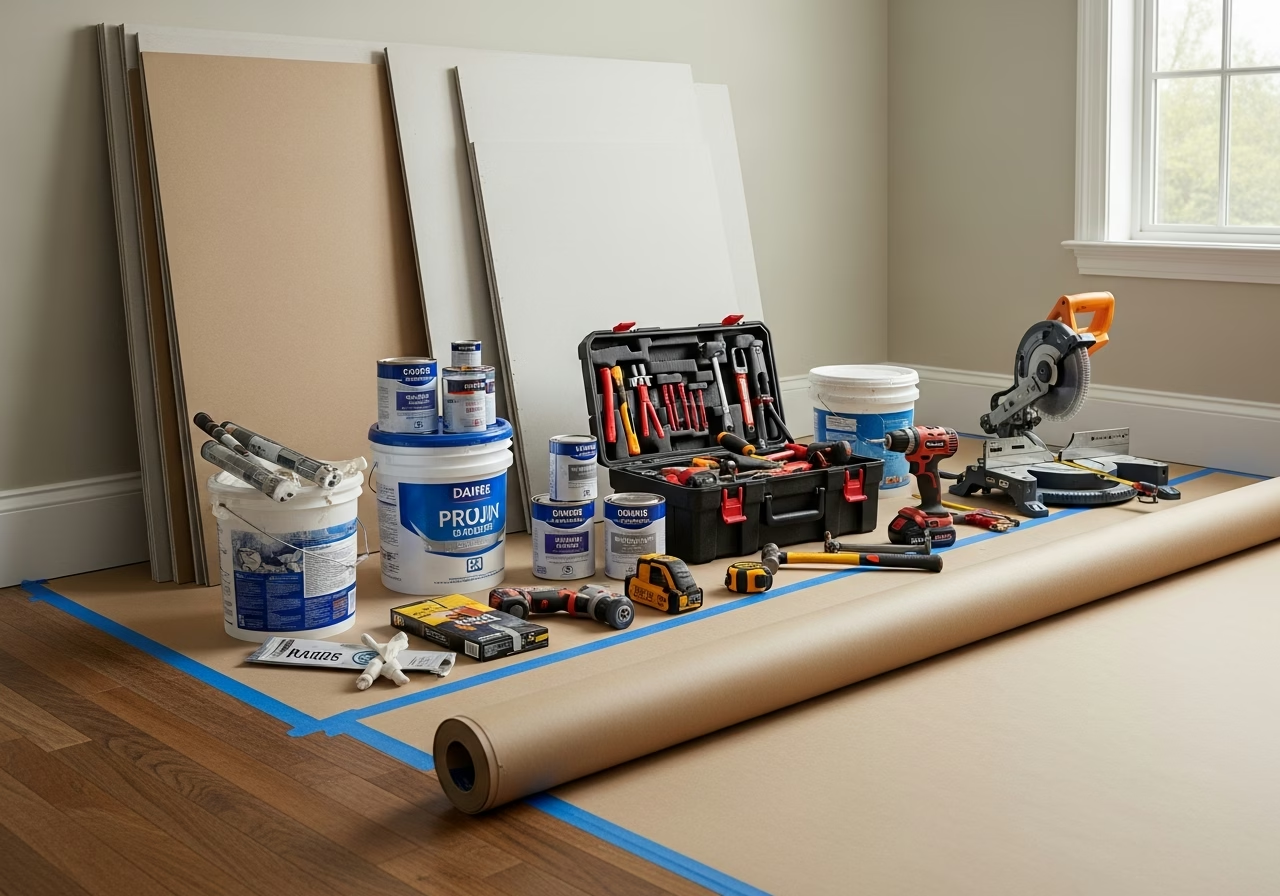
For multi-window projects (multiplex conversion, two-bedroom basement apartment), all windows can be on a single permit if they are on the same property. A site plan shows all locations; elevations and sections cover each window.
The Permit Application
Toronto submits permits through the Toronto Building Online portal. Steps:
- 1. Create or log into a Toronto Building Online account. The homeowner is the applicant; RenoHouse can be designated as the agent.
- 2. Start a new application. "Building Permit — Residential — Renovation/Alteration."
- 3. Property details. Address, roll number, zoning.
- 4. Project description. "Enlarge basement window opening for OBC 9.9.10 egress compliance" plus number of windows.
- 5. Upload drawings. Site plan, elevation, foundation section (with engineer's stamp), specifications.
- 6. Pay fees. Online via credit card.
- 7. Submit. The application enters Toronto Building's queue.
We handle steps 2 through 7 as the agent on most jobs.
Need professional home renovation?
Call RenoHouse at 289-212-2345 or get a free estimate today.
Get Free Estimate →The Fees
2026 Toronto Building fees for a single-window egress permit:
- Base permit fee: $250 to $400 depending on declared construction value.
- Plan review fee: $100 to $200.
- Inspection fees: included in base on most residential renovation permits.
- City development surcharge: ~$50.
Total city fees: $400 to $700. Add the engineer's fee ($800 to $1,500) and the drawing-prep fee (RenoHouse line item, $200 to $500) for a total permit-stack cost of $1,400 to $2,700.
For multi-window applications, the fees scale modestly — typically $100 to $200 per additional window.
The Timeline
Toronto Building's published target for residential renovation permits is 10 business days for first review and 5 business days for re-review if revisions are needed. In practice for a clean single-window egress submission in 2026, we see:
- Days 1–10: First review. Plan reviewer checks the drawings, the engineer's stamp, the dimensions, and the conformance to OBC 9.9.10.
- Days 10–14: Approval if no revisions; permit issued and emailed.
- Days 10–25: If revisions are requested, re-submission and re-review. Adds 1–2 weeks.
Common revision requests:
- Sill height not clearly dimensioned on the elevation.
- Engineer's stamp not legible.
- Window well dimensions missing or inconsistent.
- Drainage tie-in not shown.
A clean submission with all of these correct on first pass clears in 14 days or less most of the time. We have a checklist we run before submission and our first-pass clean rate is above 90% on egress jobs.
The Inspections
Two inspections on a typical single-window egress job:

- Cut quality and dimensions match the drawings.
- Lintel size, material, and bearing length match the PEng detail.
- Bedding mortar in place.
- No damage to adjacent wall sections.
- No water intrusion at the cut surfaces.
The inspection is scheduled by phone or through the portal. Lead time is typically 2 to 5 business days. We schedule during the lintel cure window so the inspector arrives just before the window install.
Inspection 2 — Final. Performed after the window, well, drainage, exterior trim, and interior patch are all complete. The inspector verifies:- Window operability from inside without tools.
- Openable area meets 0.35 sq m and 380 mm minimum dimension.
- Sill height within 1.0 m of finished floor.
- Window well projection at least 550 mm.
- Window well drainage in place.
- Window well cover (if any) openable from inside the well.
- Smoke alarm in the bedroom (if part of an apartment legalization).
Final inspection takes 20 to 30 minutes. Pass/fail is communicated on the spot; written confirmation arrives in the portal within 1 to 2 business days.
After the Final Inspection
The permit closes when the final inspection passes. The closed permit becomes part of the property's permit history visible on Toronto's permit search. This is what real estate agents and lawyers check during a future sale to confirm the basement bedroom is legal.
For basement apartment registrations, the closed egress permit is one of the prerequisites for the secondary-suite registration under Bylaw 569-2013. The registration process is separate and follows the permit closure.
What Happens Without a Permit
The risks of unpermitted egress work in Toronto in 2026:
- Stop-work order. A neighbour or passer-by reports the cutting; Toronto Building issues a stop-work order; the project is paused until permitted retroactively.
- Retroactive permit. Toronto Building will permit retroactively but charges 1.5x or 2x the normal fee, and the engineer must inspect the as-built work — sometimes finding non-compliant lintel install that has to be redone.
- Insurance impact. Unpermitted structural work voids portions of homeowner policy in many cases.
- Resale impact. Unpermitted work surfaces during a closing-side title and permit search and produces price reductions or deal collapses.
- Bylaw enforcement. For basement apartment scope, an unpermitted egress prevents secondary-suite registration entirely.
The permit fee is small relative to the project cost. There is no scenario where skipping the permit pays off.
RenoHouse's Permit Coordination
On a typical RenoHouse egress project, our scope on permitting includes:
- Coordination with the structural engineer for the stamped detail.
- Production of site plan, elevation, and foundation section drawings.
- Submission to Toronto Building Online as the homeowner's agent.
- Response to any plan-review revisions.
- Scheduling of both inspections.
- Liaison with the inspector on site.
- Permit close-out and delivery of the closed-permit confirmation to the homeowner.
For related framing, see our Egress Window Installation Toronto: Complete 2026 Guide, Egress Window Foundation Cutting Toronto, and OBC 9.9.10 Egress Requirements Toronto.
Sources & References
Authoritative sources cited in this guide:
- Ontario Building Code — OBC official text
- Toronto Building Permits — City permit portal
- Tarion New Home Warranty — Ontario new-build warranty regulator
- HCRA — Home Construction Regulatory Authority — Ontario builder/vendor licensing
Continue Reading