RenoHouse

# Egress Window vs Window Well Toronto: What You Actually Need
Quick answer. Toronto homeowners researching basement egress often confuse two related but distinct components. The egress window is the window itself — the operable opening sized to satisfy OBC 9.9.10. The window well is the excavated pit outside a below-grade window, lined with a galvanized or composite shell, that lets the window open at all...Toronto homeowners researching basement egress often confuse two related but distinct components. The egress window is the window itself — the operable opening sized to satisfy OBC 9.9.10. The window well is the excavated pit outside a below-grade window, lined with a galvanized or composite shell, that lets the window open at all and gives a person room to climb out. Most below-grade Toronto basement bedrooms need both. A homeowner who upgrades only the well without addressing a non-compliant window has spent $1,000 on something that still fails inspection. A homeowner who installs a code-compliant window without an adequate well has built a window that opens into a pit nobody can escape from.
This article walks through the distinction, the scope of each component, the typical Toronto cases where one without the other is enough, and the decision framework for when both are needed. For the full project framework, see our Egress Window Installation Toronto: Complete 2026 Guide. For the OBC dimensional rules, see OBC 9.9.10 Egress Requirements Toronto. For window well design specifics, see Window Well Drainage Toronto Design.
The Egress Window
The egress window is the operable window sash in the basement wall. To qualify as egress under OBC 9.9.10, the window must satisfy four simultaneous tests: minimum 0.35 sq m of unobstructed openable area, minimum 380 mm in any single dimension through the open sash, maximum sill height 1.0 m above finished floor, and operability from inside without keys or tools.
The egress window's job is to admit a person through the wall. Its design is governed by Code dimensions, the structural opening it sits in, the energy and thermal performance required by SB-12, and the operating style chosen for the install (almost always casement on Toronto below-grade work).
The window itself, supplied by Milgard, Pella, Marvin, or Andersen 100-Series in our typical specs, costs $900 to $2,200 for the unit. Installed cost — including any required foundation cut, lintel, sill work, and trim — is $4,000 to $9,500 depending on tier (covered in our cost article).
The Window Well
The window well is the excavated and lined pit on the exterior side of a below-grade window. Its job is twofold: to allow the window to open without the open sash hitting the soil grade, and to provide enough usable space outside the window for a person climbing through to stand, regroup, and either step up to grade or climb a ladder to grade.
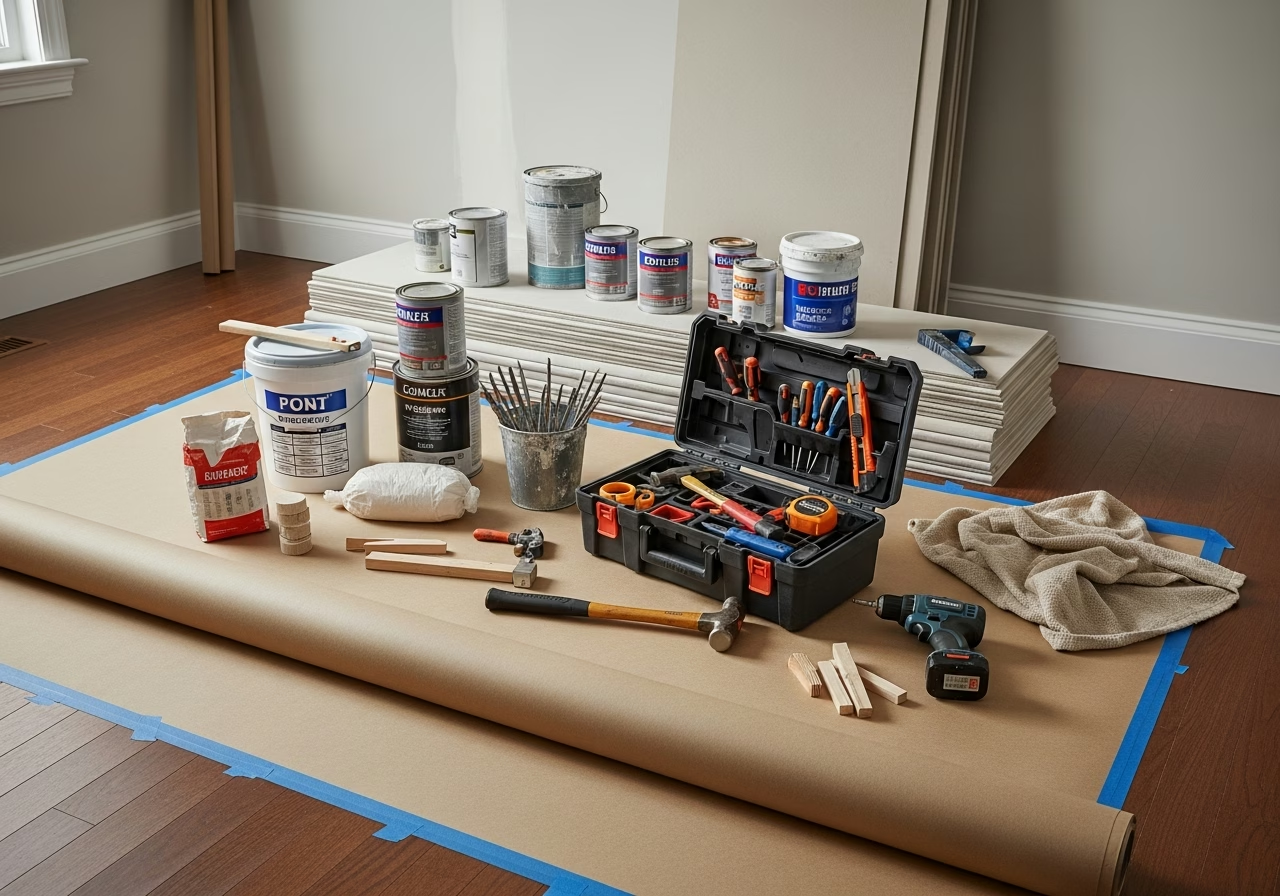
OBC and best-practice dimensions:
- 550 mm minimum horizontal projection from foundation (we install 750 mm typically).
- Width at least the window width plus modest clearance.
- Depth from grade to bottom no more than 1.0 m without a permanent ladder; deeper wells require a ladder or steps.
- Drainage at the bottom that ties into the home's weeping-tile system.
- Cover (if used) must be openable from inside the well.
The well unit itself, from Boman Kemp or composite-equivalent manufacturers, costs $400 to $900. Installed cost — including excavation, drainage tie-in, backfill, and grading — is $700 to $1,800 for a well-only project.
Why Most Toronto Basements Need Both
Toronto's housing stock has two complications that drive the both-and answer. First, original basement windows are almost always too small for OBC 9.9.10. Second, original window wells (where they exist) are almost always too small, too shallow without ladders, or have no functional drainage. A basement that needs an egress window almost always also needs a new window well, because the new larger window will not fit the old well, and the old well's drainage is typically corroded or missing entirely.
Need professional home renovation?
Call RenoHouse at 289-212-2345 or get a free estimate today.
Get Free Estimate →In our portfolio, the breakdown of egress projects by component scope:
- Both new window and new well: ~85% of jobs. The standard scope.
- Window only, existing well adequate: ~5%. Occurs when a previous owner installed a generous well years ago but the window itself was never updated.
- Well only, existing window adequate: ~10%. Occurs when the existing window already satisfies 9.9.10 (often a daylight window installed during a previous renovation) but the well failed and is now flooding or is too small to clear the sash.
When Window-Well-Only Is Enough
The window-well-only scope makes sense when:
- The existing basement window already measures up to 9.9.10 — at least 0.35 sq m clear opening, 380 mm minimum dimension, sill within 1.0 m of finished floor.
- The existing well is failing — flooding the basement, has rusted through, or was never drained properly.
- The existing well is too small to allow the window to swing open, restricting the actual egress.
- The depth-to-ladder rule was missed when the well was built and a ladder needs to be retrofitted.
In these cases the scope is excavation, well replacement, drainage, and grading. No foundation cutting, no PEng, no lintel, no permit (in most cases — well-only work usually does not require a Building Permit unless drainage modifications affect the home's plumbing service).
Cost for well-only: $700 to $1,800 per well, with the upper end on deeper wells with ladder requirements and brick exterior surrounds.
When Window-Only Is Enough
The window-only scope makes sense when:
- The existing rough opening is already sized to fit a 9.9.10-compliant unit.
- The existing well is in good condition, deep enough, drained, and cleared for the new window's swing.
- Sill height is already within 1.0 m of finished floor.
This is rare in pre-1980 Toronto homes but common in homes where a previous owner did partial egress work and stopped short of the window itself, or where a recent basement renovation lowered the floor and brought an above-grade window into compliance for sill height.
Cost for window-only: $4,000 to $5,500 (Tier 1 from our cost framework).
When Both Are Needed
Both-and is the standard. The scope is foundation cutting (Tier 2 or Tier 3), structural lintel, new code-compliant window, new window well sized to the window, drainage tie-in, exterior trim, interior patch. Cost: $5,500 to $9,500 per window.

The Drainage Question
The most consequential difference between a competent and an incompetent window well install in Toronto is drainage. A well without drainage — or with drainage that ends in clay soil — will fill with water during a heavy storm, and the water will rise above the window sill. We have inspected dozens of Toronto basements where the previous owner installed a window well to "code" but skipped the drain tie-in, and those basements flooded the moment the well filled.
Proper drainage means a 4-inch perforated pipe at the bottom of the well, surrounded by clean stone, connected directly to the home's weeping tile system. The connection runs under grade for 6 to 10 feet from the well to the foundation perimeter drain. This is plumbing work that requires a licensed trade if the connection enters the basement interior; on most Toronto jobs the connection stays exterior and is handled by the egress crew.
For full drainage details, see Window Well Drainage Toronto Design.
Decision Framework
To decide whether you need a window, a well, or both:
- 1. Measure the existing window's openable area. If less than 0.35 sq m, you need a new window.
- 2. Measure the smallest dimension of the openable area. If less than 380 mm, you need a new window.
- 3. Measure the sill height above the finished basement floor. If more than 1.0 m, you need a new (lower) window install.
- 4. Test the operability. If the window won't stay open, has security bars without quick-release, or has been painted shut, you need a new window or hardware upgrade.
- 5. Inspect the well. If the well is less than 550 mm projection, lacks drainage, has rusted through, or is too deep without a ladder, you need a new well.
- 6. Inspect the well cover. If the cover requires tools to remove, you need a new cover.
If any of 1–4 fails, scope includes a new window. If any of 5–6 fails, scope includes a new well. Most Toronto basements need both.
Ready to Diagnose Your Basement
The most efficient path is a 30-minute site visit where we measure each window, each well, and each sill, and tell you in writing exactly which components are compliant and which need work.
Book an egress window consultation to start.For more, see our Egress Window Installation Toronto: Complete 2026 Guide, Window Well Drainage Toronto Design, and Egress Window Cost Toronto Installation.
Sources & References
Authoritative sources cited in this guide:
- Ontario Building Code — OBC official text
- Toronto Building Permits — City permit portal
- Tarion New Home Warranty — Ontario new-build warranty regulator
- HCRA — Home Construction Regulatory Authority — Ontario builder/vendor licensing
Continue Reading