RenoHouse

# Fire Damage Restoration Cost Toronto: 2026 Pricing & Insurance Reality
Quick answer. Fire is the most expensive residential loss type in Ontario. Per Insurance Bureau of Canada (IBC) regional data, the average residential fire claim in Ontario runs $35,000, and Toronto-specific data trends slightly higher because of the cost of finishes, denser housing stock, and longer rebuild timelines.Fire is the most expensive residential loss type in Ontario. Per Insurance Bureau of Canada (IBC) regional data, the average residential fire claim in Ontario runs $35,000, and Toronto-specific data trends slightly higher because of the cost of finishes, denser housing stock, and longer rebuild timelines. The actual pricing range, however, is enormous: a small kitchen flash fire that scorches a single cabinet might be a $4,000 claim, while a whole-house fire that requires structural rebuild can exceed $300,000.
This post breaks down realistic 2026 Toronto pricing across the five most common fire damage scenarios, what insurance typically covers, and where the rebuild phase (RenoHouse's part of the equation) sits in the budget. For the full restoration lifecycle, see Fire & Water Damage Restoration Toronto 2026: Complete Guide.
RenoHouse's role: we partner with IICRC-certified mitigation teams (Restorx Disaster Restoration, ServiceMaster Restore, Steamatic, FirstOnSite, PuroClean) for the demolition, decontamination, and odour-removal phase, and we perform the rebuild — drywall, framing repair, kitchen, finishes — with insurance coordination and direct billing where supported.What Drives Fire Restoration Cost
Fire claims are the sum of three major cost categories, and they don't always scale together:
1. Mitigation cost — emergency response, structural drying (if firefighting water is involved), demolition of unsalvageable materials, soot removal, smoke odour neutralization. Typical range: 15–30% of total claim. 2. Reconstruction cost — rebuild of the structure: framing, drywall, electrical, plumbing, HVAC, finishes. Typical range: 50–70% of total claim. This is RenoHouse's scope. 3. Contents cost — replacement or restoration of personal property (clothing, electronics, furniture). Typical range: 10–30% of total claim. Handled by contents-restoration specialists or replaced cash-value.Three multipliers can spike any of the above:
- Smoke travel. Soot moves through HVAC ducts, electrical conduits, and pressure differentials. A fire confined to one room can deposit residue across an entire 2,500 sq ft house. The smoke-only scope can equal or exceed the burn-zone scope.
- Firefighting water. Suppression water creates a Category 2 or 3 water loss inside the fire damage. Combined fire-and-water claims are common and significantly more expensive.
- Structural heat damage. Even where flame didn't reach, sustained heat can warp framing, cure paint, and crack drywall. Often discovered weeks into the rebuild.
Scenario 1: Small Kitchen Flash Fire (Single Burner)
The most common Toronto residential fire: a forgotten pot on the stove, a grease flare-up, or an oven self-clean cycle that ignited residue. The fire is extinguished within a minute or two, often with a fire extinguisher or by closing the lid.
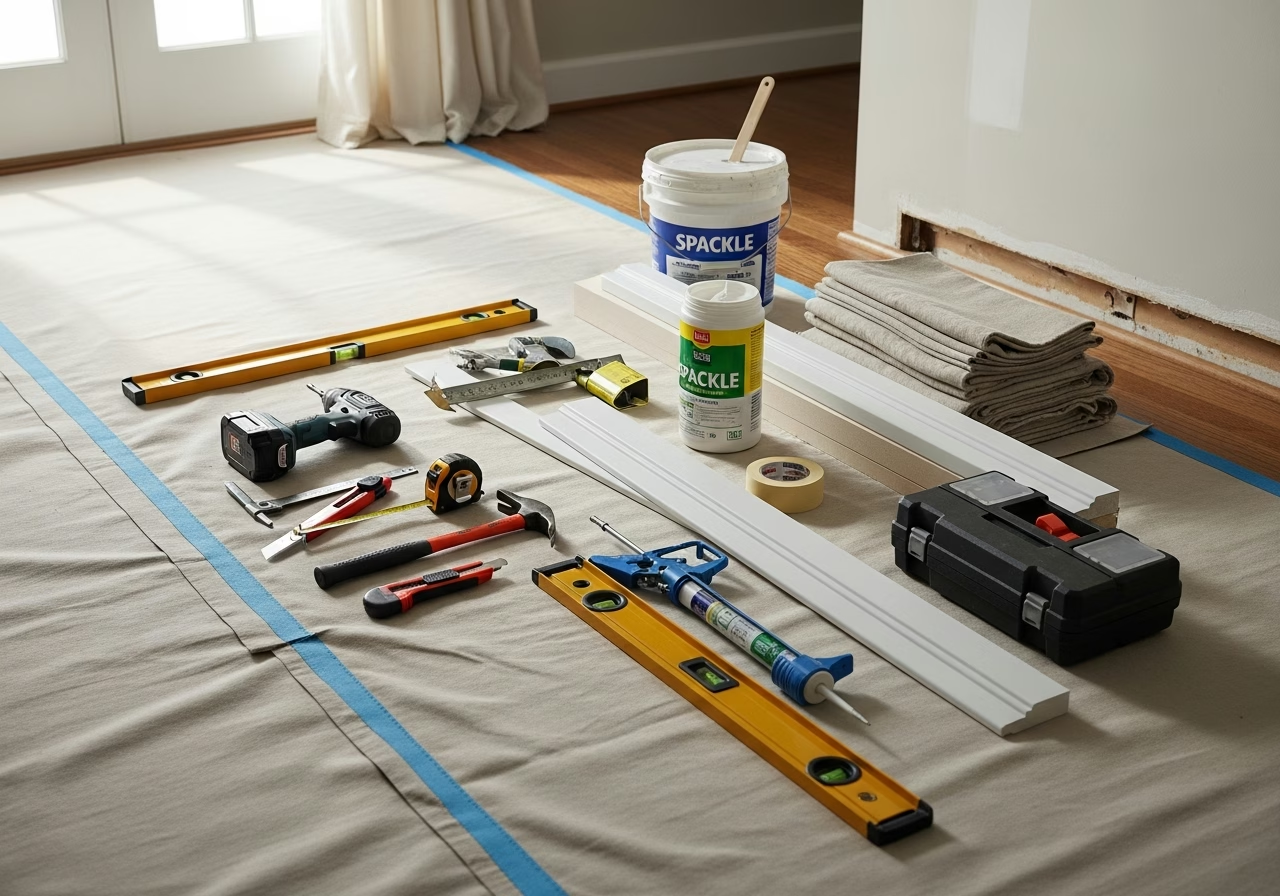
- Range hood, range, and adjacent cabinets soot-covered.
- Adjacent backsplash and countertop heat-damaged.
- Kitchen ceiling stained with smoke.
- Some smoke residue in adjoining rooms (especially via HVAC return).
For the kitchen-fire-specific process, see Kitchen Fire Restoration Toronto: The Process.
Scenario 2: Medium Room Fire (Contained to One Room)
The fire reached a contained burn before suppression. Examples: an electrical fault behind a wall, an unattended candle, a dryer-vent fire that escaped containment. Fire department responded; suppression water present.
Typical scope:- Burn zone of 50–250 sq ft (one room or part of a room).
- Heat damage extends 4–8 feet beyond the visible burn.
- Smoke residue throughout the home, intensity dropping with distance.
- Suppression water has saturated the floor below the burn (so a second-floor fire creates a first-floor water loss too).
Scenario 3: Smoke-Only Damage (No Burn Zone in Living Space)
A common Toronto pattern: a furnace puff-back, a chimney back-draft, or a fire confined to an attached garage that filled the house with smoke without any burn zone in the living space.
Typical scope:- No structural fire damage.
- Soot deposit on every horizontal surface throughout the home.
- Strong odour, sometimes wet-smoke residue (sticky, hard to remove).
- HVAC system heavily contaminated.
For the smoke odour process specifically, see Smoke Odour Removal Toronto: The Process.
Need professional home renovation?
Call RenoHouse at 289-212-2345 or get a free estimate today.
Get Free Estimate →Scenario 4: Multi-Room Fire (Significant Containment Failure)
The fire spread beyond the room of origin. Often involves a structural element — wall cavity, ceiling void, attic space — that allowed flame to travel.
Typical scope:- Burn zones across multiple rooms or floors.
- Significant structural damage (joists, studs, sheathing).
- Suppression water saturating large parts of the home.
- Severe smoke and soot throughout.
- Extended Additional Living Expenses (ALE) — homeowner displaced 4–8 months.
Scenario 5: Whole-House Fire (Total Loss or Near-Total)
The structure is uninhabitable. Often a teardown-and-rebuild scenario, or a structural rebuild on the existing foundation.
Typical scope:- Mitigation focus is contents salvage (sometimes), site safety, and demolition.
- Reconstruction is essentially new construction on the existing footprint.
- Permitting is full Toronto Building permit — structural drawings, energy code compliance, mechanical permits.
- ALE for 8–18 months is common.
How Insurance Covers Fire Claims
Three coverage types apply:
- Dwelling (Coverage A) — pays for structural repair up to the policy limit.
- Personal Property (Coverage C) — pays for contents up to a sub-limit (typically 50–70% of Coverage A).
- Additional Living Expenses (Coverage D) — pays for hotel, rental, restaurant differential while displaced (typically 20–25% of Coverage A, time-limited).
Major Toronto carriers (Aviva, Intact, TD, Wawanesa, Belair, Co-operators, RSA) all use Xactimate as the standard estimating tool. Toronto-area Xactimate price lists are updated quarterly and reflect actual market rates for materials and labour. A reputable rebuild contractor will write the estimate in Xactimate, send it to the adjuster, and negotiate any line-item disputes from there.
Two coverage subtleties worth understanding:
Replacement Cost Value (RCV) vs Actual Cash Value (ACV). Most modern Toronto policies are RCV — they pay the cost to replace the damaged item with a new equivalent. Older or lower-tier policies are ACV — they pay the depreciated value. The difference matters a lot on a 15-year-old kitchen. Code Upgrade coverage. When a fire forces a partial rebuild, current building code may require upgrades the original construction didn't include — modern smoke detectors, GFCI outlets, attic insulation to current R-60, sometimes structural upgrades. Most Toronto policies include a "Building Code Upgrade" rider (often $10,000–$25,000 of additional coverage) — confirm yours.For the claim process in detail, see Insurance Claims for Water Damage in Toronto (the fire claim process is structurally identical).
Deductibles
Toronto fire-claim deductibles run $500–$2,500, with $1,000 being the modal deductible across major carriers in 2026. Higher-value homes and condo policies sometimes carry $2,500 or $5,000 deductibles in exchange for premium reductions.
Direct Billing
Most Toronto restoration networks and most rebuild contractors (RenoHouse included, on the rebuild side) direct-bill the carrier for fire claims. The homeowner pays the deductible at project start and the carrier pays the rest directly to the contractor. For mechanics, see Direct Billing for Insurance Restoration in Toronto.
Where the Rebuild Phase Sits in the Budget
A useful heuristic for planning purposes: on a typical Toronto fire claim, the rebuild phase represents 50–70% of the total claim cost. The mitigation phase is highly visible (24/7 response, big trucks, dramatic-looking demolition) but is usually 15–30% of the budget. The rebuild is where the real money sits — and it's where the homeowner has the most influence on the final outcome. Choosing a finish-quality contractor for the rebuild is often more impactful than choosing the mitigation team.
Renovation vs Restoration Pricing
Restoration projects in Toronto typically cost more per square foot than equivalent voluntary renovations — sometimes 20–40% more. Reasons:
- More demolition, more removal-and-reinstall of un-damaged adjacent material.
- Strict scope documentation and Xactimate adherence (less flexibility on substitutions).
- Extra layers of cleaning and sealing for soot or contaminated substrates.
- Compressed timelines and rebuild-during-occupied-elsewhere logistics.
For a side-by-side breakdown, see Restoration Cost vs Renovation Cost: The Difference.
Out-of-Pocket Budget for Toronto Homeowners
For a fully insured fire claim under a standard Toronto homeowner policy, expect to pay out of pocket:
- The deductible ($500–$2,500).
- Any upgrades beyond pre-loss condition (you wanted quartz instead of laminate; that's on you).
- Any uninsured contents (items not on your inventory or above policy sub-limits).
- Depreciation float while waiting for RCV recovery (often 10–20% of the dwelling claim, recovered upon rebuild completion).
Net out-of-pocket on a typical $35,000 Toronto fire claim is usually $1,000–$4,000, assuming standard coverage and no major upgrades.
Next Steps
If you are mid-claim, call your insurer and an IICRC-certified mitigation team. Once the structure is mitigated, RenoHouse coordinates the rebuild with your carrier — direct billing where supported, Xactimate scoping, and finish-quality work.
Get a restoration consultationRelated Reading
- Fire & Water Damage Restoration Toronto 2026: Complete Guide
- Kitchen Fire Restoration Toronto: The Process
- Smoke Odour Removal Toronto: The Process
- Insurance Claims for Water Damage in Toronto
- Restoration Cost vs Renovation Cost: The Difference
Sources & References
Authoritative sources cited in this guide:
- Ontario Building Code — OBC official text
- Toronto Building Permits — City permit portal
- Tarion New Home Warranty — Ontario new-build warranty regulator
- HCRA — Home Construction Regulatory Authority — Ontario builder/vendor licensing
Continue Reading