RenoHouse

# Fire & Water Damage Restoration Toronto 2026: Complete Insurance & Rebuild Guide
Quick answer. A burst supply line at 3am. A kitchen grease fire that fills the second floor with smoke. A sewer backup after a thunderstorm. In Toronto, fire and water damage events generate roughly 40,000 residential insurance claims per year, and the average homeowner has no idea what happens between the first phone call and the keys-back walkthr...A burst supply line at 3am. A kitchen grease fire that fills the second floor with smoke. A sewer backup after a thunderstorm. In Toronto, fire and water damage events generate roughly 40,000 residential insurance claims per year, and the average homeowner has no idea what happens between the first phone call and the keys-back walkthrough four months later.
This is the RenoHouse pillar guide for fire and water damage restoration in Toronto for 2026. It covers the full lifecycle: 24/7 emergency mitigation, IICRC-certified drying and decontamination, insurance claim coordination with major Canadian carriers (Aviva, Intact, TD, Wawanesa, Belair, Co-operators, RSA), the difference between the *mitigation* phase and the *rebuild* phase, equipment standards (Phoenix DriZone, Dri-Eaz Dragon, FLIR thermal imaging), direct-billing programs, and the typical 60–120 day project timeline from event to move-back.
A note on how RenoHouse fits in. Restoration is a 24/7 operational mode that requires IICRC certification, dedicated emergency crews, and large equipment fleets. RenoHouse is a renovation contractor — we partner with established IICRC-certified restoration teams (Restorx Disaster Restoration, ServiceMaster Restore, Steamatic, FirstOnSite, PuroClean) for the mitigation phase, and we perform the rebuild and renovation phase that comes after the structure is dry and decontaminated. Insurance coordination and direct billing are available where the carrier supports it.For specific deep-dives, see the cluster posts linked at the end of this guide.
How Restoration Differs From Renovation
The single most useful concept for any homeowner facing a damage event is the difference between mitigation and rebuild. They are two separate trades, often two separate companies, billed under two separate insurance line items.
Mitigation (also called "emergency restoration" or "Phase 1"):- Stops the active loss (water shut-off, board-up, tarp).
- Extracts standing water and contents.
- Dries the structure to S500 standard (industry IICRC reference).
- Decontaminates for biohazard, smoke, or sewage exposure.
- Performs controlled demolition of unsalvageable materials (wet drywall, soaked insulation, charred framing).
- Documents everything for the adjuster.
- Replaces drywall, insulation, flooring, trim, cabinets, paint, fixtures.
- Restores finishes to pre-loss condition (or better, with insurance approval).
- Coordinates trades: framing, electrical, plumbing, HVAC, drywall, paint, flooring, tile, cabinetry.
- Final cleaning and homeowner walkthrough.
In Toronto, most carriers prefer separate vendors for the two phases — it reduces conflict-of-interest concerns and aligns each scope with the right specialty. The mitigation team is rewarded for fast, thorough drying. The rebuild team is rewarded for finish quality. This is exactly why RenoHouse focuses on the rebuild side: our craft is finish carpentry, kitchens, bathrooms, and full-home renovation, not 24/7 emergency response.
The First 48 Hours: Emergency Mitigation
When water or fire damage occurs, the clock starts immediately. Mold begins colonizing wet drywall within 24–48 hours. Smoke residues become acidic and start etching metal, glass, and finishes within hours. Insurance policies require the homeowner to take "reasonable steps to prevent further damage" — failure to act fast can result in claim reductions.
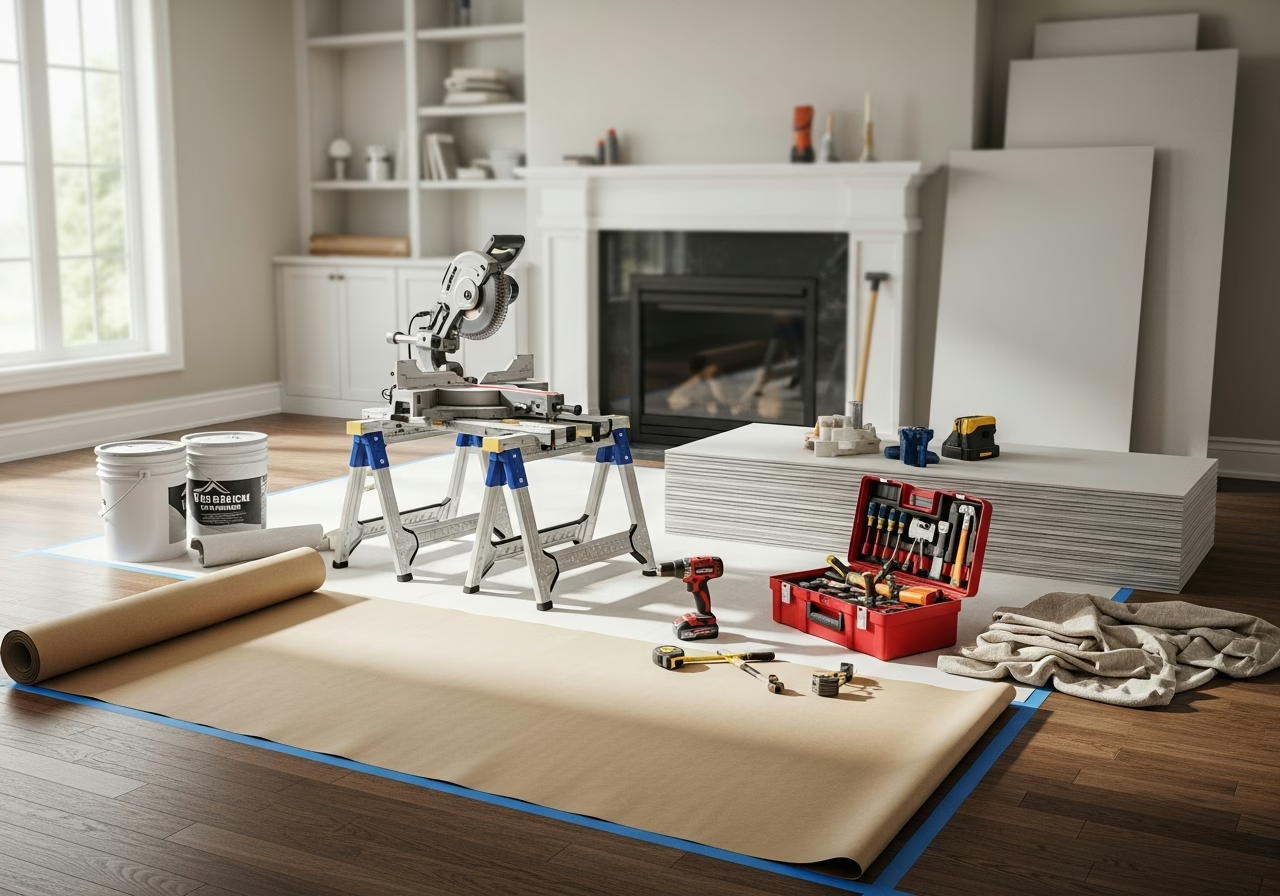
Standard 48-hour timeline:
Hour 0–1: Stop the loss.- Water: shut off the main supply, the affected fixture, or the appliance.
- Fire: confirm fire department has cleared the structure; do not re-enter until cleared.
- Sewer backup: do not enter the affected area; raw sewage is a Category 3 biohazard.
- File the claim. Get a claim number. Note the adjuster name.
- Most major Toronto restoration firms respond within 60–90 minutes inside the GTA.
- The crew will photograph, sketch, and meter (moisture readings) every affected space before touching anything.
- Water extraction with truck-mounted pumps (commercial vacuum capacity 5–15 gallons per minute).
- Content pack-out: salvageable contents are inventoried, photographed, and removed for off-site cleaning.
- Equipment deployment: air movers (Dri-Eaz Sahara or Phoenix Axial), refrigerant dehumidifiers (Phoenix R175, Dri-Eaz Revolution LGR), HEPA air scrubbers.
- Controlled demolition: wet drywall is cut at 12" or 24" lift lines; saturated insulation is bagged for disposal.
- Daily moisture readings using pin meters (Delmhorst BD-2100) and non-invasive scanners (Tramex MEP).
- FLIR thermal imaging to identify hidden moisture behind finishes.
- The structure should reach "drying goal" (target moisture content) within 3–5 days for most water losses.
For a deeper look at the equipment and process, see Water Extraction & Drying in Toronto: The Equipment Used.
Water Damage Categories (IICRC S500)
Not all water damage is created equal. The IICRC S500 standard defines three water categories, and the category drives the entire restoration approach.
Category 1 — Clean Water. Burst supply line, sink overflow with no contamination, rainwater intrusion. Can be dried in place. Lowest risk, fastest resolution. Insurance typically covers fully. Category 2 — Grey Water. Dishwasher discharge, washing machine discharge, toilet overflow (urine, no feces), aquarium water. Significant contamination. Most porous materials must be removed. Antimicrobial treatment required. Category 3 — Black Water. Sewage backup, river or lake flooding, toilet overflow with feces, any water sitting more than 72 hours. Highest contamination. All porous materials (drywall, insulation, carpet, padding, particleboard) must be removed. Containment and PPE required. Often the single largest driver of claim cost.A key Toronto wrinkle: basement sewer backups during heavy rain events are almost always Category 3, and the cleanup is typically covered under a separate "sewer backup" rider on your insurance policy — not the standard water damage coverage. Without the rider, sewer backup losses are excluded. Confirm your policy now, before an event happens. For prevention, see backwater valve installation guide.
Fire Damage: Smoke, Soot, and Structural Heat
Fire restoration is more technically complex than water restoration because the damage extends beyond the burn footprint. Smoke and soot travel through HVAC ducts, electrical conduits, and any pressure differential, depositing on every horizontal surface in the home — sometimes on floors that never saw flame.
Three fire damage categories drive the restoration approach:
Wet smoke (low-heat, slow-burning fires) — typically plastics and synthetics, leaves a sticky, pungent residue that smears and is hard to remove. Dry smoke (high-heat, fast-burning fires) — typically wood and paper, leaves a dry, powdery residue that vacuums off relatively easily but penetrates porous materials deeply. Protein smoke (kitchen fires) — typically grease and protein-based materials, leaves a nearly invisible film that produces a strong, lingering odour. Often the hardest to neutralize.Smoke odour neutralization typically uses hydroxyl generators (Odorox, Air Allergen) for occupied spaces, or ozone generators for vacant spaces (ozone is unsafe to breathe and requires evacuation). Thermal fogging may also be used to penetrate textiles and porous finishes. For the full process, see Smoke Odour Removal in Toronto: The Process.
For kitchen-specific fires (the most common residential fire type in Toronto), see Kitchen Fire Restoration Toronto: The Process.
IICRC Certifications That Matter
When hiring a restoration firm in Toronto, the most reliable quality signal is IICRC certification. The Institute of Inspection, Cleaning and Restoration Certification is the international standard-setting body, and major Canadian insurers explicitly require IICRC certification on the work they fund.
Key certifications to look for on the firm's technicians:
Need professional home renovation?
Call RenoHouse at 289-212-2345 or get a free estimate today.
Get Free Estimate →- WRT (Water Restoration Technician) — baseline water damage credential. Every technician on a water loss should hold this.
- ASD (Applied Structural Drying) — advanced drying science, psychrometrics, equipment calculation. The crew chief should hold ASD.
- AMRT (Applied Microbial Remediation Technician) — required for any mold work. If your loss exceeds 48 hours wet, AMRT is essential.
- FSRT (Fire & Smoke Restoration Technician) — fire and soot specialty certification.
- OCT (Odor Control Technician) — for difficult odour cases (smoke, sewage, decomposition).
A reputable firm will list its certifications and the technicians who hold them. For a Toronto-specific perspective on certification verification, see IICRC-Certified Restoration in Toronto: What It Means.
How Insurance Claims Work in Toronto
Most Toronto homeowner policies provide three coverage types relevant to restoration:
- Dwelling (Coverage A) — the structure itself.
- Other Structures (Coverage B) — detached garage, fence, shed.
- Personal Property / Contents (Coverage C) — your belongings.
- Additional Living Expenses (Coverage D) — hotel, rental, restaurant meals while displaced.
The standard claim sequence:
- 1. Loss reported — homeowner calls insurer. Claim number assigned.
- 2. Adjuster assigned — staff adjuster (carrier employee) or independent adjuster (third-party). Site visit within 24–72 hours.
- 3. Mitigation authorized — emergency mitigation begins under the "duty to mitigate" clause; usually no formal estimate yet.
- 4. Scope of loss documented — adjuster, restoration firm, and (sometimes) a public adjuster on the homeowner's side agree on the affected scope.
- 5. Estimate written — typically using Xactimate, the industry-standard pricing software. Toronto-area Xactimate price lists are updated quarterly.
- 6. Estimate approved — adjuster authorizes the rebuild scope and amount.
- 7. Rebuild begins — reconstruction contractor (in our case, RenoHouse) executes the approved scope.
- 8. Final invoice and depreciation recovery — actual cash value (ACV) paid up front, depreciation recovered upon completion (replacement cost value, RCV).
Major Toronto insurers all use this same sequence: Aviva Canada, Intact Insurance, TD Insurance, Wawanesa, Belair Direct, The Co-operators, RSA Canada, Allstate. Each has a preferred-vendor network, but homeowners always have the right to choose their own contractor under Ontario consumer protection law. For details on the claim process from a homeowner's perspective, see Insurance Claims for Water Damage in Toronto: The Process.
Direct Billing: How It Works
"Direct billing" means the restoration firm or rebuild contractor bills the insurer directly, and the homeowner only pays the deductible. It is faster and far less stressful than the alternative ("pay-and-claim," where the homeowner pays out of pocket and waits for reimbursement).
Direct billing is supported by most major restoration networks in Toronto and by RenoHouse on the rebuild side, when the carrier participates. Typical Toronto deductibles for water and fire claims run $500–$2,500, with $1,000 being the modal deductible across major carriers in 2026.
For the full direct-billing process, see Direct Billing for Insurance Restoration in Toronto.
Mold Risk After Water Damage
The single biggest reason fast mitigation matters: mold colonies establish on wet cellulose materials within 24–48 hours. Once mold is present, the loss expands from a water claim to a mold-remediation claim, and the remediation cost can double or triple the original water claim.
Toronto's climate makes mold a year-round concern. Summer humidity routinely exceeds 70% RH; winter heating dries the air but creates condensation behind cold-side wall assemblies. Both conditions can sustain mold growth on wet substrates.
If your loss has been wet for more than 48 hours, assume mold is present and proceed accordingly. For the full mold-after-water process, see Mold Remediation After Water Damage in Toronto.
Restoration vs Replacement: When to Save and When to Rebuild
A surprisingly large portion of restoration cost is the salvage-vs-replace decision on each material. The IICRC framework provides decision criteria:
- Hardwood floors — often salvageable if dried within 72 hours; sand and refinish post-drying.
- Engineered hardwood — usually replacement; the layered construction delaminates when wet.
- Carpet over pad — pad always replaced; carpet may be salvageable if Category 1 only.
- Drywall — bottom 12–24" cut and replaced (the "flood cut"); upper drywall dried in place if dry.
- Insulation — fiberglass batts in wet wall cavities are always replaced; closed-cell spray foam may be salvageable.
- Cabinets — particleboard cabinets are usually replaced; solid wood cabinets often salvageable.
- Subfloor (OSB or plywood) — depends on swell and delamination; replacement common in Category 2/3.
For the full decision framework, see Restoration vs Replacement in Toronto.
Toronto Equipment Standards
The restoration industry has standardized on a relatively narrow set of professional equipment. When evaluating a restoration firm, ask what they use:
- Phoenix Axial Air Mover
- Dri-Eaz Sahara
- B-Air Vento
- Phoenix R175
- Dri-Eaz Revolution LGR
- Phoenix DriZone HD (large-cavity drying)
- Dri-Eaz Dragon (recirculating heat drying)
- Phoenix FireBird
- Dri-Eaz DefendAir HEPA 500
- BlueDri AS-550
- Delmhorst BD-2100 (pin)
- Tramex MEP (non-invasive)
- FLIR thermal imaging cameras (E8, E96 series) for hidden-moisture mapping
A homeowner doesn't need to memorize this list — but seeing professional equipment on site is a strong quality signal.
Costs and Timelines: What Toronto Homeowners Pay
Per Insurance Bureau of Canada (IBC) regional data:
- Average water damage claim in Ontario: ~$12,000.
- Average fire damage claim in Ontario: ~$35,000.
- Range in Toronto specifically: $5,000 (small toilet overflow) to $200,000+ (full-house fire).
Typical timelines for Toronto water and fire claims:
| Loss Type | Mitigation | Rebuild | Total |
|---|---|---|---|
| Small water loss (one room) | 3–5 days | 2–4 weeks | 4–6 weeks |
| Medium water loss (multiple rooms) | 5–10 days | 6–10 weeks | 8–14 weeks |
| Sewer backup (basement) | 7–14 days | 6–12 weeks | 10–16 weeks |
| Kitchen fire | 10–21 days | 10–16 weeks | 14–22 weeks |
| Whole-house fire | 21–45 days | 16–32 weeks | 24–52 weeks |
For a cost-focused breakdown of fire restoration specifically, see Fire Damage Restoration Cost in Toronto. For a comparison of restoration vs ordinary renovation pricing, see Restoration Cost vs Renovation Cost: The Difference.
Common Homeowner Mistakes
Most claim disputes and cost overruns trace back to a small number of homeowner missteps. The most common:
- Waiting more than 24 hours to call the insurer.
- Throwing out damaged contents before the adjuster sees them.
- Hiring a non-IICRC firm because they were cheapest.
- Signing a "direction to pay" or "assignment of benefits" without reading it.
- Failing to keep receipts for additional living expenses.
- Cleaning soot before the adjuster documents the affected scope.
- Not photographing everything, multiple angles, before mitigation begins.
For the full mistake list, see Restoration Mistakes Toronto Homeowners Make.
Specific Loss Types
Some loss types deserve their own deep-dive:
- Basement flooding — sewer backup vs supply line vs foundation water; Category 3 protocol; subsidy program eligibility for prevention. See Basement Flooding Restoration in Toronto.
- Kitchen fire — protein smoke, grease vapour, range-hood contamination, cabinet salvage. See Kitchen Fire Restoration Toronto: The Process.
- Hidden-source water damage — slow leaks behind walls, often discovered during renovation; FLIR thermal imaging is the diagnostic tool of choice.
How RenoHouse Works With Restoration Partners
A typical RenoHouse engagement on a damage event looks like this:
- 1. Homeowner calls the insurer and an IICRC-certified mitigation partner (Restorx, ServiceMaster Restore, Steamatic, FirstOnSite, PuroClean).
- 2. Mitigation partner stabilizes, dries, and decontaminates over 1–3 weeks.
- 3. RenoHouse is brought in for the rebuild scope estimate and Xactimate review.
- 4. Adjuster approves the rebuild scope.
- 5. RenoHouse executes the rebuild — framing repair, drywall, paint, flooring, cabinetry, fixtures — coordinating directly with the carrier for direct billing.
- 6. Homeowner moves back. Final walkthrough. Depreciation recovery.
The advantage of this model: the homeowner gets a specialist mitigation team (24/7, IICRC certified, full equipment fleet) and a specialist rebuild team (finish quality, project management, single point of contact for the renovation phase). It's the same model the carriers prefer.
For asbestos-related complications during demolition phases (common in pre-1990 Toronto homes), see Asbestos Abatement Toronto 2026: Complete Guide. For prevention after a sewer backup, see [Backwater Valve & Sump Pump Toronto: Complete 2026 Subsidy Guide](/blog/backwater-valve-installation-toronto-2026) and [Toronto Basement Flooding Subsidy 2026: $6,650 Program Explained](/blog/toronto-basement-flooding-subsidy-2026-6650-program).
Next Steps
If you are facing an active loss right now, call your insurer first, then call an IICRC-certified mitigation firm. Do not wait until business hours.
If you are reading this proactively (smart), the most useful thing you can do today is:
- 1. Pull out your homeowner policy. Confirm sewer-backup rider, water-damage limits, and deductible.
- 2. Photograph every room, including under sinks, behind appliances, and inside the electrical panel. Save to cloud storage.
- 3. Inventory contents room-by-room. Save to cloud storage.
- 4. Locate your main water shut-off and confirm it actually turns. Many Toronto shut-offs are seized.
- 5. If you live in a combined-sewer neighbourhood, consider the backwater valve subsidy program.
For the rebuild side, RenoHouse is here. Once the structure is dry and decontaminated, we coordinate the renovation phase end-to-end, with insurance billing where supported.
Get a restoration consultationRelated Reading
- Water Damage Emergency Toronto: 24-Hour Response
- Fire Damage Restoration Cost in Toronto
- Mold Remediation After Water Damage in Toronto
- Smoke Odour Removal Toronto: The Process
- Insurance Claims for Water Damage in Toronto
- Water Extraction & Drying Equipment in Toronto
- Restoration vs Replacement in Toronto
- IICRC-Certified Restoration in Toronto
- Basement Flooding Restoration in Toronto
- Kitchen Fire Restoration Toronto: The Process
- Restoration Mistakes Toronto Homeowners Make
- Restoration Cost vs Renovation Cost: The Difference
- Direct Billing for Insurance Restoration in Toronto
- Cross-niche: Backwater Valve & Sump Pump Toronto: Complete 2026 Subsidy Guide, [Asbestos Abatement Toronto 2026](/blog/asbestos-abatement-toronto-2026-complete-guide), Toronto Basement Flooding Subsidy 2026: $6,650 Program.
Sources & References
Authoritative sources cited in this guide:
- Ontario Building Code — OBC official text
- Toronto Building Permits — City permit portal
- Tarion New Home Warranty — Ontario new-build warranty regulator
- HCRA — Home Construction Regulatory Authority — Ontario builder/vendor licensing
Continue Reading