RenoHouse

# Floor Soundproofing Toronto: Impact Noise and IIC 2026
Quick answer. Most Toronto neighbour-noise disputes are not about voices, music, or TV — they are about footsteps, chair drags, dog claws, and dropped objects. These are all impact noise events that travel through floor structure into the unit below as audible thumps, scrapes, and bass-frequency rumbles.Most Toronto neighbour-noise disputes are not about voices, music, or TV — they are about footsteps, chair drags, dog claws, and dropped objects. These are all impact noise events that travel through floor structure into the unit below as audible thumps, scrapes, and bass-frequency rumbles. The metric is not STC; it is IIC (Impact Isolation Class). The solution is not mass on a wall; it is a properly designed floor assembly with resilient underlayment, possibly paired with a decoupled ceiling below.
This post covers Toronto floor soundproofing for impact noise: IIC fundamentals, condo board minimums, underlayment product selection, engineered hardwood vs vinyl plank acoustic differences, and multiplex vertical assemblies. For pillar context see Acoustic Soundproofing Renovation Toronto.
Honest Positioning
Standard renovation work — flooring, subfloor preparation, underlayment installation. RenoHouse coordinates flooring and ceiling sub-trades. Condo board approvals require submitting underlayment specifications for review; we manage that submission as part of the renovation request. We do not perform field IIC testing; if a condo bylaw dispute requires verification, an acoustic consultant is engaged.
IIC vs STC: The Distinction
STC (Sound Transmission Class) measures airborne sound transmission — voices, music, TV. Tested with speakers and microphones across the partition.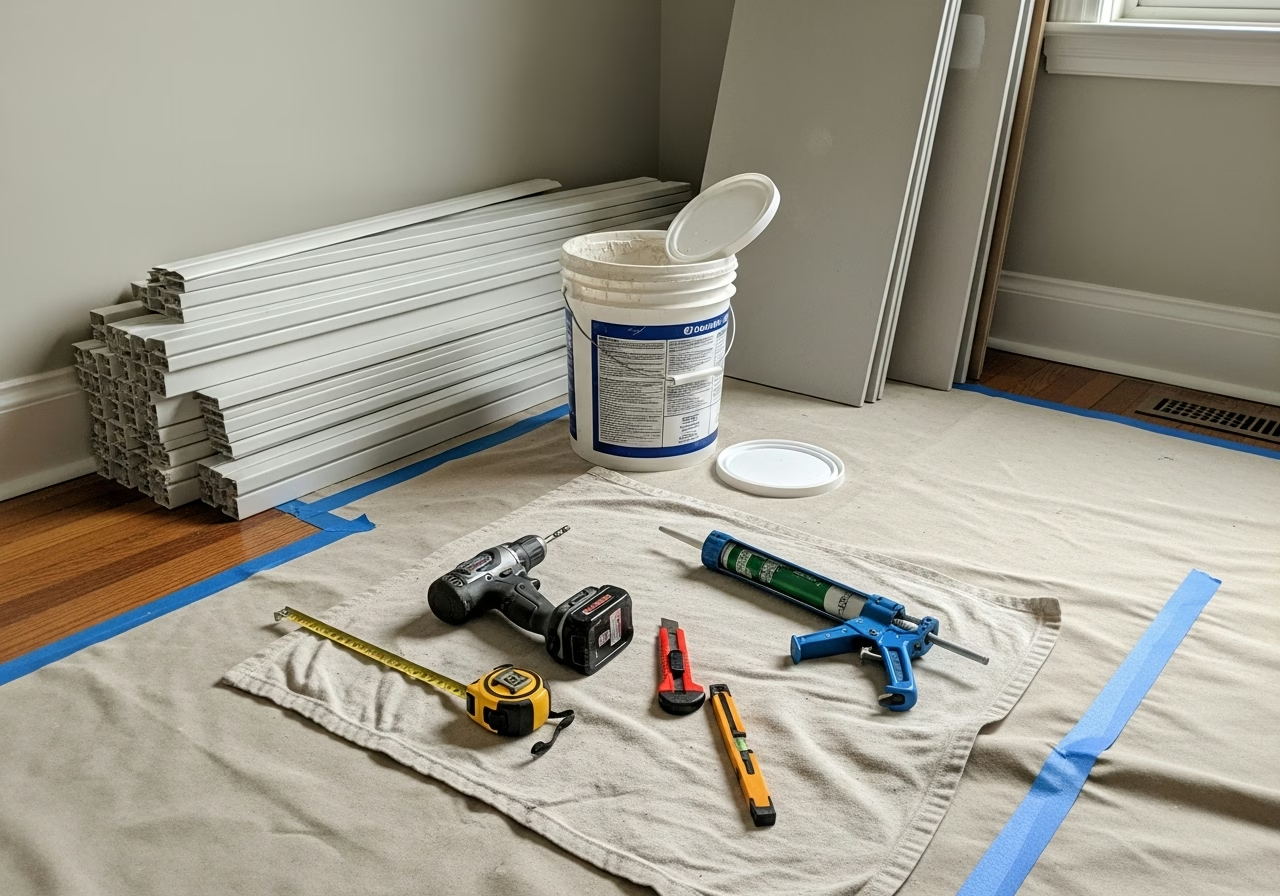
A floor assembly has both an STC rating (airborne) and an IIC rating (impact). The two ratings can be very different. A bare 6-inch concrete slab has high STC (around 50) but low IIC (around 25-30) for hard-surface flooring above. The same slab with proper underlayment can hit IIC 60+ without changing the airborne STC much.
For Toronto condos, IIC is almost always the limiting metric. The slab handles airborne fine; the impact is the problem.
Toronto Condo Board IIC Minimums
The OBC 9.11 mandate is STC 50 (airborne) between dwelling units. There is no OBC IIC mandate. However, most Toronto condo boards add their own IIC minimum in the renovation bylaw, typically:
- Mid-1990s buildings: IIC 50 minimum for hard-surface flooring approval.
- 2000s-2010s buildings: IIC 55 minimum.
- 2015+ premium buildings: IIC 60 minimum.
The bylaw is checked as part of the renovation request. The condo property manager will require a published-listing underlayment that meets or exceeds the building's IIC minimum, installed per manufacturer spec, before approving hard-surface flooring (hardwood, engineered hardwood, vinyl plank, tile).
If you install hardwood without an underlayment that meets the bylaw, you will fail post-installation review, the upstairs neighbour will complain, and you may be required to remove and reinstall the floor at your expense. We see this happen 4-6 times a year on remediation projects.
Underlayment Product Reference (Toronto 2026)
The dominant Toronto underlayment products and their typical IIC ratings on a 6-inch concrete slab:
Need professional home renovation?
Call RenoHouse at 289-212-2345 or get a free estimate today.
Get Free Estimate →- Pliteq GenieMat RST-02 (2mm rubber): IIC 56-60 with engineered hardwood; IIC 60-65 with vinyl plank. The premium standard.
- Pliteq GenieMat RST-12 (12mm rubber): IIC 65-70 with engineered hardwood. Used in premium condo buildings (Yorkville, Bay Street Corridor) and high-end condo conversions.
- Maxxon Acousti-Mat 2 (2mm fibre + Maxxon gypsum overlay): IIC 58-62 with hardwood. Used in commercial conversion buildings and lofts.
- Quiet Walk Plus (3mm felt): IIC 50-55 with engineered hardwood. Mid-range option.
- Regupol Sonus 5mm: IIC 56-60 with engineered hardwood. Common in Toronto townhome and stacked-condo construction.
- Felt-Right (5mm felt): IIC 52-56. Budget option.
- Cork underlayment (6mm): IIC 52-56. Eco-positioned option, similar performance to felt.
Vinyl plank with attached cork or rubber pad has its own integrated IIC rating; verify the manufacturer's published listing for the specific product, not the underlayment alone.
The published IIC is the lab rating. Field IIC is typically 3-5 points lower with normal workmanship.
The Key Variable: Surface Material
Impact noise is generated when a hard object hits a hard surface. The harder the surface, the more impact energy is converted to noise.
- Carpet over pad: very low impact noise generation. IIC 65-75 even on a bare slab. Carpet is acoustically excellent.
- Vinyl plank with attached pad: moderate impact noise. IIC 55-65 typical with 2mm underlayment.
- Engineered hardwood (3/8" or 1/2"): higher impact noise. IIC 50-60 with quality underlayment.
- Solid hardwood (3/4"): high impact noise. IIC 45-55 with quality underlayment.
- Ceramic tile or stone: highest impact noise. IIC 40-50 with quality underlayment; often the bylaw requires upgraded underlayment specifically for tile.
For a Toronto condo upgrading from carpet to hardwood, the building bylaw will typically be designed around the hardwood case, not the carpet case. Going from carpet (IIC 70) to hardwood without proper underlayment often produces a 25-point IIC drop and an immediate complaint from below.
The Standard Toronto Condo Floor Soundproofing Scope
For a typical condo flooring renovation hitting IIC 55 minimum:
- Slab preparation: flatten and clean the existing concrete.
- Underlayment: Pliteq GenieMat RST-02 (or equivalent meeting bylaw IIC), seamed and rolled per manufacturer spec.
- Engineered hardwood or vinyl plank: floating installation (not glued, not nailed) on top of the underlayment. Do not penetrate the underlayment with fasteners; that creates a rigid path through the resilient layer.
- Perimeter detail: 3/8" expansion gap between flooring and walls; acoustic sealant in the gap before baseboard reinstallation.
- Threshold and transition strips: floating, with acoustic sealant under the transition.
Cost: $1.50-3.00/sqft for the underlayment + ~$5-12/sqft for the engineered hardwood or vinyl plank itself. Total flooring scope ~$7-15/sqft including labour.
For premium IIC 60+ scopes, upgrade to Pliteq GenieMat RST-12 (12mm) — adds 1 inch of floor height and ~$2-3/sqft in material cost.
Ceiling-Side Treatment (From Below)
When the upstairs unit cannot be modified (separate owner, tenant in place, hardwood being preserved), impact noise from above can still be attenuated by treating the ceiling of the unit below. The IIC improvement from a decoupled ceiling alone is typically 10-18 points.
The ceiling assembly:
- AcoustiClips (RSIC-1) on the existing ceiling drywall or ceiling joists.
- Hat channel.
- Two layers of 5/8" Type-X drywall with Green Glue between.
- Roxul Safe'n'Sound in the cavity (if depth permits).
- Gasketed pot lights, IC-AT rated only.
- Acoustic sealant at perimeter.
Cost: $20-30/sqft of ceiling area. For a 12x12 bedroom the scope is $2,900-4,300.
This is the typical fix when a condo owner has an upstairs-noise complaint and the upstairs neighbour is not cooperative. See Condo Soundproofing Toronto: Stop the Upstairs Neighbour for the complete scope.
Multiplex Vertical Assemblies
For a Toronto multiplex with vertically stacked dwelling units, the floor-ceiling assembly must satisfy both STC 50 airborne and (de facto) IIC 50+ impact. The standard assembly:
- From above (upper unit): Pliteq GenieMat RST-02 (or equivalent IIC 55+ underlayment) + engineered hardwood or vinyl plank.
- From below (lower unit): strip ceiling drywall, Roxul Safe'n'Sound R-23 in joist cavity, AcoustiClips + hat channel, two layers 5/8" Type-X drywall with Green Glue.
- Penetrations: all gasketed; no IC-non-rated pot lights; HVAC ducts run via lined silencers.
Outcome: STC 55 airborne, IIC 55-60 impact. Code-compliant for OBC 9.11 and most Toronto property-standards expectations.
For the full multiplex scope context see Multiplex Soundproofing STC 50 Toronto.
Workflow Differences: Condo vs Detached vs Multiplex
Condo: read renovation bylaw, submit underlayment spec for board approval, schedule install during permitted hours (typically 9 AM-5 PM weekdays only), keep elevator booking. Detached: no bylaw constraint; the limiting factor is whether the floor-ceiling assembly is between two occupied spaces (e.g., upstairs bedroom over a basement office). For detached homes this is more often a comfort upgrade than a code requirement. Multiplex licensing: plan-examiner-driven. Floor-ceiling assemblies between units are explicit on the drawings. Both upper underlayment and lower ceiling decoupling are typically required. Permit-bound construction.What Doesn't Work
- Area rugs alone without underlayment under the hardwood. Helpful but not sufficient; many bylaws explicitly require continuous underlayment, not just area rugs.
- Cheap thin foam underlayment (1mm budget products). May meet IIC 45 but not IIC 50 — fails most condo bylaws.
- Glued-down hardwood on resilient underlayment. The glue penetrations create rigid paths through the underlayment.
- Standard subfloor installation under hardwood without a tested-listed acoustic underlayment. Standard "moisture barrier" foam underlayments are not acoustic products.
Next Step
For a condo floor renovation, the underlayment selection is the most important decision. Choose a published-listing product that meets or exceeds your building's IIC bylaw, install it per manufacturer spec, and the floor will pass review. For a condo upstairs-noise problem, ceiling-side treatment is often the right move when you cannot influence the upstairs unit. For a multiplex, both upper underlayment and lower ceiling are typically scoped together.
For pillar context see Acoustic Soundproofing Renovation Toronto. For sibling scopes see Condo Soundproofing Toronto: Stop the Upstairs Neighbour and Multiplex Soundproofing STC 50 Toronto. Or book a flooring acoustic consultation through the home renovation service page.
Sources & References
Authoritative sources cited in this guide:
- Ontario Building Code — OBC official text
- Toronto Building Permits — City permit portal
- Tarion New Home Warranty — Ontario new-build warranty regulator
- HCRA — Home Construction Regulatory Authority — Ontario builder/vendor licensing
Continue Reading