RenoHouse


Designing an in-law suite for an aging parent is fundamentally about building once, adapting later. A suite designed with universal design principles costs roughly $4,000-$10,000 more at construction than a generic suite. Retrofitting the same features after the fact costs 4-6x more — and often involves tearing out finishes that are only a few years old.
This post is the RenoHouse design playbook for Toronto in-law suites built for aging parents in 2026: room-by-room moves, what to spec at framing, what to install at finish, and what to leave as future-ready provisions.
Honest Positioning
RenoHouse delivers the construction. We coordinate occupational therapist (OT) input on request — an OT consultation ($300-$600) is the gold standard for matching the design to the specific parent's current and projected needs. For broader aging-in-place service, see Aging-in-Place Renovation Toronto 2026.
Universal Design Principles
Universal design is the framework: build the suite so it works for a 65-year-old today, an 80-year-old in fifteen years using a walker, and a 90-year-old in thirty years using a wheelchair. The same physical features that help an aging parent also help anyone with a temporary mobility issue (post-surgery, fracture, pregnancy).
Five principles guide the design:
- Equitable use — the same entry, the same kitchen, the same bathroom serve everyone.
- Flexibility in use — features adapt to changing needs.
- Simple and intuitive — controls are obvious; no hidden switches or complicated mechanisms.
- Tolerance for error — surfaces are non-slip, edges are rounded, lighting prevents trips.
- Low physical effort — lever handles instead of knobs, motion-activated lighting, soft-close drawers.
Entry
The entrance to the suite sets the tone for daily use:
- No-step entry — zero-threshold or 1/2" maximum threshold. Use a curb-less transition strip on the interior side.
- 36" wide door minimum (32" clear opening minimum, 34"+ clear preferred).
- Lever handle — never a knob. A 75-year-old with arthritis cannot grip a knob reliably.
- Sheltered exterior — small overhang or canopy keeps the parent out of rain/snow while unlocking.
- Motion-activated exterior light — eliminates fumbling for switches in the dark.
- Smart lock with keypad — no key-juggling. Many also have remote unlock for caregivers.
Cost: roughly $2,500-$5,500 above a baseline exterior door, mostly in the threshold detailing and the smart lock.
For the deep-dive on entrance options including new walkout configurations, see In-Law Suite Private Entrance Toronto.
Need professional home renovation?
Call RenoHouse at 1-289-212-2345 or get a free estimate today.
Get Free Estimate →Kitchenette
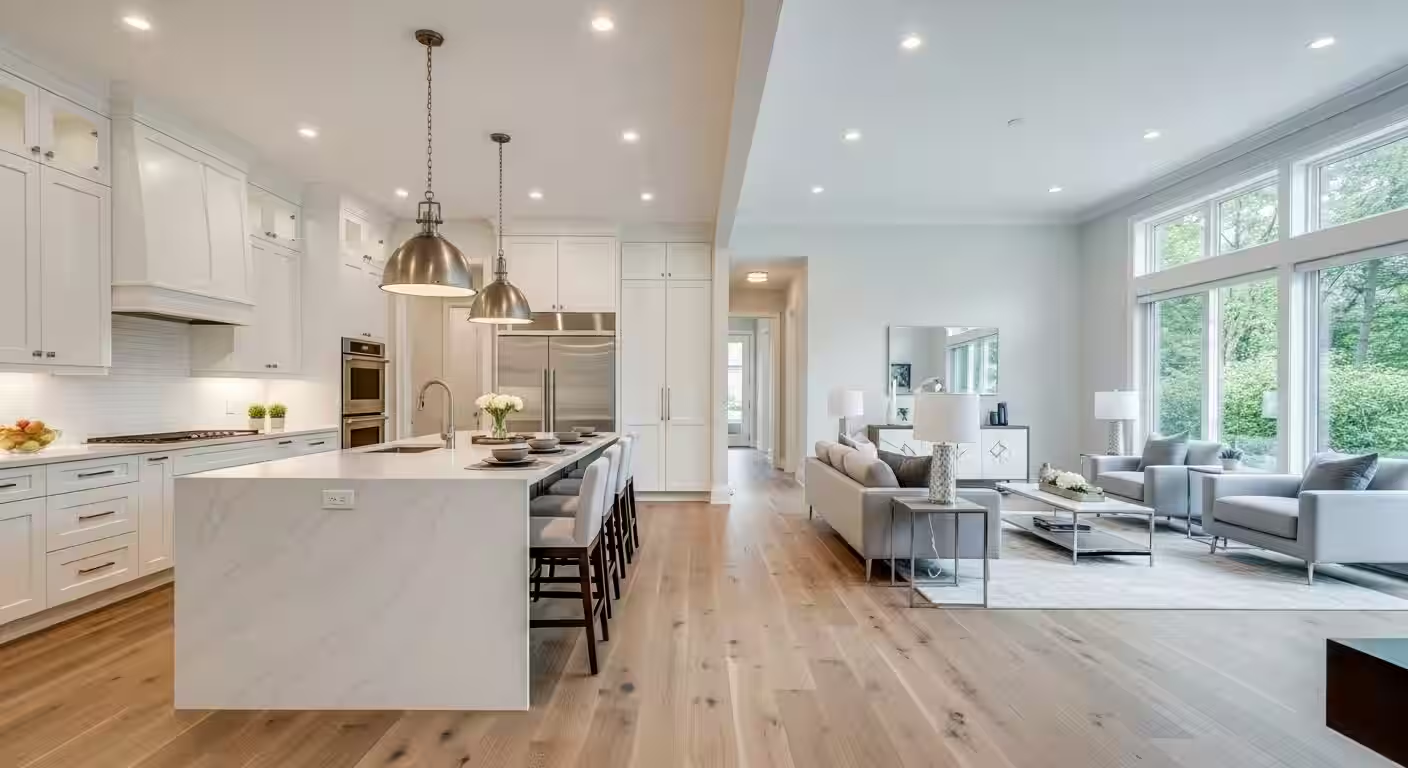
A kitchenette for an aging parent emphasizes reach, lighting, and induction:
- Lower upper cabinets — top shelf no higher than 60" above the floor (versus the standard 72-78"). Pull-down shelving for upper-cabinet contents.
- Roll-under sink — single-bowl, drain offset to the rear, exposed pipes wrapped in insulation. Allows seated use later if mobility changes.
- Induction cooktop — cooler surface (only the pot heats), automatic shut-off, no open flame, no gas line. Strongly preferred for any kitchen serving a parent with cognitive concerns.
- Side-by-side or French-door fridge — easier to reach top shelves than a top-freezer model.
- Lever faucet with anti-scald — single-lever, thermostatic if possible.
- Under-cabinet LED task lighting — eliminates shadows on the counter.
- Pull-out drawers instead of base cabinet shelves — no kneeling to reach the back.
- D-pull cabinet hardware — easier to grip than knobs.
- Contrasting counter edge to wall-cabinet bottoms — reduces head bumps and trip risk.
Cost: roughly $3,000-$6,000 above a baseline kitchenette.
For the full kitchenette deep-dive, see In-Law Suite Kitchenette Design Toronto.
Bathroom
The bathroom is where universal design pays back the most. A 78-year-old hospital-discharge after a hip replacement should be able to use the suite bathroom on day one.
- Curbless shower — linear drain, sloped tile floor, ideally 60" wide x 36" deep minimum. No threshold, no step-up.
- Grab-bar blocking — 3/4" plywood backing in the wall studs at standard heights. Even if the bars are not mounted at install, the blocking is there for cheap retrofit ($150 vs $1,500).
- Comfort-height toilet — 17-19" rim height (versus standard 14-15"). Reduces strain on knees and hips.
- Wall-hung sink or vanity with knee clearance — allows seated use.
- Anti-scald thermostatic shower valve — protects against burns when water pressure changes.
- Lever faucet handles.
- Slip-resistant tile — minimum DCOF 0.42 wet rating.
- Fold-down shower seat or ledge with grab support.
- Heated floor — comfort and helps prevent slips on cold tile.
- Lighting layered — overhead, vanity-flanking, night-light at floor level.
Cost: roughly $4,000-$8,000 above a baseline 3-piece. Worth every dollar.
For the full accessibility deep-dive, see In-Law Suite Bathroom Accessibility Toronto.
Sleeping Area
- Pathway to bathroom — clear, lit by motion-activated night-lighting, no rugs that can shift.
- Bed location — at least one side of the bed accessible by a wheelchair or walker (36" clear minimum).
- Closet — pull-down rod or adjustable-height rod. Lever handles on doors.
- Light switches at bedside — three-way switching to entry and bed.
- Phone/charging access — outlets at bed height (24-30" above floor) on both sides of the bed.
- Carbon monoxide and smoke alarms interconnected with main dwelling.
Living Area
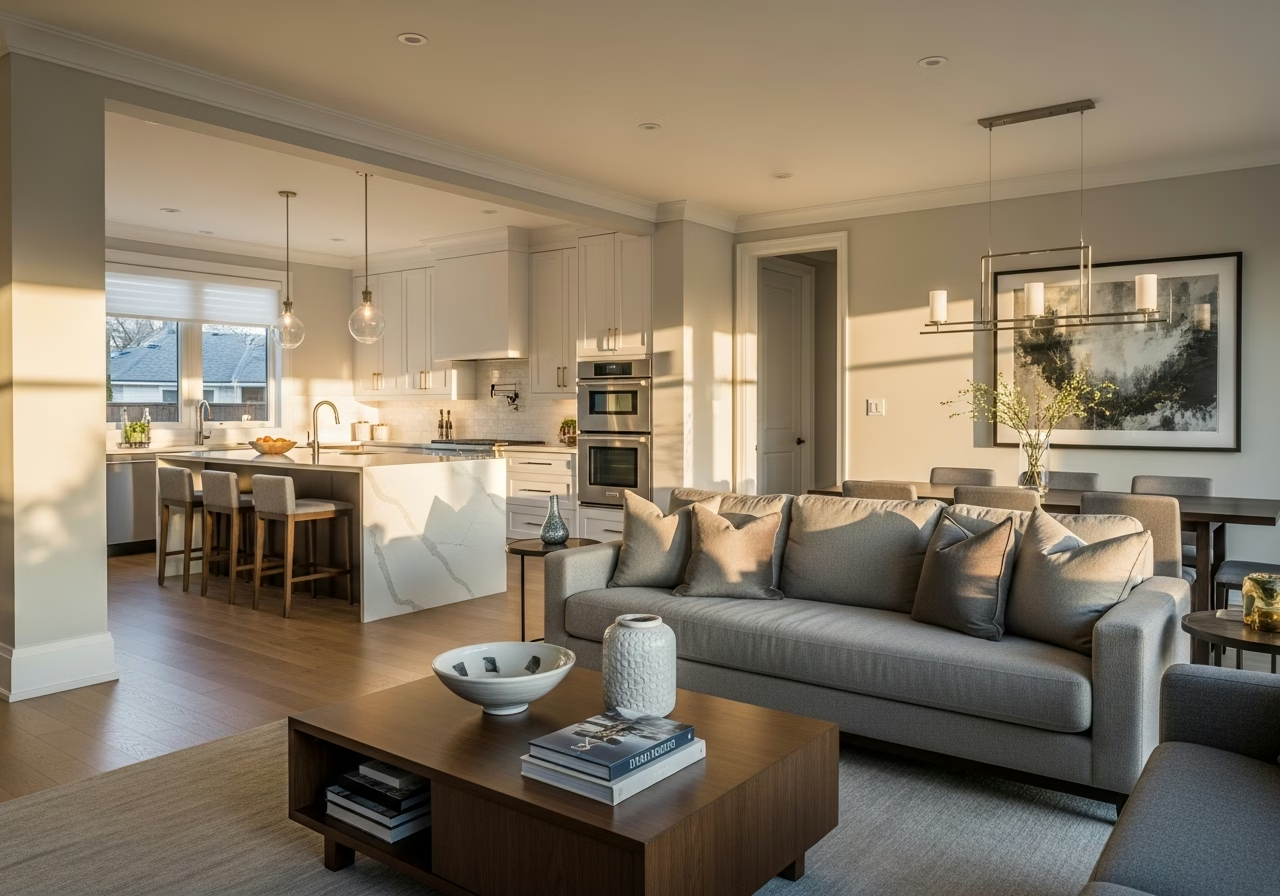
- Open layout — no narrow choke points, no thresholds between rooms.
- Furniture-friendly outlets — every 6 ft along walls.
- Cable and ethernet — pre-wired, terminated where the parent will likely place a TV and a chair.
- Lighting layered — ambient, task, accent. Multiple switched zones.
- Window operation — easy-open casement or awning windows; avoid stiff double-hung.
- Thermostat at accessible height — 48" max, easy-read display.
Throughout
These apply across the whole suite:
- Lever door handles on every interior door.
- Rocker light switches at 42-46" height.
- LED lighting throughout — no incandescent. Faster on, cooler, longer life.
- Outlets at 18-24" — not at floor level (hard to reach when bending is hard).
- No thresholds between rooms.
- Continuous flooring — same LVP or tile throughout. Reduces trip risk and visual confusion.
- Contrasting trim to wall colour — helps with depth perception in low light.
- Smoke and CO alarms interconnected and audible-visual (strobe units help if the parent has hearing loss).
Future-Ready Provisions
Some features cost very little to provide for at framing but a lot to add later:
- Stair-lift power — wire 120V outlet at top and bottom of any internal stair, even if no lift today.
- Elevator shaft footprint — leave a 5' x 5' stack of closet space aligned floor-to-floor that could become a residential elevator. Cost at install: $0. Cost to add later: $30K-$50K.
- Doorway widening provisions — non-load-bearing walls flanking key doorways. Cost at install: $0. Cost to widen later: $1,500-$3,000 per doorway.
- Reinforced ceiling joists above the bed — for a future ceiling-mounted patient lift.
- Bathroom drain capacity for a future curbless shower in case the original was a tub-shower combo.
These provisions cost effectively zero at framing and save tens of thousands in retrofit if needs change.
Cost Summary
| Universal design feature | Premium at install | Retrofit cost later |
|---|---|---|
| Curbless shower | $1,800-$3,500 | $8,000-$15,000 |
| Grab-bar blocking | $250-$450 | $1,500-$2,500 per bar location |
| 32"+ doorways | $200-$500 | $1,500-$3,000 per doorway |
| Lever handles throughout | $400-$800 | $400-$800 (same) |
| Roll-under sink | $300-$600 | $1,800-$3,200 |
| Comfort-height toilet | $0 (same price tier) | $250-$500 (replacement) |
| Anti-scald valve | $150-$300 | $400-$700 |
| Smart entry lock | $400-$700 | $400-$700 (same) |
| Heated bathroom floor | $1,200-$2,200 | $4,500-$8,500 |
| Total premium | $4,500-$9,050 |
Building accessibility-ready at install costs roughly $5,000-$10,000 more. Retrofitting later costs $25,000-$45,000 in materials and labour, plus the disruption of a second renovation in a parent's living space.
Common Design Mistakes
- Putting the suite on a single step from the entry — invisible to a healthy designer, dangerous for the parent.
- Specifying a tub-shower combo because "the parent doesn't need a curbless shower yet". They will.
- Standard-height toilets to "match the rest of the house". Comfort-height costs the same.
- Missing grab-bar blocking. Cost at install: $250. Cost to add later: $1,500+ each.
- No exterior light on the entrance. Or worse, a manual switch the parent must find in the dark.
- Cabinet hardware as round knobs. Lever-style D-pulls cost the same and work for arthritic hands.
Next Steps
Book a scoping visit at /services/home-renovation/multigenerational-inlaw-suite and request universal design planning. For the full pillar guide, see Multigenerational In-Law Suite Toronto: 2026 Complete Guide. For the bathroom-specific deep-dive, see In-Law Suite Bathroom Accessibility Toronto. For broader aging-in-place renovation service, see Aging-in-Place Renovation Toronto 2026.
Sources & References
Authoritative sources cited in this guide:
- Ontario Building Code — OBC official text
- Toronto Building Permits — City permit portal
- Tarion New Home Warranty — Ontario new-build warranty regulator
- HCRA — Home Construction Regulatory Authority — Ontario builder/vendor licensing
Continue Reading