RenoHouse

# Knob & Tube in Old Toronto Neighbourhoods: 1900-1940 Housing Stock
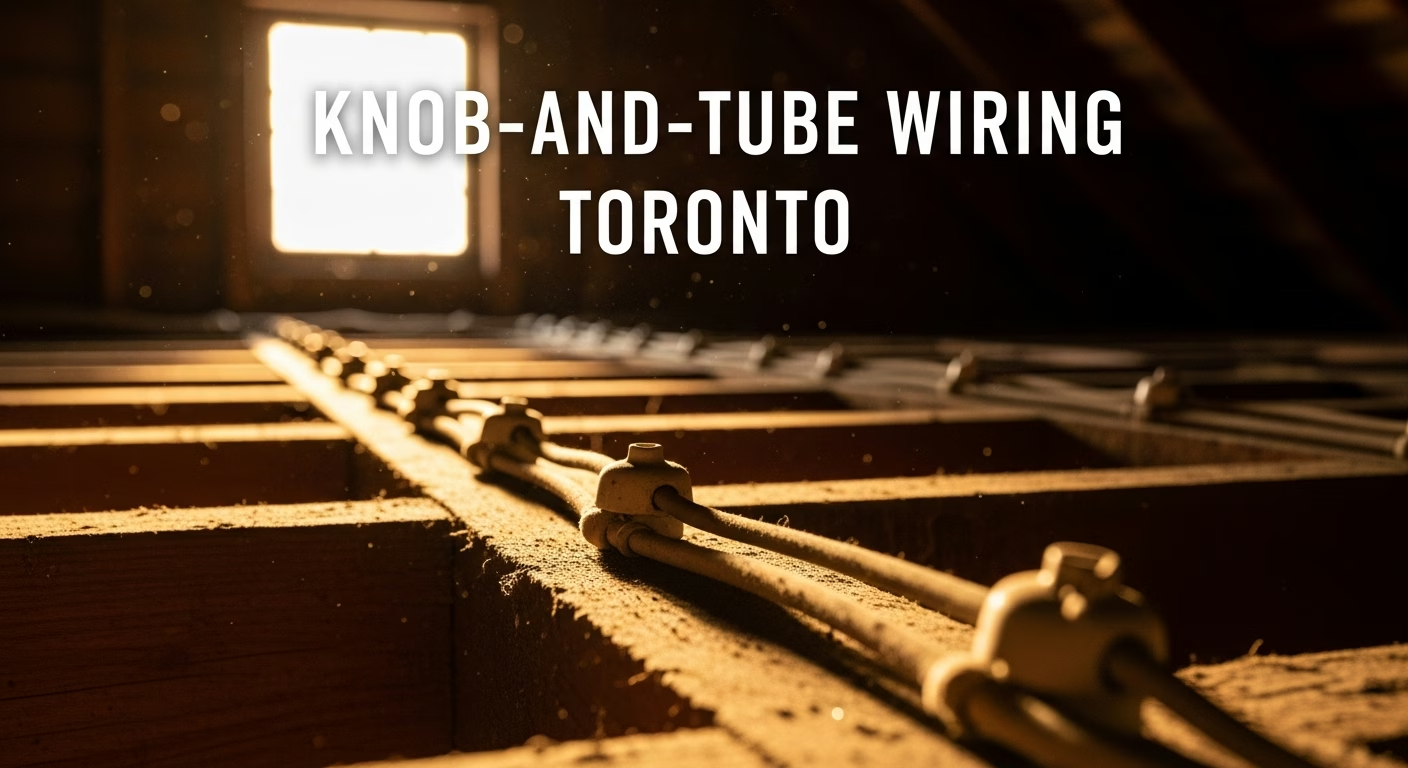
Quick answer. If your Toronto home was built between 1900 and 1945, the probability of knob and tube wiring (K&T) being present somewhere in your home is high. The exact distribution depends on neighbourhood, original construction quality, and the renovation history of your specific property.If your Toronto home was built between 1900 and 1945, the probability of knob and tube wiring (K&T) being present somewhere in your home is high. The exact distribution depends on neighbourhood, original construction quality, and the renovation history of your specific property. This post maps the Toronto neighbourhoods with the highest density of remaining K&T circuits, the typical building eras, and what to expect when you start the rewire conversation.
For the full rewiring guide, see Knob & Tube Rewiring Toronto: Complete 2026 Guide.
Why These Neighbourhoods Have K&T
Toronto's pre-WWII housing boom saw most of inner Toronto built using the wiring methods then standard. K&T was the dominant residential wiring from approximately 1880 to the late 1940s. Three factors made K&T the default in this era:
Need professional electrical services?
Call RenoHouse at 289-212-2345 or get a free estimate today.
Get Free Estimate →- Cost — single-conductor copper with porcelain hardware was cheaper than the alternative armoured cable.
- Heat dissipation — open-air installation handled the small loads of pre-WWII residential service.
- Code — the Canadian Electrical Code permitted K&T as standard residential wiring through the 1940s.
The neighbourhoods that grew during this era inherited K&T as their original wiring. Most of the homes have been partially renovated since, but full rewires were rare until the 2010s when insurance pressure made them necessary.
Neighbourhood-by-Neighbourhood Breakdown
Riverdale (East of Don Valley, South of Danforth)
- Era: 1885–1925 dominant, with infill 1925–1945.
- Stock: Victorian rowhouses, Edwardian semi-detached and detached, brick-and-frame construction.
- K&T prevalence: high. Most pre-1925 homes that have not been fully rewired retain K&T in the second floor and attic.
- Common issues: plaster walls (15–25% labour premium for fishing), narrow joist bays, asbestos paper around basement ducts, vermiculite in attics in some homes.
The Beaches / Beach (Queen East to Lake, Coxwell to Victoria Park)
- Era: 1900–1935. Original cottages 1900–1915, year-round homes 1920–1935.
- Stock: pre-WWI seasonal cottages converted to year-round residences, Edwardian and interwar detached.
- K&T prevalence: high. The conversion from cottage to year-round housing in the 1920s often added partial wiring without removing original K&T.
- Common issues: variable foundations (some on piers), creative renovations across decades, occasional asbestos in older cottages.
Cabbagetown (Bloor to Queen, Parliament to River)
- Era: 1860–1910 dominant, with infill 1910–1930.
- Stock: Toronto's largest Victorian neighbourhood, rowhouses and semi-detached, narrow lots.
- K&T prevalence: very high. Some homes have layered renovations that obscure original wiring; full rewire scope can surprise homeowners.
- Common issues: plaster walls, narrow stairs limiting material delivery, heritage considerations (Cabbagetown Heritage Conservation District) that affect exterior service work.
Leslieville (Queen East, Pape to Coxwell)
- Era: 1890–1930 dominant.
- Stock: workers' cottages, semi-detached, occasional detached. Smaller lots.
- K&T prevalence: high. Many homes had partial kitchen/bathroom rewires in the 1980s–2000s but retain K&T elsewhere.
- Common issues: small footprint reduces total rewire cost; basement access often limited.
Roncesvalles (West of Parkdale, North of Queen)
- Era: 1905–1925 dominant.
- Stock: Edwardian semi-detached and detached, two-and-half-storey common.
- K&T prevalence: high. Roncesvalles homes have undergone heavy gentrification renovation in the 2000s–2020s, but rewires often were partial.
- Common issues: heritage character considerations, plaster walls, occasional vermiculite.
High Park / Bloor West Village
- Era: 1900–1940 mixed, with substantial 1920s–1930s interwar stock.
- Stock: detached and semi-detached, larger lots than Roncesvalles, often with finished attics.
- K&T prevalence: medium-high. The interwar 1925–1940 portion may have transitioned to BX or early Romex; pre-1925 portion typically K&T.
- Common issues: finished attics complicate rewire fishing; larger panel upgrade scope.
The Annex (Bathurst to Avenue, Bloor to Dupont)
- Era: 1885–1920 dominant.
- Stock: large Victorian and Edwardian detached homes, often 3,000+ sq ft.
- K&T prevalence: very high. Many Annex homes have been converted to multi-unit (rooming houses, basement apartments) which complicates the rewire.
- Common issues: large project scope ($20,000–$45,000+), multiple kitchens / sub-panels, plaster walls throughout.
Wychwood (St. Clair West, north of the Annex)
- Era: 1910s–1925 dominant.
- Stock: Edwardian and early interwar detached homes, larger lots.
- K&T prevalence: medium-high. Many homes have been partially rewired during 2000s gentrification; some remain unrewired.
- Common issues: heritage Wychwood Park district; plaster walls.
The Junction (Dundas West, Annette to Lambton)
- Era: 1900–1930 dominant.
- Stock: workers' housing, semi-detached and detached, smaller lots.
- K&T prevalence: high.
- Common issues: smaller projects ($10,000–$20,000); occasional industrial-era complications.
Parkdale (West of King and Queen, south of Roncesvalles)
- Era: 1890–1925 dominant.
- Stock: large detached homes converted to multi-unit during the 20th century, semi-detached, rowhouses.
- K&T prevalence: very high. Multi-unit conversions often retain original wiring with patchwork additions.
- Common issues: largest projects in the city for converted multi-unit homes; complex circuiting.
Other Affected Neighbourhoods
- Bloordale, Davenport, Dovercourt — pre-1925 stock common.
- Greenwood-Coxwell — pre-1930 semi-detached.
- Trinity-Bellwoods — Victorian and Edwardian.
- Little Italy / Little Portugal — pre-1925 row and semi.
- Forest Hill (lower Forest Hill) — interwar 1925–1940.
Building Pattern Implications
A few patterns emerge across these neighbourhoods:
- Plaster walls dominate pre-1930 housing stock. Fishing wires through plaster is harder than through drywall, adds 15–25% labour, and produces patches that need plaster (not just drywall) finishing.
- Joist bay sizes in pre-1920 homes are often 16" on centre but with non-standard widths between joists due to old framing. Drilling for cable runs requires more careful navigation.
- Asbestos paper duct wrap around basement HVAC trunks is common in 1920s–1950s homes. Always assume present until visual inspection or sampling rules it out.
- Vermiculite is common in attics of homes insulated 1940s–1990. Most vermiculite contained Zonolite product with asbestos contamination.
- Federal Pioneer Stab-Lok panels were widely installed 1960–1980. Many of these homes have a 1970s panel upgrade overlaid on original K&T circuits — both need replacement.
Renovation History Implications
If your home in one of these neighbourhoods has had visible renovations, the wiring may be:
- Fully original K&T (no renovations): full rewire scope, $12,000–$25,000+.
- Kitchen and bath rewired (most common pattern): partial scope already done, full rewire $10,000–$22,000.
- Mostly rewired (1990s–2000s deep reno): scope is finishing the remaining 20–30%, $6,000–$12,000.
- Fully rewired with Certificate (rare in pre-1945 stock): no scope.
A site visit and panel inspection clarify which category your home falls into.
How RenoHouse Approaches Neighbourhood-Specific Projects
We have done projects across most of these neighbourhoods and have learned that:
- Plaster patching in pre-1930 homes deserves a dedicated trade. We bring a plasterer rather than treating it as drywall.
- Heritage Conservation Districts (Cabbagetown, Wychwood Park) require careful exterior service work. We coordinate with the City as needed.
- Multi-unit conversions (common in Parkdale, the Annex) require ESA scope clarification — single residential permit vs. multi-residential permit affects fees and timeline.
- Vermiculite and asbestos are present in most pre-1980 homes in these neighbourhoods. We sample early and coordinate Type 1/2 abatement before fishing begins.
See the Knob & Tube Rewiring Service Page and our coordinated [Asbestos Abatement](/services/home-renovation/asbestos-abatement) approach.
Related Reading
Knob & Tube Rewiring Toronto: Complete 2026 Guide, Signs You Have Knob & Tube Wiring Toronto, Knob & Tube + Asbestos & Vermiculite Coordination.Sources & References
Authoritative sources cited in this guide:
- Electrical Safety Authority (ESA) — Ontario electrical regulator
- Ontario Electrical Safety Code — OESC Section 26 / latest amendments
- Canadian Electrical Code Part I (CSA C22.1) — CEC standard
- NRCan — Electric Vehicle Resources — NRCan EV/charging programs
Continue Reading