RenoHouse

# Laneway House Cost Toronto: Full Breakdown 2026
Quick answer. A Toronto laneway house in 2026 costs $400,000 to $700,000 all-in for an 800-1,000 sq ft two-bedroom build, with hard construction running $450-$700 per square foot and soft costs adding another $30,000-$60,000 on top.A Toronto laneway house in 2026 costs $400,000 to $700,000 all-in for an 800-1,000 sq ft two-bedroom build, with hard construction running $450-$700 per square foot and soft costs adding another $30,000-$60,000 on top. The range is wide because laneway projects span everything from a 350 sq ft studio with a basic kitchen built off a pre-approved City plan ($230K-$320K) to a 1,200 sq ft cantilevered 2BR+ with brick cladding, heat pump, and a Tarion-warrantied design-build contract ($600K-$750K). This post is the line-by-line breakdown of where every dollar goes, so you can build a defensible budget before you sign a design contract.
For the broader pillar context including bylaws, timeline, and ROI, see the Laneway House Construction Toronto 2026 Complete Guide. For the rental income side of the math, see Laneway House Rental Income Toronto: ROI Analysis. For comparison with garden suites on lots without lane access, see the [Garden Suite Toronto 2026 Complete Guide](/blog/garden-suite-toronto-2026-complete-guide).
The Bottom Line: Three Realistic Budgets
| Tier | Size | All-In Cost | Build Profile |
|---|---|---|---|
| Entry | 350-500 sq ft 1BR | $280K-$400K | Pre-approved City plan, fibre-cement clad, mid-range finishes |
| Mid-range | 700-900 sq ft 2BR | $450K-$580K | Custom design, brick or premium clad, heat pump, mid-high finishes |
| Premium | 900-1,200 sq ft 2BR+ | $580K-$750K | Custom architect, Heritage District, Net Zero Ready, premium finishes |
These figures are for site-built laneway houses, which dominate the actual Toronto inner-city market. Modular/prefab options run $300-$450/sq ft hard cost ($200K-$400K all-in for smaller footprints) but require crane access that most Toronto laneway lots cannot accommodate. For most projects, modular is theoretically cheaper but practically unavailable.
Hard Construction Cost Per Square Foot
In 2026, Toronto laneway houses run $450-$700 per square foot in hard construction cost, which is $50-$100/sq ft higher than equivalent garden suites. The premium reflects:
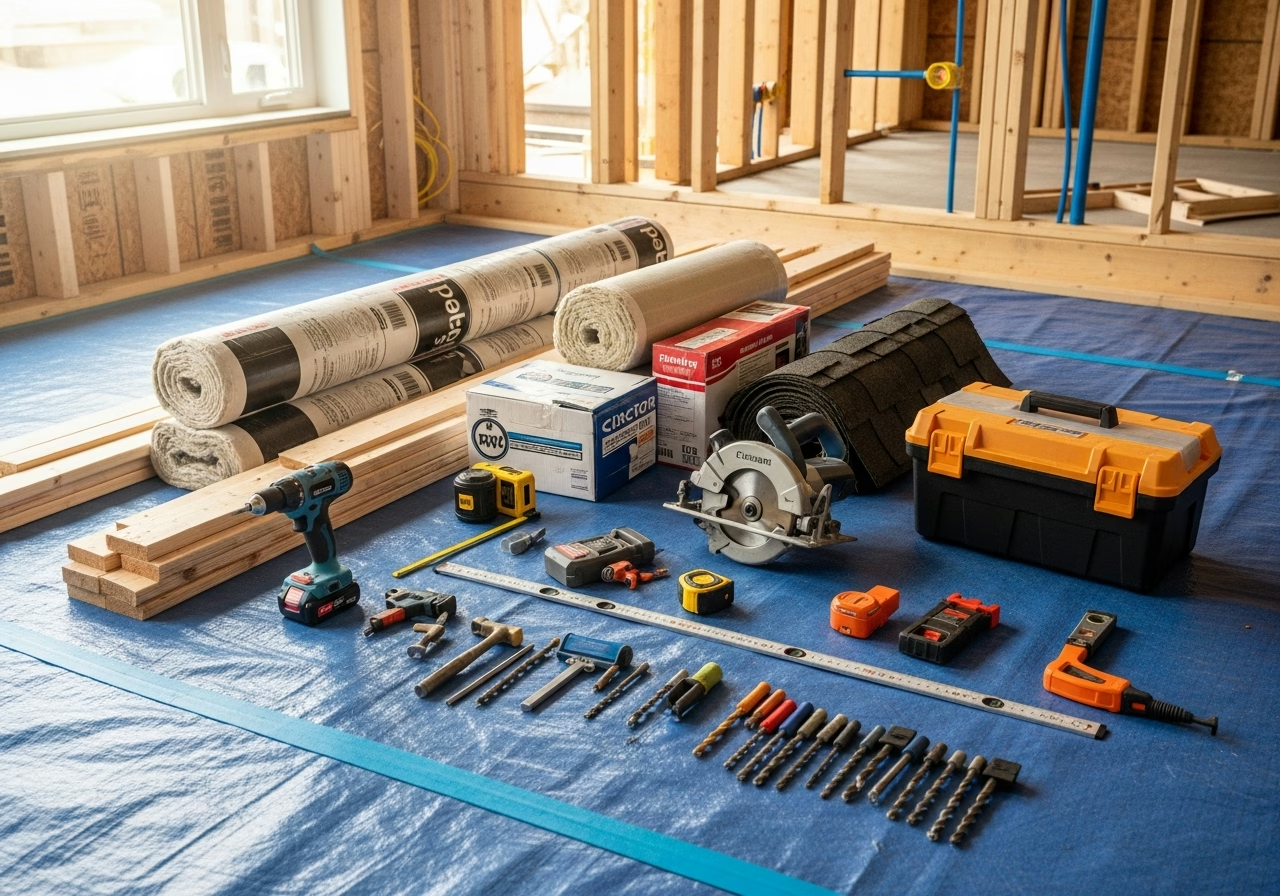
- Public-facing facade. The lane elevation is visible from the public realm, demanding brick, fibre-cement, or hardi-plank rather than vinyl.
- Tight site logistics. Material delivery via narrow lane, crane lifts that may require neighbour easements, hand-carry of materials in some cases.
- High-performance envelope. Modern laneway designs typically aim for ENERGY STAR or Net Zero Ready, requiring continuous insulation, triple-pane windows, and air-tight detailing.
- Higher window-to-wall ratio. Inner-city laneway designs often use generous glazing on the lane elevation for daylight, increasing window cost.
Per-sq-ft ranges by tier:
Need professional renovation?
Call RenoHouse at 289-212-2345 or get a free estimate today.
Get Free Estimate →- Entry tier: $450-$525/sq ft hard cost.
- Mid-range: $525-$600/sq ft hard cost.
- Premium: $600-$700/sq ft hard cost.
- Trophy custom (Williamson Williamson, Superkül): $700-$900+/sq ft.
Phase-by-Phase Cost Breakdown (~1,000 sq ft 2BR)
This is a typical mid-range build budget. Real numbers from RenoHouse projects in 2025-2026.
| Phase | Cost Range | Mid-Range | Notes |
|---|---|---|---|
| Pre-construction (design, permits, surveys, arborist, eng) | $30K-$60K | $45K | See soft cost detail below |
| Site prep / demolition (existing garage if any) | $5K-$20K | $12K | Higher if asbestos or hazmat in old garage |
| Excavation + foundation (slab-on-grade or full basement) | $50K-$90K | $70K | Slab cheaper; full basement adds $25K-$40K |
| Framing & structural | $35K-$70K | $52K | 2x6 walls with continuous insulation more expensive |
| Roofing + cladding | $30K-$55K | $42K | Brick or fibre-cement; metal roof common |
| Mechanical (plumbing, electrical, HVAC) | $50K-$100K | $75K | Heat pump central or mini-split |
| Servicing (water, sewer, hydro, gas runs) | $25K-$60K | $42K | Bore to street much pricier than tie-in to main |
| Insulation, drywall, paint | $30K-$60K | $45K | Spray foam premium |
| Finishes (flooring, kitchen, bath, trim) | $60K-$150K | $95K | Single biggest variance line |
| Site work + landscaping reinstatement | $15K-$40K | $25K | Lane apron, soft landscaping replant |
| Contingency (10-15%) | $35K-$70K | $52K | Always reserve at least 10% |
| TOTAL ALL-IN | $365K-$775K | $555K | Mid-range 1,000 sq ft 2BR |
Soft Cost Detail
Soft costs are real, recurring, and often underestimated by first-time builders. The full list:
- Topographic survey (OLS-stamped): $1,500-$3,000.
- Arborist report (ISA-certified): $1,200-$3,500.
- Architectural design: $0 (pre-approved plan) to $50K (custom).
- Structural engineering: $3,000-$8,000.
- Mechanical/electrical engineering: $2,000-$6,000.
- Energy compliance (SB-12 / ENERGY STAR / Net Zero): $1,000-$3,000.
- Permit fees (City + Zoning + Plumbing + ESA): $1,500-$3,000.
- Tree permit (if applicable): $400-$1,500.
- Heritage permit (if HCD): $1,500-$5,000.
- Committee of Adjustment (if needed): $1,200 application + $3K-$8K planner.
- Builder's Risk / Course of Construction insurance: 1-4% of project = $4K-$30K.
- Tarion enrolment: $1,000-$2,000.
- Legal (HOA agreement, easement docs if needed): $1,500-$5,000.
Soft cost subtotal typically $30K-$60K for a laneway project, slightly higher than garden suites because of lane-side servicing complexity and architectural premium.
What Drives Cost UP
Five factors that push a laneway house toward the upper end of the range:
- 1. Heritage Conservation District overlay. Cabbagetown, Riverdale, Annex, Bain Co-op, and other HCDs require Heritage Permit and design compatibility. Adds $20K-$50K in design and material costs.
- 2. Servicing bore to street. When the lane has no underground utilities (most Toronto lanes), servicing must come from the parent house or be bored to the street. Bore to street: $30K-$80K. Tie-in to main: $8K-$25K.
- 3. Full basement vs slab-on-grade. Adds $25K-$40K but also adds 200-400 sq ft of GFA for storage or mechanical room.
- 4. Net Zero Ready / Passive House targets. Adds 10-30% premium on envelope but qualifies for CMHC MLI Select energy bonuses (up to $85K/unit forgivable grant).
- 5. Premium architect. Williamson Williamson, Superkül, Studio JCI charge 12-15% of construction (vs 8-10% for mid-tier). On a $500K build that's $60K vs $40K.
What Drives Cost DOWN
Five legitimate ways to reduce a Toronto laneway budget without hurting quality:
- 1. Pre-approved City plans. Save $10K-$20K in design fees and 2-4 weeks. 24 plans available, OBC compliant.
- 2. Slab-on-grade foundation. Saves $25K-$40K vs full basement. Most laneway designs work fine without basement.
- 3. Heat pump only (no gas). Saves $5K-$10K in gas servicing, qualifies for federal heat pump rebates.
- 4. Single-storey. Skip the second storey to come in under 6.0 m height (no separation distance triggers). Saves $80K-$150K but cuts GFA in half.
- 5. Stacked plumbing. Locate kitchen and bathroom on the same wall (and on the same wall as the parent house drain) to minimize plumbing runs.
Common Hidden Costs Owners Miss
- Hydro upgrade. If the parent house has 100A service, you almost certainly need a 200A upgrade ($5K-$10K) or a separate Toronto Hydro service for the laneway ($15K-$25K).
- Lane apron. The City may require a paved apron at the lane edge; budget $2K-$5K.
- Tree replanting fee in lieu. If you remove a protected tree (rare, but possible), 3:1 replanting ratio applies, with fees $640-$2,500 per tree.
- MPAC supplementary tax bill. Retroactive supplementary property tax bill arrives 12-24 months after occupancy, often covering part of the year of occupancy plus the full following year. Budget $2K-$6K/year increase from day one.
- Construction Act 10% statutory holdback. You must hold back 10% of the contract for 60 days after substantial completion. Plan cash flow accordingly.
Comparing Laneway House Cost to Alternatives
| Approach | Cost | Monthly Rent | Time to Build | 10-yr ROI |
|---|---|---|---|---|
| Legal basement apartment | $60K-$120K | $1,500-$2,200 | 3-5 months | 80-130% |
| Garden suite | $275K-$525K | $2,200-$3,300 | 12-18 months | 150-175% |
| Laneway house | $300K-$700K | $2,500-$4,900 | 14-20 months | 160-200% |
| Multiplex conversion | $400K-$1.5M | $4,000-$10,000 | 18-30 months | 180-250% |
The laneway house occupies the middle of the cost stack but earns the highest rent per square foot of any addition type because of its private detached feel. For a deeper comparison with garden suites specifically, see Laneway House vs Garden Suite Toronto: Decision Guide.
Realistic 2026 Budget Template
For owners building on a standard 18-25 ft x 100-130 ft Toronto lot in a laneway-rich neighbourhood (Roncesvalles, Riverdale, Trinity-Bellwoods, etc.), a realistic mid-range 2BR laneway budget in 2026:
| Item | Budget |
|---|---|
| Pre-construction soft costs | $45,000 |
| Hard construction (1,000 sq ft @ $560/sq ft) | $560,000 |
| Servicing premium | $35,000 |
| Hydro upgrade or new service | $15,000 |
| Contingency (12%) | $74,000 |
| TOTAL | $729,000 |
Add or subtract based on lot conditions, finish tier, and whether you go custom or pre-approved plan.
Next Steps
A defensible laneway house budget starts with a site assessment, a topographic survey, and a fixed-fee design quote. RenoHouse provides all three as part of our laneway design-build service. Learn more at /services/multi-unit-aru-conversions/laneway-house-construction or contact us for a no-obligation cost estimate based on your specific lot.
Sources & References
Authoritative sources cited in this guide:
- Toronto Laneway Suite Bylaw 88-2018 — Toronto laneway regulations
- Bill 23 — More Homes Built Faster Act — Provincial enabling law
- Equitable Bank Laneway House Mortgage — Specialty financing
Continue Reading