RenoHouse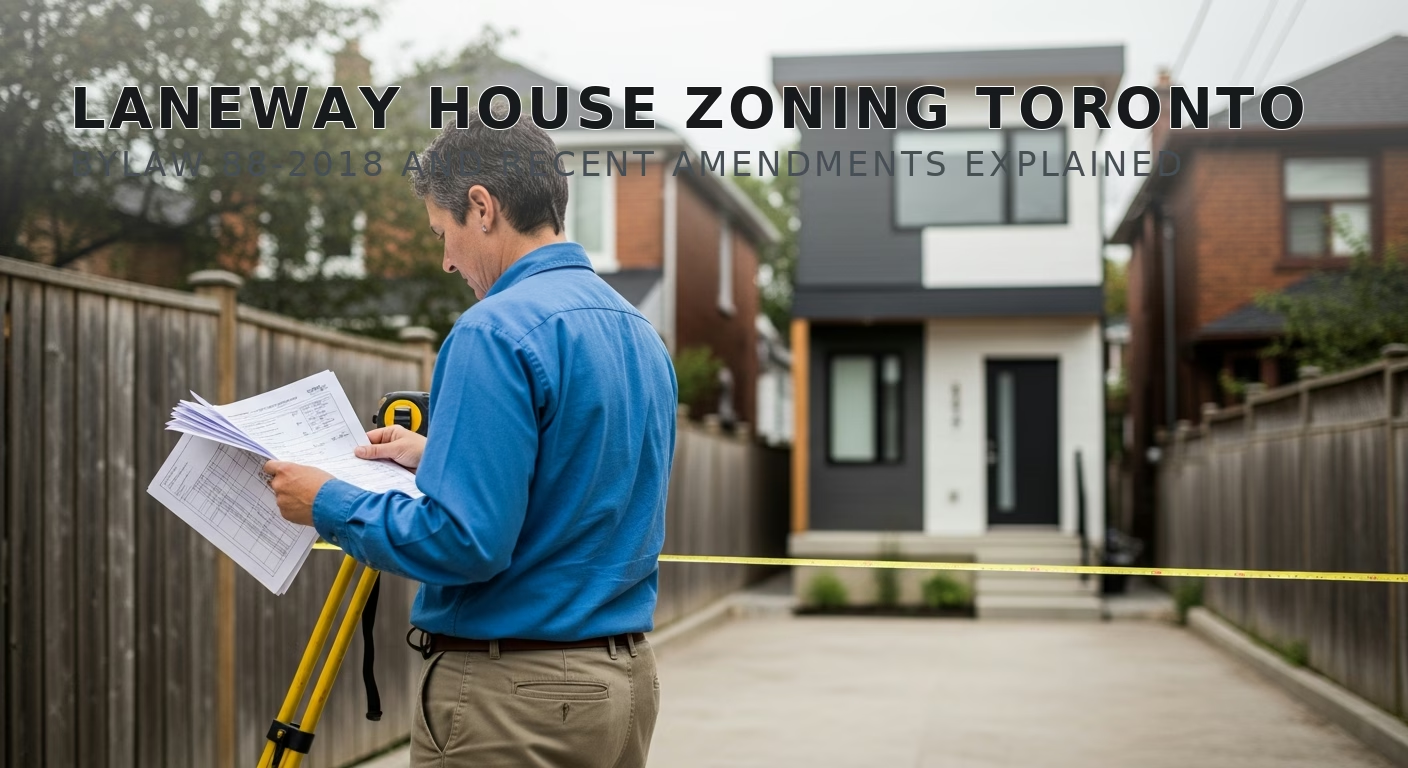

# Laneway House Zoning Toronto: Bylaw 88-2018 Explained
Quick answer. Toronto Bylaw 88-2018 is the City of Toronto's original laneway suite legislation, adopted by Council on June 28, 2018, after the "Changing Lanes" study led by Councillors Ana Bailao and Mary-Margaret McMahon.Toronto Bylaw 88-2018 is the City of Toronto's original laneway suite legislation, adopted by Council on June 28, 2018, after the "Changing Lanes" study led by Councillors Ana Bailao and Mary-Margaret McMahon. The bylaw amended Zoning By-law 569-2013 to permit laneway suites as-of-right in all residential (R) zones in the Toronto and East York District, with a citywide expansion in summer 2019. Subsequent amendments through Bylaw 849-2025 (July 2025) eliminated the angular plane requirement and increased the maximum height to 6.3 m where separation is met. This post is the practitioner's walkthrough of the bylaw as it stands in 2026: what it permits, what it requires, and where projects most commonly fail.
For broader pillar context, see the Laneway House Construction Toronto 2026 Complete Guide. For permits and timeline, see Laneway House Permits and Process: Toronto Timeline. For neighbourhood-by-neighbourhood eligibility, see Laneway House Toronto: Which Neighbourhoods Qualify.
What Bylaw 88-2018 Permits
Bylaw 88-2018, as amended through 2025, permits a detached, two-storey, residential laneway suite on lots that meet four eligibility tests, with no parking required, no zoning amendment, and (in most cases) no Committee of Adjustment.
The four eligibility tests:
- 1. Lane abutment. The rear lot line OR the side lot line must abut a public laneway for at least 3.5 m of continuous length.
- 2. Lot width. The lot must be at least 6.0 m wide at the location of the laneway suite.
- 3. R zone. The lot must be zoned R, RD, RS, RT, or RM under By-law 569-2013.
- 4. Fire access path. A 0.9 m unobstructed path of travel must exist from a public street or sidewalk to the laneway suite entrance, within 45.0 m of curb access from a fire hydrant.
If all four conditions are met, the laneway house is permitted as-of-right and proceeds directly to building permit, skipping the Committee of Adjustment that would otherwise add 3-6 months and $5K-$10K in costs.
Size and Form: The Built Envelope
The bylaw caps the laneway suite envelope at:
- Maximum length: 10.0 m (along the laneway dimension).
- Maximum width: 8.0 m (perpendicular to laneway).
- Maximum height: 6.3 m post-Bylaw 849-2025 (was 6.0 m before July 2025), measured from grade to top of roof, when separation distance from main house is at least 7.5 m.
- Single-storey alternative: 6.0 m height with 4.0 m separation.
- Maximum storeys: 2.
- Combined ancillary structure coverage: all ancillary buildings (laneway suite, shed, garage, etc.) cannot exceed 20% of total lot area.
- Maximum GFA: approximately 160 m² (~1,720 sq ft) if site geometry allows two full storeys with cantilever.
The 8.0 m x 10.0 m footprint translates to roughly 860 sq ft per floor, or 1,720 sq ft over two storeys. Most Toronto lots cannot accommodate the full 8.0 m width because lot frontage is narrower than the lot depth implies. A 16 ft wide lot has limited maneuvering room even after side setbacks.
Setbacks
The bylaw imposes the following setbacks:
| Element | Setback |
|---|---|
| Lane (rear or side abutting laneway) | 1.5 m minimum |
| Interior lot line (no openings on that face) | 0.0 m permitted |
| Interior lot line (with openings) | 1.5 m |
| Main house | 7.5 m for full-height; 4.0 m for single-storey |
| Adjacent garage or shed | per applicable side yard rule |
The 0.0 m interior side setback (with no openings) is unusual in Toronto residential zoning and is what allows laneway houses to maximize footprint on narrow lots. The trade-off is that the interior side wall must be a blind, fire-rated assembly with no windows.
Fire Access: The Most Common Failure Point
The single most common reason a Toronto laneway suite proposal fails at zoning review is the 0.9 m fire access path requirement. The path must be:
- At least 0.9 m wide (3 feet), unobstructed.
- Continuous from a public street or sidewalk to the laneway suite entrance door.
- Not pass through any enclosed space.
- Within 45.0 m (~148 ft) of fire hydrant curb access.
- Travel distance to firefighter access compliant with Toronto Fire Services criteria.
The path is not subject to relaxation by Committee of Adjustment because it is a Toronto Fire Services life-safety requirement, not a zoning rule. If the side yard between the parent house and the property line is less than 0.9 m clear of obstructions (gas meters, AC condensers, fences, BBQs, basement window wells), the project cannot proceed without physical site work to widen the path.
Need professional renovation?
Call RenoHouse at 289-212-2345 or get a free estimate today.
Get Free Estimate →Most Toronto pre-war narrow lots (16-20 ft frontage) have side yards of 0.6-1.0 m. Working out the fire access plan early — sometimes requiring fence relocation, gas meter relocation, or removal of a basement window — is the single most important thing to verify before signing a design contract.
Soft Landscaping
The bylaw requires a percentage of the rear yard between the laneway suite and the main house rear wall to remain as soft (non-paved, vegetated) landscaping:
- Lots ≤ 6.0 m wide: at least 60% soft landscaping.
- Lots > 6.0 m wide: at least 85% soft landscaping.
Permeable pavers can sometimes count toward soft landscaping for purposes of the fire access path, but the City applies this conservatively. Hard-surface patios, decks, and the laneway suite footprint itself do not count.
Servicing
Bylaw 88-2018 does not specify servicing requirements, but the Toronto Building permit process does. Laneway suites must connect to:
- Water: typically off the parent house line or a new ¾ inch service from the street.
- Sanitary sewer: gravity feed into parent house line, with a sewage ejector pump if elevation is insufficient.
- Stormwater: rear yard drainage compliance per Toronto Green Standard.
- Hydro: new 100A subpanel from main panel OR a separate Toronto Hydro service.
- Gas: optional; many designs use heat pumps and skip gas entirely.
Laneway servicing is complicated by the fact that most Toronto laneways have no underground utilities running along them. There is no water, sewer, or hydro line in the lane itself in most cases. Services therefore come from either the parent house (across the rear yard) or the fronting street (via underground bore). Bore costs run $30K-$80K. Tie-in to main runs $8K-$25K.
Occupancy and Use
A laneway suite must be:
- A self-contained dwelling unit with its own kitchen, bathroom, and living space.
- Detached from the main dwelling. No breezeway, no shared wall.
- Not severable onto its own lot. The suite is appurtenant to the parent lot.
- Not the principal residence if used as a short-term rental (Airbnb). The owner's principal residence must be either the suite OR the main house, and short-term rentals are restricted to the principal residence under separate Toronto bylaws.
The bylaw permits residential use only. Office, retail, or commercial use is not permitted. The suite may be used as the owner's principal residence, a long-term rental, or housing for family members.
What Bylaw 849-2025 Changed (July 2025)
Toronto adopted Bylaw 849-2025 on July 24, 2025, to comply with Ontario Regulation 462/24 (Additional Residential Units) filed by the Province on November 20, 2024. Key changes affecting laneway suites:
- Eliminated the 45° angular plane. The pre-2025 rule that no part of the suite could project above a 45° plane starting at 4.0 m height has been removed entirely. Flat roofs and shed roofs are now permitted, expanding usable interior volume by ~15%.
- Increased maximum height to 6.3 m (from 6.0 m) when separation distance from main house is met.
- Allowed second-storey cantilevers beyond ground footprint, up to ~120 m² total GFA for garden suites (laneway suites still capped by 8 m x 10 m envelope).
- Streamlined soft-landscaping rules.
- Allowed laneway/garden suite GFA up to (but not exceeding) the GFA of the main dwelling.
These changes apply to laneway suites as well as garden suites where consistent with the laneway-specific envelope.
Heritage Conservation District Overlay
If the lot is in a Heritage Conservation District (HCD), the laneway suite still proceeds under Bylaw 88-2018 zoning permissions but additionally requires a Heritage Permit from Toronto Heritage Preservation Services. Major Toronto HCDs with laneway-eligible lots:
- Cabbagetown HCD.
- Riverdale (parts).
- Annex (parts).
- Bain Co-operative HCD (Withrow Park area).
- Brick Workers HCD.
Heritage Permit adds 4-6 weeks to the timeline and may require design changes for compatibility with the district's heritage character: massing, materials, colour palette, fenestration. Pilot programs in Cabbagetown and Riverdale are streamlining ARU approvals in HCDs as of 2025-2026.
Tree Protection
Toronto Municipal Code Chapter 813 protects:
- Any tree at least 30 cm DBH on private property.
- Any tree at least 10 cm DBH on City property.
The Tree Protection Zone (TPZ) is a radius equal to 10 times DBH, or 1.0 m per 10 cm DBH, whichever is greater. A laneway suite cannot be built inside a healthy protected tree's TPZ without a Tree Permit, which the City rarely issues for healthy trees on laneway sites. An arborist report is required for any proposed laneway suite within 6 m of a protected tree.
Tarion Enrolment for New Builds
Every new laneway suite in Ontario must be enrolled in Tarion's New Home Warranty Program before the building permit is issued. The builder must be registered with the Home Construction Regulatory Authority (HCRA). This is a Provincial requirement, not a Toronto zoning rule, but it interacts with the permit process: Toronto Building will not issue the permit until Tarion enrolment confirmation is on file.
What's Still Not Allowed
Even under Bylaw 88-2018 with all 2025 amendments, the following are not permitted:
- More than one laneway suite per lot.
- Severing the laneway suite onto its own lot.
- Laneway suites on lots zoned MCR or CR (commercial-residential).
- Laneway suites that physically connect to the main house.
- Heritage District new-builds without a Heritage Permit.
- Five+ units (without crossing into Site Plan Control).
- Building on a TPZ of a healthy protected tree without a Tree Permit.
- Short-term rental use unless the suite is the operator's principal residence.
Practical Implications for Design
The bylaw shapes design in three concrete ways:
- 1. Footprint maximization. With 0.0 m interior side setbacks and 1.5 m lane setback, the maximum footprint is 8.0 m x 10.0 m minus front/rear setbacks from the lane edge. Designers typically push to within 200-400 mm of these limits.
- 2. Window placement. The blind side wall (against the neighbour's lot at 0.0 m) cannot have openings. All windows face the lane, the rear yard, or the open side. This shapes interior layout.
- 3. Stair location. The 8.0 m x 10.0 m envelope plus the 0.9 m fire path constraint means the entrance door usually faces the side path, with the stair against the lane wall to free the open side for living space.
Next Steps
Before signing a laneway suite design contract, verify all four eligibility tests with a zoning consultant or your designer:
- 1. Lane abutment 3.5+ m (measure from a current OLS-stamped survey).
- 2. R zone (check Toronto Interactive Zoning Map at apply.toronto.ca).
- 3. 0.9 m fire path clear of obstructions.
- 4. No protected tree TPZ conflicts.
RenoHouse offers a fixed-fee zoning verification + site assessment as the first step of every laneway project. Learn more at /services/multi-unit-aru-conversions/laneway-house-construction or contact us for a no-obligation review.
Sources & References
Authoritative sources cited in this guide:
- Toronto Laneway Suite Bylaw 88-2018 — Toronto laneway regulations
- Bill 23 — More Homes Built Faster Act — Provincial enabling law
- Equitable Bank Laneway House Mortgage — Specialty financing
Continue Reading