RenoHouse

# Garden Suite vs Laneway House Toronto: Side-by-Side Comparison
Quick answer. The simplest answer to "garden suite or laneway house?" is determined by your lot. If your rear or side lot line abuts a public laneway for at least 3.5 metres, you can build either; if it doesn't, you can build only a garden suite. The harder question is which makes more sense when both are options.The simplest answer to "garden suite or laneway house?" is determined by your lot. If your rear or side lot line abuts a public laneway for at least 3.5 metres, you can build either; if it doesn't, you can build only a garden suite. The harder question is which makes more sense when both are options. The cost differential is roughly $70K-$150K, the rental differential is $300-$1,600 per month, and the property uplift differential is $115K-$300K. The framework below resolves the choice cleanly for most Toronto homeowners.
For full pillar context on garden suites, see Garden Suite Toronto 2026 Complete Guide. For the laneway-specific pillar, see Laneway House Construction Toronto 2026 Complete Guide.
The Core Difference
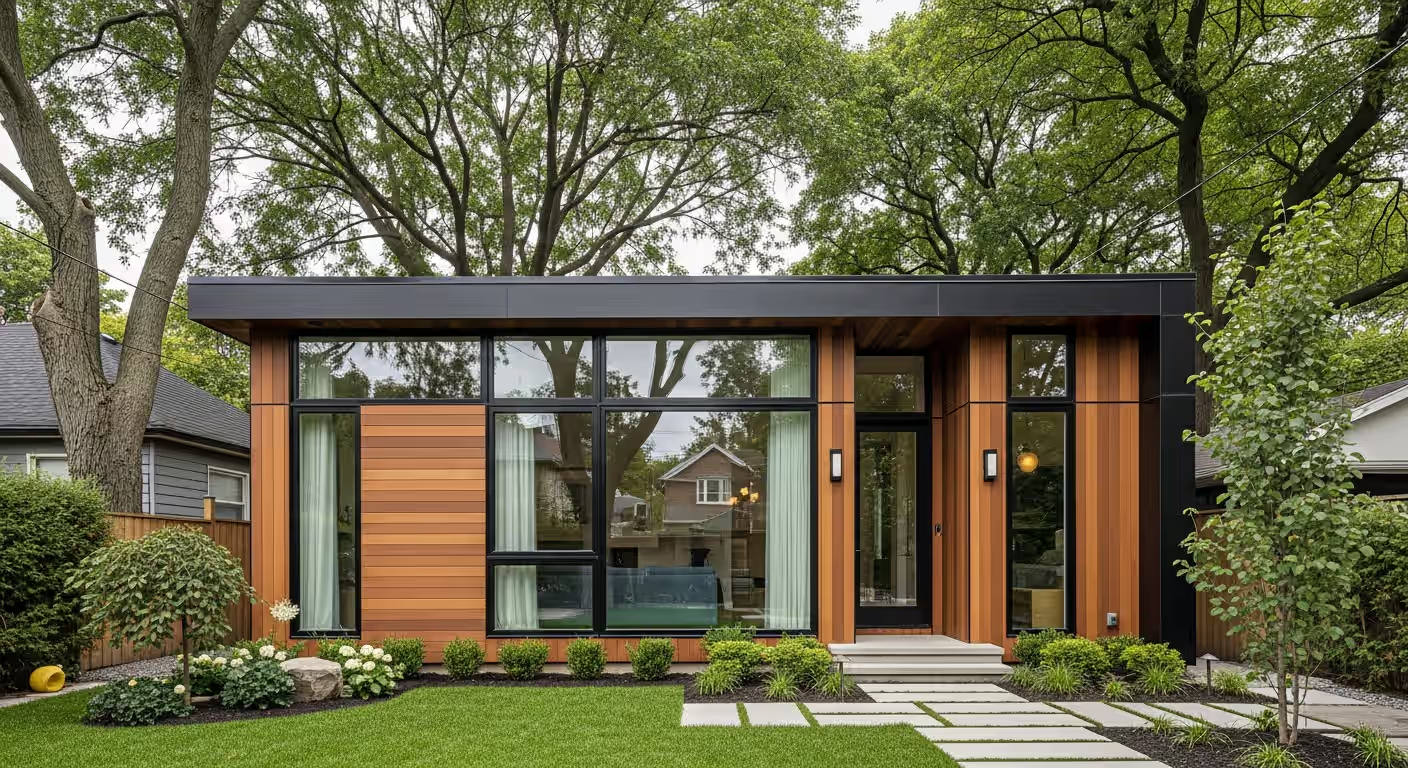
A garden suite is a detached habitable building in the rear yard of an R-zone lot, governed by Toronto By-law 89-2022 (and the 2025 amendment 849-2025). It can be built on any lot that meets eligibility criteria, regardless of laneway access.
A laneway house is a detached habitable building that abuts a public laneway, governed by the 2018 laneway suite bylaw and its 2025 amendments. It must have at least 3.5 metres of laneway abutment on a rear or side lot line. Toronto has roughly 257 km of public laneways, concentrated in the old City of Toronto and East York districts.
In every other respect (servicing, permits, finishes, financing) the two are similar. The differences boil down to: where they sit on the lot, what they cost, what they rent for, and what they look like from the public realm.
Side-by-Side Specifications
| Parameter | Garden Suite | Laneway House |
|---|---|---|
| Required lot feature | None special; any R-zone lot | Public laneway abutment ≥ 3.5 m |
| Max footprint | 60 m² (645 sqft) or 40% of rear yard | 8 m × 10 m (80 m² / 860 sqft) |
| Max GFA (2 storeys) | 120 m² (1,290 sqft) | ~160 m² (1,720 sqft) if geometry allows |
| Max height | 6.3 m | 6.3 m |
| Setback from laneway/rear | 1.5 m | 1.5 m from lane |
| Setback from interior lot line | 0.6 m or 1.5 m with openings | 0.0 m permitted (no openings) |
| Main house separation | 7.5 m (full-height) | 7.5 m (full-height) |
| Soft landscaping | 50% of rear yard | 60-85% between suite and main house |
| Path of travel | 1.0 m | 0.9 m (cannot be relaxed) |
| Parking | 0 cars; 2 bicycles | 0 cars; 2 bicycles |
The biggest practical specification difference: laneway houses can have a wider and deeper footprint (8 m × 10 m), while garden suites are capped at 60 m² ground footprint. The total GFA is different too: 160 m² laneway versus 120 m² garden suite. Laneway wins on size.
Cost Comparison
| Cost Element | Garden Suite | Laneway House |
|---|---|---|
| Hard cost per sqft | $400 to $650 | $450 to $700 |
| All-in 1BR (450-650 sqft) | $275K to $380K | $315K to $430K |
| All-in 2BR (700-900 sqft) | $380K to $540K | $420K to $600K |
| All-in 2BR+ premium (900-1,200 sqft) | $480K to $650K | $540K to $750K |
| Mid-range (typical) | $450K | $525K |
Laneway houses run $50-$100 per square foot more in hard cost than equivalent garden suites. The drivers:
- Architectural finish premium. The laneway-facing facade is highly visible from the public realm and almost always gets brick or fibre-cement cladding rather than vinyl, plus higher-quality windows and doors.
- Tighter site logistics. Material delivery via the laneway is constrained; cranes often need to lift over neighbouring properties.
- Servicing complexity. Most Toronto laneways have NO underground utilities (no water, no sewer, no hydro running along the lane itself). Services must come from the main house across the rear yard, or from the fronting street via underground bore. Bore costs: $30K-$80K to street; $8K-$25K extending from main house.
- Heritage District compatibility. Laneway-rich neighbourhoods (Riverdale, Cabbagetown, Roncesvalles) often have HCD overlays adding design and material constraints.
The $75K mid-range cost differential is real money, but the rental and property-uplift differentials more than compensate in most premium corridors.
Rental Income Comparison
| Type | Monthly Rent (2026 Toronto) |
|---|---|
| Garden suite studio (300-400 sqft) | $1,800 to $2,200 |
| Garden suite 1BR (450-650 sqft) | $2,200 to $2,800 |
| Garden suite 2BR (700-900 sqft) | $2,800 to $3,500 |
| Laneway house studio | $2,000 to $2,500 |
| Laneway house 1BR | $2,500 to $3,300 |
| Laneway house 2BR | $3,200 to $4,500 |
| Laneway house 2BR premium (Roncesvalles, Trinity-Bellwoods) | $3,500 to $4,900 |
Laneway houses command $300-$1,600 per month higher rent than equivalent garden suites in the same neighbourhood. The reasons tenants pay more:
- Direct street access. Laneway suites have their own front door on a public laneway. No walking through the landlord's backyard. Privacy and independence equivalent to a freestanding house.
- Better daylight. Laneway suites typically have larger window openings on the laneway-facing facade. Garden suites are surrounded by neighbouring fences and trees.
- Address differentiation. Some Toronto laneways are now formally addressed (e.g., Crawford Lane, Loblaw Lane), giving the suite a distinct mailing address.
- Desirable neighbourhoods. Laneway-rich areas (Roncesvalles, Trinity-Bellwoods, Leslieville) command premium rents already.
Property Uplift Comparison
| Type | Property Value Uplift |
|---|---|
| Garden suite (typical) | $285K to $320K |
| Laneway house (typical) | $400K to $600K |
| Laneway house (premium corridor) | $500K to $700K+ |
The differential here is substantial. Laneway houses are scarce (only ~257 km of public laneways exist citywide; only a fraction of laneway-abutting lots have built laneway suites yet) and trade at a premium when the parent home sells. Real estate appraisers routinely value laneway-suited properties at $500K-$700K above comparable laneless lots in the same neighbourhood.
Garden suites add $285K-$320K in uplift. Real but smaller. The garden suite uplift is mostly the rental income capitalized at neighbourhood cap rates (5-6% in inner-city Toronto), with little scarcity premium because every R-zone lot is now eligible.
ROI Comparison Worked Example
Roncesvalles 25 ft × 130 ft lot. 2BR suite. Self-managed.
| Metric | Garden Suite | Laneway House |
|---|---|---|
| All-in cost | $475,000 | $560,000 |
| Monthly rent | $3,150 | $3,800 |
| Annual gross rent | $37,800 | $45,600 |
| NOI (after vacancy, tax, insurance, maintenance) | $28,186 | $34,000 |
| Cap rate on cost | 5.93% | 6.07% |
| Property uplift estimate | $295K | $475K |
| 10-year total return | ~155-175% | ~160-200% |
| Payback period (rent only) | 5.5 to 7.5 years | 5.5 to 7 years |
The cap rates are similar. The laneway wins on absolute return because of property uplift.
Need professional renovation?
Call RenoHouse at 289-212-2345 or get a free estimate today.
Get Free Estimate →Eligibility: Where Each Works
Garden Suite Eligibility
Any R-zone lot in Toronto that:
- Has a detached, semi-detached, duplex, or row-house main building.
- Is not zoned MCR or CR.
- Has at least 25 ft frontage and 100 ft depth (practical minimum).
- Can accommodate the 1.5 m setbacks and 50% soft landscaping.
- Has a 1.0 m unobstructed path of travel for emergency access.
This is most of Toronto's residential lot inventory. Eligibility is rarely the binding question for garden suites.
Laneway House Eligibility
Lots that meet all garden suite criteria PLUS:
- A rear or side lot line abuts a public laneway for at least 3.5 metres.
- Lot width is at least 6.0 metres.
- A 0.9 m unobstructed path from a public street/sidewalk to the laneway suite entrance.
- Within 45.0 m of curb access from a fire hydrant.
The 0.9 m fire-access path cannot be relaxed by Committee of Adjustment. This is the single most common reason laneway proposals fail at zoning review.
Laneway-Rich Neighbourhoods (where laneways are an option)
- Roncesvalles, Parkdale, Junction Triangle, The Junction
- Trinity-Bellwoods, Little Italy, Little Portugal
- Leslieville, Riverdale, Riverside
- Cabbagetown, Corktown
- Annex, Seaton Village
- Bloor West, High Park
- Dovercourt-Wallace Emerson
- Greenwood-Coxwell, Danforth-Greenwood
Laneway-Sparse Neighbourhoods (garden suite only, almost always)
- Most of North York (Don Mills, Willowdale, Bayview)
- Most of Scarborough
- Most of Etobicoke (some pockets in Mimico, New Toronto, Long Branch)
When to Choose Each
Choose a Garden Suite When:
- Your lot has no laneway abutment (most Toronto lots).
- You want the cheapest path to a backyard rental ($75K savings versus laneway).
- You prefer privacy (suite tucked into the rear yard, not exposed to public lane).
- Your neighbourhood is laneway-sparse (North York, Scarborough, Etobicoke).
- You're worried about laneway-side servicing complexity.
- You want to optimize for the 6-9% cap rate on rent rather than chase property uplift.
Choose a Laneway House When:
- Your lot has at least 3.5 m of public laneway abutment.
- You're in a premium laneway-rich neighbourhood (Roncesvalles, Trinity-Bellwoods, Leslieville).
- You want maximum rental rate ($300-$1,600/month premium over garden suite).
- You want maximum property uplift ($115K-$300K more than garden suite).
- You can absorb the $75K-$150K higher build cost.
- You're willing to handle the trickier servicing logistics.
When Both Work: The Tiebreaker
For lots in laneway-rich neighbourhoods where both options are available, the tiebreaker is usually:
| Priority | Recommendation |
|---|---|
| Lowest cost of capital | Garden suite |
| Highest absolute return | Laneway house |
| Fastest occupancy | Garden suite (slightly easier servicing) |
| Best privacy for owner | Garden suite |
| Best independence for tenant | Laneway house |
| Best resale uplift | Laneway house |
| Heritage District compatibility | Garden suite (typically less visible) |
For most rental-focused investors with a laneway-eligible lot, the laneway house wins on lifetime return. For multigenerational owner use or privacy-prioritized owner-occupied scenarios, the garden suite often wins.
Both at Once: The 5-Unit Multiplex Stack
The most aggressive 2026 Toronto play is to build BOTH: convert the main house to a 4-unit multiplex (under By-law 474-2023) AND build a garden suite or laneway house. Total: 5 units. This crosses the CMHC MLI Select threshold and unlocks:
- 95% loan-to-value financing (5% down).
- Up to 50-year amortization.
- Forgivable energy-efficiency grants up to $85K per unit.
- Reduced mortgage insurance premiums.
Total cost: $975K to $2.21M for the 5-unit stack. Cap rates on cost typically 5.5-7%. Cash-on-cash returns at 95% MLI Select financing run 12-18%.
For more on the multiplex side, see Multiplex Conversion Toronto 2026 Complete Guide.
Decision Tree
Does your lot abut a public laneway for ≥ 3.5 m?
├── NO → Garden Suite (only option)
└── YES
├── Is the laneway in a premium neighbourhood (Roncesvalles, Leslieville, Trinity-Bellwoods)?
│ ├── YES, and you want max ROI → Laneway House
│ └── YES, but privacy matters more → Garden Suite
└── Is the laneway in a less-premium area?
├── Capital is tight → Garden Suite
└── Capital is available → Laneway House (uplift differential still meaningful)
What Doesn't Differ
- Permit process. Identical. Same Toronto Building permit set, same plan review, same inspections.
- Bicycle parking. Both require 2 bicycle spaces; both require zero car parking.
- Tree protection. Toronto Municipal Code Chapter 813 applies equally.
- Heritage Conservation District requirements. Both require Heritage Permit if in HCD.
- Property tax impact. Both trigger MPAC reassessment and a $2K-$6K/year increase.
- Financing options. Equitable Bank Laneway House Mortgage covers both garden suites and laneway houses. CMHC MLI Select stacks the same way.
What Does Differ in the Build
- Material delivery. Laneway: via the lane. Garden suite: through the main house lot or side yard.
- Crane access. Laneway: from the lane. Garden suite: from the front street or neighbour easement.
- Servicing path. Laneway: typically from main house across the rear yard, OR from the fronting street via bore. Garden suite: from main house only.
- Facade visibility. Laneway: highly visible from public realm; demands premium materials. Garden suite: invisible from public street; can use more economical materials.
Summary Table
| Factor | Garden Suite | Laneway House |
|---|---|---|
| Eligible lots | Most of Toronto | ~257 km of laneway-abutting lots only |
| Cost (mid-range) | $450K | $525K |
| Monthly rent (2BR) | $2,800-$3,500 | $3,200-$4,500 |
| Property uplift | $285K-$320K | $400K-$700K |
| Cap rate on cost | 5.5-6.5% | 6.0-7.0% |
| Privacy for owner | High | Lower |
| Servicing complexity | Standard | Higher |
| Resale liquidity | Good | Excellent |
Get a Lot Assessment
The right answer for your specific lot depends on whether your rear or side lot line abuts a public laneway and whether the 0.9 m fire access path is achievable. RenoHouse offers a free site assessment that confirms eligibility for either option and quotes both side-by-side.
Get a quote at /services/multi-unit-aru-conversions/garden-suite-construction.
Sources & References
Authoritative sources cited in this guide:
- Toronto Garden Suite Bylaw 89-2022 — Toronto garden suite regulations
- Bill 23 — More Homes Built Faster Act — Provincial ARU enabling legislation
- Toronto Committee of Adjustment — Variance process
Continue Reading