RenoHouse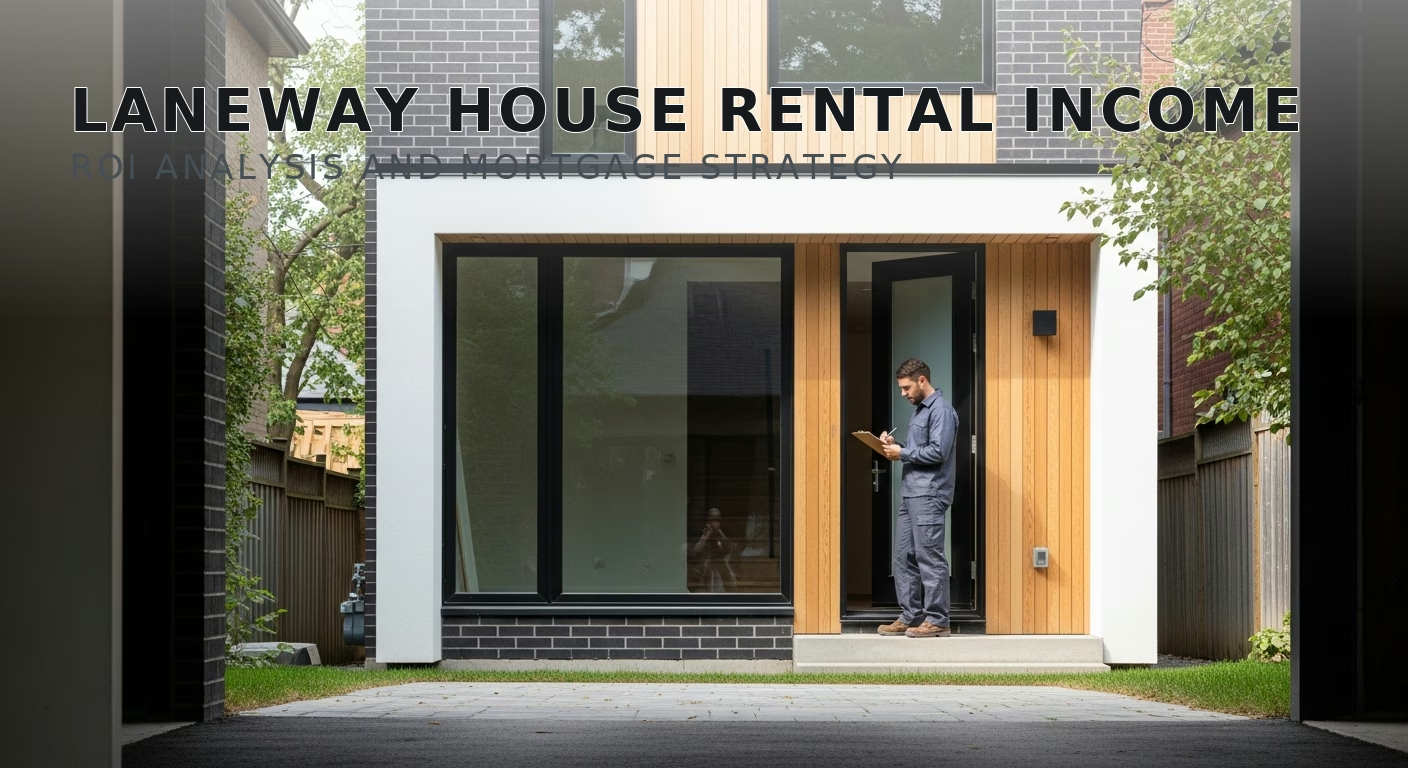

# Laneway House Rental Income Toronto: ROI Analysis
Quick answer. A typical Toronto laneway house rents for $3,000 to $5,500 per month in 2026 depending on size, neighbourhood, and finish tier, generating a 5-8% cap rate on construction cost and a 7-10 year rent-only payback period.A typical Toronto laneway house rents for $3,000 to $5,500 per month in 2026 depending on size, neighbourhood, and finish tier, generating a 5-8% cap rate on construction cost and a 7-10 year rent-only payback period. Property value uplift on the parent lot adds another $400,000-$700,000 to long-term returns, and 95% LTV CMHC MLI Select financing (when combined with a 4-unit multiplex) can push cash-on-cash returns into the 12-18% range. This post is the worked-out rental ROI for a Toronto laneway house in 2026, including rents by neighbourhood, financing scenarios, mortgage strategy, and tax considerations.
For the broader pillar context, see the Laneway House Construction Toronto 2026 Complete Guide. For the cost side of the math, see Laneway House Cost Toronto: Full Breakdown 2026. For the comparison with garden suites, see Laneway House vs [Garden Suite Toronto: Decision Guide](/blog/laneway-house-vs-garden-suite-toronto-decision).
2026 Toronto Laneway Rents by Neighbourhood
Real laneway-house 2BR rents in Toronto in 2026, based on Q1 leasing data:
| Neighbourhood | Studio (~400 sf) | 1BR (~600 sf) | 2BR (~900 sf) |
|---|---|---|---|
| Annex / Yorkville / Seaton Village | $2,400-$2,800 | $3,200-$3,800 | $4,200-$5,500 |
| Cabbagetown / Corktown | $2,200-$2,600 | $3,000-$3,500 | $3,800-$4,800 |
| Riverdale / Riverside | $2,300-$2,700 | $3,100-$3,600 | $3,800-$4,800 |
| Leslieville / Greenwood-Coxwell | $2,200-$2,600 | $3,000-$3,500 | $3,600-$4,500 |
| Trinity-Bellwoods / Little Italy / Little Portugal | $2,300-$2,800 | $3,200-$3,700 | $3,900-$4,800 |
| Roncesvalles / Parkdale | $2,100-$2,500 | $2,900-$3,400 | $3,500-$4,300 |
| The Junction / Junction Triangle | $2,000-$2,400 | $2,800-$3,300 | $3,200-$4,000 |
| Bloor West / High Park | $2,100-$2,500 | $2,900-$3,400 | $3,400-$4,200 |
| Dovercourt-Wallace Emerson | $2,000-$2,400 | $2,800-$3,200 | $3,200-$3,900 |
| Danforth / Greektown | $2,000-$2,400 | $2,700-$3,200 | $3,200-$4,000 |
These figures assume mid-to-high finish tier, in-suite laundry, heat pump HVAC, and detached private entry on the lane. Rents trend higher when the design is architect-led and lower for strict pre-approved-plan builds.
Worked ROI Example: 2BR Riverdale Laneway
A real-world worked example for a 2BR, 1,000 sq ft laneway house in Riverdale, completed Q1 2026:
| Metric | Value |
|---|---|
| All-in cost | $560,000 |
| Monthly rent | $3,800 |
| Annual gross rent | $45,600 |
| Vacancy + collection (5%) | -$2,280 |
| Effective gross income | $43,320 |
| Property tax delta | -$4,000 |
| Insurance delta | -$1,400 |
| Maintenance reserve (8% of rent) | -$3,648 |
| Property management (8%, optional) | -$3,466 |
| NOI (self-managed) | $34,272 |
| NOI (managed) | $30,806 |
| Cap rate on cost (self-managed) | 6.12% |
| Cap rate on cost (managed) | 5.50% |
At a market cap rate of 5.5% (typical Toronto inner-city investment property in 2026), the implied resale value of the laneway suite alone is roughly $560,000-$620,000. But because the suite is appurtenant to the parent lot rather than severable, what actually shows up on resale is a property uplift on the parent lot in the range of $400K-$700K (laneway-corridor lots trade at premium because the laneway development right is real and irreversible).
Total Return Calculation: 10 Years
Assuming 2.5%/year property appreciation (Toronto baseline) and 2-3%/year rent growth:
| Year | Cumulative Net Rent | Property Value | Total Return |
|---|---|---|---|
| Year 1 | $34,272 | $560,000 | $34,272 |
| Year 5 | $182,000 | $635,000 | $257,000 |
| Year 10 | $390,000 | $720,000 | $550,000 |
| Year 10 + uplift | $390,000 | $720,000 + $500K parent uplift | $1.05M |
At the 10-year mark, total return on a $560K all-in build is roughly $1.05M, including rent received plus property appreciation plus parent lot uplift, against the original $560K invested. That is a 10-year total return of approximately 187%, or 11% annualized including inflation.
Need professional renovation?
Call RenoHouse at 289-212-2345 or get a free estimate today.
Get Free Estimate →Cap Rate by Build Tier
Cap rates compress at the high end because premium-finish laneway houses cost disproportionately more than they earn in rent:
| Tier | All-In Cost | Monthly Rent | Annual NOI | Cap Rate |
|---|---|---|---|---|
| Entry (350 sf studio) | $290K | $2,500 | $20,000 | 6.90% |
| Mid 1BR (600 sf) | $400K | $3,200 | $25,000 | 6.25% |
| Mid 2BR (900 sf) | $510K | $3,800 | $30,500 | 5.98% |
| Premium 2BR (1,100 sf) | $670K | $4,500 | $35,000 | 5.22% |
| Architect trophy (1,200 sf) | $850K | $5,200 | $39,500 | 4.65% |
The "rental sweet spot" is the 1BR-to-2BR mid-tier where cap rates clear 6%. Premium and trophy builds are owner-amenity plays; their financial case rests on parent lot appreciation rather than current rent.
Mortgage Strategy: Three Routes
Route 1: HELOC bridge plus refinance. Pull a HELOC up to 65% LTV on the parent property (typically prime + 0.5-1.0%, around 6.7-7.2% in May 2026) to fund construction. After completion, refinance the parent property to 80% LTV based on the as-improved appraisal. Standard 5-year fixed rates in May 2026 are 4.7-5.2%. The refinance pays off the HELOC and locks in long-term rates.For a $560K build with $200K equity already in the parent home, this route looks like:
- Phase 1: HELOC draws of $560K during construction (prime+1%, interest-only).
- Phase 2: Refinance to 80% LTV on $1.6M as-improved appraisal = $1.28M total mortgage.
- Net cash: $1.28M new mortgage - $400K existing mortgage - $560K construction = $320K returned to owner.
- Up to 95% loan-to-value.
- Up to 50-year amortization (with 0.25% surcharge per 5-year increment above 25; max 1.25% at 50).
- Forgivable energy-efficiency grants up to $85K per unit on Net Zero Ready builds.
- Reduced mortgage insurance premium on points scoring (affordability + energy + accessibility).
For sophisticated investors targeting maximum leverage, Route 3 is the highest-return strategy. The 5-unit stack typically delivers 12-18% cash-on-cash returns vs 4-7% on a standalone laneway.
Tax Considerations
Rental income. Taxable as income on Schedule T776 (rental statement) or T2125 (business statement). Deductible expenses include mortgage interest, property tax (proportional), repairs, utilities, insurance, advertising, and professional fees. Capital Cost Allowance (CCA). Optional. Claiming CCA reduces current taxes but creates recapture on sale (potentially massive). Most accountants advise against claiming CCA on rental ADUs. Capital gains on sale. When you sell the parent property:- Principal residence exemption (PRE) applies to the main house portion.
- The laneway portion is generally exempt under PRE rules because it is on the same parcel.
- HOWEVER, if the suite was used to earn rental income, CRA may attribute a portion of the gain to non-PRE use under change-in-use rules. A subsection 45(2) election can defer this.
- Consult a tax accountant before the suite is rented out.
Property Tax Reassessment
The Municipal Property Assessment Corporation (MPAC) is automatically notified by Toronto Building when the laneway suite occupancy permit is issued. A site review or desk reassessment follows within 6-18 months. A supplementary property tax bill is issued retroactively, often covering the partial year of occupancy plus the full following year.

Expected property tax increase: $2,000-$6,000+ per year depending on the assessed value of the laneway suite. Budget this from day one and reserve from rent. Failing to budget for the supplementary bill is one of the most common cash-flow surprises among first-year laneway operators.
Vacancy and Operations
Toronto laneway vacancy in 2026 is structurally low (~2-3% in laneway-rich neighbourhoods) because of:
- Quality of stock (modern build, no shared walls).
- Limited supply (only ~3,500 lots eligible).
- Tenant preference for detached private entries.
Typical operating workflow:
- Tenant turnover every 2-4 years.
- Re-leasing time 1-3 weeks at market rent.
- Maintenance reserve 5-10% of gross rent (lower for new builds in years 1-5).
- Property management 8% of gross if outsourced.
Sensitivity: When the Math Stops Working
The laneway ROI breaks down in three scenarios:
- 1. Build cost overruns above $700K all-in. At $750K+ for a 900 sq ft 2BR, cap rate falls below 5%. Tight cost control matters.
- 2. Rent below $3,000/month. In laneway-sparse neighbourhoods (suburban Etobicoke, North York), market rents may not support the build cost.
- 3. Heritage District over-restrictions. Some HCD-area laneway projects run 20-30% over budget on materials and design, eroding cap rate.
In any of these scenarios, a garden suite (lower cost, lower rent) often produces a similar cap rate at lower absolute risk. See Laneway House vs Garden Suite Toronto.
Comparative ROI Across Toronto Investment Options
| Investment | Cost | Annual Cash Flow | Cap Rate | 10-yr Total Return |
|---|---|---|---|---|
| Toronto laneway 2BR | $560K | $34K | 6.1% | 165-200% |
| Toronto garden suite 2BR | $475K | $28K | 5.9% | 150-175% |
| Toronto fourplex conversion | $1.5M | $80K | 5.3% | 180-250% |
| Toronto downtown 2BR condo | $750K | $25K | 3.3% | 80-110% |
| Toronto purpose-built rental REIT | varies | distributions ~4% | 4.0% | 50-90% |
| GIC / fixed income | varies | ~4% | 4.0% | ~48% |
Among Toronto residential investment vehicles, the laneway house is one of the highest cap-rate assets available, particularly when stacked with multiplex financing.
Next Steps
To build a defensible ROI projection for your specific lot, start with:
- 1. A site assessment confirming Bylaw 88-2018 eligibility.
- 2. A topographic survey and arborist report.
- 3. A fixed-fee design and construction quote.
- 4. A market rent assessment from a local rental specialist.
- 5. A mortgage pre-qualification through a broker familiar with Equitable's laneway product or CMHC MLI Select.
RenoHouse offers a fixed-fee laneway feasibility package that delivers all five at the front of the project. Learn more at /services/multi-unit-aru-conversions/laneway-house-construction or contact us to start the analysis.
Sources & References
Authoritative sources cited in this guide:
- Toronto Laneway Suite Bylaw 88-2018 — Toronto laneway regulations
- Bill 23 — More Homes Built Faster Act — Provincial enabling law
- Equitable Bank Laneway House Mortgage — Specialty financing
Continue Reading