RenoHouse

The Most-Asked Toronto Condo Renovation Question
Toronto condo owners regularly ask whether they can knock out a wall to open up their unit. The honest answer: sometimes yes, often no, and the process is dramatically more complex than in a detached home. This post explains why, what's actually load-bearing in concrete construction, the condo board approval process, and what's realistically possible.
For wall removal in detached and semi-detached homes, see the pillar guide.
How Toronto Condos Are Built
Most Toronto condos built since the 1990s are post-and-slab concrete construction: cast-in-place concrete columns and shear walls supporting cast-in-place concrete floor slabs. Older Toronto condos (1970s-1980s) are sometimes similar; some are precast concrete; a few are steel-frame.
In post-and-slab construction:
- Columns carry vertical loads. They are concrete, often 16x16 or 24x24 inches, and located on a regular grid. They cannot be moved.
- Shear walls carry lateral loads (wind, seismic). They are typically concrete walls along the perimeter and around stair/elevator cores. They cannot be moved.
- Slab edges rest on columns and shear walls, sometimes with thickened drop panels.
- Internal partitions (the walls inside your unit, between rooms) are usually non-load-bearing drywall — metal studs and gypsum board.
The good news: most internal walls in your condo unit are NOT load-bearing. They divide rooms but don't carry structural load.
The bad news: some are load-bearing or part of the building's lateral system, and even non-bearing walls can contain plumbing stacks, HVAC chases, fire-rated assemblies, or party walls (between units) that you cannot legally modify.
What Could Be Load-Bearing in Your Unit
In a typical Toronto concrete condo:
- 1. Walls along the suite perimeter at columns or shear walls. Cannot be removed. The exterior wall is the building envelope; concrete columns embedded in interior wall lines belong to the building structure.
- 2. Walls containing plumbing stacks. Not load-bearing per se, but the stack serves multiple units and cannot be relocated by an individual unit owner.
- 3. Demising walls between your unit and your neighbour's unit. Not load-bearing, but they are fire-rated and acoustically rated assemblies regulated by the condominium declaration. Modification is essentially never approved.
- 4. Walls containing the suite's main electrical or HVAC chase. Not load-bearing, but contain vertical infrastructure shared with other units.
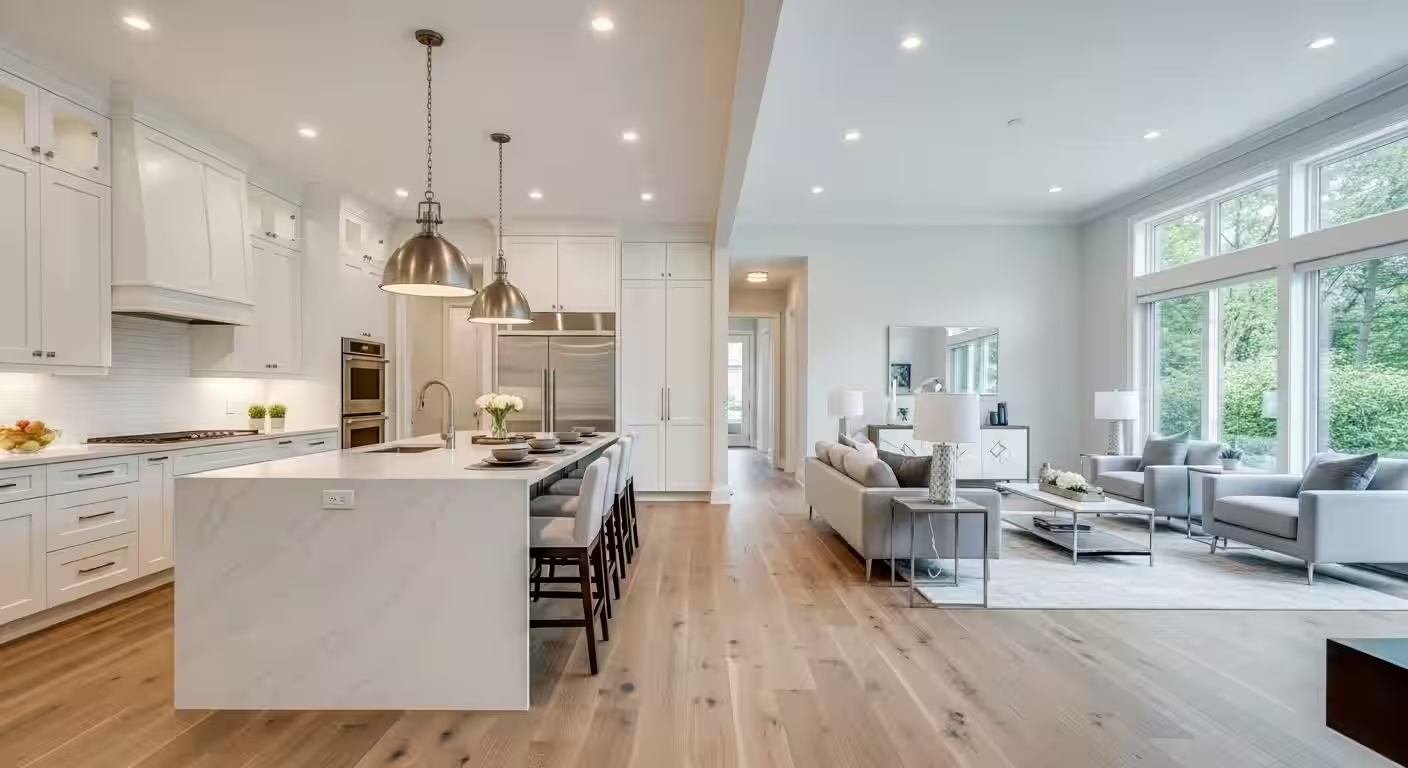
What is potentially removable: the drywall partitions that divide kitchen, dining, living, and bedroom within the unit, where they don't contain stacks or chases or sit at column lines.
The Approval Process Has Three Layers
Even for a clearly non-load-bearing partition, removing a wall in a Toronto condo requires three separate approvals:
Need professional home renovation?
Call RenoHouse at 289-212-2345 or get a free estimate today.
Get Free Estimate →1. Condo Board / Property Manager
Your condominium's declaration and bylaws govern unit modifications. Most Toronto condo declarations require:
- Written application to the property manager / condo board
- Description of the proposed work
- Engineer's letter confirming the wall is non-load-bearing and modification will not affect the building structure or other units
- Insurance certificate from contractor
- Approval from the board (typically a meeting agenda item, can take 4–8 weeks)
Some condos require a refundable deposit ($1,000–$5,000) against damage to common elements during construction. Some require specific contractors from an approved list.
Approval is not guaranteed even for non-load-bearing walls. Condo boards routinely deny applications they consider risky or precedent-setting.
2. Toronto Building Permit
If the wall is structural or if the modification involves electrical/plumbing alteration, a Toronto Building permit is required. Same process as for detached homes (see Load-Bearing Wall Permit and PEng Process).
For purely cosmetic wall removal of a confirmed non-load-bearing partition, permit may not be required — but condo board approval still is.
3. Engineer's Letter
Even when the wall is clearly non-bearing, the condo board almost always requires a sealed PEng letter confirming:
- The wall in question is not load-bearing
- The wall does not contain critical mechanical or electrical infrastructure shared with other units
- Modification will not affect fire ratings between units or to corridors
- Modification will not affect acoustic separation between units
PEng fee for a condo wall assessment letter: $1,200–$2,500 typically. Sometimes the engineer needs to coordinate with the building's original structural engineer of record, which adds time and cost.
Cost Reality
For a successful Toronto condo wall removal of a confirmed non-load-bearing partition:
- Engineer's letter and condo board approval coordination: $1,500–$3,000
- Building permit (if required): $250–$700
- Demolition and removal: $1,500–$3,500
- Drywall, paint, flooring patch: $2,500–$5,500
- Electrical or HVAC adjustments (often required even for non-load-bearing): $800–$2,500
- Condo elevator booking, common-area protection, dust mitigation premium: $500–$1,500
- Total: $7,000–$16,500 for a relatively simple non-load-bearing wall removal in a Toronto condo
Compare to a detached home where the same scope (non-load-bearing wall) might cost $3,500–$6,500 — the condo premium is the approval process, infrastructure complexity, and access constraints.
When the Answer Is "No"
Common scenarios where we tell condo owners not to pursue wall removal:
- 1. Wall is at a column line. Even if part of the wall is just drywall, the column inside is structural. Cost-benefit doesn't work.
- 2. Wall contains a plumbing stack. Stack cannot be relocated; either keep the wall, or wrap the stack as a column with a partial wall removal.
- 3. Condo board denies based on precedent. Some Toronto condos categorically refuse interior modifications regardless of structural evidence. The board's prerogative.
- 4. Wall is a fire separation. Modification would compromise fire rating; never approved.
- 5. Cost-to-benefit too high. Adding $5,000-$10,000 of approval and infrastructure cost to a $5,000 wall removal often doesn't make sense for the perceived value.
What Often Works Instead
Many Toronto condo owners who initially asked about wall removal end up doing one of these alternatives:
- Wide cased opening. Replace a section of wall with a wide doorway-style opening, leaving structural partition intact. Cheaper, faster, often achieves much of the visual goal.
- Glass partition or interior window. Replace solid wall with glass to maintain separation but allow light and visual flow.
- Furniture-driven layout. Use the existing room divisions but layout furniture and flooring to create visual flow.
- Selective demo to expose a column. Wrap a kept structural element as a feature column rather than hiding it.
These solutions are usually $3,000–$8,000 vs. $10,000–$16,500 for full wall removal, get faster condo approval, and often work better aesthetically in a small footprint.
The Honest Recommendation
If you're a Toronto condo owner thinking about wall removal, start with these steps:
- 1. Read your condo declaration and bylaws. Look for sections on unit modifications.
- 2. Talk to your property manager informally. Ask whether the board has approved similar work recently.
- 3. Engage a structural engineer for an assessment visit ($600–$1,200 for a preliminary opinion before sealed letter).
- 4. Decide whether the cost-benefit makes sense. Often the answer reframes to a cased opening or glass partition.
We do condo renovations regularly in Toronto and have walked through this approval process many times. Book a condo renovation consultation and we'll look at your unit, identify what's truly removable, and tell you honestly whether to pursue full removal or a smarter alternative.
Sources & References
Authoritative sources cited in this guide:
- Ontario Building Code — OBC official text
- Toronto Building Permits — City permit portal
- Tarion New Home Warranty — Ontario new-build warranty regulator
- HCRA — Home Construction Regulatory Authority — Ontario builder/vendor licensing
Continue Reading